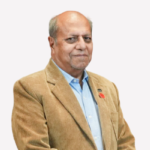
Prof. Debasis Chakraborty had experience in working for 35 years on variety of complex physical problems at Vikram Sarabhai Space Centre (VSSC), Thiruvananthapuram and Defense Research and Development Laboratory (DRDL), Hyderabad and Indian Institute of Technology (IIT), Bombay. He did his M.Sc in Applied Mathematics from Jadavpur University, M.Tech in Computational Mechanics from IIT, Kharagpur and Ph.D in Aerospace Engineering from IISc, Bengaluru. His Ph.D dissertation is on Direct Numerical Simulation (DNS) studies in high-speed confined mixing layer in chemically reacting environment which have brought out many important issues of high-speed mixing and combustion.
At VSSC (Sep’86-Nov’01), he contributed significantly in launch vehicle base flow analysis and provided vital inputs for thermal protection system design. The interaction of different propulsive jets from strap-on and main rocket motors and with free stream supersonic flows at different altitudes were analysed analytically and numerically to provide design data of base pressures and convective heat fluxes. His most noteworthy contribution in VSSC was aerodynamic parameters prediction of heat shield separation test in ground.
At DRDL (Nov’01-Nov’19) as Technology Director (Computational Dynamics), Group Director (Design) and Associate Director (Technology), he provided leadership to develop core competence in missile design for both tactical and strategic applications. Indigenous CFD codes were developed and routinely used to generate aerodynamic design data in complete M-α-δ-φ flight envelope. Integration of 6 DOF trajectory program with indigenous CFD solver has enabled the demonstration of missile separation for fighter aircraft based on CFD simulation without any wind tunnel tastings. Combustion instability in solid rocket motor has been predicted and indigenous Large Eddy Simulation (LES) code is developed for accurate prediction of compressible turbulence. His significant contributions in DRDL include: (a) design and Analysis of hydrocarbon-fuelled scramjet combustor (b) Jet Vane design for missile control (c) installed and isolated air intake characterization in supersonic and hypersonic flows (d) base flow characterization of strategic missile (e) missile plume interaction with jet deflector and canister etc. Tip to tail CFD simulation including nonreacting flow in the vehicle forebody and reacting flow (kerosene –air reaction) in the scramjet combustor enabled the design of hypersonic airbreathing cruise vehicle which has been successfully flight tested recently in an autonomous mode. These studies enabled India to join a select league of countries having this complex technology. He was the leader of the design team of long range hypersonic mission in DRDL and chairman and members of various System Engineering Committees (SEC), Flight Readiness Review(FRR) committees of various ongoing and future missile projects of DRDO. He managed all technical collaboration between DRDL and IISC during the period 2004-2019. He led Indo- Israel Joint CFD collaborative work.
He was involved in the review of many important national programs related to supercomputing and aerospace including DST& MEITY funded National Super Computing Mission (NSM), DST funded National Centre of Combustion Research and Development (NCCRD), Aerodynamics and propulsion panels of Aeronautics Research and Development board (AR&DB) and chaired many reviews of Indian Air Force (IAF) to certify the safe separation of powered and unpowered missiles and bombs from fighter aircrafts. He is the member of the Research Council (RC) of CSIR-CMERI, Durgapur and serving as expert member for faculty/scientist recruitment in IISc, IIT (Madras), IIT (Kanpur) and DRDO. While being responsive to the needs of the projects, he maintained an academic interest in understanding basic issues and published nearly 250 technical papers in refereed international journals of repute and conferences. He guided many students for premier academic institutes for their Ph,D, M.S and M. Tech thesis. He is the member of editorial boards of many aerospace journals and reviewed many papers for reputed journals and conferences. He is a fellow of many professional bodies like Indian Academy of Engineering (INAE), West Bengal Academy of Science and Technology (WAST), Telangana Academy of Science (TAS), Aeronautical Society of India (AeSI) and Institute of Engineers and received many awards including DRDO Scientist of the year, DRDO best innovation award, Technology Group award etc. His research interests include Aerodynamics, Propulsion, CFD (RANS, LES, Grid free methods), Combustion, High speed reacting flows, modelling of turbulence – chemistry interaction, unsteady flows etc.
After superannuation from DRDL, he was appointed as Professor in the department of Aerospace Engineering of IIT, Bombay and took charge of the Director of Centre of Propulsion Technology (COPT)- a DRDO-IIT(Bombay)-IIT(Madras) initiative for directed research in critical technologies in Aerospace propulsion. He was guiding M.Tech and Ph.D students and offered advanced courses on combustion of high energetic materials, Aerospace propulsion to M.Tech and Ph.D students of IIT, Bombay. In June, 2022, he has joined as a professor in the Mechanical Engineering department of Mahindra University. Currently, he is offering course on Aerodynamics and Flight Mechanics.