







Quick facts
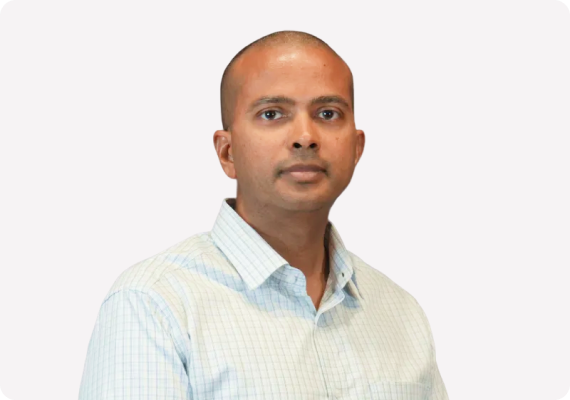
Dr. Ravi Kiran Donthu is an Assistant Professor at the Center for Life Sciences, Mahindra University, with a Ph.D. in cattle genomics and bioinformatics from the University of Illinois at Urbana‑Champaign focused on dense SNP mapping for milk‑production QTLs and synteny‑block detection tools. He has over a decade of experience as a bioinformatics research scientist working on 100+ genomics projects across many organisms and now aims to develop AI/ML‑based tools for early disease detection and marker discovery, alongside broad omics analyses including microbiome, differential expression, single‑cell RNA‑seq, and integrated spatial omics.
Publications
No publications added yet.
Research
No Research Interests added yet.
Ravi Kiran Donthu
Assistant Professor
Dr. Donthu completed his Ph.D. at the University of Illinois at Urbana-Champaign in 2009, specializing in cattle genomics and comparative genomics. His doctoral research focused on developing an in silico dense SNP map within a QTL region known to be associated with milk production traits in the North American Holstein population. Additionally, he identified putative genes associated with these traits.
During his Ph.D., Dr. Donthu also developed a comparative genomics tool to detect synteny blocks, facilitating the analysis of conserved genomic regions across different species.
After earning his Ph.D., Dr. Donthu joined the Roy J Carver Biotechnology Center at the University of Illinois at Urbana-Champaign as a Research Scientist. Between 2009 and 2017, he actively worked on over 100 genomics and bioinformatics projects involving diverse organisms, including bacteria, insects, plants, animals, and humans. His work encompassed various genomic analyses, such as de novo genome assemblies, transcriptome assemblies, genome and transcriptome annotation, Chip-Seq, RIP-Seq, RNA-Seq, miRNA analysis, SNP analysis, and microbiome data analysis of 16S, 18S, ITS, and archaea.
From 2017 to 2023, Dr. Donthu collaborated with professors from Florida International University and the University of Puerto Rico on multiple insect genome projects. Notably, he successfully identified a subset of 272 SNPs capable of distinguishing honeybee populations. To facilitate population identification of unknown honeybees, he developed a specialized tool.
- Ph.D. Cattle genomics and bioinformatics, Department of Animal Sciences, University of Illinois at Urbana-Champaign, Illinois, USA: (2004-2009)
- Master of Research in Bioinformatics, University of Leeds, UK: (2002-2003)
- Bachelor of Pharmacy, Jawaharlal Nehru Technological University, Hyderabad, India: (1996-2000)
- R. Donthu, J. Marcelino, Y. Tao, E. Weber, A. Avalos, M. Band, T. Akraiko, S. Chen, M. Reyes, H. Hao, Y. Ortiz-Alvarado. BeeID: A molecular tool that differentiates honey bee subspecies from different geographic populations. Bioinformatics (in prep)
- R. Giordano*, R. Donthu*, A. Zimin, I. C. J. Chavez, T. Gabaldon, M. van Munster, L. Hon, R. Hall, J. Badger, M. Nguyen, A. Flores, B. Potter, T. Giray, F. N. Soto-Adames, E. Weber, J. A. P. Marcelino, C. J. Fields, D. J. Voegtlin, C. B. Hill, G. L. Hartman, Soybean aphid research community. “Soybean Aphid Biotype 1 Genome: Insights into the invasive biology and adaptive evolution of a major agricultural pest” Insect Biochemistry Molecular Biology 2020 120:103334 *contributed equally to the work
- B. Coates, J. Hohenstein, R. Giordano, R. Donthu, A. Michel, E. Hodgson, M. O’Neal. “Genome scan detection of selective sweeps among biotypes of the soybean aphid, Aphis glycines, with differing virulence to resistance to A. glycines (Rag) traits in soybean, Glycine max.” Insect Biochemistry and Molecular Biology, 2020 124:103364.
- H. Song, R. Donthu, R. Hall, L. Hon, E. Weber, J. H. Badger, and R. Giordano. “Description of soybean aphid (Aphis glycines Matsumura) mitochondrial genome and comparative mitogenomics of Aphididae (Hemiptera: Sternorrhyncha).” Insect Biochemistry and Molecular Biology, 2019 113:103208.C.
- V. Jongeneel, O. Achinike-Oduaran, E. Adebiyi, M. Adebiyi, S. Adeyemi, B. Akanle, S. Aron, E. Ashano, H. Bendou, G. Botha, E. Chimusa, A. Choudhury, R. Donthu, J. Drnevich, O. Falola, C. J. Fields, S. Hazelhurst, L. Hendry, I. Isewon, R. S. Khetani, J. Kumuthini, M. P. Kimuda, L. Magosi, L. S. Mainzer, S. Maslamoney, M. Mbiyavanga, A. Meintjes, D. Mugutso, P. Mpangase, R. Munthali, V. Nembaware, A. Ndhlovu, T. Odia, A. Okafor, O. Oladipo, S. Panji, V. Pillay, G. Rendon, D. Sengupta, N. Mulder “Assessing Computational Genomics Skills: Our Experience in the H3ABioNet African Bioinformatics Network” PLOS Computational Biology 2017E. J. Muturi, R. Donthu, C. J. Fields, I. K. Moise, C. Kim. “Effect of pesticides on microbial communities in container aquatic habitats.” Nature Scientific Reports 2017
- M. Cohen-Zinder, R. Donthu, D. M. Larkin, C. G. Kumar, S. L. Rodriguez-Zas, K. E. Andropolis, R. Oliveira, H. A. Lewin. “A multisite haplotype on cattle chromosome 3 is associated with quantitative trait locus effects on lactation traits.” Physiological Genomics 2011.
- D. M. Larkin, G. Pape, R. Donthu, A. Loretta, M. Welge, H. A. Lewin. “Breakpoint regions and homologous synteny blocks in chromosomes have different evolutionary histories,” Genome research 2009.
- R. Donthu, H. A. Lewin, D. M. Larkin. “SyntenyTracker: a tool for defining homologous synteny blocks using radiation hybrid maps and whole genome sequence”. BMC Research Notes 2009.
- R. Donthu, M. Heaton, D. M. Larkin, H. A. Lewin. “In silico discovery, mapping, and genotyping of 1,039 cattle SNPs on a panel of eighteen breeds”Animal Genetics 2009.
Conference presentations and abstracts
- T. Giray, R. Giordano, R. Donthu, A. Avalos. “The blind watchmaker: Evidence of selection in the genome of Puerto Rico bees after Hurricane Maria” Annual Meeting of the Entomological Society of America. Virtual, 2020
- C. Ortiz-Alvarado, A. N. Delgado, A. R. Pemberton, T. Giray, R. Donthu, S. Feliciano-Cardona, M. A. Doke, J. L. Agosto-Rivera. “Circadian gene expression comparison across honey bee (Apis mellifera) long-lived bees and foragers” Annual Meeting of the Entomological Society of America. Virtual, 2020
- J. Marcelino, R. Donthu, R. Giordano, A. R. Lluch, C. A Cuff, Y. Ortiz-Alvarado, C. A. Ortiz, C. P. R. Alemany, C. Ramirez, S. Cruz, F. Noel, Í. C. Cordero-Ford, S. F. Cardona, J. Aleman-Rios, S. A. S. Echeandia, T. Aponte, T. Giray. “Genomic comparison of bee populations on Puerto Rico before and after hurricanes Irma and Maria” Entomology 2018
- R. Donthu, J. Drnevich, C. J. Fields, K. M. Keating, R. S. Khetani, C. V. Jongeneel. “Methods and Strategies for Incorporating Data from the Latest Sequencing Platforms in Genomic Analysis”. Plant and Animal Genome, San Diego, 2014
- A. Levi, A. Hernandez, J. Thimmapuram, R. Donthu, C. L. Wright, S. Ali, W. P. Wechter, U. K. Reddy, M. A. Mikel. “Sequencing The Genome Of The Heirloom Watermelon Cultivar Charleston Gray”. Plant and Animal Genome, San Diego, 2011.
- C. L. Wright, J. Thimmapuram, S. Bachman, L. Hetrick, E. Vlach, D. Vullaganti , F. Sun, R. Donthu , M. Band, M. A. Mikel, H. Bohnert, A. G. Hernandez. “Strategies For Next-Generation Sequencing And Bioinformatic Analysis”. Plant and Animal Genome, San Diego, 2010.
- M. Cohen-Zinder, R. Donthu, D. M. Larkin , H. A. Lewin. “Identification Of Candidate QTNs For Milk Production Traits In A QTL Critical Region Of Bta3 Using Sequence Capture Technology”. Plant and Animal Genome, San Diego, 2010.
- D. M. Larkin, G. Pape, R. Donthu, L. Auvil, L. Chen, M Welge, E. Eichler, H. A. Lewin. “Large-Scale Chromosomal Rearrangements In The Cattle Lineage And Their Association With Segmental Duplications And Repetitive Elements”. Plant and Animal Genome, San Diego, 2009.
- M. Cohen-zinder, R. Donthu, D. M. Larkin, H. A. Lewin. “Identification of candidate QTNs for milk production traits in a QTL critical region of BTA3 using sequence capture technology”. Bovine genome meeting, Cold Spring Harbor Laboratory, New York City, 2009
- R. Donthu, D. M. Larkin, M. Cohen-zinder, H. A. Lewin. “Haplotype Definition and Linkage Disequilibrium in a 16.3 Mbp QTL Critical Region on Cattle Chromosome 3”. Plant and Animal Genome, San Diego, 2009
- D. M. Larkin, G. Pape, R. Donthu, A. Loretta, M. Welge, H. A. Lewin. “Breakpoint regions and homologous synteny blocks in chromosomes have different evolutionary histories,” The biology of the genomes, Cold Spring Harbor Laboratory, New York City, 2008.
- D. M. Larkin, G. Pape, L. Auvil, R. Donthu, M. Welge, H. A. Lewin. “Multi-species whole genome analysis of vertebrate chromosomal evolution reveals ancient reuse breakpoints and large conserved syntenies”. Plant and Animal Genome, San Diego, 2007.
- R. Donthu, D. M. Larkin, M. P. Heaton, H. A. Lewin. “In silico discovery, mapping, and genotyping of 1,039 cattle SNPs on a panel of eighteen breeds”. International conference on Animal Genetics, Porto Seguro, Brazil, 2006.
- R. Donthu, D. M. Larkin, M. P. Heaton, H. A. Lewin. “In silico discovery, mapping, and genotyping of 1,039 cattle SNPs on a panel of eighteen breeds”. Plant and Animal Genome, San Diego, 2006.
- Assistant Professor, Center for Life Sciences, Mahindra University, Hyderabad, India: (2023-Present)
- Senior Associate Professor, uGDX School of Technology, ATLAS SkillTech University, India: (2022-2023)
- Bioinformatics Research Scientist, Know Your Bee inc., Florida, and Puerto Rico Science Technology and Research Trust, Puerto Rico, USA: (2017-2022)
- Bioinformatics Research Specialist, High Performance Biological Computing (HPCBio), Roy J Carver Biotechnology Center, University of Illinois at Urbana-Champaign: (2009-2017)
With the advancement of next generation sequencing (NGS) technologies and long read sequencing techniques the entire scope of biological research is primarily driven by latest emerging field of bioinformatics which involves application of computational tools to analyse and interpret biological data. Genome research is estimated to generate between 2 and 40 exabytes of data within the next decade. There is a great need to implement Artificial Intelligence (AI) and machine learning (ML) algorithms to extract valuable biological information from these gigantic datasets.One of our research goals is to develop AI/ML based tools or models that will be utilized for the early detection of cancer and other human diseases and to identify genetic markers that are associated with important phenotypes in agricultural and biological research. Furthermore, our research interests extend to conducting omics-based analysis, incorporating diverse areas such as microbiome analysis, differential gene expression analysis, single-cell RNA sequencing, as well as the integration of spatial omics and microbiome profiles with disease states. By leveraging these cutting-edge techniques, we aim to gain comprehensive insights into the intricate molecular basis of various biological processes and disease mechanisms.
