











B. Tech in Civil Engineering for Working Professionals
A three-year undergraduate programme designed for employed diploma holders to advance their engineering qualifications while balancing work commitments, through a flexible weekend-based curriculum.
Programme overview
This programme enables practising civil engineers with a diploma and industry experience to earn a B.Tech degree in civil engineering through a schedule that accommodates professional responsibilities. You will deepen your technical expertise and expand your ability to plan, design, construct and manage infrastructure projects, while integrating academic learning with workplace practice. Students experience:

Weekend-friendly learning
Classes are scheduled on weekends and holidays so you can pursue academic progression without interrupting your current employment.

Applied engineering curriculum
You build on your practical knowledge with structured coursework in core civil engineering domains including structural concepts, materials, construction methods and analysis, adapted for working professionals.

Professional growth and application
Designed to encourage to directly apply skills and frameworks learnt in class to real-world challenges at work, sharpening both competence and problem-solving.

Career continuation and advancement
Completing this degree boosts your formal credentials while you continue working, positioning you for roles with greater responsibility or leadership in infrastructure, construction and engineering consulting.
Programme details
Academic structure
The B.Tech for Working Professionals is structured to balance work and study over three years / six semesters. Classes are primarily conducted on weekends, allowing you to maintain employment while completing a recognised undergraduate degree.
You will progress from foundational civil engineering concepts to more advanced topics, integrating theory, design principles and practical applications.
| Course |
|---|
| Mechanical Properties of Materials |
| Modern Surveying and Digital Cartography |
| Concrete Technology |
| Fluid Mechanics and Hydraulic Machines |
| Course |
|---|
| Structural Modeling and Behavior |
| Water Resource and Hydrological Systems |
| Introduction to Transportation Engineering |
| Environmental Engineering |
| Course |
|---|
| Urban Transportation Systems and Planning |
| Geotechnical Engineering |
| Reinforced Cement Concrete |
| Green Buildings and Sustainable Materials |
| Course |
|---|
| Traffic Engineering and ITS |
| Geosynthetics and Reinforced Soil Structures |
| Steel Structures |
| Industrial Waste Management |
| Course |
|---|
| Construction Law and Policy |
| Prestressed Concrete |
| Construction Planning, Estimating, and Scheduling |
| PEB / Prefab |
| Course |
|---|
| Forensic Engineering |
| Construction Safety Engineering |
| Remote Sensing and GIS |
| Dissertation / Thesis |
Eligibility:
To be eligible for this programme:
- You must hold a diploma in civil engineering with at least 60% aggregate marks.
- You must have a minimum of two years’ work experience in civil engineering after completing your diploma.
- Applicants should be employed during the programme to benefit from integrated workplace learning.
Admission process:
- Complete and submit the online application via the Mahindra University admissions portal.
- Upload academic transcripts, diploma certificate and proof of work experience.
- Attend any interview or interaction as requested by the admissions panel.
- Receive your offer upon successful review of eligibility criteria and documentation.
Fee structure (per annum):
Fees for this working-professionals programme will be published in the official admission materials for the relevant academic year. Prospective applicants can request a fee schedule from the admissions office or through the admissions portal.
Note: Flexible payment plans or EMI options may be offered at the university’s discretion.
Learning facilities and laboratories:
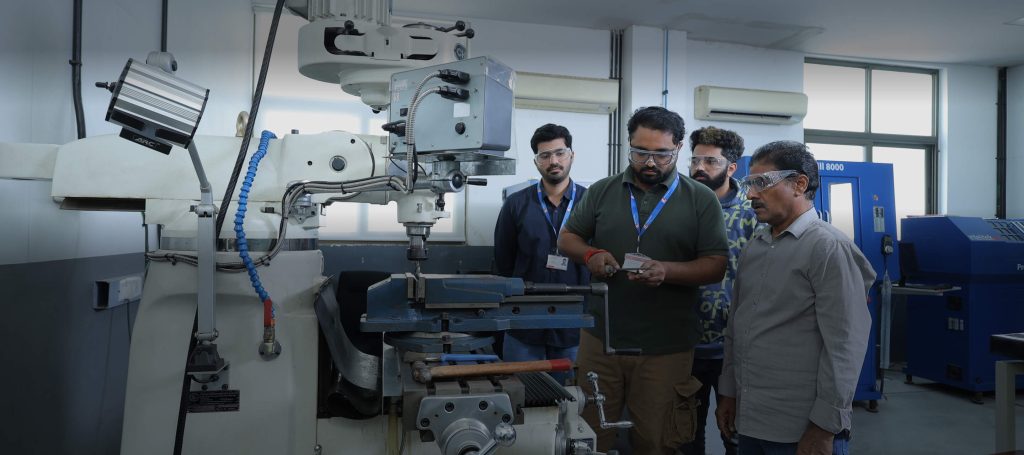
The Civil Engineering for Working Professionals programme is supported by dedicated civil engineering laboratories that reinforce classroom learning through hands-on application. These facilities are integrated into the weekend-based academic structure, allowing working professionals to gain practical exposure without disrupting their employment.
Students engage with laboratory sessions linked to core civil engineering subjects, enabling them to apply concepts related to materials, structures, surveying and construction practices. The emphasis remains on practical understanding and professional relevance, ensuring that learning connects directly to real-world engineering contexts encountered at work.
Laboratory access is structured to align with the programme’s delivery model, supporting applied coursework, problem-solving exercises and project work throughout the programme.

Where global education meets real-world outcomes
From AI and biotechnology to aerospace and consulting, our graduates are shaping industries worldwide; many joining leading firms, founding start-ups, or pursuing advanced study at top universities
250+
Graduate acceptances
for advanced studies at premium universities across the world
100+
Recruiters
offering career-defining opportunities across industries
20+
Global academic partners
collaborating on exchanges, dual degrees, and joint research initiatives
From engineering classrooms to global careers



FAQs
Working professionals in construction and infrastructure roles seeking formal project management training.
Yes. Classes are conducted on weekends to support working professionals.
Graduates move into roles such as project manager, planning engineer, contracts manager and construction management lead.
Yes. Project and dissertation components are aligned with real construction challenges.
The curriculum includes BIM, project management software, analytics tools and digital construction methods.
