













BA LL.B. (Honours)
A five-year integrated undergraduate programme combining law with liberal arts to prepare students for legal practice, public service, policy and research.
B.A. LL.B. (Honours) overview
We blend legal studies with humanities to build strong analytical, ethical, and communication skills while grounding students in core legal disciplines and social sciences. This integrated structure helps learners develop legal reasoning alongside contextual understanding of society, politics, and history. Students experience:

Law with liberal arts foundations
Study of constitutional law, criminal law, contracts, and jurisprudence alongside sociology, political science, economics, and history.

Progressive legal specialisation
A structured curriculum across ten semesters with increasing focus on advanced law subjects in later years.

Practice-oriented legal training
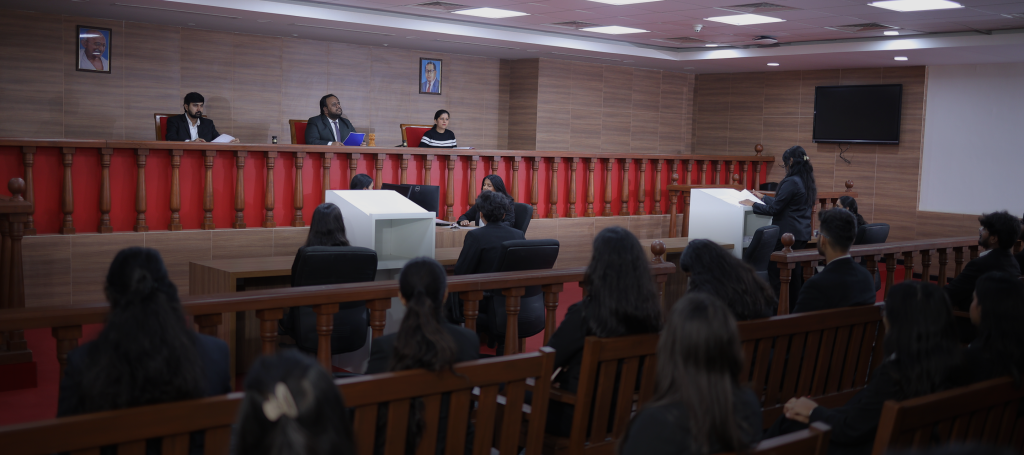
Exposure to moot courts, drafting, legal research, clinical courses, and internships connecting theory with practice.

Preparation for diverse legal careers
Academic grounding suited for litigation, judiciary, corporate law, policy roles, and higher studies.
Programme details
MU’s vision
- Train multi-skilled leaders capable of reflection and innovation, committed to inclusive and sustainable progress.
- Pursue interdisciplinary academic excellence by integrating the study of science and technology with the liberal arts, including humanities, ethics, philosophy, and design thinking.
- Balance academic learning with real-world experience through entrepreneurial projects that address complex societal challenges.
- An international faculty with strong industry and academic backgrounds, global exposure, and research expertise ensures that the curriculum remains contemporary, continuously evolving, and aligned with global business and industry needs.
Academic structure
The programme is designed to build interdisciplinary foundations before progressing to specialised legal study.
- Duration: 5 years / 10 semesters
- Structure:
- Early semesters: law fundamentals and liberal arts
- Later semesters: advanced law subjects, electives, and honours papers
| Course | L-T-P | Credits |
|---|---|---|
| Legal Methods & Legal Research | 3-0-0 | 3 |
| Law of Torts | 3-0-0 | 3 |
| English-I | 3-0-0 | 3 |
| Sociology-I | 3-0-0 | 3 |
| Political Science-I | 3-0-0 | 3 |
| History | 3-0-0 | 3 |
| Course | L-T-P | Credits |
|---|---|---|
| Law of Contracts-I | 3-0-0 | 3 |
| English-II | 3-0-0 | 3 |
| Sociology-II | 3-0-0 | 3 |
| Moot Court: Clinical Paper-I | 0-0-2 | 1 |
| Legal and Constitutional History | 3-0-0 | 3 |
| Political Science-II | 3-0-0 | 3 |
| Course | L-T-P | Credits |
|---|---|---|
| Law of Contracts-II | 3-0-0 | 3 |
| Criminal Law-I: Bhartiya Nyaya Sanhita | 3-0-0 | 3 |
| Constitutional Law-I | 3-0-0 | 3 |
| Family Law-I | 3-0-0 | 3 |
| Economics-I | 3-0-0 | 3 |
| Moot Court: Clinical Paper-I | 0-0-2 | 1 |
| Course | L-T-P | Credits |
|---|---|---|
| Constitutional Law-II | 3-0-0 | 3 |
| Family Law-II | 3-0-0 | 3 |
| Jurisprudence | 3-0-0 | 3 |
| Criminal Law-II: Bhartiya Nagrik Suraksha Sanhita | 3-0-0 | 3 |
| Political Science-III | 3-0-0 | 3 |
| Economics-II | 3-0-0 | 3 |
| Course | L-T-P | Credits |
|---|---|---|
| International Trade Law | 3-0-0 | 3 |
| Property Law | 3-0-0 | 3 |
| Company Law – I | 3-0-0 | 3 |
| Administrative Law | 3-0-0 | 3 |
| Interpretation of Statutes | 3-0-0 | 3 |
| Alternate Dispute Resolution – Clinical Paper II | 0-0-2 | 1 |
| Course | L-T-P | Credits |
|---|---|---|
| Bhartiya Sakshya Adhiniyam | 3-0-0 | 3 |
| Civil Procedure Code & Law of Limitation | 3-0-0 | 3 |
| Company Law – II | 3-0-0 | 3 |
| Land Laws | 3-0-0 | 3 |
| Competition Law | 3-0-0 | 3 |
| Intellectual Property Rights | 3-0-0 | 3 |
| Course | L-T-P | Credits |
|---|---|---|
| Labour & Industrial Law – I | 3-0-0 | 3 |
| Public International Law | 3-0-0 | 3 |
| Private International Law | 3-0-0 | 3 |
| Optional I | 3-0-0 | 3 |
| Optional II | 3-0-0 | 3 |
| Optional III | 3-0-0 | 3 |
| Course | L-T-P | Credits |
|---|---|---|
| Labour & Industrial Law – II | 3-0-0 | 3 |
| Principles of Taxation | 3-0-0 | 3 |
| Drafting, Pleading and Conveyance – Clinical Paper III | 0-0-2 | 1 |
| Optional IV | 3-0-0 | 3 |
| Optional V | 3-0-0 | 3 |
| Optional VI | 3-0-0 | 3 |
| Course | L-T-P | Credits |
|---|---|---|
| Environmental Law | 3-0-0 | 3 |
| Professional Ethics – Clinical Paper IV | 0-0-2 | 1 |
| Honours Paper I | 3-0-0 | 3 |
| Honours Paper II | 3-0-0 | 3 |
| Honours Paper III | 3-0-0 | 3 |
| Course | L-T-P | Credits |
|---|---|---|
| Honours Paper IV | 3-0-0 | 3 |
| Honours Paper V | 3-0-0 | 3 |
| Honours Paper VI | 3-0-0 | 3 |
| Honours Paper VII | 3-0-0 | 3 |
| Honours Paper VIII | 3-0-0 | 3 |
Eligibility
Candidates aspiring to the B.A. LL.B. programme must meet the prescribed eligibility criteria and demonstrate the required academic background. Admission is based on performance in recognised law entrance examinations and other specified requirements.
Academic eligibility
- 10+2 or equivalent from a recognised statutory board with a minimum of 60% aggregate marks across all subjects, or an equivalent grade for students from IB or other approved boards, as per AICTE/UGC norms.
Entrance examination requirement
Applicants must satisfy one of the following:
- A valid CLAT 2026 examination score (exact cut-off score or All India Rank will be announced after the results are declared), or
- A valid LSAT score, or
- Qualification in the Mahindra University Law Entrance Test 2026 (MULET 2026).
Important: all applicants to undergraduate programmes who have completed Class 12 under the IB, Cambridge or any other international curriculum must submit a UGC equivalence certificate by 30 August 2026. Failure to do so will result in automatic cancellation of admission.
MULET 2026 examination pattern
The test consists of 90 multiple-choice questions, distributed as follows:
- English knowledge and skills – 20 questions
- Logical reasoning – 25 questions
- General knowledge and current affairs – 20 questions
- Mathematics – 15 questions
- Legal reasoning – 10 questions
Total marks: 90 (each question carries 1 mark)
Negative marking: 0.25 marks will be deducted for every incorrect answer.
Fee structure (per annum):
| Category | Amount |
|---|---|
| Academic fees | ₹4,00,000 |
| Hostel charges | ₹1,70,000 |
| Caution deposit* | ₹20,000 |
*Refundable at the end of study or graduation.
Note: Hostel stay is not mandatory for students enrolled in the B.A. LL.B. (Hons.) and BBA LL.B. (Hons.) programmes. All fees are subject to revision each year. Accommodation will be provided in accordance with the University’s standard norms. During the first academic year, all students will be allotted triple-occupancy rooms. From the second year onwards, students may have the option to choose double or triple occupancy, subject to availability, with hostel fees applicable according to the type of accommodation allotted.
Important dates
Aspiring students may apply for admission to the B.A. LL.B. programme to pursue a comprehensive legal education. Applicants are advised to review the eligibility requirements carefully and ensure timely submission of their applications.
| Admission milestone* | Date |
|---|---|
| Last date to apply for the next round of admission | 9th May 2026 |
| Mahindra University Law Entrance Test (MULET 2026) | To be announced |
| Last date for receipt of applications | 09th July 2026 |
*Dates and schedules are subject to change
FAQs
The programme is a five-year, full-time integrated undergraduate degree spread across ten semesters. It is structured to build interdisciplinary foundations in the early years, followed by deeper legal specialisation in the later stages.
Admission is based on a valid score in CLAT, LSAT (India) or the Mahindra University Law Entrance Test (MULET), subject to meeting the eligibility criteria and university requirements.
Yes. Practical training is embedded through moot courts, drafting and pleading courses, clinical papers and internships, enabling students to apply legal theory to real-world legal problems.
Yes. In the later semesters, students choose honours papers and electives that allow focused study in selected areas of law, supporting both professional practice and academic interests.
Graduates pursue careers in litigation, judiciary, corporate and commercial law, public policy, governance, legal research and academia. The programme also provides a strong foundation for higher studies in law in India or abroad.
