










B.Sc. in Biomedical Sciences
A four-year, research-oriented, career-ready programme that combines biomedical science with hands-on laboratory and clinical training.
Programme overview
The B.Sc. in biomedical sciences at Mahindra University, offered in collaboration with Apollo Healthcare Academy, is a four-year programme designed to build strong scientific foundations with practical application. It combines academic rigour with hands-on training to prepare students for roles across healthcare and life sciences.

Strong foundation in biomedical sciences
The curriculum, aligned with NCAHP guidelines, builds core knowledge in biomedical sciences, integrating theoretical learning with applied laboratory exposure.

Hands-on laboratory and simulation training
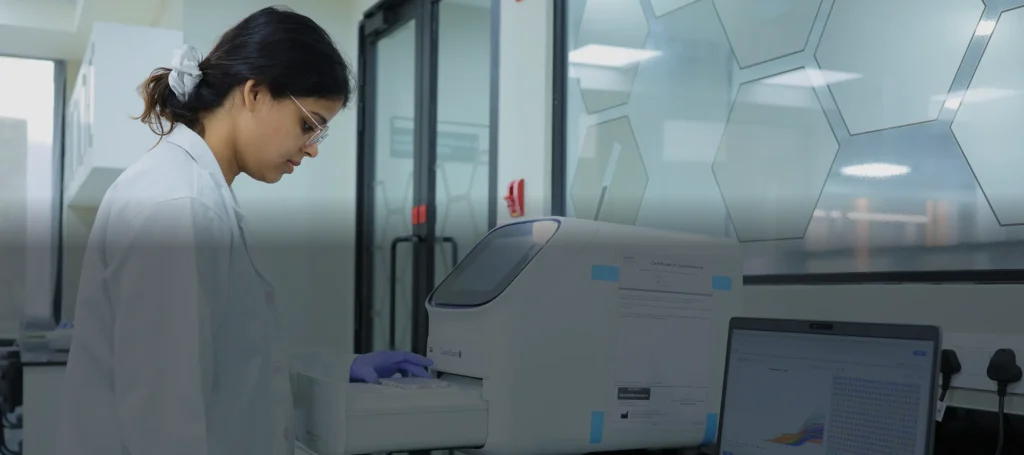
Students learn in advanced laboratories and simulation environments, developing practical skills in diagnostic techniques and laboratory operations.

Clinical exposure through Apollo network
Learners undergo clinical rotations and internships across Apollo facilities, gaining real-world experience under the guidance of experienced faculty.

Career readiness across healthcare and biotech sectors
Graduates are prepared for roles in research labs, diagnostic centres, biotech firms and healthcare organisations, supported by placement assistance and access to Apollo’s alumni network.
Programme details
Course structure

Year 1 subjects
- Human anatomy and physiology
- Cell biology and genetics
- Basic biochemistry
- Microbiology and immunology
- Biomedical physics
- Communication skills
- Environmental studies
- Introduction to biomedical sciences
- Medical ethics and patient safety
- Basic laboratory techniques
- Scientific writing and research basics
Year 2 subjects
- Molecular biology
- Clinical biochemistry
- Medical microbiology
- Pathology and haematology
- Instrumentation and analytical techniques
- Human disease mechanisms
- Bioinformatics foundations
- Genetic engineering
- Toxicology
- Basics of biomedical statistics
- Clinical practicum I
Year 3 subjects
- Advanced molecular diagnostics
- Immunotechnology
- Pharmacology and therapeutics
- Biotechnology applications
- Research methodology
- Biomedical waste management
- Medical virology
- Advanced laboratory management
- Tissue culture techniques
- Clinical practicum II
- Internship and research project
Year 4 subjects
- Job training / advanced internship
Career prospect
| Key sectors | Roles | Avg. starting salary (LPA) |
|---|---|---|
| Research labs and institutes | Research assistant, lab technologist, junior scientist | ₹3.5–5 |
| Hospitals and diagnostic centres | Medical lab technologist, molecular diagnostics specialist, clinical biochemist | ₹3–4.8 |
| Biotechnology and pharma companies | Quality analyst, product specialist, clinical research coordinator | ₹4–6.5 |
| Public health and government agencies | Public health analyst, laboratory officer | ₹3–5 |
Curriculum
| S. no. | Course code | Course title | Credits |
|---|---|---|---|
| 1 | BMS1A | Anatomy for health sciences | 4 |
| 2 | BMS1C | Physiology for health sciences | 4 |
| 3 | BMS1G | Psychology for health sciences | 3 |
| 4 | BMS1E | Biochemistry for health sciences | 4 |
| 5 | BMS1H | Medical terminologies | 2 |
| 6 | BMS1J | English | 2 |
| 7 | BMS1B | Anatomy (practical) | 1 |
| 8 | BMS1D | Physiology (practical) | 1 |
| Total credits | 21 | ||
| S. no. | Course code | Course title | Credits |
|---|---|---|---|
| 1 | BMS2A | Microbiology for health sciences | 4 |
| 2 | BMS2C | Pathology for health sciences | 4 |
| 3 | BMS2D | Pharmacology for health sciences | 4 |
| 4 | BMS2H | Environmental sciences | 2 |
| 5 | BMS2E | Sociology for health sciences | 3 |
| 6 | BMSE | General elective | 3 |
| 7 | BMS2B | Microbiology (practical) | 1 |
| 8 | BMS2J | Observational posting | 2 |
| 9 | BMS2G | Computer science | 2 |
| Total credits | 25 | ||
| S. no. | Course code | Course title | Credits |
|---|---|---|---|
| 1 | BMS3A | Medical microbiology | 4 |
| 2 | BMS3L | Medical biochemistry | 4 |
| 3 | BMS3N | Biophysics | 4 |
| 4 | BMS3G | Research methodology and biostatistics | 3 |
| 5 | BMSE | General elective | 3 |
| 6 | BMS3B | Medical microbiology (practical) | 1 |
| 7 | BMS3M | Medical biochemistry (practical) | 1 |
| 8 | BMS3H | Clinical training 1 | 5 |
| Total credits | 25 | ||
| S. no. | Course code | Course title | Credits |
|---|---|---|---|
| 1 | BMS4J | Cell and molecular biology | 4 |
| 2 | BMS4L | Immunology and vaccinology | 4 |
| 3 | BMS4E | Medical electronics for health sciences | 3 |
| 4 | BMSE | General elective | 3 |
| 5 | BMS4M | Immunology and vaccinology (practical) | 1 |
| 6 | BMS4K | Cell and molecular biology (practical) | 1 |
| 7 | BMS4H | Clinical training 2 | 5 |
| Total credits | 21 | ||
| S. no. | Course code | Course title | Credits |
|---|---|---|---|
| 1 | BMS5J | Medical genetics | 4 |
| 2 | BMS5L | Pharmacology and toxicology | 4 |
| 3 | BMS5N | Bioprocess and enzyme technology | 3 |
| 4 | BMSE | General elective | 3 |
| 5 | BMS5K | Medical genetics (practical) | 1 |
| 6 | BMS5M | Pharmacology and toxicology (practical) | 1 |
| 7 | BMS5H | Clinical training 3 | 5 |
| Total credits | 21 | ||
| S. no. | Course code | Course title | Credits |
|---|---|---|---|
| 1 | BMS6J | Bioinformatics | 4 |
| 2 | BMS6L | Cancer and radiation biology | 4 |
| 3 | BMS6E | Basic life support and emergency care | 2 |
| 4 | BMS6K | Bioinformatics (practical) | 1 |
| 5 | BMS6M | Cancer and radiation biology (practical) | 1 |
| 6 | BMS6G | Advanced cardiac life support | 2 |
| 7 | BMS6H | Clinical training 4 | 7 |
| Total credits | 21 | ||
| S. no. | Course code | Course title | Credits |
|---|---|---|---|
| 1 | BMS7A | Internship | 15 |
| Total credits | 15 | ||
| S. no. | Course code | Course title | Credits |
|---|---|---|---|
| 1 | BMS8A | Internship | 15 |
| 2 | BMS8B | Project | 6 |
| Total credits | 21 | ||
Total Credits: 21+25+25+21+21+21+15+21 = 170
Note: “This is as per current NCAHP guidelines and is under discussion and may be subject to change.”
FAQs
It is a 4-year undergraduate programme combining academic coursework with advanced laboratory training, clinical exposure and research.
Yes, students can avail merit-based scholarships up to 25%. Additional financial support is available through partner-bank education loans and need-based assistance. Special scholarships are also offered to learners from underrepresented backgrounds.
Students who have completed 10+2 with PCB and secured a minimum of 50% marks are eligible. Admission is through an entrance exam followed by a personal interview.
