






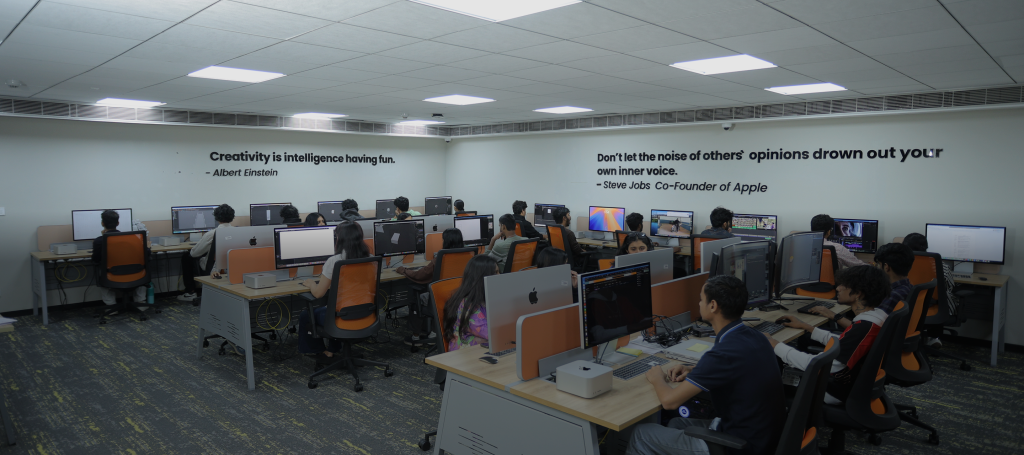
B.Tech in Computation & Media
A 4-year programme combining computing, media, design and immersive technologies for careers in digital media and storytelling.
B.Tech in computation & media overview
We prepare students to shape the future of digital media, communication and storytelling through a strong foundation in computing, media theory, design and immersive technologies, blending technical rigor with creative, project-based learning. Students experience:

Integrated media production,
storytelling and communication skills blended with engineering and computing

Hands-on exposure
to immersive technologies, AR/VR, interactive sound and computational creativity

Project-based learning
across media production, human-computer interaction and user-centred design

Preparation for careers
spanning game design, film & video, journalism, advertising, UX/UI and digital media strategy
Programme details
Our academic structure is designed to establish robust foundations, followed by increasing specialization in later years.
- Credit structure: Basic Sciences, Computing & Engineering, Humanities, Social & Creative Sciences, Media Studies, Design & Enterprise Sciences
- Total credits & degree requirement: The programme requires not less than 165 credits to be awarded a B.Tech degree.
- Duration: 4 years / 8 semesters
- Core vs Professional phases: The first two years constitute the “Core Program,” and the last two years the “Professional Program,” with electives introduced in the latter phase.
Assessment is designed to evaluate students’ progressive understanding throughout the programme. Continuous assessment plays a central role and contributes significantly to the final grade. Evaluation is based on specific, tangible outputs such as projects, presentations and assignments. Active participation is an important component, and students are expected to attend all classes. While examinations are conducted, they carry a relatively smaller weight in the overall evaluation.
Plagiarism is strictly prohibited and will result in a zero grade. Repeated instances may lead to academic suspension or other disciplinary action.
Typical grading distribution
- Research / role-play / debate / presentations – 20%
- Class quizzes / in-class tests / take-home assignments – 25%
- Midterm examination – 15%
- Semester-end examination or final project – 30%
- Class participation – 10%
The pedagogical model places strong emphasis on regular participation and continuous evaluation. Limited absences may be permitted at the discretion of the faculty member; however, repeated absences may affect a student’s ability to complete course requirements successfully. Due to the nature of continuous assessment, missed submissions or activities may not always be recoverable, though individual instructors may review exceptional cases.
- Leverage emerging technologies to enable an interactive, personalised and diverse communication ecosystem.
- Develop students into specialised, technology-driven storytellers with strong foundations in media and communication.
- Adopt continuous assessment while reinforcing in-class evaluation methods.
- Encourage learning through multiple formats, including classroom instruction, mentoring and simulated practice, culminating in student-led projects.
- Prepare students to operate in an evolving media environment shaped by changing technologies, policies and professional practices.
- Emphasise both conceptual understanding and practical application in advanced semesters, supported by engagement with academic research and industry experts.
- Enable students to undertake a specialised capstone project by the end of the programme.
- Provide structured exposure to social and industry environments through guided experiential learning under faculty supervision.
- Offer three internships during the programme: a social sector internship or initiative, two mandatory industry internships, and one optional internship.
Students gain exposure to social and industry practices through structured learning experiences under faculty supervision. The programme includes multiple internship opportunities: a social sector internship or initiative, at least one mandatory industry internship, and one optional internship. These experiences help bridge the gap between academic concepts and real-world practice.
Graduates typically pursue careers in fields such as news media, film, television, game design, advertising, public relations and related industries. The programme also introduces elements of entrepreneurship as part of the advanced curriculum.
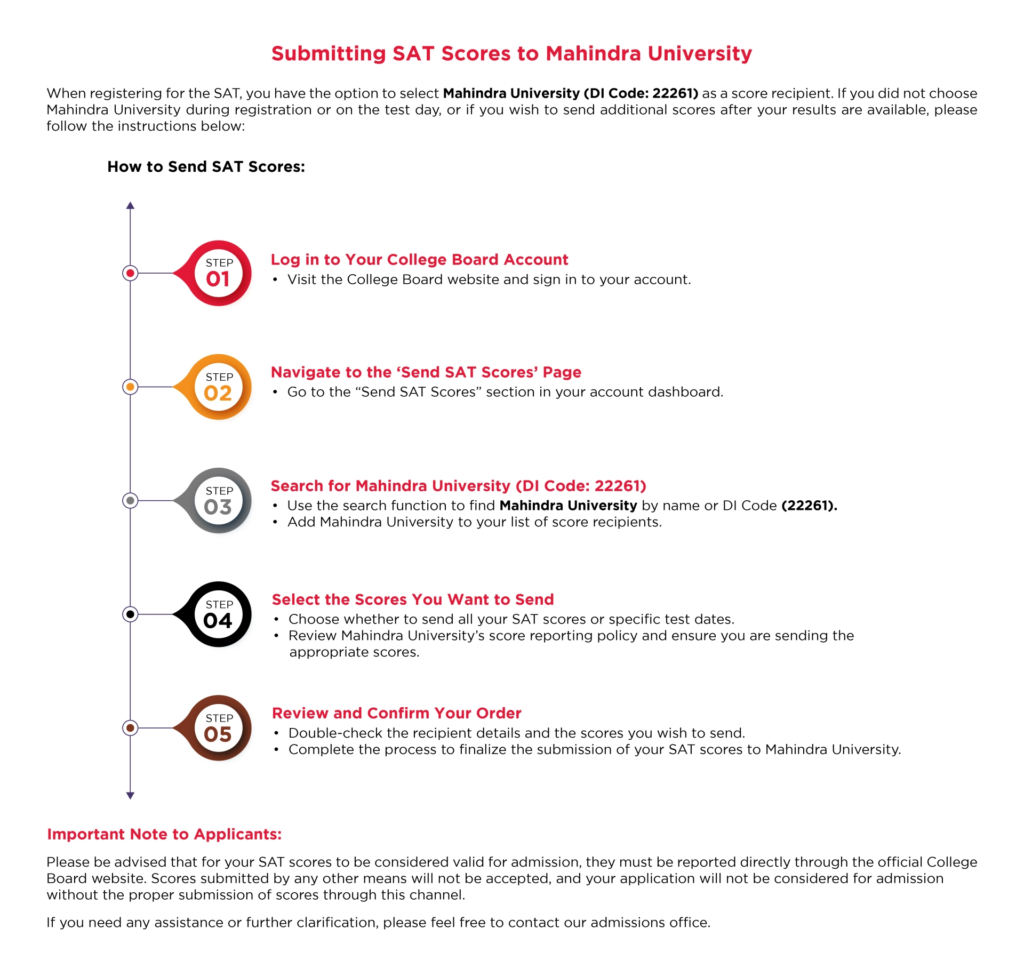
Submitting SAT scores
| Course | L-T-P | Credits |
|---|---|---|
| Math I – Calculus & ODE | 4-1-0 | 5 |
| Earth and Environmental Sciences | 2-0-0 | 2 |
| Fundamentals of Drawing & Practice | 0-0-4 | 2 |
| Introduction to Computer Science | 2-1-2 | 4 |
| Learning to Learn | 1-0-2 | 2 |
| Photography I: Still and Moving Images | 1-0-4 | 3 |
| Introduction to Media and Communication | 1-0-2 | 2 |
| French I | 0-2-0 | 0.5 |
| Course | L-T-P | Credits |
|---|---|---|
| Math II – Linear Algebra, Complex Analysis | 3-1-0 | 4 |
| Physics – I | 2-1-2 | 4 |
| Discrete Mathematical Structures | 2-0-0 | 2 |
| Data Structures | 2-2-2 | 5 |
| Visual Communication and Graphic Design | 0-1-4 | 3 |
| Professional Writing | 1-0-0 | 1 |
| Professional Ethics | 1-0-0 | 1 |
| Introduction to Game Design | 1-0-4 | 3 |
| French II | 0-2-0 | 0.5 |
| Course | L-T-P | Credits |
|---|---|---|
| Math III – Probability and Stats | 3-1-0 | 4 |
| Design and Analysis of Algorithms | 3-1-0 | 4 |
| Optimization Techniques for AI | 3-0-0 | 3 |
| Object Oriented Programming | 2-0-2 | 3 |
| Introduction to Computation and Media | 2-0-0 | 2 |
| Computer Graphics | 2-0-2 | 3 |
| Media Production | 0-0-8 | 4 |
| Economics (Fractal) | 3-0-0 | 1.5 |
| French III | 0-2-0 | 0.5 |
| Course | L-T-P | Credits |
|---|---|---|
| Math IV – Numerical Methods | 3-0-2 | 4 |
| Theory of Computation | 3-0-0 | 3 |
| Machine Learning with Python | 3-0-2 | 4 |
| Programming Workshop | 0-0-2 | 1 |
| Modelling and Animation | 2-0-4 | 4 |
| Advanced Computer Graphics | 2-0-2 | 3 |
| Design Thinking | 1-0-2 | 2 |
| French IV | 0-2-0 | 0.5 |
| Financial Accounting | 3-0-0 | 1.5 |
| Course | L-T-P | Credits |
|---|---|---|
| Operating Systems | 3-0-2 | 4 |
| DBMS | 3-0-2 | 4 |
| Digital Image Processing | 2-0-2 | 3 |
| Augmented, Virtual & Extended Reality | 2-0-2 | 3 |
| Interactive Sound and Music | 2-1-2 | 4 |
| Elective I | 3-0-0 | 3 |
| HSS Elective I | 2-0-0 | 2 |
| French V (Optional) | 0-0-0 | 0 |
| Course | L-T-P | Credits |
|---|---|---|
| User Centred Design Methods | 2-0-2 | 3 |
| Data Visualization and Communication | 2-0-2 | 3 |
| Media Psychology | 2-0-0 | 2 |
| Computational Creativity | 2-0-2 | 3 |
| Elective II | 3-0-0 | 3 |
| 3rd Year Project | 0-1-4 | 3 |
| Professional Development & Employability Skills | 2-0-0 | 2 |
| HSS Elective II | 2-0-0 | 2 |
| French VI (Optional) | 0-2-0 | 0 |
| Course | L-T-P | Credits |
|---|---|---|
| Human Computer Interaction | 2-0-2 | 3 |
| Entrepreneurship Practice & Lean Startup Management | 3-0-0 | 3 |
| Elective III | 3-0-0 | 3 |
| Final Year Project – Phase I | 0-0-18 | 9 |
| HSS Elective III | 2-0-0 | 2 |
| French VII (Optional) | 0-2-0 | 0 |
| Course | L-T-P | Credits |
|---|---|---|
| Elective IV | 3-0-0 | 3 |
| Elective V | 3-0-0 | 3 |
| Final Year Project – Phase II | 0-4-10 | 9 |
| French VIII (Optional) | 0-2-0 | 0 |
Eligibility:
- Must have passed 10+2 (or equivalent) from a recognised board, with physics, chemistry and mathematics in 12th grade are eligible.
- Minimum aggregate of 60% or equivalent in 10+2 for candidates applying through JEE / SAT / ACT.
- One of the following accepted test scores:
- Qualify JEE (Main) and be eligible to write JEE Advanced (or achieve top All India Rank in JEE Main)
- Valid SAT Subject Test scores (Mathematics, Physics, Chemistry), minimum 1800
- Valid SAT Test Score (minimum 800)
- Valid ACT composite score (minimum 18)
- For applications via SAT / ACT, a technical & aptitude-based interview may be required.
Fee structure (per annum):
| Category | Academic fees | Hostel charges | Caution deposit * |
|---|---|---|---|
| Indian Students | ₹ 5,00,000 | ₹ 1,70,000 | ₹ 20,000 |
| PIO / NRI Students | USD 9,000 | USD 3,000 | USD 400 |
*Refundable at the end of study or graduation. Hostel stay is mandatory for B.Tech students. Fees are subject to revision each year.
Important dates
| Admission milestone | Date |
|---|---|
| Last date to apply for the next round of admissions | 9th May 2026 |
| Next round of personal interviews | 11th May – 15th May 2026 |
| Last date for receipt of applications for admission | 31st July 2026 |
Dates are subjected to changed.
FAQs
It is intentionally balanced. Students build strong computing foundations (programming, algorithms, graphics) while also developing creative skills in media production, design and storytelling. Graduates are expected to be technically competent and creatively fluent.
Graduates work in roles such as UX/UI designer, game designer, interactive media developer, data visualisation specialist, media technologist, product designer, digital content strategist, or pursue higher studies in media technology, HCI or design.
No. A background in physics, chemistry and mathematics at the 10+2 level is sufficient. Creative skills are developed progressively through coursework and projects during the programme.
While computer science focuses primarily on software systems and computation, this programme applies computing to media, communication and human-centred design. It emphasises storytelling, interaction, visual communication and immersive experiences alongside core computing.
Yes. The curriculum includes multiple studio-based courses, media labs, interdisciplinary projects, internships and a final-year capstone project, ensuring students graduate with a strong portfolio of real-world work.
