







M.A in Education
A two-year postgraduate programme that combines rigorous academic study with close faculty mentoring and sustained engagement with contemporary educational thought and practice.
M.A in education overview
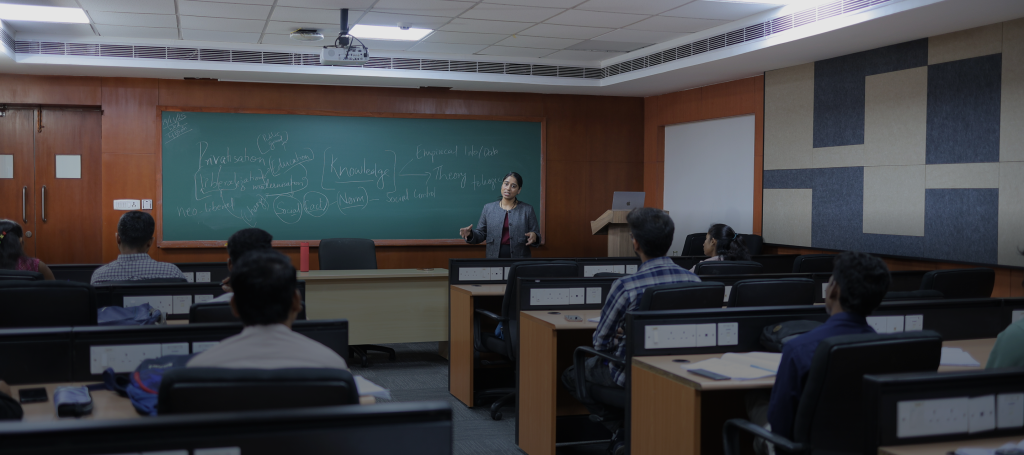
The M.A. in Education is designed for graduates who want to think deeply about education and its role in society. Students develop strong analytical, reflective and practical capabilities that support careers across education, research, policy and allied fields. Students experience:

Discussion-led learning
Small, interactive classes that examine education through social, cultural and theoretical perspectives.

Project-based engagement
Coursework and group projects that connect academic ideas with real educational questions and contexts.

Academic exposure beyond the classroom
Participation in seminars, workshops and outreach activities that deepen understanding of learners, schools and systems.

Individual mentoring
Ongoing faculty guidance to strengthen research skills, academic writing and professional communication.
Programme details
The M.A. programme includes 11 core (mandatory) courses, 5 elective courses, and skill/practice-based modules, which comprise two mandatory modules and several choice-based options.
- In Semester 1, students complete five core courses (CC) and two mandatory skill/practice-based modules (SB) to build a strong academic foundation.
- In Semester 2, students take four core courses (CC), one elective course (EC) and two skill-based modules (SB).
- In Semester 3, the curriculum includes two core courses (CC), two elective courses (EC) and two or three skill-based modules to choose from.
- In Semester 4, students complete two elective courses (EC) and undertake their dissertation.
Courses (core and electives)
- Foundational courses
- Discipline-based courses
- Sector-based courses
- Theme-based courses
- Integrated courses combining sectoral and thematic perspectives
Field engagement
- Intensive field experience
- Fieldwork report
Skill and practice-based modules
- Hands-on, practice-oriented module courses
Dissertation
- Identification and development of a research problem
- Literature review, findings and analysis
- Final presentation of the research work
| Course Type | Course Title | Credits |
|---|---|---|
| Core | Education in India: Themes & Perspectives | 4 |
| Core | Texts, Institutions and Transformation: A History of Indian Education | 3 |
| Core | Society, Culture and Education | 3 |
| Core | Learner, Learning and Development | 3 |
| Core | Understanding Economy & Education | 3 |
| Skill/Practice-based | Introduction to Academic Writing | 2 |
| Skill/Practice-based | Understanding and Using Educational Data | 2 |
| Course Type | Course Title | Credits |
|---|---|---|
| Core | Foundations of Social and Educational Research | 4 |
| Core | Educational Ideas and Thought | 3 |
| Core | Children and Childhoods | 3 |
| Core | Education Policy in India | 3 |
| Elective | Sector-Based Elective (Select any one)* | 3 |
| Skill/Practice-based | Choice-Based Module (1) | 1 |
| Skill/Practice-based | Choice-Based Module (2) | 1 |
| Skill/Practice-based | Choice-Based Module (3) | 1 |
| Course Type | Course Title | Credits |
|---|---|---|
| Core | Research Design and Methods – 2 | 4 |
| Core | Curriculum and Pedagogy | 4 |
| Elective | Theme-Based Elective (e.g., Urban & Education; Values & Education; Educational Leadership; Teacher Education; Diversity, Marginality & Education) | 4 |
| Elective | Discipline-Based Elective (e.g., History of Science & Tech Education; Advanced Sociology of Education; Advanced Economics of Education; Advanced Psychology of Education) | 4 |
| Skill/Practice-based | Choice-Based Module (1) | 2 |
| Skill/Practice-based | Choice-Based Module (2) / Optional | 1 |
| Course Type | Course Title | Credits |
|---|---|---|
| Elective | Political Economy of Higher Education | 4 |
| Elective | Evolution of the Modern University | 4 |
| Elective | Feminist Pedagogy | 4 |
| Elective | Educational Assessment & Evaluation | 4 |
| Elective | Schooling in a Changing Society / Sociology of School in India | 4 |
| Dissertation | Master’s Dissertation (Compulsory) | 12 |
Eligibility
Applicants must meet one of the following criteria:
- A bachelor’s degree in any discipline with a minimum of 55% marks, or
- A B.Ed. or B.El.Ed. degree with a minimum of 55% marks, or
- A valid CUCET (PG) score.
These requirements ensure that applicants have the appropriate academic background to pursue advanced studies in education. Shortlisted candidates will be invited for a panel interview.
Application and admission procedure
Applicants seeking admission to IMSE – Mahindra University should follow the steps below:
Step 1
- Apply online through www.mahindrauniversity.edu.in by completing the application form.
- Upload a recent scanned photograph during online registration.
- Follow the instructions to pay the registration and processing fee of ₹1,000.
Payment through demand draft
- Obtain a Demand Draft (DD) of Rs. 1000 from any Scheduled Bank in favour of “Mahindra University” payable at Hyderabad, India.
- Fill DD details in the DD payment option in the Application Portal and please include Student Name, Application No. & Mobile Number along with the DD on a separate paper which has to be sent to the below address: (The photocopy of the Demand Draft is to be kept for further reference.)
Admissions Office
Mahindra University
Survey No: 62/1A, Bahadurpally, Jeedimetla,
Hyderabad – 500043, Telangana, INDIA
Online payment through credit card
Applicants may also pay the application fee online using a Mastercard or Visa card by following the instructions provided on the application portal after registration.
Online payment through netbanking
- Applicants may also transfer the registration fee to the Mahindra University account using the net banking option after completing the registration process.
- The application fee for the M.A. (Education) programme is ₹1,000.
- All disputes between the applicant and Mahindra University shall be subject to the exclusive jurisdiction of the courts in Hyderabad, and may be resolved through arbitration as applicable.
Step 2:
Applicants must ensure that the following steps are completed on the application portal:
- Update all relevant academic details in the application form.
- Upload the required scorecards and supporting documents.
- Select the preferred course in the application portal.
- Complete and submit the application form online.
Only duly completed and eligible applications will be considered for admission in accordance with the University’s guidelines.
Applicants will be shortlisted based on their academic credentials and/or CUCET (PG) scores. Shortlisted candidates will be invited to attend a physical or virtual interview.
Candidates who are selected after the interview will receive an admission offer via email, along with further instructions from the University.
Please note that submission of an application does not guarantee admission. Final selection is subject to evaluation by the selection panel and availability of seats at the time of allocation.
Fee structure (per annum):
The fee structure for the M.A. in Education programme is outlined below. Hostel accommodation is optional.
| Fee component | Amount |
|---|---|
| Academic fees | ₹1,00,000 |
| Hostel charges | ₹2,10,000 |
| Caution deposit* | ₹20,000 |
*Refundable at the end of the programme or upon graduation. All fees are subject to revision as per University norms.
Teaching Assistantship
Students awarded a Teaching Assistantship based on their application, test, and/or interview performance as part of the PG admission process will be eligible to receive assistantship support of approximately Rs. 42,000 per month, comprising the following:
- Monthly Stipend: A stipend of Rs. 21,000 per month will be credited directly to the student’s registered bank account.
- Boarding & Lodging: Free on-campus boarding and lodging facilities, valued at approximately Rs. 21,000 per month, will be provided as per the standard campus amenities available to students. In case a student opts to be a day scholar, no equivalent monetary compensation shall be provided in lieu of these facilities.
Teaching Assistantship (TA) duties, as assigned by the Institute, will be mandatory for all eligible students.
Important dates
Aspiring candidates are invited to apply for admission to the M.A. (Education) programme and pursue advanced study in the field. Applicants are advised to note the admission deadlines to ensure timely submission of their applications.
| Admission milestone | Date |
|---|---|
| Last Date for submission of applications – 1st Round | 27-Apr, 2026 |
| Shortlisting of candidates for interview | 4th May, 2026 |
| Virtual/Physical interviews for selection | 15-16 May, 2026 |
| Announcement of Results | 27th May, 2026 |
| Last date for receipt of applications for admission | 31st July 2026 |
| Commencement of the Fall 2026 Semester Teaching | Aug, 2026 |
Note: Dates and schedules are subject to change.
Outcomes
This programme is designed to help graduates translate academic depth into meaningful professional and intellectual pathways across education systems.
Graduates of the M.A. in Education are prepared to:
- Build conceptual and analytical clarity around education, society, culture, and policy
- Conduct independent academic and field-based research, including qualitative inquiry and critical writing
- Contribute to curriculum design, academic content development, and teacher education initiatives
- Engage with education-focused organisations, including NGOs, policy bodies, schools, and research institutions
- Progress toward doctoral study (PhD) in education or related social science disciplines
The programme emphasises reflective thinking, structured argumentation, and research readiness—skills that remain relevant across teaching, policy, research, and leadership roles within education.
FAQs
This programme is well suited for graduates who are interested in understanding education beyond classroom practice, whether from perspectives of policy, society, culture, or research. It attracts aspiring educators, researchers, curriculum designers, and professionals looking to work in education-focused organisations.
No. Teaching experience is not mandatory. The programme is open to graduates from any discipline and includes foundational coursework that helps students from non-education backgrounds engage confidently with education studies.
Graduates move into roles such as educators, curriculum associates, academic researchers, programme officers in NGOs, education consultants, and policy or research assistants. Some also use the programme as preparation for doctoral study in education or allied fields.
Research is a core component of the programme. Students engage in close reading, academic writing, seminars, and a structured thesis in the later semesters, building strong preparation for research-intensive roles or further study.
Unlike professional teacher-training degrees, this programme focuses on education as a field of inquiry. It emphasises theory, research, and critical engagement with educational systems rather than instructional methods alone.
