











Department of Physics
Developing a deep understanding of physical principles that underpin science, engineering, and technology.
Department overview
The department of physics at Mahindra University provides a strong foundation in fundamental and applied physics, supporting teaching and research across undergraduate and postgraduate programmes. Physics education at Mahindra University integrates theoretical instruction with experimental practice, equipping students with analytical thinking, quantitative reasoning, and scientific problem-solving skills essential for advanced study and professional work.

Strong foundations in physics
Core instruction in mechanics, electromagnetism, quantum physics, optics, and thermal physics.

Theory integrated with experimentation
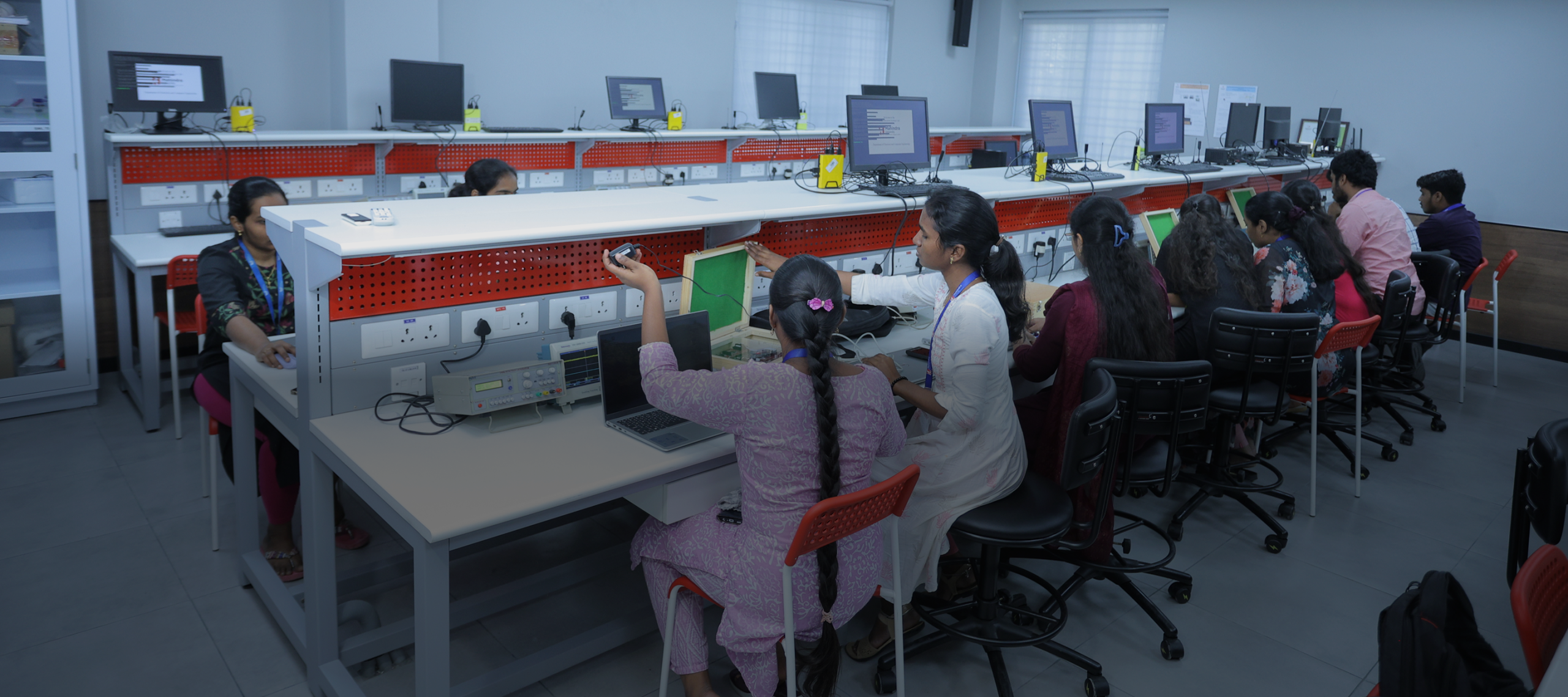
Laboratory courses that reinforce concepts through measurement, observation, and analysis.

Interdisciplinary relevance
Physics learning that supports engineering, materials science, electronics, and emerging technologies.

Progressive academic development
Courses structured to build conceptual depth and analytical capability over time.
Department details
Academic philosophy
The department’s academic approach emphasises conceptual clarity, mathematical rigour, and experimental validation.
- Fundamental understanding: focus on physical laws, models, and principles that govern natural phenomena.
- Analytical and quantitative reasoning: emphasis on mathematical formulation, modelling, and interpretation of physical systems.
- Experimental rigour: laboratory practices that stress precision, measurement, and scientific method.
- Preparation for advanced study: supporting pathways into research, higher education, and physics-intensive careers.
Teaching and academic contribution
The Department of Physics contributes extensively to the University’s curricula by offering:
- foundational physics courses for engineering and science programmes
- laboratory modules aligned with theoretical instruction
- interdisciplinary courses supporting electronics, materials, and applied sciences
Faculty work closely with other departments to ensure physics instruction aligns with programme-specific academic requirements.
Research and recognition
The physics department at MU is an active and growing research establishment focusing on the fields of fiber optics, spintronics, nanotechnology, liquid crystals, meta-materials, terahertz photonics and theoretical particle physics. It offers a vibrant and rigorous research program drawing on its core strengths:
- Many of the faculty members have worked in some of the leading international research institutes. Some of them are part of large international research collaborations.
- The department encourages collaborative research with industry, hence some of the faculty members are engaged in joint research programs with leading technological companies.
- The faculty members frequently organize National and International conferences. In addition, they organize Workshops and Seminars for academic and research communities.
Publications in high impact peer reviewed journals
Our faculty members have had the exposure and also enjoy the scope to carry out original research, contributing genuinely towards the enhancement of academic standards and industry requirements.
- Prof. Bishnu Pal have been awarded various prestigious fellowships such as Esther Hoffman Beller Medal 2016 of OSA – The Optical Society (USA) in its centenary year for outstanding contributions to optical science and engineering education.
- Prof A. Selvarajan award for 2017 for outstanding contributions to photonics education and research given by IEEE photonics society bangalore india chapter on the 1st International day of light at the Indian Institute of Science Bangalore, May 16 (2018);
- Early Career Research Award (2016): Department of Science and Technology (DST), Government of India, and various International collaborative projects (Indo-Austria, Indo-Taiwan, CNRS and OIST visiting professorship); and SERB research projects, etc.
Faculties
The department is supported by faculty with expertise across theoretical and experimental physics. Faculty members mentor students through coursework, laboratory work, research projects, and academic inquiry.