










M.Tech in Robotics
A two-year interdisciplinary postgraduate programme focused on the design, control and integration of intelligent robotic systems.
M.Tech in robotics overview
The programme integrates mechanical design, electronics, control and computer science to prepare graduates for advanced roles in robotics and automation. Students experience:

Core robotics foundations
Learning dynamics, embedded systems, mathematics for robotics and robot control theory from a multidisciplinary perspective.

Hands-on robotics laboratories
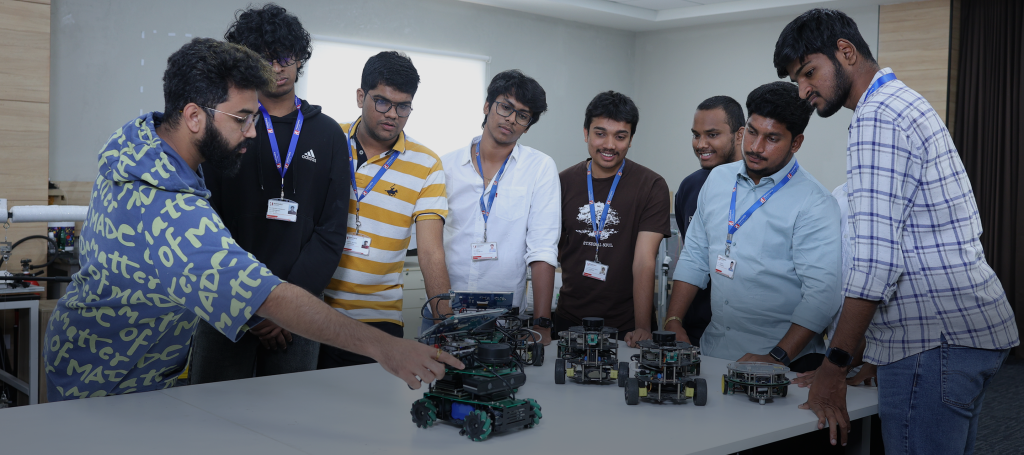
Practical work with robotic hardware, embedded systems and automation through lab-intensive courses.

Robotic intelligence and autonomy
Exposure to robot modelling, AI for robotics and Robot Operating System, linking perception, planning and control.

Research and industry readiness
Advanced electives and a two-phase master’s thesis addressing real-world robotics challenges.
Programme details
Objective
This interdisciplinary programme is offered by the Department of Mechanical and Aerospace Engineering at the École Centrale School of Engineering, Mahindra University, in collaboration with the Departments of Electronics and Computer Science.
The two-year programme provides advanced engineering knowledge through courses in kinematics, dynamics, electronics, computer programming, mathematics and specialised electives. Students also gain exposure to emerging areas such as intelligent machines, healthcare technologies and automation systems.
The programme requires a minimum of 60 credits across four semesters. Approximately two-thirds of the credits are devoted to coursework, while the remaining credits are allocated to a master’s thesis based on original research. Most courses include practical components to ensure hands-on learning and application.
Expected programme outcomes
Graduates of the programme are expected to:
- Design and implement analogue and digital electronic circuits within robotics and automation systems.
- Understand fundamental and advanced engineering concepts with a strong theoretical foundation in robotics.
- Apply principles of mechanical design, electronics design and control systems.
- Use engineering tools and methodologies to design and develop mechanical components and robotic systems.
- Develop robotic products and automation systems using integrated hardware and software approaches.
The curriculum includes courses across major areas such as:
- Robotics and automation
- Electronics and embedded systems
- Programming and software–hardware interfaces
- ROS (Robot Operating System)
- Advanced robotics and automation technologies
In addition, students may choose specialised elective courses covering emerging topics in robotics and intelligent systems.
| Course | L-T-P | Credits |
|---|---|---|
| Multi‐body Dynamics | 2-0-2 | 4 |
| Embedded Systems | 3-0-2 | 4 |
| Plant Automation and Cyber-Physical Systems | 3-0-0 | 3 |
| Mathematics for Robotics | 3-0-0 | 3 |
| Robot Control Theory | 3-0-0 | 3 |
| Robotics Lab-1 | 0-0-2 | 1 |
| Robotics and Hardware Interfacing | 3-0-2 | 1 |
| Course | L-T-P | Credits |
|---|---|---|
| Advanced Robot Modelling and Analysis | 3-0-2 | 4 |
| AI for Robotics | 3-0-0 | 3 |
| Elective I | 3-0-0 | 3 |
| Elective II | 3-0-0 | 3 |
| Elective III | 3-0-0 | 3 |
| Introduction to Robot Operating System (ROS) | 1-0-2 | 2 |
| Robotics Lab-2 | 0-0-2 | 1 |
| Course | L-T-P | Credits |
|---|---|---|
| Master Thesis Phase-I | 0-0-24 | 12 |
| Course | L-T-P | Credits |
|---|---|---|
| Master Thesis Phase-II | 0-0-24 | 12 |
Mobile robots
- Introduction to mobile robots (MAE)
- Aerial robotics / UAVs (MAE)
- Bio-inspired robots (MAE)
Medical robots
- Medical robots (MAE)
- Soft robotics (MAE)
- Human–computer interaction (MAE)
Industrial robots
- AI in industrial IoT (CSE)
- Advanced grasping and actuation (MAE)
- Machine vision and image processing (CSE)
Autonomous systems
- Machine learning for automobiles (ECE)
- Digital image processing and computer vision for self-driving cars (ECE)
- State estimation and localisation of self-driving cars (ECE)
- Motion planning for self-driving cars (ECE)
- Safety and standards in autonomous electric vehicles (ECE)
Career roles
Graduates of the programme can pursue roles such as:
- Project manager
- Robotics engineer
- Automation engineer
- Industrial robotics manager
- Automation and logistics manager
Robotics and hardware systems
- Industrial robots, mobile robots, legged robots and drones
- Haptics and exoskeleton (exo-suit) systems
- Embedded systems and PLC platforms
- Pneumatic and electro-pneumatic control systems
- Measurement and instrumentation laboratory
- Robotics and hardware interface laboratory
Software tools
- ABB RobotStudio
- ROS (Robot Operating System)
- OpenCV
- MATLAB
- Simulink
Admission process
Route 1 – GATE-qualified candidates
Applicants with a valid GATE score and a percentile above 90% will be shortlisted for an interview.
Route 2 – Non-GATE candidates
Applicants without a valid GATE score, or with a percentile below 90%, must appear for a written examination, followed by an interview for shortlisted candidates.
FAQs
It integrates mechanical design, electronics, control and software within a single robotics-focused curriculum.
Students work with robotic hardware, embedded systems, automation tools and robotics software platforms.
Mechanical, mechatronics and electronics engineering graduates are eligible to apply.
The first year focuses on core robotics coursework, while the second year is dedicated to thesis and project work.
Yes. The strong thesis component and advanced coursework provide a solid foundation for doctoral study.
