







Masters of Design (M. Des) in Design Innovation
A 2-year postgraduate programme that enables creative thinkers and designers to apply design thinking, innovation methods and technology to real-world challenges.
M. Des in design innovation overview
This programme at the School of Design Innovation blends theory and hands-on project work with industry-aligned problem solving. Learners explore design methods, creative technology and innovation frameworks that prepare them for multidisciplinary roles in design practice, strategic innovation and leadership. Students experience:

Interdisciplinary design progression
Across product, communication, interaction and apparel design, enabling students to move from foundational design thinking to specialised, practice-led innovation domains.

Studio-led learning environments
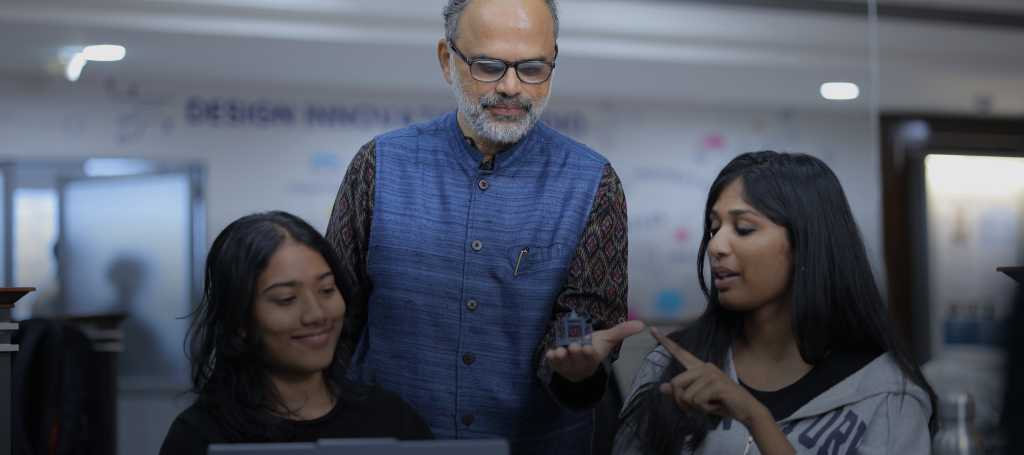
With hands-on design studios, workshops and project spaces that support visualisation, prototyping, research and iterative design development.

Industry-linked design practice
Through project-based learning, real-world briefs and thesis work that connect design methods with contemporary challenges in products, services and experiences.

Strong conceptual grounding
In design thinking, visual language, research methods and innovation frameworks, supported by structured coursework and guided project work across semesters.
Programme details
Academic structure
Our faculty combines academic depth with real-world expertise, guiding students through both fundamental theory and applied innovation.
| Courses | Description | Credits |
|---|---|---|
| Design Thinking and Innovation | Applying design thinking to develop innovative solutions for complex challenges. | 3 |
| Photography and Visualization Techniques | Developing visual storytelling through photography and digital visualization. | 3 |
| Element of Design – Applied | Applying design elements to create meaningful visual compositions in the context of their respective tracks. | 3 |
| Form and Aesthetics | Exploring form, proportion, and aesthetics in design practice. | 3 |
| Entrepreneurship Practice | Developing entrepreneurial skills for design-led ventures and innovation. | 3 |
| Design Method for Project | Applying structured design methods for successful project execution in collaboration with university labs. | 6 |
| Courses | Track | Description | Credits |
|---|---|---|---|
| Research Methods & Representation Techniques | Common | Learning research methods and effective techniques for design representation. | 3 |
| Design with AI Tools | Track Specific | Exploring AI-powered tools to enhance creativity and design workflows in track specific contexts. | 3 |
| User Experience Design | Track Specific | Designing meaningful and user-centered digital and physical experiences specific to their respective tracks. | 3 |
| Track Electives (As per the last tab after semester 4) | Track Specific | Building specialized expertise through discipline-specific elective courses as listed in the last tab. | 3 |
| Sustainable Design | Common | Integrating sustainable principles into products, systems, and services. | 3 |
| Design Project – 2 | Common | Applying research and design methods to solve real-world challenges in partnership with industry. | 6 |
The selected student(s) will have the opportunity for international immersion at Pininfarina during the entire second year.
| Courses | Description | Credits |
|---|---|---|
| Innovation Internship | Gaining hands-on experience by working on innovation-driven industry projects. | 3 |
| Project Aligned MOOC 1 | Building project-specific skills through a curated online course. | 3 |
| Project Aligned MOOC 2 | Advancing project expertise through specialized online learning. | 3 |
| Industry Project 1 | Solving real-world industry challenges through applied design practice. | 15 |
| Courses | Description | Credits |
|---|---|---|
| Project Aligned MOOC 3 | Strengthening project capabilities through advanced online learning. | 3 |
| Industry Project 2 | Delivering innovative solutions through an industry-sponsored design project as the final thesis project. | 18 |
| Courses | Track | Description | Credits |
|---|---|---|---|
| Human Factors and Ergonomics | Industrial | Designing products and systems centered on human capabilities and comfort. | 3 |
| Transportation Design & Styling | Industrial | Exploring the design and styling of future mobility solutions. | 3 |
| Materials & Manufacturing Processes | Industrial | Understanding materials and manufacturing techniques for product innovation. | 3 |
| CAD & Digital Prototyping | Industrial | Developing digital models and prototypes for design validation. | 3 |
| Immersive Systems Design (AR/VR) | Interaction | Designing immersive experiences using augmented and virtual reality technologies. | 3 |
| Tangible Interactions & Prototyping | Interaction | Creating interactive physical interfaces through rapid prototyping with electronic components. | 3 |
| Multi-model Interfaces | Interaction | Designing seamless interactions across multiple input and output modalities. | 3 |
| Game Design | Interaction | Designing engaging gameplay, mechanics, and interactive experiences. | 3 |
| Motion Graphics & Storyboarding | Communication | Visualizing concepts through motion graphics and storyboarding techniques. | 3 |
| Typography & Information Design | Communication | Communicating information effectively through typography and visual organization. | 3 |
| Advanced Graphic Design | Communication | Advancing visual communication through contemporary graphic design practices. | 3 |
| Film Theory and Making | Communication | Exploring cinematic storytelling through film theory and production. | 3 |
| Fashion Illustration & Sketching | Apparel | Developing fashion visualization through illustration and sketching techniques. | 3 |
| Textile Science & Creative Fabric Manipulation | Apparel | Exploring textile properties and creative fabric development techniques. | 3 |
| Advanced Garment Making Skills | Apparel | Mastering advanced garment construction and finishing techniques. | 3 |
| Fashion Innovation Lab: From Concept to Catwalk | Apparel | Transforming fashion concepts into innovative runway-ready collections. | 3 |
Eligibility
- A bachelor’s degree in Fine Arts, Engineering, Architecture, Design, Interior Design or an equivalent discipline (four-year programme after 10+2).
- A professional diploma in Design equivalent to a four-year programme after 10+2.
- A bachelor’s degree in Fine Arts (10+5).
Admission
- Additional consideration: Preference may be given to candidates with UCEED or CEED scores.
Fee structure (per annum):
Below is the core fee structure for the Master of Design Innovation programme.
| Category | Tuition fees (per annum) | Hostel charges (per annum) | Caution deposit |
|---|---|---|---|
| Indian students | ₹ 2,00,000 | ₹ 2,10,000 | ₹ 20,000 |
*Note: The M. Des fee structure is designed to provide transparency and help students and parents plan their education effectively. The fees reflect the value of a programme that combines creativity, innovation and industry exposure. A detailed breakdown is provided to ensure applicants have complete clarity before applying.
Teaching Assistantship
Students awarded a Teaching Assistantship based on their application, test, and/or interview performance as part of the PG admission process will be eligible to receive assistantship support of approximately Rs. 42,000 per month, comprising the following:
- Monthly Stipend: A stipend of Rs. 21,000 per month will be credited directly to the student’s registered bank account.
- Boarding & Lodging: Free on-campus boarding and lodging facilities, valued at approximately Rs. 21,000 per month, will be provided as per the standard campus amenities available to students. In case a student opts to be a day scholar, no equivalent monetary compensation shall be provided in lieu of these facilities.
Teaching Assistantship (TA) duties, as assigned by the Institute, will be mandatory for all eligible students.
Important dates
| Event | Date |
|---|---|
| Last date to apply for 2nd round of admissions | 20 July 2026 |
| 2nd round of personal interviews | 15-31 July 2026 |
| Last date for receipt of applications for admission | 31st July 2026 |
| Commencement of the Fall 2026 semester | August 2026 |
Hear what our students say…

“Here, teaching and research are not separate silos. Every project is an opportunity to involve students, to make them active contributors to new knowledge.”

“The University’s global partnerships have allowed me to co-teach with peers abroad and bring international perspectives into the classroom, something our students truly value.”

“What excites me at Mahindra University is the freedom to pursue interdisciplinary research. Collaborating with colleagues from engineering and social sciences has expanded my work in ways I never imagined.”

FAQs
The Master of Design Innovation develops the ability to apply creative design thinking, problem framing and research methods to product, service and experience challenges in diverse sectors.
Students choose one track from Industrial Design, Communication Design, Interaction Design or Apparel Design during the programme.
Weightage is given to UCEED/CEED scores where applicable; an in-person interview is mandatory for evaluation.
Final-year applicants may apply, subject to meeting eligibility criteria at the time of admission.
