A few years ago, AI used to feel like something out of a sci-fi movie, but today, it is helping shape the present as well as the foreseeable future. No matter the industry, application or level of integration, the bottom line is that AI is everywhere. Due to this, a lot of students are now considering AI courses after 12th to future-proof their careers.
According to MeitY’s 2025 report, India will need nearly 1 million AI professionals by 2026, indicating a steady demand for AI talent, resulting in industry transformation and an increased investment in AI led solutions.
Additionally, the demand for AI professionals in India is expected to grow at a compound annual growth rate of 15% until 2027. In such a lucrative scenario, entering into the job market with a proficiency in AI is a very safe and convenient option.
Let’s explore the best AI courses after 12th, their eligibility, fees, duration and more.
Why Choose AI Courses After 12th?
With the rapid advancement of AI, government initiatives and infrastructure support have been consistently strengthening. However, that’s only part of the picture. Let’s explore the other key factors that make AI one of the most promising career choices today and why it is being widely adopted across industries.
High Demand for AI Talent
Future-Proof Career Path
Cross-Industry Application
Competitive Edge Due to Early Start
List of Best AI Courses after 12th
Sr. No.
Course Name
Key Highlights
Typical Duration
Typical Fees
Eligibility
Who Should Pursue It
1
B.Tech. in Artificial Intelligence
Engineering-focused programme covering AI, ML, robotics, data science and intelligent systems.
4 years
1.5 to 4 lakhs
10+2 with PCM (50–60%) + entrance exams in many institutes.
PCM students aiming for a technical career in AI, software or research.
2
B.Sc. in Artificial Intelligence
Science degree focusing on AI fundamentals, data analysis, and computational modelling.
3 years
₹3 to 4 lakhs
10+2 Science, often with mathematics.
Science students (preferably with maths) interested in AI research, analytics or software development.
3
BCA in Artificial Intelligence
Computer applications degree integrating AI, ML, and software development skills.
3 to 4 years
₹2.5 to 3 lakhs
10+2 in any stream (maths/CS preferred in some colleges).
Students from any 12th stream (maths/CS preferred) wanting a career in AI software, coding or IT applications.
4
BBA in Artificial Intelligence
Management-focused programme combining business fundamentals with AI and analytics.
3 years
₹3 to 9 lakhs
10+2 in any stream.
Students from any 12th stream aspiring for AI-driven business, analytics or management roles.
5
B.Voc. in Artificial Intelligence
Vocational, hands-on programme emphasizing practical AI and automation skills.
Students seeking industry-ready AI skills with focus on employability and practical training.
6
Integrated B.Tech. + M.Tech. (AI)
Dual-degree combining undergraduate engineering with advanced AI specialisation.
5 years
₹2 to 6 lakhs PA
10+2 PCM + institute entrance/merit.
PCM students targeting deep technical expertise, research or leadership roles in AI.
7
Diploma in Artificial Intelligence
Short, applied course covering AI, ML, and data skills.
1 to 2 years
₹50,000 to ₹1.5 lakhs
10+2 (some allow 10th, depending on institute).
Students or professionals seeking foundational AI knowledge and skill-based entry into AI careers.
8
Short AI Certification Courses
Brief, focused AI/ML courses for quick upskilling or career transition.
3 to 6 months
₹5,000 to ₹50,000
Usually 10+2 or any undergraduate background.
Anyone with basic education or graduates looking to gain AI skills quickly or enhance career prospects.
Skills You Will Learn in AI Course After 12th
There are a multitude of skills that you will pick up throughout these courses. These can be categorised (but not limited to) as the following:
Programming- Python, C++ and other languages for AI development
Machine Learning- Supervised, unsupervised and deep learning algorithms
Data Analysis- Data cleaning, preprocessing, visualisation, statistical analysis
Neural Networks & Deep Learning- CNNs, RNNs, transformers and model deployment
Mathematics for AI- Linear algebra, probability, calculus, optimisation techniques
Cloud & Deployment- Using AWS, Azure, Google Cloud for AI projects
Model Evaluation & Optimisation- Accuracy measurement, overfitting prevention, performance tuning
Problem-Solving & Logical Thinking- Breaking down complex problems and computational solutions
Critical Thinking & Decision-Making- Pattern analysis and data-driven decisions
Hands-on Experience- Labs, capstone projects, real-world datasets, AI toolchain exposure
However, some courses might have extra modules from different disciplines for an integrated learning experience.
How to Choose the Right AI Course After 12th
Here are a few things you should consider to pick the right AI course after 12th:
Career Goal Alignment- Choose a course that matches whether you want a technical, research, management or applied AI career.
Course Duration- Consider how long you are willing to study: short-term certification, 3‑year degree, or integrated 5‑year programmes.
Curriculum Content- Check if the programme balances AI theory, programming, data science and practical projects.
Industry Exposure- Look for internships, industry tie-ups, workshops, or hands-on labs for real-world experience.
Flexibility & Mode- Decide between full-time, online, part-time, or hybrid courses depending on your learning style.
Accreditation & Recognition- Ensure the institution is recognised and the degree/certificate is valued by employers.
Cost & ROI- Compare fees versus potential career benefits, placement support and salary prospects.
Skill Focus- Verify that the course develops essential AI skills like programming, ML, analytics and problem-solving.
Future Studies & Specialisation- Consider if the course allows further specialisation or advanced studies (M.Tech., PhD, etc.).
Student Support & Resources- Check availability of mentors, lab facilities and career guidance.
Master AI with Mahindra University’s B.Tech. in Artificial Intelligence Programme
Mahindra University has established itself as a premier university in India, aiming to reach the pinnacle of excellence in engineering education by offering industry-aligned courses that are globally-relevant and taught by world-class faculty. Through its École Centrale School of Engineering, the University offers a fully residential B.Tech. course specialising in AI and ML.
The B.Tech. in Artificial Intelligence programme aims to create a breed of exceptional AI engineers who will transform the world through creative AI solutions. The ultimate goal is for the students to gain extreme precision and expertise in machine learning and automated reasoning for building the AI of tomorrow.
Some core learning areas of the programme are:
Machine Vision
Smart Industry
Autonomous & Robotics System
Natural Language Processing
Cyber Security
Bio-Informatics
Combining trending areas in artificial intelligence with modern educational elements like interdisciplinary curriculum, strong research environment, international collaboration with École Centrale Paris and a focus on practical skills, Mahindra University emerges as a strong choice to kickstart your AI journey.
Conclusion
AI has rapidly transformed from a futuristic concept into a crucial part of today’s industries, making AI courses after 12th highly sought after. With rising demand across healthcare, finance, manufacturing and retail, students pursuing AI can secure future-proof careers.
Courses like B.Tech, BSc, BCA, BBA, B.Voc, diplomas and short certifications offer varied paths depending on one’s goals, skills and interests. Choosing the right AI programme early ensures a competitive edge and prepares students for a dynamic, technology-driven future.
Mahindra University, with its industry-aligned curriculum, highly experienced faculty and hands-on learning approach, equips students with technical expertise and critical problem-solving skills. If you’re someone who is passionate about artificial intelligence, Mahindra University is the perfect launchpad for you. Apply now!
Frequently Asked Questions (FAQs)
Is AI a good career in India? It is a good career option in India. According to The Economic Times, the demand for AI professionals is about to reach 1 million by 2026.
How can I study AI after 12th? You can enrol in undergraduate courses like B.Tech, BSc, BCA with AI/ML specialisation, or diplomas & certification courses.
What are the AI courses after 12th without maths? Yes, there are AI/ML‑specialised courses like BCA (with AI/ML).
What are AI courses after 12th commerce? Commerce students can pursue AI via courses like BCA in AI & ML that don’t strictly require science stream background.
What are AI courses after 12th science? Science students (especially PCM) are eligible for B.Tech in AI & ML, BSc in AI and other AI‑centric degrees, which offer strong technical and coding foundations.
What are AI courses after 12th for biology students? Biology‑stream students may enter AI courses, especially BCA with AI/ML or diploma/certificates.
What are AI courses after 12th arts? Students from arts backgrounds can also pursue AI via flexible courses such as BCA (AI/ML), diplomas or certification programmes that accept any 12th stream.
What is the fees for AI courses after 12th? Fees vary depending on the course but stay close to INR 30,000 to 5,00,000.
Who is Eligible for AI Courses after 12th? Students who have completed Class 12 from a recognised board are eligible for AI courses, with most technical degrees (like B.Tech. in AI) requiring PCM, while programmes such as BSc AI, BCA AI, diplomas and certificates may also accept non-PCM students depending on the institution.
Two Tech Titans, One Dilemma- B.Tech. CSE vs B.Tech. AI? Is your dream to create an app like Swiggy or Spotify- something that millions rely on every day?
Or
Do you want to develop an algorithm that teaches machines to think for themselves? Both sound interesting. Also, they stem from both distinct fields shaping the future of technology- Computer Science Engineering and Artificial Intelligence. CSE is the backbone of the digital world that powers everything from online banking systems to e-commerce platforms. Meanwhile, AI is recognised as the brain of modern innovation, which drives voice assistants- Alexa, chatbots and many more. Together, they shape the way we experience technology every day. So, selecting between them often feels like being at a digital crossroads. Here in this guide, you will know what each degree truly offers that helps you decide which one matches your ambition best.
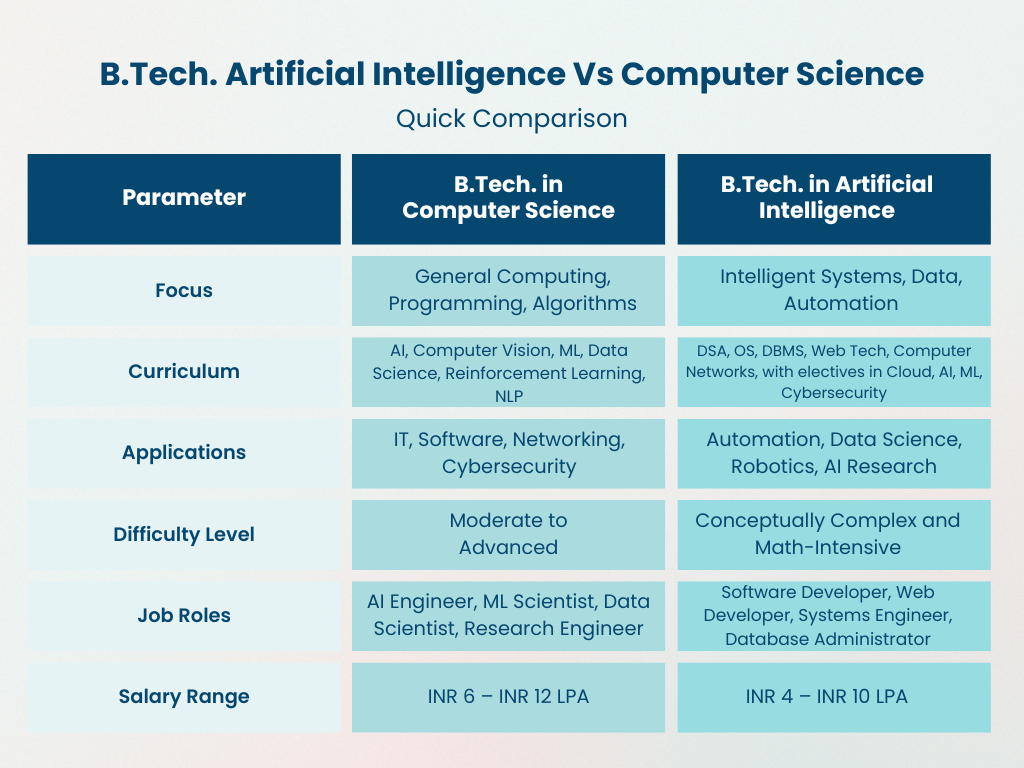
The Big Debate- Artificial Intelligence vs Computer Science
Here is a quick comparison-
Inside the Code- What You’ll Study in B.Tech. Computer Science
The B.Tech. in Computer Science Engineering provides you with a thorough grounding in both hardware and software systems. It is ideal for students who love to work on analysis, logic and building computing solutions from scratch.
The subjects you get to study during this course-
Programming in C, C++, Python or Java
DSA
OS and Computer Architecture
Computer Networks
Database Management Systems
Cloud Computing and Cybersecurity
In addition to theory-based knowledge, you will spend hours in coding labs, hackathons and other courses where you will be working on real-world projects. By the time you graduate, you will be well-versed in building apps, maintaining networks, designing for scaling and integrating AI tools with pre-existing systems.
The Future Is Smart- What You’ll Study in B.Tech. Artificial Intelligence
B.Tech. in Artificial Intelligence comprises all the same things as included in CSE, but with a sharper focus on intelligent systems. It is, essentially, about teaching machines to analyse data, recognise patterns and make intelligent predictions.
Core subjects included in the curriculum-
Machine Learning and Deep Learning
Computer Vision and Image Processing
Data Mining and Predictive Analytics
Natural Language Processing
Neural Networks and Reinforcement Learning
From Coding to Developing – B.Tech. CSE vs B.Tech. AI Skills That Define Each Degree
Both degrees are capable of shaping your intellect and can turn you into a tech professional, but the skill sets slightly differ. Let’s find out how-
B.Tech. in Computer Science
B.Tech. in Artificial Intelligence
Proficiency in multiple programming languages
Advanced mathematical and statistical knowledge
Strong analytical and logical reasoning
Data interpretation and visualisation skills
Expertise in database and system design
Expertise in neural networks and algorithm design
Understanding of hardware-software interaction
Experience in automation, robotics and predictive systems
Can design and build applications that grow smoothly as user demand increases
Expertise in machine learning algorithms and statistical modelling
Who Gets In? Eligibility & Admission Insights
A science educational background is necessary as well as a good foundation in mathematics to pursue these degrees.
Eligibility- +2 with Physics, Chemistry and Mathematics and a total score of 50 – 60% aggregate.
Entrance Tests– JEE Main (or state-level engineering tests or entrance exams as per University)
The Growth Curve- Job Demand, Market Value and Salary Trends
Both B.Tech. CSE and B.Tech. AI led to excellent career growth, but the dynamics differ.
NASSCOM predicts India’s AI sector will cross USD 17 billion by 2027, fuelling job creation across analytics and automation. Meanwhile, CSE continues to anchor the IT world with its focus on software and security.
B.Tech. CSE- ₹8-10 LPA
B.Tech. AI- ₹6-18 LPA
While AI offers faster salary growth due to its niche expertise, CSE provides broader stability and flexibility across various sectors.
Who’s Hiring- Leading Recruiters for AI and CSE Students
You’ll find top companies that want to hire graduates from both domains.
Recruiters for CSE Graduates-
Infosys
TCS
Wipro
Amazon
Microsoft
Accenture
Companies for AI Graduates-
Google AI
NVIDIA
IBM
Tesla
Adobe
OpenAI
Deloitte AI Labs
B.Tech. CSE vs B.Tech. AI – What Can You Become?
Both B.Tech. AI or CSE programmes offer a wide range of innovative and well-paid job roles. Career Pathways After B.Tech. AI
Job Role
Average Annual Salary
AI Engineer
₹8 – 18 LPA
Machine Learning Engineer
₹9 – 20 LPA
Data Scientist
₹9 – 18 LPA
NLP Expert
₹8 – 16 LPA
Computer Vision Engineer
₹8 – 17 LPA
Robotics Engineer
₹7 – 15 LPA
AI Research Scientist
₹15 – 35 LPA
AI Product Manager
₹18 – 25 LPA
Career Prospects After B.Tech. CSE
Job Role
Average Annual Salary
Software Developer
₹4 – 8 LPA
Full Stack Developer
₹6 – 12 LPA
System Analyst
₹5 – 10 LPA
Cybersecurity Specialist
₹6 – 14 LPA
Data Engineer
₹7 – 15 LPA
Cloud Architect
₹8 – 16 LPA
Database Administrator
₹6 – 10 LPA
Software Project Manager
₹12 – 20 LPA
B.Tech. CSE vs B.Tech. AI? Here’s How to Pick the Right One
So, how do you decide between B.Tech. CSE vs B.Tech. AI? The choice completely depends on your interests, mindset as well as career vision. Here are some crucial aspects that you need to consider-
Your Interest and Aptitude
Curriculum Breadth vs. Depth
Career Goals
Academic Pathways
Placement Trends
Long-term Learning Curve
These things will help you make an informed decision.
B.Tech. CSE vs B.Tech. AI- Which One Will You Master at Mahindra University
When choosing between B.Tech. CSE vs B.Tech. AI, Mahindra University bridges both worlds- allowing students to be builders of the next generation of digital solutions. Whether your career interests you in creating the systems that manage the world or designing the intelligence behind those systems, you will be future-ready with Mahindra University’s programmes.
At the university, you’ll find a balance between solid theory and real industry projects. That combination helps you sharpen your coding, master algorithms and work confidently with new technologies shaping the world today.
Conclusion- It’s Not AI or CSE, It’s About Finding Your Fit
The debate isn’t which degree is superior – it’s which one is superior for you. Both B.Tech. AI and B.Tech. CSE degree tracks can lead to exciting careers that are ready for the future and continue to shape the digital world around us.
If you enjoy the use of structured logic and the creation of software, then CSE offers you nearly limitless breadth. If you have always dreamed of building smart technologies that change the way that we live and work, then perhaps AI is where you belong. In today’s digital world, CSE and AI do not compete with each other; they coexist to create an intelligent world.
Wherever your dream may lie, look to Mahindra University to help you turn that dream into a reality. Apply today!
FAQs
B.Tech. CSE vs B.Tech. AI- Which one is better? The choice completely depends on your interests, career goals as well as your mindset. You can consider significant aspects- interest and aptitude, curriculum breadth vs. depth, career goals, academic pathways, placement trends and long-term learning curve.
Does B.Tech. AI provide a higher salary than CSE? Yes, B.Tech. AI offers faster salary growth due to its niche expertise, but CSE gives broader stability and flexibility across sectors.
What is the duration of B.Tech. CSE and AI? Both are usually four-year undergraduate programmes.
In a world where professional success increasingly hinges on adaptability as well as strategic acumen, the MBA (Master of Business Administration) is witnessing renascence like never before. Once considered a luxury for the elite or a stratum of the already privileged, the MBA is now attracting a new generation of determined professionals across diverse sectors and demographics. But what’s the major reason for this renewed interest in Business Education? The Avant-garde Job Market? Let’s dig in!
The Demand
The rapid pace of technological innovation and global economic shifts have made the job market more diverse, dynamic, and competitive. Conventional career paths are evolving, and professionals are finding they need more frequent pivots.
Also, the reports shared by Statista reveal that in 2023, the employability among Indian Masters of Business Administration graduates were about 60%, an increase from 47% in the year 2021. It wouldn’t be wrong to say that the MBA degree has emerged as a symbol of versatility, power, and influence in the present era, suggesting that pursuing an MBA is both promising and lucrative in all respects.
The Scope of Studying the Master of Business Administration
In the coming future, the scope of an MBA appears vibrant as this has become the most sought-after course specifically for professionals looking to ameliorate their management skills to climb corporate ladders. Multiple authentic reports indicate that nations, including the United States, Australia, India, etc., will have a massive demand for MBA graduates.
For your better understanding, when the deadly pandemic was at its peak, some top B-schools were able to place their aspiring minds at a high rate, exceeding 90%, according to LinkedIn. Moreover, the average income of these students holding prominent degrees has also risen, with some reputed institutions reporting an average package of Rs. 24 LPA. Shared below are some of the eminent career options after an MBA:
Marketing Manager
Human Resources Manager
Risk and Insurance Manager
Financial Manager
Operational Decision Manager
Business Analytics Manager
And more!
Remember, the world is diverse, and so are the opportunities. To be specific, there will be lots of job opportunities for MBA professionals in the future.
The MBA Course Details
The Master of Business Administration (MBA) is among the most versatile and prestigious graduate degrees, designed to equip students with a wide array of business skills and knowledge. No matter if you are looking to accelerate in your current career, switch industries, or kick-start your own business, an MBA can be a powerful tool. Below is a detailed overview of what to expect from an MBA program:
Core Courses
Financial Accounting
Managerial Economics
Marketing Management
Operations Management
Organizational Behavior
Finance
Strategic Management
Business Ethics and Corporate Responsibility
Electives and Specializations
Finance
Marketing
Entrepreneurship
Operations and Supply Chain Management
Data Analytics
International Business
Sustainability
Capstone Project or Thesis
Consulting Projects
Business Plan Development
Research Thesis
Internships and Practical Experience
Internships
Practical Experience
The MBA Admission Process
Educational Qualification
Bachelor’s degree or equivalent in any discipline.
To be eligible, you should be in your final year of an undergraduate degree. Nonetheless, the final transcript and degree must be submitted before the commencement of classes.
Standardized Test Scores
Official GMAT scores are to be sent to us directly by GMAC.
Valid CAT and GRE scores are to be submitted.
The MBA Course Details Fees
Item
Details
Total Fee for Entire Program
₹ 16 Lakhs (₹ 8 Lakhs per annum)
Exclusions
Boarding & Lodging
Not included; additional cost.
Study Material (Books, etc.)
Not included; additional cost.
To Consolidate
Certainly, the MBA at Mahindra University is showing to be a trend that is here to stay, regardless of your goals—be they to advance up the corporate ladder, launch your own business, or remain competitive in a fast-paced job market. As we move ahead into the twenty-first century, this iconic degree continues to evolve and thrive, shaping the leaders of the day after tomorrow.
Frequently Asked Questions
Is prior work experience mandatory before applying for an MBA course? No, prior work experience is not mandatory to apply to an MBA program; however, some exposure to a work environment is beneficial. Insights from prior work experience will provide practical experience in real-world business situations.
Is job placement guaranteed after successful completion of an MBA program? Job placement is not 100% guaranteed after successful completion of the MBA. Candidates are prepared for various real-world scenarios and are specialized in analyzing, strategizing, and decision-making. They are prepared for various job roles; however, individual performance in qualifying examinations, written tests, and group discussions determines a candidate’s career prospects.
We use cookies to ensure that we give you the best experience on our website. If you continue to use this site we will assume that you are happy with it.