




B.Tech in Computer Science Engineering
A 4-year undergraduate program developing computer scientists through a curriculum focused on real-world problem-solving, and industry collaboration.
B.Tech in computer science overview
Our programme builds expertise beyond just coding. The curriculum is structured to give students deep knowledge of computational theory and software design, ensuring they graduate as innovators who can architect complex digital solutions. Students experience:

Foundational mastery
of algorithms, data structures, and computational theory for programming excellence

Hands-on development
with coding labs, software projects, and building full-stack applications

Cutting-edge specialisations
in AI, Cybersecurity, and Data Science through advanced electives and research

Industry-aligned innovation
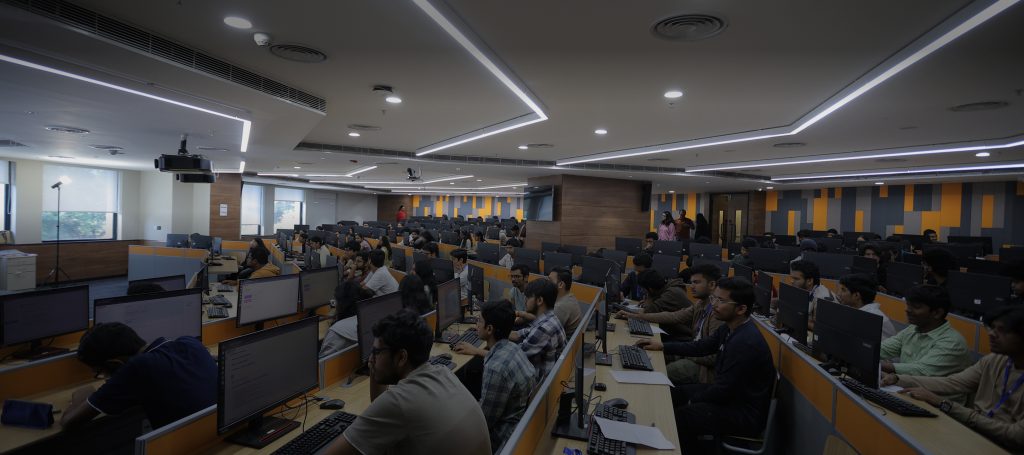
via hackathons, capstone projects, and internships solving real-world problems
Programme details
Programme objective
- Graduates will be able to identify and solve complex problems of the future and contribute to advancing the frontiers of computer science.
- Graduates will develop original ideas and build technology-driven solutions that simplify processes and improve quality of life.
- Graduates will demonstrate entrepreneurial thinking and advance their careers through continuous development of professional, communication and analytical skills.
Academic structure
Our academic structure is designed to establish robust foundations, followed by increasing specialization in later years.
- Duration: 4 years / 8 semesters
- Total credits & degree requirement: The programme requires not less than 165 credits to be awarded a B.Tech degree.
| Course | L-T-P | Credits |
|---|---|---|
| Calculus & ODE | 4-1-0 | 5 |
| Chemistry – I + lab | 2-1-2 | 4 |
| Introduction to Electrical Engineering | 2-1-2 | 2 |
| Electronics | 2-1-2 | 4 |
| Introduction to Computing | 2-1-1 | 3 |
| Introduction to Entrepreneurship | 1-0-0 | 1 |
| Media Project | 1-0-2 | 1.5 |
| English | 0-3-0 | 3 |
| French – I | 0-2-0 | 0.5 |
| Earth and Environmental Sciences | 2-0-0 | 2 |
| Total Credits | 26 |
| Course | L-T-P | Credits |
|---|---|---|
| Linear Algebra & Complex Analyses | 3-1-0 | 4 |
| Physics – I | 2-1-2 | 4 |
| Biology | 3-0-0 | 3 |
| Data Structures | 2-2-2 | 5 |
| Discrete Mathematics | 2-0-0 | 2 |
| Workshop Practice | 0-0-2 | 1 |
| Entrepreneurship Practise | 0-0-2 | 1 |
| Professional Ethics | 0-1-0 | 1 |
| French – II | 0-2-0 | 0.5 |
| Total Credits | 21.5 |
| Course | L-T-P | Credits |
|---|---|---|
| Probability and Statistics | 3-1-0 | 4 |
| Physics – II | 3-1-2 | 5 |
| Optimization Techniques for AI | 3-0-0 | 3 |
| Signals & Systems | 3-1-0 | 4 |
| Lean Start-up | 0-0-3 | 1 |
| Principles of Economics (7 Weeks) | 3-0-0 | 1.5 |
| French – III | 0-2-0 | 0.5 |
| Programming Workshop | 0-0-2 | 0.5 |
| Total Credits | 19.5 |
| Course | L-T-P | Credits |
|---|---|---|
| Numerical Methods | 3-0-2 | 4 |
| Digital Logic Design and Computer Architecture | 3-1-0 | 4 |
| Machine Learning with Python** | 3-0-2 | 4 |
| Artificial and Computational Intelligence | 2-1-2 | 4 |
| Theory of Computation | 3-0-0 | 3 |
| Design Thinking | 1-0-2 | 2 |
| Financial Accounting | 3-0-0 | 1.5 |
| French – IV | 0-2-0 | 0.5 |
| Programming Workshop | 0-0-2 | 0.5 |
| Total Credits | 23.5 |
| Course | L-T-P | Credits |
|---|---|---|
| Design and Analysis of Algorithms | 3-1-0 | 4 |
| Operating Systems | 3-0-2 | 4 |
| Database Management Systems | 3-0-2 | 4 |
| Object Oriented Programming | 2-0-2 | 3 |
| Microprocessors and Interfacing | 2-0-0 | 3 |
| HSS + Mgmt. – Elective – I | 2-0-0 | 2 |
| French – V (Optional) | 0-2-0 | 0 |
| Programming Workshop | 0-0-2 | 1 |
| Total Credits | 21 |
| Course | L-T-P | Credits |
|---|---|---|
| Big Data Analytics | 2-0-2 | 3 |
| High Performance Computing | 2-0-2 | 3 |
| Computer Networks | 3-0-2 | 4 |
| Software Engineering | 2-0-2 | 3 |
| Third Year Team Project | – | 2 |
| AI Elective – I | 3-0-0 | 3 |
| Elective – I | 3-0-0 | 3 |
| HSS + Mgmt. – Elective – II | 2-0-0 | 2 |
| Intro to Professional Development & Employability Skills | 2-0-0 | 2 |
| French – VI (Optional) | 0-2-0 | 0/0.5 |
| Total Credits | 25 |
| Course | L-T-P | Credits |
|---|---|---|
| Distributed Systems | 3-0-2 | 4 |
| Compiler Design | 3-0-0 | 3 |
| Cryptography and Network Security | 3-0-2 | 4 |
| HSS + Mgmt. – Elective – III | 2-0-0 | 2 |
| Elective – II | 3-0-0 | 3 |
| Elective – III | 3-0-0 | 3 |
| Year-4 Project | – | 3 |
| French – VII (Optional) | 0-2-0 | 0/0.5 |
| Total Credits | 22 |
| Course | L-T-P | Credits |
|---|---|---|
| Elective – IV | 3-0-0 | 3 |
| Elective – V | 3-0-0 | 3 |
| Year-4 Project | 0-5-8 | 10 |
| French Language & Culture – VIII (Optional) | 0-2-0 | 0/0.5 |
| Total Credits | 16 |
FAQs
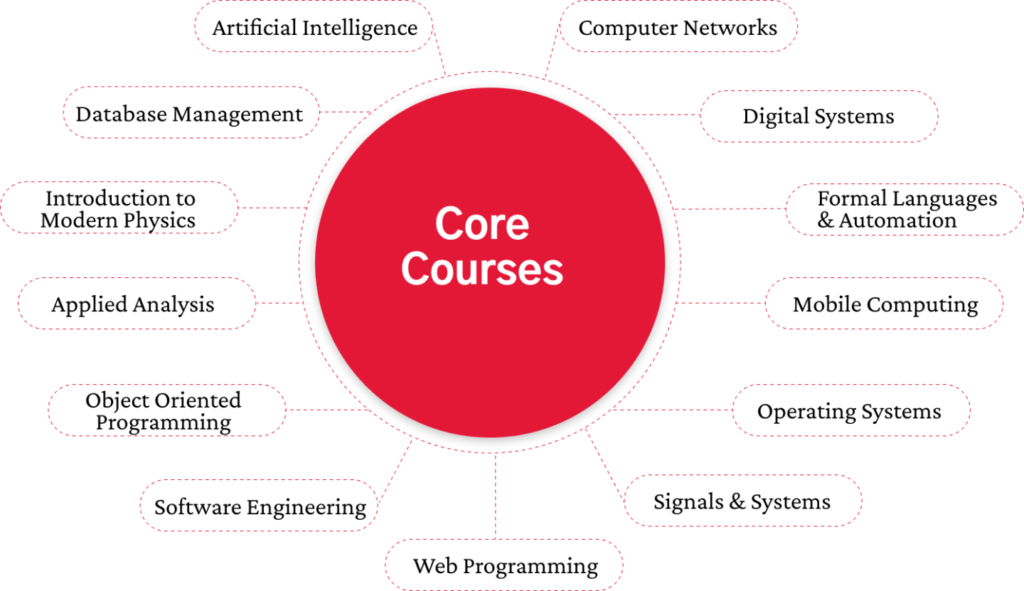
The CSE curriculum is designed around 11 core departmental courses (40 credits) covering algorithms, data structures, databases, cryptography, and machine learning. It blends strong theoretical grounding with application-driven labs and projects, ensuring graduates are industry-ready from day one.
Students can pursue five professional and open electives (15 credits) in areas like High-Performance Computing, Data Mining, Information Security, Graphics, and Embedded Systems, allowing them to tailor their expertise toward emerging technologies.
The CSE programme encourages research from the undergraduate level, with faculty-mentored projects, capstone work, and access to research labs in AI, Robotics, and Computational Systems. Students are guided by Ph.D. faculty from top global institutions.
With a 12:1 student-faculty ratio, fully residential campus, and project-based learning culture, CSE students experience personalized mentorship, vibrant peer learning, and a collaborative atmosphere ideal for growth and innovation.
