








B.Tech in Nanotechnology
A 4-year undergraduate programme that merges nano-scale science with engineering applications to shape future innovators in materials, healthcare and electronics.
B.Tech in nanotechnology overview
The B.Tech in Nanotechnology programme at Mahindra University provides a strong interdisciplinary foundation across key engineering disciplines, including mechanical, electrical and computer science. This programme focuses on engineering matter at the nanoscale (0.1–100 nm) for applications across healthcare, electronics, energy and advanced manufacturing, combining foundational engineering with advanced nano-scale applications. Students experience:

Foundational exposure
to mechanical, electrical and computer science engineering through common courses in the first three semesters.

Progressive training
from semester four through seven in nano-science, nano-materials and nano-device engineering, enabling deep specialisation.

Hands-on learning
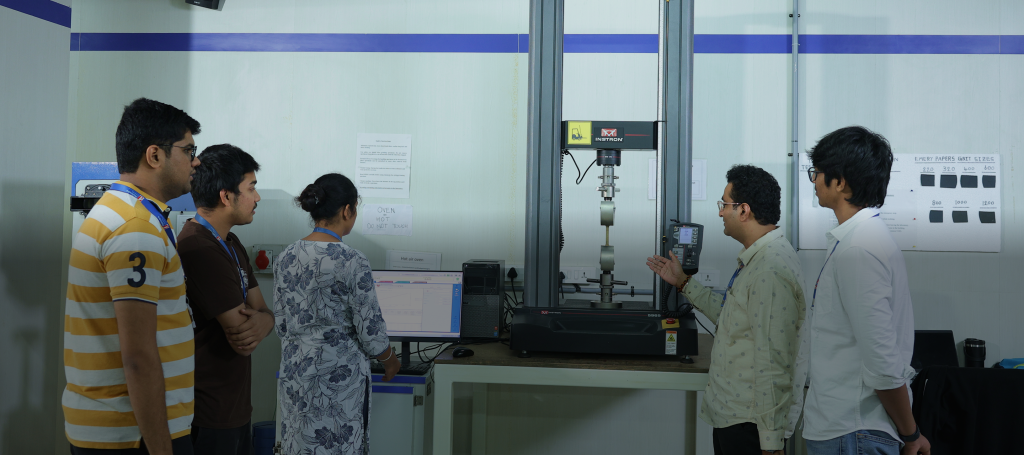
in advanced labs, nanoscale fabrication and device testing environments, equipping students to work in emerging technologies

Strong positioning
for research and industry roles in nanotechnology-driven sectors, supported by the university’s residential, global-facing engineering programme.
Programme details
Academic structure
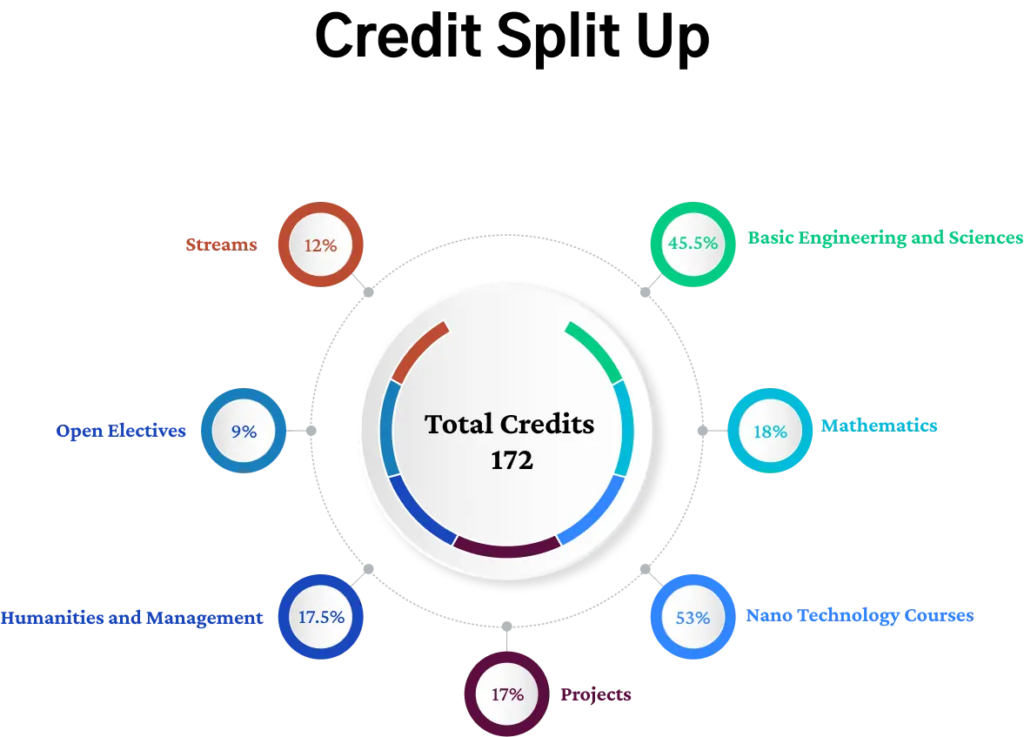
- During the first three semesters, students undertake common courses that introduce core engineering concepts along with foundational subjects in mathematics, natural sciences, humanities and social sciences.
- From Semester 4 to Semester 7, students are progressively exposed to fundamental and advanced courses that underpin nanomaterials and nano-devices. The programme equips students with the scientific and technological knowledge required to work in this rapidly evolving field.
- Nanotechnology has emerged as a significant area of study over the past few decades and serves as a key enabler of innovation across multiple engineering domains.
- The final semester is primarily dedicated to an internship or an industrial or academic research project, allowing students to apply their learning in real-world or research environments.
| Course | L-T-P | Credits |
|---|---|---|
| MA 1101 – Calculus and ODE | 4-1-0 | 5 |
| CH 1101 – Chemistry – I | 2-1-2 | 4 |
| EC 1102 – Intr. to Electrical Engineering | 2-1-2 | 4 |
| CE 1101 – Earth and Environmental Sciences | 2-0-0 | 2 |
| ME 1105 – Engineering Mechanics | 2-1-0 | 3 |
| BI 1101 – Introduction to Biology | 3-0-0 | 3 |
| HS 1101 – English | 0-3-0 | 3 |
| HS 1102 – Media Project | 1-0-2 | 1.5 |
| HS 1103 – French Language – I | 0-2-0 | 0.5 |
| HS 1104 – Introduction to Entrepreneurship | 0-0-2 | 1 |
| Total Credits | 27 |
| Course | L-T-P | Credits |
|---|---|---|
| MA 1202 – Linear Algebra and Complex Analyses | 3-1-0 | 4 |
| PH 1201 – Physics– I (Classical and Quantum Mechanics) | 2-1-2 | 4 |
| CH 1202 – Applied Chemistry | 2-0-2 | 3 |
| CS 1201 – Introduction to Computing | 2-1-2 | 4 |
| ME 1203 – Workshop Practice | 0-0-2 | 1 |
| ME 1204 – Thermodynamics | 2-1-0 | 3 |
| ET 1201 – Entrepreneurship Practice | 0-0-2 | 1 |
| HS 1202 – Professional Ethics | 0-1-0 | 1 |
| HS 1203 – French Language– II | 0-2-0 | 0.5 |
| Total Credits | 21.5 |
| Course | L-T-P | Credits |
|---|---|---|
| MA 2103 – Probability and Statistics | 3-1-0 | 4 |
| PH 2102 – Physics– II (Electrodynamics, Optics) | 3-1-2 | 5 |
| PH 2103 – Introduction to Physics of Materials | 3-0-2 | 4 |
| CH 2103 – Introduction to Nano-technology and Science | 3-0-0 | 3 |
| CS 2102 – Data structures | 3-0-2 | 4 |
| ET 2101 – Lean Startup | 0-0-3 | 1 |
| HS 2103 – French Language-III | 0-2-0 | 0.5 |
| HS 2102 – Principles of Economics | 1-1-0 | 1.5 |
| Total Credits | 23 |
| Course | L-T-P | Credits |
|---|---|---|
| MA 2208 – Numerical Methods | 3-0-2 | 4 |
| PH 2201 – Thermodynamics and Statistical Mechanics for Nanosystems | 3-0-0 | 3 |
| PH 2202 – Micro and Nano Fabrication | 1-0-4 | 3 |
| PH 2203 – Optoelectronic Devices | 3-0-0 | 3 |
| CH 2204 – Nanomaterial Synthesis | 3-0-2 | 4 |
| HS 2201 – Design Thinking | 1-0-2 | 2 |
| HS 2203 – French Language-IV | 0-2-0 | 0.5 |
| HS 2202 – Financial Accounting | 1-1-0 | 1.5 |
| Total Credits | 21 |
| Course | L-T-P | Credits |
|---|---|---|
| MA 3115 – Computational Methods for PDE | 3-1-0 | 4 |
| PH 3101 – Advanced Nanomaterials and Devices | 3-0-2 | 4 |
| CH 3105 – Nanostructure Characterization | 3-0-2 | 4 |
| PH 3102 – Nano Photonics | 3-0-2 | 4 |
| CH 3106 – Molecular Spectroscopy | 3-0-0 | 3 |
| Program Elective – I | 3-0-0 | 3 |
| Liberal Arts elective – I | 2-0-0 | 2 |
| HS 3101 – French Language & Culture – V | 0-2-0 | 0.5 |
| Total Credits | 24.5 |
| Course | L-T-P | Credits |
|---|---|---|
| BI 3201 – Nano-Biotechnology and Toxicology | 4-0-0 | 4 |
| PH 3201 – Semiconductor Devices | 3-0-0 | 3 |
| CH 3207 – Computational Nanotechnology | 3-0-2 | 4 |
| Program Elective II | 3-0-0 | 3 |
| Program Elective III | 3-0-0 | 3 |
| Program Elective IV | 3-0-0 | 3 |
| HS 3201 – Professional Development | 2-0-0 | 2 |
| Liberal Arts Elective – II | 2-0-0 | 2 |
| HS 3202 – French Language & Culture –VI | 0-2-0 | 0.5 |
| Total Credits | 24.5 |
| Course | L-T-P | Credits |
|---|---|---|
| PR 4000 – Research Project | 0-0-6 | 3 |
| CH 4108 – Carbon Nanotechnology | 3-0-0 | 3 |
| PH 4102 – MEMS and NEMS | 3-0-0 | 3 |
| Program Elective V | 3-0-0 | 3 |
| Liberal Arts Elective III | 2-0-0 | 2 |
| HS 4111 – French Language & Culture – VII | 0-2-0 | 0.5 |
| Total Credits | 14.5 |
| Course | L-T-P | Credits |
|---|---|---|
| PR 4000 – Research Project | 0-5-14 | 12 |
| HS 4222 – French Language -VIII | 0-2-0 | 0.5 |
| Total Credits | 12.5 |
FAQs
The programme blends fundamentals of engineering with cutting-edge nano-science and provides a platform to build nano-materials and devices, giving students a rare interdisciplinary advantage.
From early semesters students cover core engineering disciplines, and then move into specialised nano-science and device engineering with strong hands-on lab exposure and applied learning.
Our fully-residential, global curriculum emphasises emerging technologies, with access to advanced laboratories and exposure to research and industry applications, equipping graduates for high-impact roles.
Graduates are prepared for roles in healthcare materials, electronics, energy sectors, device fabrication, advanced manufacturing and academic research in nanotechnology-enabled innovations.
The curriculum emphasises emerging technologies, global engineering challenges and the ability to master complexities of multinational organisations, thereby fostering innovation-led graduates.
