


Bachelor of Design (B.Des) in Design Innovation
A 4-year, fully residential programme at MU School of design innovation curated to build creative confidence, design thinking skills, and global exposure.
B. Des overview
Our B.Des in design innovation programme prepares students to solve real-world challenges by blending creativity with technology, business, and social insight. The programme combines studio practice, industry projects, and global immersion, giving graduates the ability to design for impact in a fast-changing world. Students experience:

Purpose-driven design
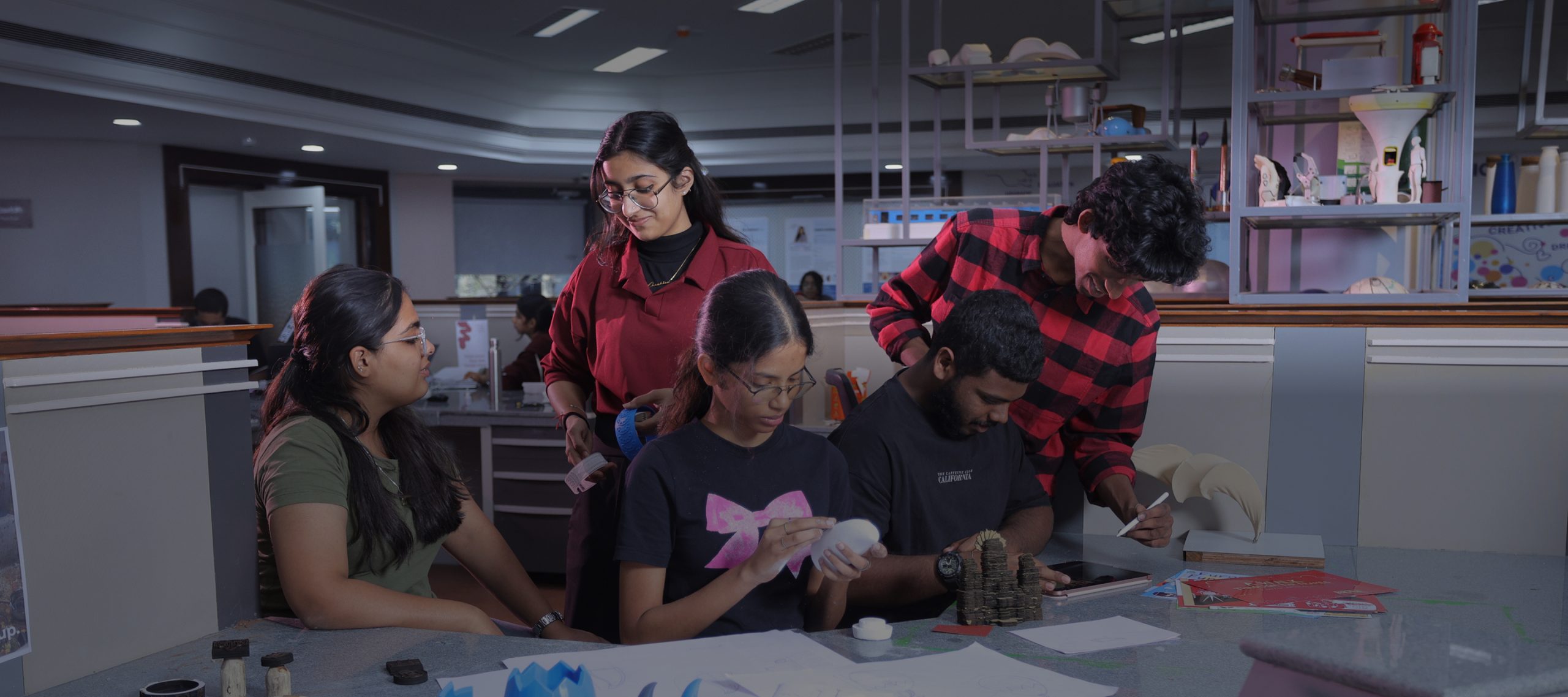
From day one, with students working in immersive studios to turn ideas into prototypes that solve real problems

Cross-discipline learning
Blending design with technology, business, and liberal arts to nurture versatile innovators

Global exposure
Through international exchanges, visiting faculty, and industry collaborations that connect students to worldwide design practice

Impactful capstone thesis
That showcases creativity, research, and problem-solving in a professional portfolio recognised by industry
Programme details
Academic structure
- The Bachelor of Design Innovation is a four-year / eight-semester full-time undergraduate programme delivered by the School of Design Innovation.
- Proposed intake for the academic year 2026-27*: 60
*Up to a maximum of 15% of the overall intake will be kept for NRI / PIO applicants
- Core skills: Learn design principles, sketching, material exploration, and foundational design history.
- Technological exposure: Introduction to tools such as Blender, Photoshop, video editing software, and AI-powered design tools.
- Hands-on exploration: Engage in creative projects that integrate theoretical knowledge with practical application.
- Electives: Explore domains such as industrial design, communication design, interaction design, and apparel design.
Semester 1
| Courses | Description | Credits |
|---|---|---|
| The joy of sketching and coloring | To enable students to experience and imbibe the joy of observing, drawing and recording objects and events. | 3 |
| Nature Human and Design | Examine theories about the origins of life, natural selection and evolutionary design. | 3 |
| Element of Design and AI | Exploring the foundations of visual harmony and creative expression. | 3 |
| Design Thinking | Chakku’s 7 Concerns of Design Thinking for Innovation | 3 |
| Design Tinkering | Practical hands-on learning by unraveling the art and science behind daily products. | 3 |
| Design Exploration Project – 1 | Exploring the complete journey of a product life cycle along with small scale enterprises. | 6 |
Semester 2
| Courses | Description | Credits |
|---|---|---|
| Visualization and Sketching | To imagine more and sketch beyond | 3 |
| History of Design | Understanding the Past, Designing the Future | 3 |
| Sustainable Design | To Rethink, Reuse, and Reconnect by exploring sustainability through hands-on design interventions | 3 |
| Design Exploration – 1 | Introduction to Interaction design and Apparel design | 3 |
| Design Exploration – 2 | Introduction to Industrial Design and Communication Design | 3 |
| Design Project – 2 | Understanding the constraints of grass-root enterprises to design practical interventions. | 6 |
Discipline-specific learning: Choose from industrial design, communication design, interaction design or apparel design.
Systems-based thinking: Work on interdisciplinary projects that address real-world challenges.
Advanced tools: Develop expertise in tech modelling, AR/VR, sustainable materials, animation and motion graphics.
Semester 3
| Courses | Track | Description | Credits |
|---|---|---|---|
| Intro to Photography | Common | Learning the fundamentals of photography, composition, lighting, and visual storytelling. | 3 |
| User Research | Common | Understanding user needs through observation, interviews, and research methods. | 3 |
| Form Studies | Common | Exploring form, structure, proportion, and aesthetics in design. | 3 |
| Engineering Principles & Design | Industrial | Applying basic engineering principles to design and product development. | 3 |
| Bio-mimicry & Creativity | Industrial | Drawing inspiration from nature to develop innovative design solutions. | 3 |
| UI Cognitive Ergonomics | Interaction | Understanding human cognition to design intuitive user interfaces. | 3 |
| Usability Evaluation | Interaction | Evaluating the usability and user experience of products and interfaces. | 3 |
| Basic Graphic Design | Communication | Exploring typography, color, layout, and visual communication principles. | 3 |
| Animation Basics | Communication | Learning the principles of motion, timing, and animated storytelling. | 3 |
| Fashion Illustration and Sketching | Apparel | Developing fashion sketching and garment visualization techniques. | 3 |
| Textile and Pattern-making Mastery | Apparel | Exploring textile materials, surface patterns, and pattern-making techniques. | 3 |
| Design Project – 3 | Common | Applying the complete design process to solve real-world challenges from startups. | 6 |
Semester 4
| Courses | Track | Description | Credits |
|---|---|---|---|
| Typography and Layout | Common | Exploring typography, layout, and visual hierarchy for effective communication. | 3 |
| Human Factors in Design | Common | Understanding human capabilities and limitations in design. | 3 |
| Design for Inclusivity | Common | Designing accessible and inclusive products, services, and experiences. | 3 |
| Application of AI in design | Common | Exploring AI tools and workflows to enhance the design process. | 3 |
| Material and Manufacturing process | Industrial | Understanding materials and manufacturing methods for design applications. | 3 |
| User Experience Design | Interaction | Designing meaningful and user-centered digital and physical experiences across Screens, AR/VR & CUI. | 3 |
| Pitch Deck Design | Communication | Creating compelling presentations to communicate design ideas effectively. | 3 |
| Technology and Fashion | Apparel | Exploring the integration of emerging technologies in fashion design. | 3 |
| Design Project – 4 | Common | Developing innovative design solutions through a medium-scale industry linked project. | 6 |
Emerging technologies: Explore emerging fields such as artificial intelligence and advanced prototyping.
Strategic thinking: Develop skills in entrepreneurship, service design and innovative problem-solving.
Elective deep dives: Tailor your learning in areas such as medical devices, game design, advertising, animation, graphic design or couture fashion.
Semester 5
| Courses | Track | Description | Credits |
|---|---|---|---|
| System Design | Common | Designing integrated systems that address complex user and business needs. | 3 |
| Design Innovation Management | Industrial | Managing innovation through design strategies and collaborative practices. | 3 |
| Advance Computer Aided Design | Industrial | Developing advanced 3D modeling and digital design skills. | 3 |
| Smart Product Design (Industrial) | Industrial | Designing intelligent industrial products with emerging technologies. | 3 |
| AR/VR Interfaces | Interaction | Creating immersive interfaces for augmented and virtual reality experiences. | 3 |
| Digital Game Design | Interaction | Designing engaging gameplay, mechanics, and interactive experiences. | 3 |
| Smart product design (Interaction) | Interaction | Developing interactive smart products focused on tangible interactions and electronics. | 3 |
| Advanced Graphic Design | Communication | Exploring advanced visual communication and branding techniques. | 3 |
| Film Theory and Appreciation | Communication | Understanding cinematic language, storytelling, and film analysis. | 3 |
| Motion Graphics | Communication | Creating dynamic visual content through animation and motion design. | 3 |
| Advance Draping and Construction | Apparel | Mastering garment draping and advanced construction techniques. | 3 |
| Branding, Merchandising & Packaging | Apparel | Developing brand identity through merchandising and packaging design. | 3 |
| Smart Product Design (Apparel) | Apparel | Designing innovative apparel integrated with smart electronic and wearable technologies. | 3 |
| Design Project – 5 | Common | Solving complex design challenges through interdisciplinary projects. | 9 |
Semester 6
| Courses | Track | Description | Credits |
|---|---|---|---|
| Industry Exposure Internship Project | Common | Gaining professional experience through industry-based design practice. | 3 |
| Qualitative Design Research Methods | Common | Applying qualitative methods to understand users and design contexts. | 3 |
| Advanced Materials & Manufacturing | Industrial | Exploring advanced materials and modern manufacturing processes. | 3 |
| Sustainable Design Management | Industrial | Integrating sustainability principles into design and innovation practices. | 3 |
| Tangible Games Design | Interaction | Designing interactive games using physical and tangible interfaces. | 3 |
| Emerging Trends in Interaction Technology | Interaction | Exploring next-generation interaction technologies and applications. | 3 |
| Semantics & Communication theory | Communication | Understanding meaning, perception, and communication in design. | 3 |
| 3D Animation | Communication | Creating three-dimensional animations for storytelling and visualization. | 3 |
| Digital Fabric Design | Apparel | Developing digital textile patterns and fabric surface designs. | 3 |
| Style & Accessories | Apparel | Exploring fashion styling and accessory design principles. | 3 |
| Design Project – 6 | Common | Delivering a comprehensive design project integrating research, innovation, and execution. | 9 |
Semester 7
| Courses | Description | Credits |
|---|---|---|
| Project-aligned online course – 1 | Building specialized skills through an online course aligned with the project. | 3 |
| Industry project and internship (Capstone 1) | Solving real-world industry challenges through an internship and capstone project. | 18 |
Semester 8
| Courses | Description | Credits |
|---|---|---|
| Project-aligned online course – 2 | Advancing project expertise through a specialized online learning experience. | 3 |
| Graduation Project (Capstone 2 or continuation of Capstone 1) | Executing a comprehensive graduation project demonstrating design knowledge and innovation. | 18 |
Eligibility:
10+2 or equivalent from a recognised statutory board with a minimum of 80% marks or an equivalent grade (for students from IB or other approved boards).
A valid score in the 2026 entrance examinations of UCEED, NID or NIFT.
Followed by Panel Interview for shortlisted candidates.
Important: Applicants to undergraduate programmes who have completed Class 12 under the IB, Cambridge or any other international curriculum must submit a UGC Equivalence Certificate certificate by 30 August 2026. Failure to do so will result in automatic cancellation of admission.
Fee structure (per annum):
| Category | Academic fees | Hostel charges (boarding & lodging – triple occupancy) | Caution deposit* |
|---|---|---|---|
| Indian category | ₹ 5,00,000 | ₹ 1,70,000 | ₹ 20,000 |
| PIO / NRI category | USD 9,000 | USD 3,000 | USD 400 |
Note: Hostel residence is mandatory for all students enrolled in the B.Des programme. Accommodation shall be provided in accordance with the University’s standard norms. During the first academic year, all students will be allotted triple-occupancy rooms. From the second year onwards, students may have the option to opt for double or triple occupancy, subject to availability, with hostel fees applicable as per the allotted accommodation type.
Important dates
| Milestone | Date |
|---|---|
| Last date to apply for next round of admissions | 9th May 2026 |
| next round of personal interviews | 11th May – 15th May 2026 |
| Last date for receipt of applications for admission | 31st July 2026 |
Note: Dates and Schedules are subject to change.
FAQs
It is a four-year full-time undergraduate degree delivered over eight semesters.
Yes. You can apply based on your 10+2 marks (80% aggregate), followed by a panel interview. Entrance scores such as UCEED, NID, or NIFT also strengthen eligibility.
Yes. Hostel residence is mandatory for all B.Des students as part of the full-time programme requirement.
In later years, students choose from disciplinary tracks including industrial design, communication design, interaction design and apparel design.
The curriculum includes collaborative projects, intermediate-level interdisciplinary work, internships and a final capstone thesis developed in partnership with industry contexts.
