







B.Tech in Aerospace Engineering
A 4-year undergraduate programme enabling engineers to design, develop and optimise aircraft, spacecraft and aerospace systems for the future.
B.Tech in aerospace engineering overview
We prepare students to excel in aerodynamics, propulsion, and structures, leveraging expert faculty and a strong research ecosystem to launch careers in advanced aerospace engineering. Students experience:

Progression into aerospace-specific domains
such as aerodynamics, propulsion and structural engineering, contextualised within India’s aerospace ecosystem.

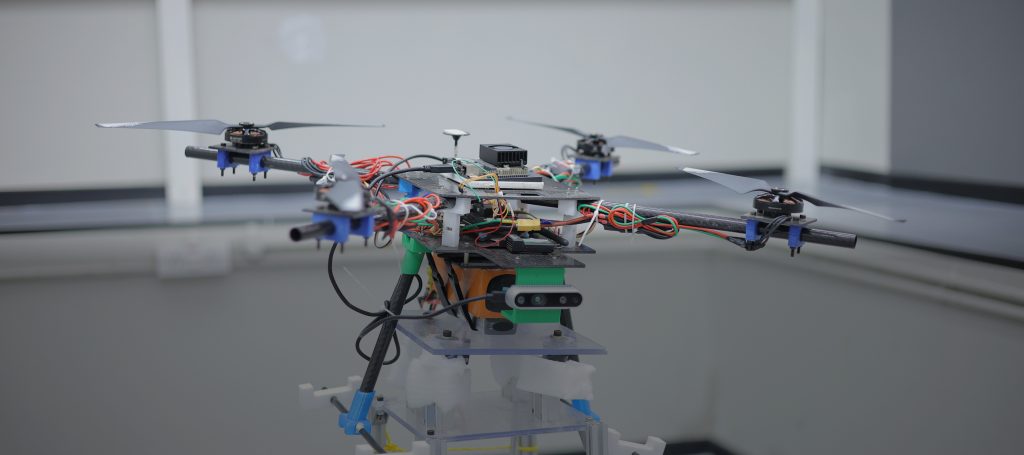
Hands-on engineering labs
design-drawing and project-based modules enabling students to apply theoretical aerospace principles.

Career-oriented training
aligned with the rapidly growing aerospace industry and research in India, giving students access to future mobility, defence and space initiatives.

Strong grounding
in mathematics, chemistry and engineering with a combination of courses like Calculus, Mechanics and Engineering Drawing.
Programme details
Academic structure
Our faculty combines academic depth with real-world expertise, guiding students through both fundamental theory and applied innovation
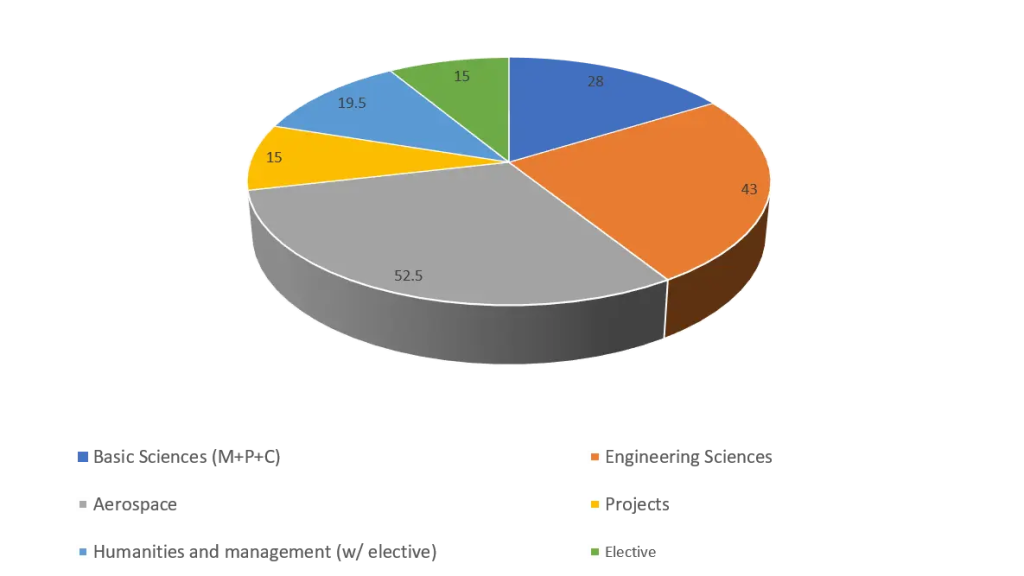
- Credit structure: Basic Sciences (28 credits), Engineering Sciences (43 credits), Aerospace (52.5 credits), Projects (15 credits), Humanities & Management (19.5 credits), Electives (15 credits), Total 173 credits.
- Total credits & degree requirement: The programme requires not less than 165 credits to be awarded a B.Tech degree.
- Duration: 4 years / 8 semesters
- Core vs Professional phases: The first two years constitute the “Core Program,” and the last two years the “Professional Program,” with electives introduced in the latter phase.
| Course | L-T-P | Credits |
|---|---|---|
| Mathematics I (Calculus & ODEs) | 4-1-2 | 5 |
| Chemistry I | 2-1-2 | 3 |
| Introduction to Electrical/Electronics Engg w/ lab | 2-1-2 | 2 |
| Engineering Drawing | – | 1.5 |
| Mechanics | 2-1-2 | 3 |
| Earth & Environmental Sciences | 2-0-0 | 2 |
| Intro. to Entrepreneurship | 0-0-3 | 1 |
| Media Project | 0-0-3 | 1.5 |
| English | 3-0-0 | 3 |
| French I | 0-2-0 | 0.5 |
| Course | L-T-P | Credits |
|---|---|---|
| Mathematics II (Linear Algebra & Complex) | 3-1-2 | 4 |
| Physics I with Lab | 2-1-2 | 4 |
| Chemistry II with Lab | 2-0-2 | 3 |
| Thermodynamics | 2-1-2 | 3 |
| CAE Design | 1-0-3 | 2.5 |
| Intro to Computing | 2-2-2 | 4 |
| Workshop Practice | 0-0-2 | 1 |
| Entrepreneurship Practice | 0-0-2 | 1 |
| Professional Ethics | 0-1-0 | 1 |
| French II | 0-2-0 | 0.5 |
| Course | L-T-P | Credits |
|---|---|---|
| Mathematics III (Probability & Stats) | 3-1-2 | 4 |
| Physics II with Lab | 3-1-2 | 5 |
| Data Structures & Algorithms | 2-2-2 | 5 |
| Introduction to Aerospace Engineering | 2-0-0 | 2 |
| Fluid Mechanics | 3-1-2 | 4 |
| Solid Mechanics | 2-1-2 | 3 |
| Lean Start-up | 0-0-3 | 1 |
| Principles of Economics | 3-0-0 | 1.5 |
| French III | 0-2-0 | 0.5 |
| Course | L-T-P | Credits |
|---|---|---|
| Numerical Methods | 3-0-2 | 4 |
| Aerospace Structures | 3-1-2 | 4 |
| Aerodynamics-I (Low Speed) | 2-1-2 | 3 |
| Finite Element Method | 2-0-2 | 3 |
| Fluid & Solid Mechanics Lab | – | 2 |
| Financial Accounting | 3-0-0 | 1.5 |
| Design Thinking | 1-0-2 | 2 |
| French IV | 0-2-0 | 0.5 |
| Course | L-T-P | Credits |
|---|---|---|
| Heat & Mass Transfer | 3-1-2 | 4 |
| Flight Dynamics & Aircraft Performance | 3-0-2 | 4 |
| Aerodynamics-II (Compressible Flow) | 3-1-2 | 4 |
| CFD for Aerospace Engineers | 3-0-2 | 4 |
| Propulsion-I (Rocket) | 3-0-0 | 3 |
| Aerodynamics Lab | – | 1.5 |
| Elective / HSS | – | ~2 |
| French V (Optional) | – | ~0.5 |
| Course | L-T-P | Credits |
|---|---|---|
| 3rd Year Project | – | 3 |
| Orbital Mechanics & Space Dynamics | 3-0-0 | 3 |
| Propulsion-II (Aircraft) | 3-0-0 | 3 |
| Aerospace Control & Guidance | 3-0-0 | 3 |
| Vibrations | 3-0-0 | 3 |
| Propulsion Lab | – | 1 |
| Aeromodelling Workshop | – | ~2 |
| Elective I | – | 3 |
| French VI | – | 0 |
| Course | L-T-P | Credits |
|---|---|---|
| Aerospace Materials & Processes | 3-0-0 | 3 |
| Aircraft Design | 2-0-2 | 3 |
| Space Vehicle Design | 2-0-2 | 3 |
| Control Systems Lab | – | 1 |
| Elective II & III | – | ~6 |
| Year-4/1 Project | 1-4-3 | 3 |
| French VII | – | 0 |
| Course | L-T-P | Credits |
|---|---|---|
| Elective IV | – | 3 |
| Elective V | – | 3 |
| Final Project II | – | 9 |
| French VIII | – | 0 |
Expected programme output
- To be able to understand the basic engineering concepts with theoretical foundation in mathematical/physical modelling and software engineering.
- To be able to understand and apply various concepts of mechanical design, electronics design and control.
- To have the ability to apply engineering methods and tools to specify and develop mechanical components and systems in the context of mechatronics.
- To have the ability to apply the engineering methods and tools and master the related skills in the process of developing mechatronic systems and products.
- To have the ability to apply engineering methods and tools to, specify and develop analog and digital electronic circuits, specify and develop embedded hardware and software in a mechatronic context.
FAQs
By covering aerodynamics, propulsion, and structures alongside engineering design projects, the curriculum mirrors the technical demands of the aerospace sector.
Laboratory sessions, computer-aided design and mechanics workshops give students early exposure to aerospace applications and simulations.
An emphasis on experiential learning, project work and strong foundational sciences ensures graduates possess both breadth and depth of knowledge.
Students are prepared for roles in aircraft design, defence technology, propulsion systems, unmanned aerial vehicles and research institutions.
The project-based framework encourages students to design creative engineering solutions while developing collaboration and leadership skills essential to the industry.
