













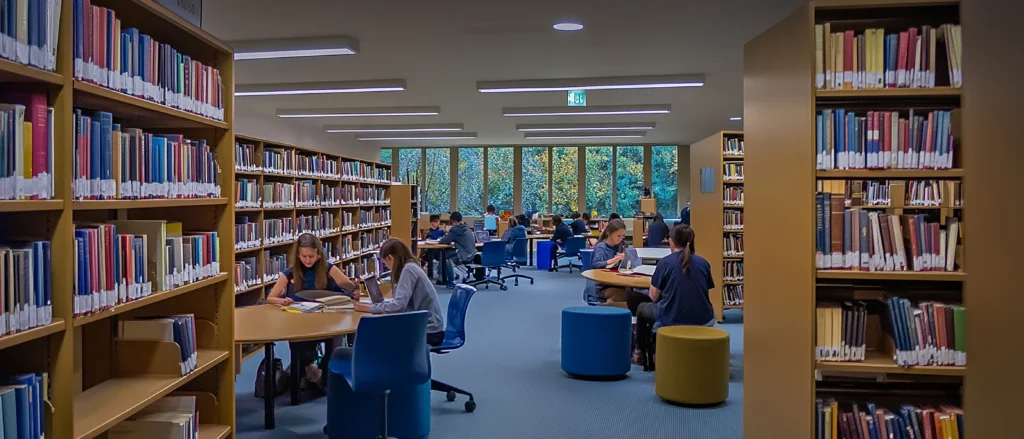
Walk into the Mahindra University library on any given afternoon, and you’ll notice something curious. There’s a hush in the air, broken only by the soft shuffle of pages, the occasional tap of a keyboard, and every now and then, a stern glance thrown at a group of friends who forgot they weren’t in the cafeteria. Behind that quiet, though, lies one of the most powerful resources at the university, a space built not just for books, but for ambition, discovery, and the kind of focus that’s hard to find anywhere else.
For a lot of students, the library conjures up images of tall shelves and the smell of old paper. And sure, that’s part of it. But the Mahindra University library has grown into something far bigger. It is a hub where exam preparation turns into genuine learning, where a stray research idea becomes a full-blown thesis, and where the right book at the right time can change the entire direction of a project. The trick lies in knowing how to use it, and that is where most students are pleasantly surprised.
Gone are the days of wandering through endless racks hoping to stumble upon the one journal that’s needed. With a simple login, students can tap into a vast collection of online databases, e-journals, and e-books, browsing through thousands of scholarly articles without ever leaving their seat. It is researching at the speed of thought; no dusty shelves required, though the shelves are still very much there for those who love the ritual of pulling a book down and flipping through it. And if a particular book isn’t on the shelf or in the digital catalogue, that isn’t a dead end. It is a conversation that is waiting to happen.
The Vineet Nayyar Learning Resource Center (VNLRC) at Mahindra University is 36,650 square feet, offering spacious and well-organized facilities for effective learning and research. The library has RFID & KOHA Automation and use cutting-edge systems for self-checkout, real-time tracking, and seamless access. They have over 29,000+ books and journals, providing the students a huge variety to read and research on.
OPAC (Online Public Access Catalog) at the University is an online library search system that allows students, faculty, and staff to easily find books, journals, e-resources, and other library materials available in the university library.
The timings of the main library and SOL are
8:00 AM to 11:00 PM (Mon–Fri)
9:00 AM to 5:00 PM (Saturday and Sunday)
During Examination Time Saturday and Sunday : 9:00 AM to 11:00 PM
SOL
9:00 AM to 9:00 PM (Mon–Fri)
9:00 AM to 5:00 PM (Saturday and Sunday)
During Examination Time Saturday and Sunday : 9:00 AM to 9:00 PM
Librarians aren’t just there to stamp due dates. They are research allies. If a book isn’t easy to find for a class or a paper, the librarians are the first people to ask. If a particular e-book would help with a thesis, there is a good chance the library can order it. If a useful title falls within budget, the librarians will often buy it outright. The golden rule of the library is simple: when in doubt, ask. The people behind the desk have spent years learning where everything lives, both on the shelves and across digital archives, and they are almost always glad to help.
Not every student study the same way, and the library seems to understand that better than most places on campus. For those who need dead silence and a spot to disappear into a textbook, there are peaceful reading corners, the kind where sunlight streams through the windows and the outside world simply fades away. For students who prefer more structure, study rooms can be booked after classes, offering a private, quiet space to focus once the day’s lectures wrap up.
Coming in early is the unofficial trick that seasoned students swear by. Grab a good seat, settle into a rhythm, and the rest of the afternoon tends to fall into place. Many of these study rooms connect directly to the main library floor, which means students can step out for a quick reference or a forgotten book without losing their spot or their momentum.
The university ID card that every student carries isn’t just for swiping into buildings. It doubles as a library card, unlocking the ability to borrow books straight from the shelves. It is a small detail, but a useful one to remember before heading empty-handed. There is a quiet transformation that happens to people who read often. Vocabulary expands; comprehension sharpens, and books that once felt intimidating begin to feel approachable. It doesn’t happen overnight, but it happens, and the library is designed to be the place where that habit takes root. For anyone who hasn’t yet made the library part of their routine, the advice is simple: take the tour. Most students discover the library’s layout, resources, and quieter corners far too late in their time at university, when they could have known it all from day one. A short walk around the building early on saves a great deal of confused searching later. It is also worth bookmarking the library’s website and getting comfortable navigating it, since research skills are built through practice, and the earlier that practice starts, the smoother the years ahead become.
At its heart, the Mahindra University library is exactly what its name suggests: a gateway. Used well, it opens doors to research, discovery, and a kind of focus that is hard to find elsewhere on campus. Used occasionally, it is still a fine place to borrow a novel and enjoy some sunlight through the windows. Either way, the invitation stands: walk in, explore it, ask questions, and let the space work in your favour.