






B.Tech in Electronics & Computer Engineering
A 4-year interdisciplinary program that integrates electronics, computer science, and engineering fundamentals to prepare students for the evolving tech landscape.
B.Tech in electronics & computer engineering overview
We prepare students to design and integrate intelligent electronic and computing systems that power modern digital products and platforms. The programme develops system-level thinkers who can work across hardware and software boundaries, translating complex requirements into robust, scalable solutions. Students experience:

Interdisciplinary mastery
across electronics, computer science, and systems engineering, enabling them to tackle diverse technological challenges.

Practical innovation
with extensive lab sessions, hands-on projects, and workshops translate theoretical knowledge into tangible solutions.

Industry-ready skills
enriched via a curriculum focuses on emerging technologies, equipping students for careers in AI, IoT, embedded systems, and beyond.

Global exposure
and opportunities for international collaboration and research help students develop a worldwide perspective and adaptability.
Programme details
Programme specific outcomes
- PSO1: Electronics System Design
Apply principles of electronics, analog and digital circuits, signal processing, and VLSI knowledge to analyze, design, test, and implement reliable electronic hardware systems for real-world applications.
- PSO2: Computing and Embedded Systems
Apply knowledge of programming, data structures, microprocessors/microcontrollers, real-time operating systems, and hardware–software co-design to develop IoT and embedded system solutions that address societal challenges.
- PSO3: Modern Tools and Emerging Technologies
Apply modern EDA tools, simulation platforms, and emerging technologies—including IoT, AI enabled hardware, and hardware security—while working collaboratively in interdisciplinary teams to design innovative engineering solutions and engage in research activities.
Academic structure
Programming and algorithms: Courses include problem solving in C, data structures, object-oriented programming, advanced problem solving, design and analysis of algorithms, and software application design.
Electronics fundamentals: Core courses such as electrical and electronic circuits, digital electronics, signals and systems, and signal processing.
Integrated hardware–software systems: Courses covering computing infrastructure, programmable devices, computing systems architecture, machine learning, and computer and communication networks.
Humanities and management: An interdisciplinary humanities track including management electives and design thinking.
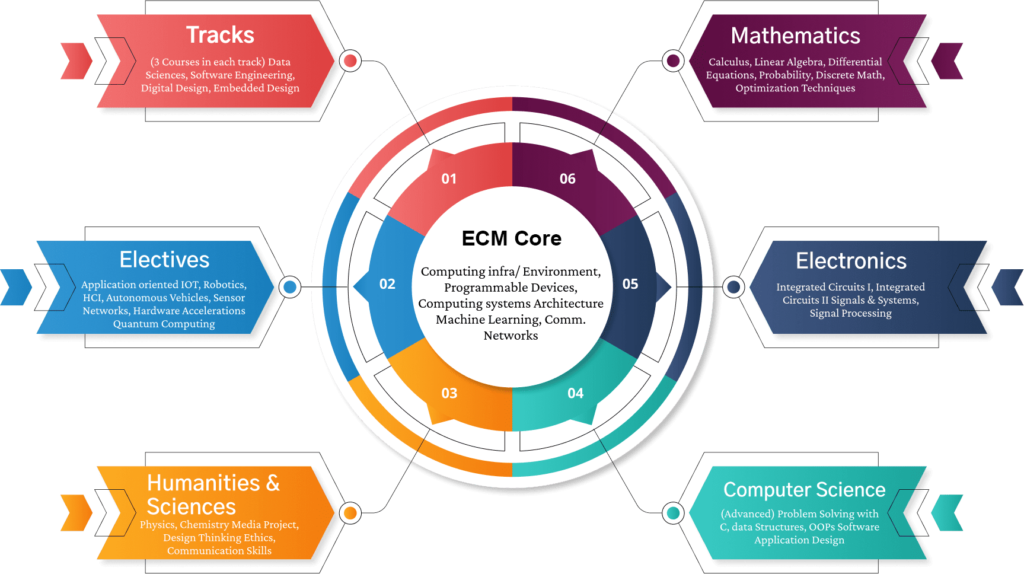
- Digital design: VLSI design, hardware acceleration and low-power IC design.
- Data science: Data management and warehousing, deep learning and big data technologies.
- Embedded systems: Real-time systems, hardware–software co-design and embedded programming.
- Software engineering: Software construction, testing and verification.
- Intelligent, connected and autonomous vehicles
- Internet of Things (IoT) system design
- Cyber-physical systems
- Mixed reality systems
- Human–computer interaction
- Robotics and automation
- Hardware-accelerated machine learning
- Smart systems
Newsletter
| Course | L-T-P | Credits |
|---|---|---|
| Calculus and ODE | 4-1-0 | 5 |
| Quantum Chemistry & Spectroscopy | 2-1-2 | 4 |
| Introduction to Electrical Engineering | 2-1-2 | 4 |
| Introduction to Computing | 3-0-2 | 4 |
| Earth and Environmental Sciences | 2-0-0 | 2 |
| English | 3-0-0 | 3 |
| Media Project | 1-0-2 | 1.5 |
| French – I | 0-2-0 | 0.5 |
| Introduction to Entrepreneurship | 0-0-2 | 1 |
| Total | 17-5-10 | 25 |
| Course | L-T-P | Credits |
|---|---|---|
| Linear Algebra and Complex Analysis | 3-1-0 | 4 |
| Classical & Quantum Mechanics | 2-1-2 | 4 |
| Introduction to Biology | 3-0-0 | 3 |
| Introduction to Electronics | 2-1-2 | 4 |
| Discrete Mathematical Structures | 3-0-0 | 3 |
| Data Structures | 3-0-2 | 4 |
| Entrepreneurship Practice | 0-0-2 | 1 |
| Professional Ethics | 0-1-0 | 1 |
| French – II | 0-2-0 | 0.5 |
| Total | 16-6-8 | 24.5 |
| Course | L-T-P | Credits |
|---|---|---|
| Probability and Statistics | 3-1-0 | 4 |
| Electromagnetics & Optics | 3-1-2 | 5 |
| Signals and Systems | 3-1-0 | 4 |
| Digital System Design | 3-0-2 | 4 |
| Operating Systems | 3-0-2 | 4 |
| Design and Analysis of Algorithms | 3-0-2 | 4 |
| Lean Startup | 0-0-3 | 1 |
| Principles of Economics | 1-1-0 | 1.5 |
| French – III | 0-2-0 | 0.5 |
| Total | 19-6-11 | 28 |
| Course | L-T-P | Credits |
|---|---|---|
| Numerical Methods | 3-0-2 | 4 |
| Communication Systems | 3-0-2 | 4 |
| Analog Circuits | 3-1-2 | 5 |
| Optimization Techniques for AI | 3-0-0 | 3 |
| Theory of Computation | 3-0-0 | 3 |
| Design Thinking | 1-0-2 | 2 |
| Financial Accounting | 1-1-0 | 1.5 |
| French – IV | 0-2-0 | 0.5 |
| Total | 17-4-8 | 23 |
| Course | L-T-P | Credits |
|---|---|---|
| Introduction to VLSI Design | 3-0-3 | 4.5 |
| Programmable Devices | 3-0-2 | 4 |
| Digital Signal Processing | 2-1-2 | 4 |
| Object Oriented Programming | 2-0-2 | 3 |
| Machine Learning | 3-0-0 | 3 |
| DBMS | 3-0-2 | 4 |
| HSS/ET/Mgmt. Elective I | 2-0-0 | 2 |
| French – V (Optional) | 0-2-0 | 0.5 |
| Total | 18-3-11 | 24.5 |
| Course | L-T-P | Credits |
|---|---|---|
| Computing Systems Architecture | 3-0-0 | 3 |
| Computer & Communication Networks | 3-0-0 | 3 |
| Engineering Program Elective I | 3-0-0 | 3 |
| Engineering Program Elective II | 3-0-0 | 3 |
| Introduction to Professional Development | 2-0-0 | 2 |
| French – VI (Optional) | 0-2-0 | 0.5 |
| HSS/ET/Mgmt. Elective II | 2-0-0 | 2 |
| Total | 16-2-0 | 16 |
| Course | L-T-P | Credits |
|---|---|---|
| Embedded Hardware Project | 0-0-6 | 3 |
| Research Project Phase I | 0-0-6 | 3 |
| Engineering Program Elective III | 3-0-0 | 3 |
| Engineering Program Elective IV | 3-0-0 | 3 |
| HSS/ET/Mgmt. Elective III | 2-0-0 | 2 |
| French – VII (Optional) | 0-2-0 | 0.5 |
| Total | 8-2-12 | 14 |
| Course | L-T-P | Credits |
|---|---|---|
| Research Project Phase II | 0-0-24 | 12 |
| French – VIII (Optional) | 0-2-0 | 0.5 |
| Total | 0-2-24 | 12 |
FAQs
Our ECM program combines electronics, computer science, and systems engineering in a carefully designed curriculum, giving students the skills and confidence to become future innovators in technology.
Graduates are prepared for careers in embedded systems, IoT, AI, robotics, hardware-software design, and even higher studies or entrepreneurial ventures.
Both. The program ensures students gain strong expertise in electronics and circuits as well as programming, computational theory, and system design.
Our holistic approach includes mentorship, innovation labs, clubs, and leadership opportunities, helping students develop confidence, teamwork, and problem-solving skills.
