












Summary: Picking a branch off a college brochure rarely tells you what four years will actually look like. This guide breaks down what a B.Tech in Electronics and Communication Engineering really involves, semester by semester, and how it holds up against ECM, CSE and AI when you’re trying to decide between them. You’ll find real fee and scholarship numbers from a private university, what the eligibility criteria actually require, where the mandatory internship and capstone project fit into the timeline and what graduates end up earning once they’re out, from core roles to the VLSI and semiconductor track that’s currently paying the most.
Table of Contents
- Introduction
- What Exactly Does a B.Tech in ECE Cover?
- ECE, ECM, CSE or AI: Which One is Actually Right for You?
- How is a Typical 4-year ECE Programme Structured?
- What Will You Actually Study, Year by Year?
- VLSI, Embedded or Wireless: How Do You Pick an Elective Track?
- Do ECE Programmes Actually Require an Internship or a Research Project?
- Who’s Eligible to Apply and What Score Do You Need?
- What Does a B.Tech in ECE Actually Cost and What Scholarships Exist?
- When Do B.Tech Admissions Actually Close?
- What Can You Actually Earn After a B.Tech in Electronics and Communication Engineering?
- What Should You Actually Check Before Shortlisting a College?
- How MU Has Built Its Electronics and Communication Engineering Programme Around this Shift
- The Bottom Line
- FAQs
For a while, computer science had all the momentum. That’s shifting now and the numbers explain why.
India’s semiconductor market is worth around USD 45 billion today and is on track to hit USD 100 billion by 2030, growing at roughly 13% a year. Real fabrication plants are coming up in Gujarat & Assam and the sector is set to add close to a million jobs by FY27. RF, analogue and VLSI roles are already commanding a pay premium over standard IT jobs because trained engineers haven’t caught up with demand yet.
That raises an obvious question: Is ECE the right choice for you?
If you are a 12th grader weighing a B.Tech in ECE (Electronics and Communication Engineering), this piece walks you through what the degree actually covers, how it differs from Electronics and Computer Engineering, CSE and AI, what a typical semester looks like, real fee and eligibility numbers and what graduates actually earn once they’re out.
What Exactly Does a B.Tech in ECE Cover?
Electronics and Communication Engineering sits where three things meet: electronics (circuit and device design), communication systems (how information moves- wired, wireless or optical) and computing (because nothing modern runs without software).
In plain terms, an ECE graduate learns how a signal (voice, video, sensor data) gets created, encoded, transmitted and processed. That one idea threads through a Bluetooth earbud, a 5G tower and the control unit inside an EV.
It’s also a flexible degree. Depending on electives, you can steer toward-
- Chip design (VLSI)
- Wireless and telecom systems
- Embedded hardware and IoT
- Signal processing
- Or pivot into software/AI roles later
ECE, ECM, CSE or AI: Which One is Actually Right for You?
This is the question that trips up most applicants, because the names sound interchangeable. They aren’t.
| Branch | Core Focus | Best Fit if You Want… |
|---|---|---|
| ECE (Electronics & Communication) | Circuits, signal processing, communication systems, VLSI, embedded systems | A strong hardware + communication base, with room to specialise later |
| ECM (Electronics & Computer) | Electronics blended tightly with computer architecture and systems programming | More computing depth alongside electronics from year one |
| CSE | Programming, algorithms, software systems | A primarily software/coding career |
| AI | Machine learning, data science, applied AI | To focus on AI/ML specifically from day one |
ECE and ECM overlap heavily in the first two years with subjects like maths, physics, basic electronics, programming and split apart from year three, when ECE goes deeper into communication theory, RF/analogue design and VLSI, while ECM leans further into computer architecture. If you’re unsure, read the third- and fourth-year elective list before deciding and that is where the real difference shows up.
How is a Typical 4-year ECE Programme Structured?
Most reputed programmes follow the same rhythm, even when the exact terminology differs-
- Years 1-2 (Foundation): Maths, physics, chemistry, basic programming, an introduction to electrical/electronic circuits, plus some humanities and communication courses
- Years 3-4 (Specialisation): Core ECE subjects (signal processing, communication systems, VLSI design, embedded systems) followed by electives, a mandatory industry internship and a capstone project
Grading, in plain terms- Most universities blend continuous evaluation (tests, quizzes, lab work, usually 40-50% of the grade) with an end-semester exam for the rest, on a letter-grade scale with a minimum CGPA requirement to stay in good standing.
What Will You Actually Study, Year by Year?
| Year | Focus | Typical subjects |
|---|---|---|
| 1 | Foundation | Calculus, Physics, Chemistry, Basic Electrical & Electronics Engineering, Programming for Problem Solving, Engineering Graphics |
| 2 | Core building blocks | Signals & Systems, Analogue Electronic Circuits, Digital Electronics, Electromagnetic Field Theory, Probability & Statistics |
| 3 | Core ECE | Communication Systems, Digital Signal Processing, VLSI Design, Microprocessors & Microcontrollers, Control Systems |
| 4 | Specialisation + Application | Wireless Communication, RF & Microwave Engineering, electives (VLSI/Embedded/AI crossover), Industry Internship, Capstone Research Project |
(Subject names vary slightly by university and are usually listed in full on each programme’s curriculum page. It is worth checking directly before you shortlist.)
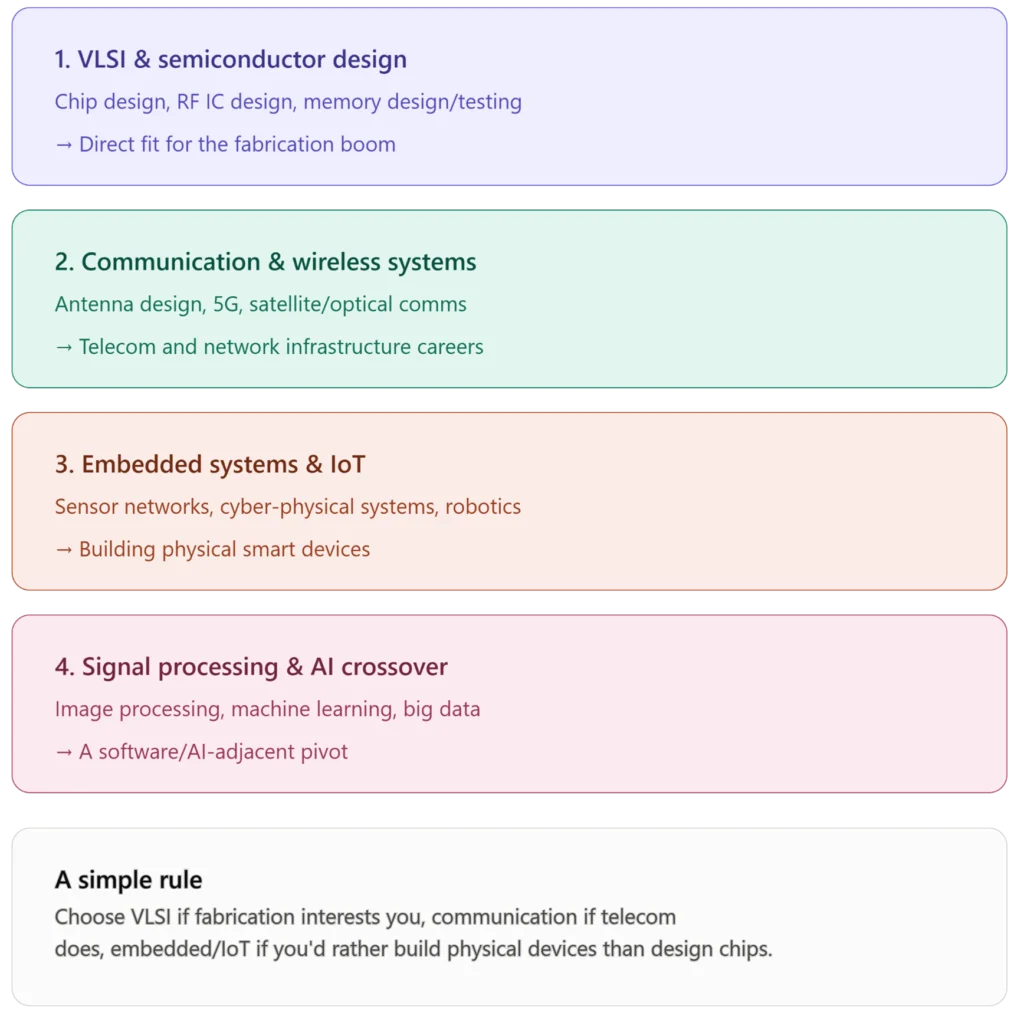
VLSI, Embedded or Wireless: How Do You Pick an Elective Track?
Most programmes group final-year electives into baskets like-
Do ECE Programmes Actually Require an Internship or a Research Project?
At most well-structured universities, yes and it’s usually non-negotiable-
- A pre-final-year industry internship, evaluated by the host organisation, sometimes with an added viva
- A two-phase capstone/research project, typically spanning both semesters of the final year, starting with a defined problem and ending with a working prototype, a report and a formal presentation
Labs run in parallel with nearly every core theory course from year one, getting more specialised (VLSI, communication systems, embedded hardware) from year three onward.
Who’s Eligible to Apply and What Score Do You Need?
Eligibility structures at most reputed private engineering universities in India tend to follow this pattern-
Basically, any one of these routes, alongside a minimum 60% (or equivalent) in Class 12th:
- A qualifying JEE Main score with eligibility for JEE Advanced or a strong All-India Rank
- A valid SAT Subject Test score (Maths, Physics, Chemistry)
- A valid ACT score
For NRI/PIO/international students, it’s typically an 80% (or equivalent) Class 12th aggregate for IB/other international boards, followed by a panel interview for shortlisted candidates. SAT scores are considered but not always mandatory.
What Does a B.Tech in ECE Actually Cost and What Scholarships Exist?
Here’s a realistic benchmark based on a well-established private university’s published 2026 fee structure-
| Category | Academic Fee (Per Year) | Hostel Charges (Per Year) | Caution Deposit (Refundable) |
|---|---|---|---|
| Indian Students | ₹5,00,000 | ₹1,70,000 | ₹20,000 |
| NRI / PIO Students | USD 9,000 | USD 3,000 | USD 400 |
Hostel residence is typically mandatory for the first year (usually triple-occupancy), with the option to move to double/single occupancy from year two, subject to availability.
A typical JEE-linked merit scholarship ladder looks like this-
| JEE Main Percentile | Typical Benefit |
|---|---|
| 98th percentile and above | 100% tuition fee waiver |
| 96th-98th percentile | 50% tuition fee waiver |
| 94th-96th percentile | 100% hostel & mess fee waiver |
| 90th-94th percentile | 25% tuition fee waiver |
Almost every scholarship comes with a continuation clause, commonly a minimum GPA of 7.5 with zero backlogs each year, so it’s worth confirming renewal terms directly with any university you shortlist, rather than assuming a first-year discount carries through all four years.
When Do B.Tech Admissions Actually Close?
Cycles vary by university, but the broad rhythm, based on a representative 2026 admission calendar, looks like this-
| Stage | Typical Window |
|---|---|
| Applications open | Early in the calendar year, alongside JEE Main prep season |
| SAT-based virtual interaction rounds | Spring (commonly March-May) |
| JEE Main/Advanced results trigger main application wave | June-July |
| Final deadline across all admission routes | Early-to-mid July |
Because exact dates shift year to year and are sometimes announced close to the deadline itself, treat any specific date as indicative and confirm directly with the university’s admissions page closer to the season.
What Can You Actually Earn After a B.Tech in Electronics and Communication Engineering?
- Typical Career Paths- Telecom and network engineering, semiconductor/VLSI design, embedded systems and IoT, RF and wireless engineering and, increasingly, software/AI-adjacent roles, since the analytical grounding ECE provides transfers well into data-heavy careers.
| Career Track | Typical Fresher Salary (India) |
|---|---|
| General ECE fresher (average) | ₹3-5 LPA |
| Core roles (Electronics/Control Systems Engineer) | ₹3-4 LPA |
| VLSI/semiconductor design (Tier-1 companies) | ₹15-30 LPA |
| IT/software pivot roles | ₹10-30 LPA |
| Government/PSU (DRDO, ISRO, BEL, Railways) | ₹35,000-96,000/month |
Salary figures vary meaningfully by various factors like specialisation and the strength of the placement process, but the pattern is consistent: VLSI and semiconductor specialists are currently the highest earners among fresh ECE graduates, a direct result of India’s fabrication push outpacing the supply of trained engineers.
- Higher Studies- A meaningful share of graduates go on to an M.Tech (often via GATE), an MS abroad or a direct research pathway if their capstone project produces publishable or patentable work.
What Should You Actually Check Before Shortlisting a College?
A shorter checklist than most brochures suggest-
- Curriculum Currency- Does it go beyond textbook theory into 5G, fabrication or IoT system design?
- Lab Infrastructure- Dedicated, industry-sponsored labs or shared generic ones?
- Internship & Project Rigour- A genuine, evaluated requirement or a formality?
- Placement Transparency- Verifiable data and named recruiters or vague aggregate percentages?
- Faculty Research Activity- Active publishing/patenting tends to correlate with useful project mentorship
- International Academic Affiliations- Some universities benchmark their curriculum against international engineering schools, which shapes how rigorously it’s updated
How Mahindra University Has Built Its Electronics and Communication Engineering Programme Around this Shift
Mahindra University has responded to this shift by designing its B.Tech in Electronics and Communication Engineering through the École Centrale School of Engineering. This programme is built on an academic collaboration with France’s École Centrale group, one of Europe’s oldest engineering education networks.
Here are a few aspects of the ECE programme that reflect those industry needs-
- Two-phase capstone structure: A dedicated Research Project spanning the final two semesters, evaluated in phases, alongside a separate team-based Embedded Hardware Project earlier in the final year
- Mandatory pre-final-year industry internship, evaluated directly by the industrial or academic partner
- Industry Recruiters spanning telecom, semiconductors and networking, like Qualcomm, Nokia Networks, Juniper Networks, Silicon Labs, Thales and L&T, have featured among connected employers
- A JEE-percentile-linked merit scholarship ladder running from a 25% tuition waiver up to a full 100% waiver, contingent on maintaining a minimum GPA each year
- Multiple entry routes including JEE Main/Advanced, SAT, ACT, with 2026-27 admissions running virtual SAT interaction rounds
If you’re weighing ECE against ECM or AI, it’s worth knowing this university offers all three as distinct programmes, so the branch-selection logic above applies just as directly here. Apply Now!
The Bottom Line
Electronics and Communication Engineering in 2026 is a bet on where Indian manufacturing and infrastructure are actually heading and the underlying numbers (semiconductor market growth, near-million new jobs by FY27, a real shortage of specialised engineers) back that up more than most branch debates do.
What should decide where you study isn’t the course hype created by the university- it’s the curriculum depth, whether the internship and capstone are substantive, the real fee and scholarship numbers and how transparent the placement data actually is. Use the checklist above regardless of which university you land on.
FAQs
Yes. The programme runs through the École Centrale School of Engineering, built on an academic collaboration with France’s École Centrale group. You’ll also see this reflected in the curriculum, with French language courses running across most semesters.
You need a minimum CGPA of 4.00 to be promoted to the next academic year and 4.50 to graduate. You also need to have earned at least 60% of that year’s credits and 90% of all previous years’ credits to move up.
165 credits across 4 years and 8 semesters. Years 1 and 2 focus on maths, physics and core electronics; years 3 and 4 move into specialisation, electives, the internship and the capstone project.
They’re two separate final-year deliverables. The Embedded Hardware Project is a team-based build, evaluated earlier in the final year. The Research Project runs across both final-year semesters in two phases, starting from a defined problem and ending with a working prototype, a report and a presentation.
JEE Main with JEE Advanced eligibility, SAT (including Subject Tests) and ACT, alongside a minimum Class 12th aggregate. NRI/PIO applicants with an 80% Class 12th aggregate go through a panel interview instead.
Academic fees run around ₹5,00,000/year for Indian students, plus mandatory hostel charges (~₹1,70,000/year) and a refundable caution deposit of ~₹20,000. NRI/international fees are quoted separately in USD.
Yes. A JEE-percentile-linked scholarship ladder runs from a 25% tuition waiver up to a full 100% waiver, contingent on maintaining a minimum GPA each year.
Entry-level salaries commonly range from ₹3-6 LPA, with VLSI/semiconductor specialists at Tier-1 companies earning ₹15-30 LPA as freshers, given the current sector-wide talent shortage.
Most routes close by early-to-mid July. SAT/ACT applicants go through earlier virtual interaction rounds in spring. Confirm exact dates on MU’s admissions page since they shift year to year.