

















Summary- Lawyers and advocates are different. How? The two terminologies may seem similar at times; they both have distinct meanings in the Indian context. Here, we analyse the roles, qualifications and responsibilities of both and compare their future prospects in regard to career and salaries. We will also explore career avenues available through a law degree, ranging from becoming an advocate to practising law, technology, public policy, intellectual property and more.
Envision yourself at a drama that features a court scene. The judge arrives, the courtroom becomes silent and a person in a black gown enters the courtroom, arguing for their client. Your mate sitting beside you whispers in your ear, “That’s the lawyer.” Nevertheless, the question that arises is, “whether the person arguing in the drama is really a lawyer or an advocate.”
In everyday conversation, “lawyer” and “advocate” are often used to mean the same thing. However, in the Indian legal system, the terms have a more specific distinction. The difference is in the issue of professional membership and the right to appear in court and not just in the possession of the LLB qualification alone. This is important in understanding the functions, scope of practice and the definition of the profession.
The legal community is constantly growing. Based on the latest statistics, there were in excess of 12 lakh advocates in India a decade ago, which makes India among the largest law-practising communities in the world. With more and more organisations and individuals using the services of lawyers, the scope of employment is not limited to litigation anymore.
Hence, the question pops up – “what is the difference between a lawyer and an advocate? What should you choose if you wish to make a career in law?” Let us take you through the world of law and learn about the differences, careers and starting your legal journey.
Two Titles, One Legal World: Where Does the Difference Begin
On the surface, both a lawyer and an advocate seem to do the same job. Both learn about law, know the rules of law and assist people in dealing with their problems concerning law. But here, the distinction comes in who is legally authorised to practice before a court of law.
Who is a Lawyer?
A lawyer is a person qualified through a recognised law degree like LL.B., B.A. LL.B. or BBA LL.B. and legally qualified to provide legal advice, prepare contracts, conduct legal research and do other work in corporate law, consultancy, compliance, public policy and governance.
The responsibilities of lawyers include the following-
- Attend trials and hearings
- Conduct research and gather evidence supporting their client
- Collaborate with police and investigators
- Review a case and provide legal opinion to clients
- Advise clients on their constitutional rights in their legal matters
- Schedule interviews, assessments and meetings with their clients and witnesses related to the case
Who is an Advocate?
On the other hand, an advocate is a lawyer who has fulfilled additional professional requirements prescribed in the Advocates Act of 1961. Once enrolled with a State Bar Council and holding a Certificate of Practice, advocates become eligible to represent their clients legally in the courts of law in India.
The responsibilities of advocates are as follows-
- Represent clients in the court and fight cases in court
- Assist the police and investigator to present themselves well-prepared in the proceedings
- Notify authorities of complaints against court officials
- Conduct necessary legal research concerning the case
- Observe court etiquette and proper conduct
- Provide the required evidence to the court to reach a conclusion in a legal matter.
What Makes an Advocate Different From a Lawyer?
A distinction will be easier to draw when looking into professional qualification than mere educational qualification. An individual who possesses an accredited degree in law can serve in multiple capacities in the field of law, such as legal research, drafting, advice, corporate and compliance laws. On the other hand, an advocate can be defined as a lawyer who fulfils the necessary qualifications for practising law in front of courts.
Put in simple words, a lawyer is one who is qualified in law, while an advocate is one who is a qualified lawyer and is entitled to practice law in front of the courts according to the applicable law.
Lawyer vs Advocate: The Difference That Changes Your Career Path
The best way to know the differences between the two is- all advocates are lawyers, but not all lawyers are advocates. The two hold the same qualifications, but while all advocates may defend themselves in court, having enrolled themselves and been certified in line with the provisions of the Bar Council of India, this is not possible for lawyers.
Lawyer vs Advocate: Quick Comparison
All differences between the two will become clear when you compare their roles and qualifications.
| Aspect | Lawyer | Advocate |
|---|---|---|
| Holds a recognised law degree | ✔ | ✔ |
| Can provide legal advice | ✔ | ✔ |
| Can draft legal documents and contracts | ✔ | ✔ |
| Can represent clients before courts | ✖ | ✔ |
| State Bar Council enrolment | Not mandatory | Mandatory |
| Certificate of Practice | Not required | Required |
It is vital to understand this difference, as it not only determines where you can practice but also the professional avenues available throughout your legal career.
The Work Behind the Black Coat: What Do They Actually Do
What comes to your mind when you think about lawyers? Is it all about intense court battles and cross-examination in court? Actually, that’s just a small part of what the law profession is about.
A courtroom is only one setting for legal expertise; lawyers may work on contracts, legal research, compliance, transactions, policies and advisory matters, while advocates may represent clients in litigation and appear before courts and tribunals, subject to the applicable rules.
The distinction is better understood through the nature of the work and professional authority, rather than by assuming every lawyer works outside court and every advocate works only inside it.
Lawyer vs Advocate: Day-to-Day Responsibilities
| Lawyers Often… | Advocates Often… |
|---|---|
| Draft contracts and agreements | Represent clients in court |
| Provide legal opinions | Present arguments before judges |
| Conduct legal research | File petitions and appeals |
| Advise businesses on compliance | Handle litigation matters |
| Support mergers and acquisitions | Cross-examine witnesses |
| Review policies and regulations | Appear before tribunals |
According to the India Brand Equity Foundation (IBEF), the legal and professional services industry in India continues to grow along with the economy, creating opportunities in areas such as corporate law, arbitration, compliance, intellectual property and legal tech.
Where Does the Lawyer vs Advocate Difference Matter?
A law degree can lead to several professional roles, but the lawyer–advocate distinction matters most when the work involves courtroom practice.
| Legal Area | Typical Role | Is Advocate Status Relevant? |
|---|---|---|
| Litigation | Advocate | Yes |
| Corporate Legal | Corporate Lawyer / Legal Counsel | Generally not for non-court work |
| Compliance | Legal / Compliance Professional | Generally not |
| Legal Consulting | Legal Consultant | Depends on the role |
| Intellectual Property | IP Lawyer / Specialist | Depends on the role |
| In-house Legal | Legal Counsel | Generally not |
| Arbitration & Dispute Resolution | Legal Professional / Advocate | Depends on the forum |
| Public Policy | Legal / Policy Professional | Generally not |
This division does not indicate that one is superior to the other, as it basically helps one understand whether the particular profession has the right to practice in courts or not.
The Career Question Everyone Asks: Who Earns More
One of the most frequently asked queries by those aspiring to become lawyers is whether lawyers or advocates earn more. This is more based on how much money you make and where you practice rather than what you call yourself.
For example, an advocate who works in a multinational company has a set salary package, whereas the earnings of an advocate increase with their experience, clients and successful cases.
Lawyer vs Advocate: Salary Snapshot
| Experience / Role | Lawyer | Advocate |
|---|---|---|
| Early Career | ₹3–6 LPA* | ₹3–8 LPA* |
| With Experience | ₹6–12 LPA* | ₹8–15 LPA+* |
| Senior Level | ₹12 LPA+* | ₹15 LPA+* |
*Approximate salaries based on Glassdoor.
Ultimately, both lawyers and advocates can achieve strong earning potential, with experience, specialisation and professional reputation playing a key role in long-term growth.
Does a Law Degree Automatically Make You an Advocate?
No, a law degree provides the academic foundation for a legal career, but practising as an advocate involves additional professional requirements. A law graduate can work across several areas without necessarily pursuing courtroom practice, including-
- Corporate legal work
- Compliance
- Legal research
- Legal consultancy
- Policy
- Intellectual property
- In-house legal roles
Those who want to practise as advocates must fulfil the applicable enrolment and professional requirements. This is why “lawyer” and “advocate” are related terms, but should not always be treated as exact synonyms in Indian legal practice.
Does the Difference Matter Outside the Courtroom?
Yes, while the most visible distinction is the right to represent clients before courts, the lawyer–advocate difference can also shape the kind of legal work a professional takes up. A lawyer may use their legal education in several non-litigation roles, while an advocate can combine legal advisory work with courtroom representation, subject to applicable professional requirements.
| Area | Lawyer | Advocate |
|---|---|---|
| Legal research | ✓ | ✓ |
| Legal advice | ✓ | ✓ |
| Drafting documents | ✓ | ✓ |
| Corporate / business matters | ✓ | ✓ |
| Court representation | Not by degree alone | ✓, subject to applicable rules |
| Litigation practice | Not by degree alone | ✓ |
The distinction is therefore less about what you studied and more about the professional authority you hold after completing the required enrolment and practice requirements.
Does Every Law Graduate Become an Advocate?
The short answer is no; completing a recognised law degree does not automatically make a graduate an advocate. A law degree provides the academic foundation for entering the legal profession, but those who want to practise as advocates must fulfil the applicable professional requirements prescribed in the Advocates Act of 1961.
After completing their legal education, graduates may choose to work in areas such as-
- Legal research and drafting
- Corporate and business law
- Compliance and regulatory work
- Legal consultancy
- Policy and advisory roles
- Litigation and courtroom practice
The distinction at a glance:
| Stage | What It Means |
|---|---|
| Law degree | Provides formal legal education |
| Legal professional role | Allows a graduate to apply legal knowledge in relevant roles |
| Advocate | Requires the applicable professional enrolment and authorisation to practise before courts |
So, a law degree does not automatically put someone in a courtroom. Advocacy is a specific professional route within the broader legal field, which is why understanding the difference between a lawyer and an advocate matters.
Advocate or Lawyer: Which Path Should You Choose?
Once the difference is clear, the next question is fairly simple- which path fits the kind of legal work you see yourself doing?
The answer depends less on which title sounds better and more on whether you want your legal career to involve courtroom practice or other areas of legal work.
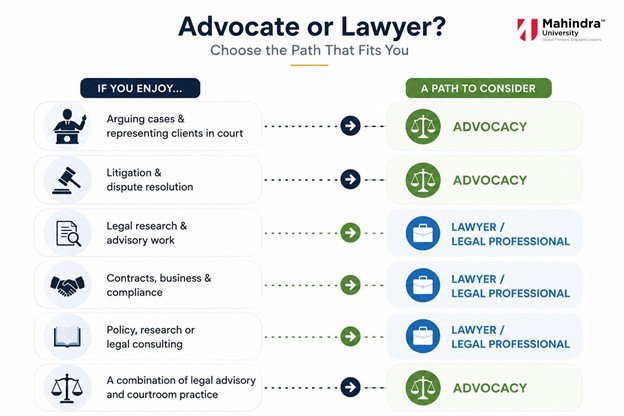
Before choosing your direction, consider:
- Do you want to appear before courts? If yes, the professional route towards advocacy becomes relevant.
- Do you prefer advisory or business-oriented legal work? A law degree can lead to several non-litigation roles.
- Do you enjoy arguments and dispute resolution? Litigation and advocacy may be a natural fit.
- Do you prefer research, drafting or policy? You can build a legal career without making courtroom practice the centre of your work.
There is no universally better choice. A lawyer and an advocate are part of the same legal profession, but their professional roles and authority to practise can differ. Understanding that distinction allows you to choose a direction based on the kind of legal work you actually want to do.
Find Your Legal Direction at Mahindra University’s School of Law
At Mahindra University’s School of Law, you are expected to go beyond the conventional concepts of legal education. In addition to a strong academic base, the learning process here involves practical exposure, an interdisciplinary approach and interaction with real legal problems.
You may attain all these qualities through-
- Moot Courts
- Legal Aid and Clinical Learning
- Research
- Interdisciplinary Studies
- Debates and Discussions
- Emerging Fields of Law
There are courses like B.A. LL.B. (Hons.), BBA LL.B. (Hons.) and B.Tech-LL.B. (Hons.) available at Mahindra University, which gives students scope to explore legal studies from a variety of academic angles. Such exposure would help students who have not chosen any particular field of specialisation in law yet to not only pursue what is in their interest, but also explore various options and gradually develop towards the career they want to take up.
Students are provided with not just an understanding of law, but also exposure and confidence to choose a place for themselves in law at Mahindra University’s School of Law.
Final verdict
By now, the difference should be pretty clear; a lawyer and an advocate are linked, but not necessarily synonyms when it comes to Indian law. An advocate is a lawyer who qualifies to practise law according to India’s regulatory laws.
The choice of careers takes things a step further. Do you enjoy arguing? Do you like negotiating? Do you enjoy investigation? Do you love advising? Do you like creating policies? Do you like working at the interface of law and technology? Your answers to these questions may say more about your future than the title of “Lawyer” or “Advocate”.
So, if you are ready to take up this challenge, you’ll find a suitable platform to apply your legal skills and knowledge at the Mahindra University School of Law. It’s time to make your legal journey unique; you get to write your own script. So, what are you waiting for? Apply now.
FAQs
Neither of them is better than the other, as the choice between the two solely lies in individual aspirations. Though an advocate may prove suitable for someone looking to become a lawyer in courtrooms, a graduate in law can explore various career options too.
While an advocate has the professional right to practice law through the Advocates Act and other rules, power is not something that distinguishes them from a lawyer.
This cannot be generalised since salaries depend on experience, specialisation, place of work, employer, clientele and practice areas.
No. While a lawyer is anyone trained in law, an advocate refers to a legal professional enrolled in the State roll.
Yes. A lawyer can become an advocate by completing the applicable professional requirements, including enrolment with a State Bar Council and fulfilling the requirements for the All India Bar Examination (AIBE) and Certificate of Practice.
Both lawyers and advocates have legal education and a strong understanding of laws and legal procedures. They can research legal matters, advise clients, draft legal documents and contracts and use legal reasoning to help resolve legal issues.
Completing an LLB alone does not automatically make you an advocate. To practise, you need to fulfil the applicable enrolment and professional requirements, including the AIBE requirements.
A law degree alone does not automatically authorise a person to practise before courts. Court representation requires the applicable professional enrolment and authorisation to practise as an advocate.
Neither is inherently more senior; “Lawyer” refers broadly to someone trained in law, while “advocate” refers to a lawyer who has fulfilled the requirements to practise before courts.
Court representation is governed by India’s legal framework. Under the Advocates Act, advocates are the recognised class entitled to practise law, subject to the Act and applicable rules.
No. An accredited law degree is needed to be enrolled as an advocate, as per the eligibility criteria of the Advocates Act and the Bar Council.
Neither is universally better. It depends on the type of legal work you want to pursue. Advocacy suits those interested in courtroom practice, while legal education can also lead to non-litigation roles.
An advocate is already a lawyer by legal education; advocacy is a professional status within the legal field. Eligibility and appointment requirements for becoming a judge depend on the specific judicial position and applicable rules.
Yes. An advocate is a lawyer who has fulfilled the applicable professional requirements to practise before courts. Therefore, an advocate is also a lawyer.