Published On: September 26, 2025 Many people provide you with the same answer when you ask them about “What can you do with a hospitality degree?” The answer is “work at a hotel”.
The hospitality industry is racing ahead as one of the world’s fastest-growing sectors. The World Travel & Tourism Council’s 2024 report highlights this momentum, predicting that by 2034 the sector will add around US$16 trillion to global GDP. That’s over 11% of the world’s economy, driven by nearly 30 billion tourist visits each year.
This remarkable trajectory highlighted that opportunities are everywhere!
You just need to know where your BBA Hospitality Management degree can take you. This programme is not like a general business degree; it amalgamates service-oriented expertise with management education. Students will explore diverse areas like finance, marketing, hotel operations, event planning and many more to thrive in this evolving industry.
Hospitality as a Degree of Global Opportunity and Career Growth
Hospitality today goes far beyond hotels and restaurants. It touches everything from luxury fashion houses and international airlines to destination events, wellness retreats and even technology-driven guest experiences.
That’s the answer to “Why choose a BBA Hospitality Management programme?”
In reality, BBA Hospitality course opens doors to a wide range of careers in-
Aviation and Airlines
Luxury Resorts and Cruises
Tourism Boards and Destination Marketing
Event Management
Real Estate and Corporate Services
Wellness and Sustainable Tourism
Hospitality Tech Start-ups
As we know that international travel and cultural exchange are growing, the demand for skilled managers is also rising.
Reasons that Make a BBA Hospitality Management Course Globally Valuable
What makes this programme stand out is the way it blends business know-how with hospitality training. You won’t just study finance and marketing- you’ll also dive into areas like customer experience, cross-cultural communication and leading teams in service-driven settings.
Here are some potential factors that make this degree globally valuable-
Service-centred mindset that trains you to lead with empathy, professionalism and customer focus
Develop business skills by combining operations, marketing, finance and strategy with hands-on learning
Cross-cultural awareness to work across borders
Experience-driven innovation that focuses on creativity in designing services, spaces and many more
Adaptability and problem-solving to thrive in a fast-changing industry
Global industry exposure through internships, study abroad as well as global connections
These things ensure a graduate is well-positioned to succeed anywhere.
Inside the Classroom- What You Will Learn
1. Core Business Foundations Every student will learn subjects like-
Financial accounting
Marketing strategies
Human resource management
Business operations
These subjects provide you with transferable skills that allow you to work in any industry. 2. Hospitality-Specific Modules You will also delve into-
Food and beverage management
Hotel operations
Tourism studies
Event and conference management
This ensures you will develop both managerial know-how and specialised expertise. 3. Experiential Learning The BBA Hospitality Management course emphasises “learning by doing.” The programme lets you work on live case studies, internships as well as simulation projects. Also, many universities have training partners and labs where students experience and practice in real-world environments.
Career Pathways with a BBA Hospitality Management Degree
After completion of your BBA Hospitality Management course, this degree offers you plenty of career opportunities. You will get the opportunity to work across a diverse range of areas- 1. Travel and Tourism Careers Graduates who are interested in building careers in the travel and tourism sector have several career pathways. Some of the popular options are-
Roles
Responsibility
Salary (Annually)
Destination Marketing Manager
Work on promoting countries or cities via partnerships and marketing campaigns
₹9L-₹17.8L
Travel Consultant
Creating high-end itineraries for solo travelers or corporate clients
₹2L-₹10L
Adventure Tourism Operator
Managing experiences like luxury safaris, private yacht charters or many more
₹4L-₹8L
2. Luxury and Lifestyle Brand Management As we know, high-end brands are investing in experience design to foster customer loyalty. So, here are some high-demand careers in luxury and lifestyle brand management for graduates-
Luxury Brand Manager who works on developing and executing marketing strategies for the brand’s identity. The salary range of a manager is 8LPA to 28 LPA.
Private Jet Concierge who is responsible for managing bespoke air travel, from in-flight amenities and ground transfers to security arrangements and last-minute itinerary changes for clients. The salary range is between ₹4L-₹16L per year.
Cruise Director organises and manages exclusive events and entertainment programmes on cruise ships to meet the demands of a global audience.
3. Technology Careers A report highlighted how digital service tools play a significant role in guest experience and satisfaction. Here are some emerging career roles for graduates-
Guest experience innovation manager to integrate technology in service models.
Hospitality data analyst for optimising loyalty programmes and service offerings.
Hospitality technology consultant who helps brands to implement guest-facing digital platforms.
Mahindra University’s Edge- A World-Class BBA Hospitality Management
You will discover the BBA Hospitality Management programme at Mahindra University that blends global exposure with practical learning. The course is designed with a curriculum that integrates business fundamentals, hospitality operations as well as service innovation. Not only this, students will gain expertise in finance, marketing, hotel operations, event management and tourism while developing leadership and cultural intelligence.
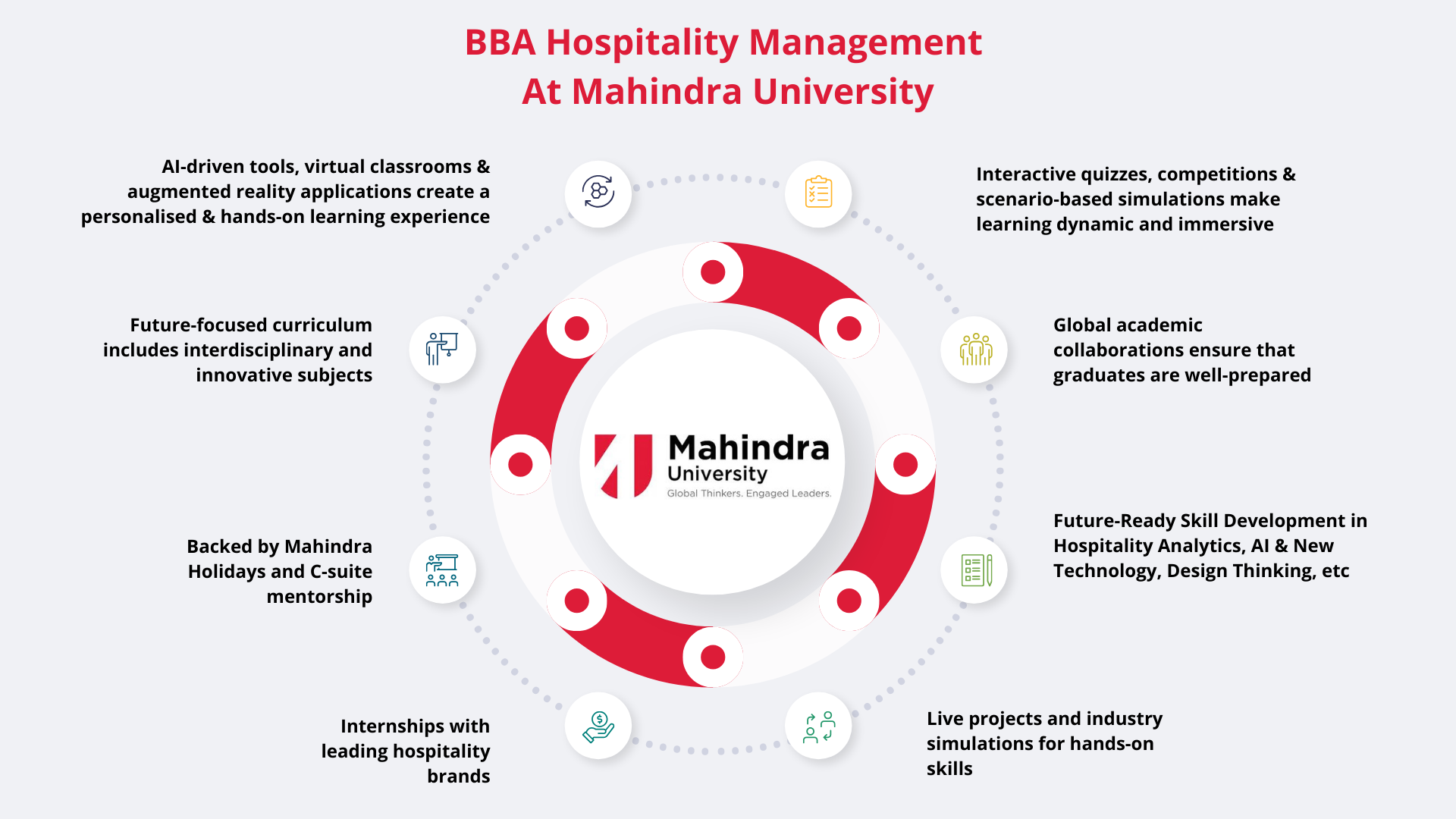
What sets Mahindra University apart is-
The BBA Hospitality Management course at Mahindra University opens a gateway towards global opportunities to build impactful careers in an evolving industry.
Synopsis
Now, it’s clear that pursuing a BBA Hospitality Management programme means mastering the art of service and leadership in a global context. The course will provide you with classroom learning as well as concierge-level expertise that prepares you to manage, innovate and thrive in this industry. If you are an aspiring candidate who wants to gain global opportunities, this programme is suitable for you.
Take your first step toward your dream by applying for BBA Hospitality Management at Mahindra University. This is where you shape unforgettable experiences and lead the service economy with the course that blends business with cultural fluency.
FAQs
Who can apply for BBA Hospitality Management course? You can apply for this programme at Mahindra University if you have completed 10+2 or equivalent from a recognised board with a minimum of 80% marks. You have to qualify for the NCHMCT JEE or MUHET entrance exam.
Why is BBA Hospitality Management ideal for global opportunities? Some potential factors that make it globally valuable are service-centred mindset, business skills, cross-cultural awareness, experience-driven innovation, adaptability and global industry exposure.
What career pathways does BBA Hospitality Management lead to? You will get a wide range of career opportunities across areas- Travel and Tourism, Luxury and Lifestyle Brand Management and Technology.
Published On: September 22, 2025 In a world shaped by algorithms, interfaces and invisible systems, it is design that shapes our experiences. Design is everywhere, and it is no longer just about posters and Photoshop. It has a strong presence in UI/UX, web design, app design, simulation models and more.
And yet, even today, design education remains trapped in a fog of misunderstanding. Across households, classrooms and career counselling sessions, deep-rooted myths still persist:
It is only for those who can draw.
It leads only to fashion or interior careers.
It lacks structure, rigour, or relevance in a job-driven world.
You can “learn it all online” only.
The myths around design schools are holding back curious, capable students.
In this blog, we unpack these myths. Not with vague counterpoints, but with clarity, depth and real-world relevance. We’ll explore what design education actually involves and what structured programmes like the B.Des in Design Innovation and M.Des course offer.
Only Naturally Gifted People Can Succeed in Design
Myth: You must be born with artistic talent to become a designer.
Reality: Design is taught, not inherited.
Design isn’t about whether you can sketch a perfect apple. It’s about how you solve problems with systems thinking and creative logic.
Formal education, like a B.Des in Design Innovation, starts with the basics.
You’re taught how to see, not just how to draw, you learn how colour affects behaviour and understand user journeys, not just interfaces.
You don’t need to be a prodigy. You need to be curious and creative.
Drawing is the Core Requirement to Study or Practice Design
Myth: If you don’t know drawing, you can’t design.
Reality: Drawing helps, but it’s not a dealbreaker every time.
In the design work, you will use many tools such as:
Figma
Blender
Adobe Creative Cloud
Canva
Rhino
These tools are here to convert your idea and creativity into a design masterpiece. Your ideas matter more than the lines you can draw on a sheet. You could design a public transport system without sketching a single seat; what matters is how people experience it.
This is exactly why B.Des in Design Innovation now focuses on design research, user behaviour and strategic thinking. You collaborate, model, prototype and pitch – not just draw.
Drawing helps you visualise. But design asks: Can you think clearly and express it in form, flow or function? If the answer is yes, then you can go for design courses.
Design School is All About Learning Software and Aesthetics
Myth: Design school teaches you how to use tools, make things pretty and send them off.
Reality: Software is a small part of what you’ll actually learn.
If you think a design degree is about learning Photoshop, you’re being sold short. Good design schools are studios for critical thinking.
In a structured B.Des in Design Innovation, you’ll study:
Design ethics and social impact
Visual communication theory
Semiotics and user psychology
Systems design and service flows
Real-world projects with industry mentors
A 4-Year B.Des Program is Too Long and Outdated
Myth: Four years is too long. You can learn design from YouTube in six months.
Reality: Design maturity takes time, and that time shapes your edge.
There’s a reason every global design school follows a 3 to 4-year degree model. You need time to build:
Conceptual clarity
Collaborative skills
Iterative thinking
Research capabilities
A strong, strategic portfolio
In the B.Des in Design Innovation course:
Year 1 builds fundamentals.
Year 2 explores tools and contexts.
Year 3 introduces real-world briefs.
Year 4 is where you define your design voice and solve real industry problems.
A 10-hour crash course or weekend bootcamp cannot teach that.
What You Learn in a Design Degree vs. a Short Course
Focus Area
B.Des in Design Innovation / M.Des Course
Short-Term Design Courses
Foundations of Design
Yes (History, Theory, Context)
No or Minimal
Practical Software Skills
Yes (Industry-ready tools)
Yes
Strategic Design Thinking
Yes
No
Research & User Studies
Yes
Rare
Long-term Mentoring
Yes
No
Portfolio with Depth
Yes
Often template-based
Industry Projects & Internships
Yes
Rare
Career Path Mapping
Yes
No
Design Equals Fashion or Interior Design – Nothing More
Myth: Design is only about designing dresses or making a decorative layout of a living room.
Reality: Design is everywhere, and it touches almost every industry.
This narrow view of design is common. Fashion and interiors are well-known, visible and often used as shorthand for “design.”
But the field is much bigger and more influential. Design now covers more than 20+ specialisations. Some key areas that students explore include:
Design Domain
Applications
UX/UI Design
App flows, website interfaces, wearable tech
Product Design
Consumer goods, packaging, industrial systems
Interaction Design
AR/VR, AI-based interfaces, voice design
Strategic Design
Innovation consulting, business transformation
Service Design
User journey mapping, policy design
Motion & Animation Design
Film graphics, gaming, advertising
Every major sector, health, education, mobility, finance, governance, etc, requires design input. Not just logos or layouts, but deep thinking on how people interact with systems and solutions.
When you choose a formal design path like a B.Des in Design Innovation, you step into a growing, global network of skills that industries actively recruit for.
A Degree in Design is Not Valued by Employers
Myth: Recruiters only care about your portfolio, not your degree.
Reality: Employers care about both: degree & portfolio, and your education gives you a sharp edge there.
A good portfolio gets attention, and a strong degree builds trust. Most design-led companies look for:
Critical reasoning
User-centric thinking
Collaborative skills
Research-informed decisions
Recruiters today are also looking for:
Exposure to interdisciplinary teams
Familiarity with design ethics and inclusive design
Long-term thinking, not just visual style
You build these in a structured design programme, not in isolation.
Self-Taught Designers Have the Same Opportunities as Graduates
Myth: Online learning tutorials and self-study resources can replace design school.
Reality: Self-learning builds skill, but design school builds depth, process and perspective.
There’s no doubt that you can learn tools on your own. Plenty of self-taught designers make beautiful work. But when it comes to strategy, systems and long-term growth, structured design education gives you more than just skills.
Here’s what often lacks in self-study:
Peer critiques that sharpen your thinking
Exposure to real client needs and constraints
Mentoring from professionals who’ve led projects at scale
Frameworks for ethical decision-making
Understanding design in social, political and cultural contexts
You can always start by teaching yourself. But if you want to build a career, formal education gives you the rigour and recognition that short paths can’t match.
Design is a Risky Career Path
Myth: Designing has very limited opportunities and cannot be picked as a career.
Reality: Designers are required in many industries for different roles, and opportunities are just rising.
Many people consider design a side hobby and not a career field. They worry about financial security, job prospects and public recognition. This fear isn’t irrational, but it’s built on years of limited access, few examples and unclear career paths.
But things have changed. India now has a booming design economy.
Design Role
Industries Hiring
UX Designer
Tech, E-commerce, Healthcare
Service Designer
Government, NGOs, Public Policy
Graphic Designer
Digital Marketing, Tech, Media
Product Designer
Startups, FMCG, Manufacturing
Design Strategist
Consulting, Finance, Education
Interaction Designer
Media, Gaming, Virtual Reality
Design is not an “arts and crafts” career. It’s a future-proof path with real outcomes. And formal degrees help you navigate it with purpose and credibility.
Top Professional Courses for Design Enthusiasts
If you want to build a career in design, there are undergraduate courses and post-graduate courses available:
Des in Design Innovation
Des course
Both courses are built to challenge outdated thinking.
B.Des in Design Innovation gives you:
A multi-disciplinary foundation in visual, digital and physical design
Access to live industry problems from year two
Studio-based learning where process matters as much as the final product
Exposure to systems design, sustainability and design ethics
M.Des courses take it further with:
Specialisations like interaction design
Immersive fieldwork and collaboration
Design for scale, inclusion and long-term impact
Thought leadership through critical writing, publishing or exhibitions
Design is never about just making; it’s about thinking, testing, changing and making again.
Apply Ideas to the Real World – Start Your Design Career at Mahindra University
Choosing where to study design isn’t just about picking a college; it’s about selecting a space that shapes your ability to think, innovate and lead through design. Not every programme is built to equip you for the realities of today’s design roles or the demands of tomorrow’s. This is where Mahindra University shines among the rest.
The B.Des in Design Innovation and M.Des course at Mahindra University are shaped by the belief that design is more than craft; it’s a way to improve systems, rethink industries and create meaningful change.
Here, design education doesn’t sit in a silo. It works across disciplines, with engineering, business and public policy, just as you would in the real world.
International faculty roster, global exposure and research focus, contemporary and updated curricula and an MoU with Pinnifarina Design for a joint M.Des programme make Mahindra University an ideal place for the new generation of design leaders and innovators.
Conclusion
Design is not what most people think it is. It’s not just drawing, not only for artists and certainly not a fallback option. Whether you want to improve user experiences, drive business strategy, or design for social change, structured programmes offer clarity, credibility and long-term value.
Formal programmes like the B.Des in Design Innovation or the M.Des course offer a structured learning path, mentorship from experts, real-world exposure and more.
If you are keen on making design your profession and not merely as a skill, then Mahindra University is the place which realises your aspirations and is capable of mentoring and skilling you.
Apply now. Design what matters. Lead what’s next.
FAQ
Is the design field growing in India? Yes. Design is expanding across sectors. With more government, private and global opportunities, it’s one of the most versatile career paths today.
Can I get a job after a design degree? Yes. Design graduates work in tech, healthcare, education, marketing and other sectors. Your degree opens doors to UX, product design, strategy, research and leadership roles.
Do I need to know drawing to join design school? No, drawing helps, but design schools focus on problem-solving, creativity, and systems thinking.
Published On: September 22, 2025
The media is considered the fourth pillar of democracy. Yes, it is seen as being on par with the Legislature, the Executive and the Judiciary, serving as a vigilant watcher over all three. And, to be precise, it has played its vital role in several incidents of the past and has proved its mettle. With its constant presence, the media has not just performed a duty, but has carried a responsibility, shaping democracy itself.
The role and importance of the media have never changed. What has changed over time is the way the media function. For over a few decades or centuries, Print Media was the only form of media. But in the 20th century, when radio reached the general public, the media found a human voice for the first time. Very quickly, it took a long leap forward and reached the television screen.
However, the biggest transformation in the world of media began with the arrival of the Internet age. With the internet came a new form of media that we now call Digital Media. Through online websites, apps and platforms like YouTube, its influence grew rapidly, and today it reaches a massive consumer base with great ease.
With the rise of digital media, many old misconceptions were broken. The skills, including technical and news reporting, required to work in media have changed significantly. Let us now understand how you should prepare yourself to have a career in the new media era.
Media is Not About News Reporting Anymore
What were the traditional job roles in the media?
In Print Media Era
Journalists / Reporters
Editors
Photographers / Photojournalists
Columnists / Critics
Printers / Press Operators
Advertising & Sales Executives
Roles Emerged with Radio & Television
Radio Presenters / RJs (Radio Jockeys)
News Anchors (TV)
Producers (Radio & TV)
Camerapersons
Video Editors
Sound Engineers & Broadcast Technicians
Scriptwriters
Traditionally, these roles required a core understanding of Journalism and Mass Communication. And, very rarely, any technical skill was needed.
But with the rise of digital media, the landscape is changing very fast. AI, VR/AR, XR, etc, technologies are making their way at a very fast pace. This is where the traditional media courses start lacking. They are centred around the principles of Mass Communication.
The new media requires people who have both: Knowledge of Journalism and Technical Abilities. This is where the B.Tech. Computation and Media stand out.
What is B.Tech. Computation and Media (BTCM)?
B.Tech. Computation and Media (BTCM) is a four-year multidisciplinary degree that includes courses in Computer Science, Humanities and Social Sciences, Journalism and Mass Communication and general engineering. It teaches students to be engineers capable of entering the news, entertainment and user media businesses, as well as other connected industries, with the necessary skills and competencies for the use of these new technologies.
How B.Tech. Computation and Media Prepare for Jobs in Emerging Media
The B.Tech. Computation and Media programme equips students with the technical foundation in computing, with creative and critical thinking skills. The complete syllabus of this programme is designed by integrating the concepts of Digital Media and Communication and Computer Science and Engineering.
In the B.Tech. Computation and Media course, students learn to:
Do immersive storytelling with the help of AR, VR and XR.
Use Data Visualisation, AI and automation for producing personalised content, analysing audience data and combating misinformation.
Use technology for new forms of expression and communication, such as interactive and personalised narratives.
Handle issues related to misinformation and media integrity in the digital age.
What are the Job Opportunities for B.Tech. Computation and Media Graduates?
All students pursue a course in the hopes that they will be able to access enough job opportunities across a range of different sectors. It is, therefore, necessary to discuss which career fields students can enter upon completing this course:
News & Journalism
Immersive Journalist / XR Journalist
Data Journalist
Broadcast Technologist
Ethical Media Analyst
Entertainment & Film Production
Film & Media Technologist
360° Video / VR Filmmaker
Interactive Storytelling Designer
Gaming & User-Media Industry
Game Designer / Developer
XR/VR Game Producer
Gamification Specialist
Graphics & Animation Expert
Advertising & Strategic Communication
Advertising Technologist
AR/VR Communication Specialist
Creative Technologist
These are some of the career roles you can pursue after doing the B.Tech. Computation and Media programme.
Turn Your Media Career Dreams into Reality with B.Tech. Computation and Media Programme at Mahindra University
Mahindra University, with its quality education, advanced infrastructure and world-class faculty, has established itself as a premier educational university in India.
Taking a move forward, the School of Digital Media and Communication has designed a 4-year B.Tech. Computation and Media programme which combines Computer Science, Humanities and Social Sciences, Journalism and Mass Communication and general engineering in a single interdisciplinary course.
The goals of this programme at Mahindra University are:
Utilising emerging technology to be more interactive, personalised and diverse in the media world.
Produce a trained, technically sound storyteller who also understands the core of Media and Communication.
Equip students with the skillsets to work in an evolving environment of the policies, technologies and media roles.
If you are someone who wants to study media but with a technical lens, then B.Tech. Computation and Media at Mahindra University is the best way forward.
Conclusion
As the world of media is changing continuously, the in-demand skills and kinds of jobs available in the market are also changing to a greater degree in comparison to traditional norms. To equip yourself with the new-age media tools, expertise and be a perfect fit in the emerging roles in the media, B.Tech. Computation and Media is the ideal course you can pursue.
The programme is designed to equip you with the core understanding of Media Communication and technical skills like AR, VR, XR, etc. After completing the programme, you will be ready to work in multiple roles across sectors like News & Journalism, Entertainment & Film Production, Gaming & User-Media Industry, Advertising & Strategic Communication, etc.
Mahindra University offers this unique B.Tech. Computation and Media course and the admissions are open. Apply now before the seats get filled.
FAQs
What is the total duration of B.Tech. Computation and Media programme? The B.Tech. Computation and Media is a 4-year course, divided into 8 semesters.
What are the subjects in B.Tech. Computation and Media? The programme includes subjects like French, Data Structures, Object Oriented Programming, Computer Graphics, DBMS, Media Psychology, Augmented, Virtual & Extended Reality, etc.
Can I do a start-up in media after doing the BTCM course? The BTMC programme equips you with technical skills in computer science and core knowledge of media communications, making you a perfect fit to start and successfully run a new venture in this domain.
Published On: September 3, 2025 Computer Science Engineering remains highly relevant today due to its central role in driving technological advancement. It plays a crucial part in the digital transformation of industries and offers students a wide range of career opportunities.
The field goes beyond just computers—it branches into core areas shaping the future, such as programming, artificial intelligence, software development, and cybersecurity. This versatility opens the door to high-paying roles and diverse career paths.
Among these emerging fields, the Internet of Things (IoT) stands out as a transformative development. It refers to a network of connected devices embedded with software, sensors, and technologies that enable them to share and exchange data. Within computer science engineering, IoT is seen as a groundbreaking force that continues to simplify daily life and enhance the way we interact with technology.
The Internet of Things (IoT) refers to a network of physical objects equipped with sensors, software, and other technologies that allow them to collect and exchange data over the internet. These objects can range from everyday household items to complex industrial machines.
An IoT system typically consists of four key components:
Sensors/Devices – These capture real-time data from the surrounding environment.
Connectivity – The collected data is transmitted to the cloud using networks such as Wi-Fi, Bluetooth, 5G, or LPWAN.
Data Processing – Once the data reaches the cloud, it is processed and analyzed.
User Interface – The processed data is then presented to the user in a clear and actionable format
History of Internet of Things (IoT)
The history of the Internet of Things (IoT) dates back several decades, rooted in early developments in networking and embedded systems. One of the first known IoT devices was a toaster connected to the internet in 1990, built by John Romkey. However, the term “Internet of Things” wasn’t coined until 1999 by Kevin Ashton, who envisioned a world where everyday objects could communicate through the internet using sensors.
Throughout the 2000s, as wireless technology, cloud computing, and mobile devices advanced, the idea began to gain traction.
By the early 2010s, IoT had entered mainstream use, with smart home devices, fitness trackers, and industrial applications becoming increasingly common. Today, with the rise of 5G and AI, IoT has become a key part of sectors ranging from healthcare and transportation to agriculture and urban planning, quietly transforming the way people live and work.
How IoT Expands the Scope of Computer Science Engineering
The Internet of Things (IoT) has significantly broadened the application of computer science across multiple domains. By integrating physical systems with digital technologies, IoT creates the need for a multidisciplinary approach, combining hardware, software, and data science expertise.
Embedded Systems and Real-Time Computing Embedded systems are the backbone of IoT devices. Computer science professionals design firmware and low-level code to manage sensors and microcontrollers. These systems must often meet strict real-time requirements, where delays in processing can lead to system failure. As a result, real-time operating systems (RTOS) have become a vital focus area in IoT development.
Networking and Communication Protocols Reliable and efficient communication is crucial for IoT devices, especially in low-power, constrained environments. Traditional internet protocols like TCP/IP are often too heavy for such use cases. This has led to the development and adoption of lightweight protocols such as MQTT (Message Queuing Telemetry Transport) and CoAP (Constrained Application Protocol). Computer scientists continue to work on optimizing routing algorithms, reducing latency, and managing bandwidth for large-scale IoT networks.
Cloud and Edge Computing The massive data output from IoT devices requires robust processing and storage solutions. Cloud computing provides scalable infrastructure for handling this data, but for latency-sensitive tasks—like those in autonomous vehicles or factory automation—edge computing is becoming increasingly important. Here, data is processed closer to the source. Computer science plays a critical role in designing algorithms for resource management, load balancing, and real-time data handling at the edge.
Artificial Intelligence and Machine Learning IoT data feeds directly into AI and machine learning systems, offering valuable insights and automation capabilities. From smart thermostats that adapt to user behavior to predictive maintenance in industrial settings, these applications rely on real-time sensor data. Computer scientists are now focused on developing lightweight AI models, known as TinyML, that can run directly on resource-constrained IoT devices.
Cybersecurity and Data Privacy With billions of interconnected devices, security in IoT is a top priority. The expanded attack surface makes systems more vulnerable to threats. Computer science contributes to developing secure communication protocols, encryption standards, and real-time threat detection. Privacy-focused solutions like differential privacy and secure multiparty computation are also being implemented to safeguard user data.
Data Science and Big Data Analytics IoT is a major driver of the big data revolution. The continuous stream of data generated by devices must be processed, analyzed, and stored efficiently. Computer scientists are building systems that support real-time analytics, distributed computing, and the use of NoSQL databases to handle unstructured data. The focus is not just on storing data, but on extracting meaningful insights to guide decision-making.
Software Development and Middleware Developing scalable and interoperable IoT applications requires new approaches to software engineering. Middleware platforms like Node-RED and AWS IoT Core simplify the integration of hardware, software, and data layers. Computer scientists design these platforms to manage device discovery, data aggregation, and remote device management, streamlining the development process.
Simulation and Modeling Before deployment, IoT systems must be tested for performance, efficiency, and resilience. Simulations using tools like Cooja (for Contiki OS) and NS-3 help model device behavior, energy consumption, and network traffic. These tools are essential for optimizing deployments and ensuring reliable operation in real-world conditions.
Real-World Applications of IoT in Computer Science
Smart Cities IoT technology is reshaping urban infrastructure with smart traffic management, energy-efficient lighting, and automated waste collection. Computer science enables the integration of sensor data, GIS systems, and real-time route optimization, while ensuring secure and scalable data flow.
Healthcare IoT in healthcare supports remote patient monitoring, smart diagnostics, and emergency alert systems. Computer scientists develop systems that ensure secure data collection and transmission, often integrating AI for anomaly detection and medical image analysis.
Agriculture Precision agriculture uses IoT devices like soil sensors and automated irrigation to increase yield and sustainability. Computer science plays a vital role in developing decision support systems and control algorithms that guide data-driven farming.
Industrial IoT (IIoT) Manufacturing is being transformed by IoT through automation, predictive maintenance, and energy optimization. Real-time control systems, AI algorithms, and secure device integration—designed by computer scientists—are central to the success of smart factories.
For students of Computer Science and Engineering (CSE), IoT is not just an emerging trend but a powerful opportunity to design the future.
At its core, CSE provides the strong foundation needed to build and innovate in IoT. Programming, data structures, operating systems, and networks form the technical backbone. When these fundamentals are combined with IoT-focused knowledge, students learn how sensors, software, and hardware can work together to solve real-world problems. For example, a student skilled in coding and algorithms can design applications where smart sensors monitor air quality or optimize energy use in buildings.
What makes IoT so exciting for CSE graduates is its multidisciplinary nature. It draws not only from computing, but also from electronics, communication systems, and even data science. A university that offers IoT as part of its CSE curriculum gives students the chance to explore this convergence. Through specialized courses, projects, and labs, they can learn how to design embedded systems, manage real-time data streams, and apply machine learning models to connected devices.
To conclude, IoT is not just a technological trend—it’s a defining force in the evolution of computer science. From edge computing and machine learning to cybersecurity and simulation, IoT has expanded the horizon for engineers and developers, creating new challenges and countless opportunities across industries.
Published On: September 3, 2025 In today’s fast-paced world, media is everywhere—on our phones, televisions, laptops, and even our watches. Whether it’s a breaking news alert, a trending hashtag, or a podcast episode, the media shapes the way we see the world and each other. With this powerful influence comes a serious responsibility, and that’s where media ethics steps in.
What is Media Ethics?
Media ethics refers to the principles and standards that guide journalists, content creators, broadcasters, and other media professionals in their work. It covers areas like truthfulness, fairness, accuracy, respect for privacy, accountability, and avoiding harm. In simple terms, media ethics is about doing the right thing when creating and sharing information.
Think of it as a moral compass for those who create content that reaches the public. Just as doctors follow a code of ethics to “do no harm,” media professionals are expected to act with integrity and responsibility because what they publish can have real-world consequences.
Why is Media Ethics Important?
The media is often called the “fourth estate” because of its power to influence public opinion and hold those in power accountable. This makes ethical behavior essential. Here’s why:
Public Trust: People rely on the media for accurate information to make decisions—about voting, public health, social issues, and more. If the media is dishonest or biased, trust is lost, and misinformation spreads. Ethical journalism builds and maintains public trust.
Preventing Harm: Irresponsible media coverage can lead to real harm. For example, publishing unverified rumors during a crisis can cause panic or damage to their reputation. Ethical standards help avoid these outcomes.
Respect for Rights: Ethical media practices protect individuals’ rights, such as their right to privacy or to be presumed innocent until proven guilty. Sensational stories might grab attention, but they can also cross the line into exploitation.
Democracy and Accountability: In democratic societies, a free press plays a vital role in checking power and promoting transparency. But freedom without ethics can lead to abuse. Ethics ensure that freedom of the press doesn’t become freedom to harm or mislead.
Why Media Ethics is More Relevant Now Than Ever
Today, media ethics isn’t just for journalists or traditional newsrooms. Anyone with a smartphone can be a “citizen journalist” or content creator. With platforms like X (formerly Twitter), YouTube, and Instagram, the power to inform or misinform is in nearly everyone’s hands. This shift makes ethical media behavior more important—and more complicated—than ever.
Here are some key reasons media ethics matters so much today:
The Rise of Misinformation and “Fake News” We’re living in an age of information overload. While this has made knowledge more accessible, it’s also opened the floodgates to misinformation. During the COVID-19 pandemic, for instance, false claims about vaccines, masks, and treatments spread rapidly across social media, sometimes faster than the truth. Ethical media practice demands fact-checking and responsible reporting, especially in life-or-death situations.
AI and Deepfakes With advancements in artificial intelligence, creating realistic but fake audio and video content—known as deepfakes—is easier than ever. These can be used to manipulate public opinion, smear individuals, or spread disinformation. Ethics in media must now evolve to tackle these new threats and ensure authenticity.
Cancel Culture and Online Shaming Media, especially social media, can become a tool for public shaming. Sometimes this is used to hold people accountable, but other times it spirals into harassment or punishment without due process. Ethical guidelines help media practitioners—and everyday users—navigate the line between necessary critique and online mob behavior.
Coverage of Sensitive Issues From war and terrorism to gender identity and mental health, media plays a huge role in shaping public understanding of sensitive topics. Ethical media reporting can humanize victims, give voice to the unheard, and educate the public. Unethical coverage can reinforce stereotypes, create panic, or worsen trauma.
Diversity and Representation Ethical media must also consider who is being represented and how. Are stories being told from a single perspective? Are certain voices being excluded? Ethical storytelling demands diversity, inclusiveness, and fair representation.
Real-World Examples
George Floyd’s death (2020): The viral video of a police officer kneeling on Floyd’s neck was shared widely, sparking global protests against racial injustice. While the footage was graphic, its ethical publication helped expose systemic issues. However, many media outlets also had to consider how to share such content respectfully.
Migrant Crisis Coverage: Photos of drowned refugee children, like Alan Kurdi, were shared by media around the world. Some argued these images were necessary to show the human cost of the crisis, while others said they were exploitative. Ethical questions about dignity, consent, and purpose were central to the debate.
What Can You Do?
Verify before sharing: Check if something is true before reposting it.
Be respectful: Don’t share content that invades someone’s privacy or spreads hate.
Think critically: Question what you see and read—who made it, and why?
Support ethical journalism: Follow and fund trustworthy news sources.
Journalists today are more than storytellers—they carry the responsibility of safeguarding truth. To do this well, they must be grounded in both ethical principles and legal frameworks. A course like Media Ethics and Law in a BA in Journalism and Mass Communication helps students tackle real-world dilemmas, from balancing free expression with hate speech to weighing public interest against individual rights.
Final Thoughts
Media ethics is not just a set of rules—it’s a mindset. It’s about being aware of the impact your words, images, and choices can have on others. In an age where “going viral” can happen to anyone, understanding media ethics is no longer optional. It’s essential.
By engaging with media critically and ethically, we can all contribute to a more informed, respectful, and just society.
Published On: August 26, 2025 Long road to your MBA seat- Why the journey feels like a Marathon!
Securing a seat in an MBA programme often feels like you are running in a marathon. As the demand is continuously increasing in India as well as globally, the competition has never been challenging. But the scenario has completely changed. How?
Business schools are not attracted towards candidates who just want to climb corporate ladders. They want applicants, including budding entrepreneurs, career switchers and professionals who want international exposure.
This clearly explains why the road to MBA admission feels overwhelming.
The journey includes months of preparation, multiple exam attempts, honest essays, interviews that test confidence and a silent waiting period. Here, this guide provides you with ease. It breaks the MBA admission journey into clear and manageable stages, offering practical insights for a seamless procedure!
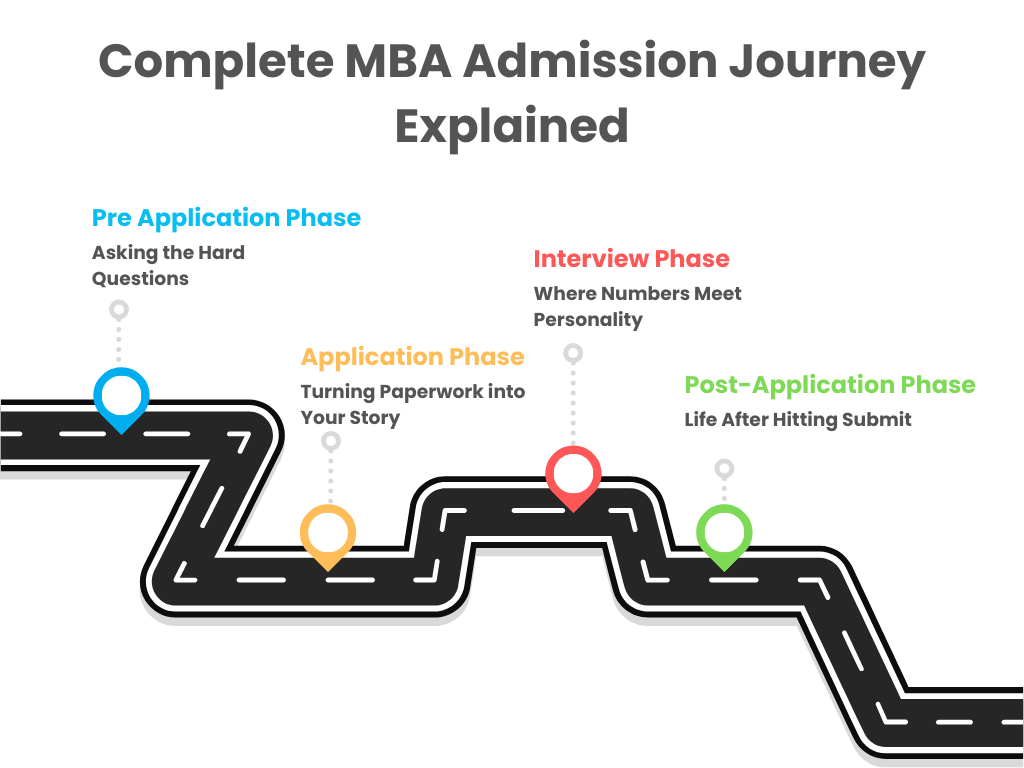
Pre Application Phase- Asking the Hard Questions
Is an MBA the Right Move for You? Before starting your application process, pause and ask. Do you select an MBA for your next career move or are you just following the crowd? Without clarity, the best programme cannot deliver its intended value. Pick Your Exam Path Make sure to choose the exam type which reflects both your target schools and strengths.
CAT- perfect for those who focus on Indian institutes
GMAT or GRE- ideal for international or globally-oriented courses
Do You Need a Language Test? TOEFL or IELTS language tests are mandatory for admission to global programmes. You can prepare for these exams that help you sharpen your communication skills.
Application Phase- Turning Paperwork into Your Story
Shortlisting Universities- Fit Vs. Prestige Finalising business school should not rely on rankings. You should think about curriculum, learning approach, placements and industry connections. A well-matched course will deliver you better outcomes. Craft Your Personal Brand Across Documents MBA admission committees value consistency. It is important to make sure your CV, essays and interview answers reflect who you are, what you value and where you aim to go. Letters of Recommendation- Pick the Right Ones Select mentors and managers who have seen your work first-hand. As we know, a heartfelt endorsement influences better than a letter with a big title. Must-Have Documents Before You Hit Submit Below is the list of essential documents for MBA admission-
Academic transcripts
Test scorecards
Proof of work experience
Identity documents
Certificates from key extracurricular activities
Essay That Work- Authenticity, Vision and Clarity In your essay, you should represent your real motivations, like your challenges, what you learned from them and how they shaped your career objectives. Application Portals- Pay Attention to Details Cross-check all the basic details before submission. A missing date or a late submission can weaken your MBA admission application.
Quick Recap for MBA Admission Checklist
Element
Why It Matters
Test Scores
Show academic readiness
Essays
Reveal motivation and clarity
Recommendations
Validate strengths externally
Documents
Back up every claim
CV
Present achievements on one page
Interview Phase- Where Numbers Meet Personality
After shortlisting, you can expect an interview round soon. That’s why it’s crucial to prepare well before the call arrives. Beneath are some crucial things you can do-
Common Questions- Be ready for commonly asked questions, such as “Why MBA?” or “Tell me about yourself”
Body Language- Show confidence in your posture and during eye contact
Handling Curveballs- Stay calm for an unexpected question or scenario
Post-Application Phase- Life After Hitting Submit
Waitlist Dilemma- Wait or Hold? Sometimes students think waitlist means rejection, but it’s not true. It means the university needs more clarity- you can share your achievements or certifications. Offer Letters & Deposits- Deadlines to Track If you are selected, pay your deposit to confirm your seat. Missing a deadline can be quite expensive for you. Scholarships & Negotiations- What’s Possible and What’s Not Many universities provide scholarships, but the criteria are not the same everywhere. So, make sure you check and review all the things.
Common Mistakes Every Applicant Makes During MBA Admission
There are some common mistakes that every student makes all the time. It will directly affect your MBA admission. So, it’s important to know how you can avoid them-
Don’t submit the same essay to multiple business schools without tailoring it
Never select leading recommenders who barely know you
Missing minor deadlines
Don’t over-rehearse, as it sounds robotic during an interview
Avoiding communication skills
MBA Admission Trends 2025- How the Game is Changing
Candidates who are going to begin the MBA admission procedure should be aware of these popular trends in 2025. Below, we mention some essential ones-
Profiles Over Percentiles
Video Essays & AI Filters
Global Orientation of Indian MBAs
Sustainability & Social Impact
Flexible Entry Paths
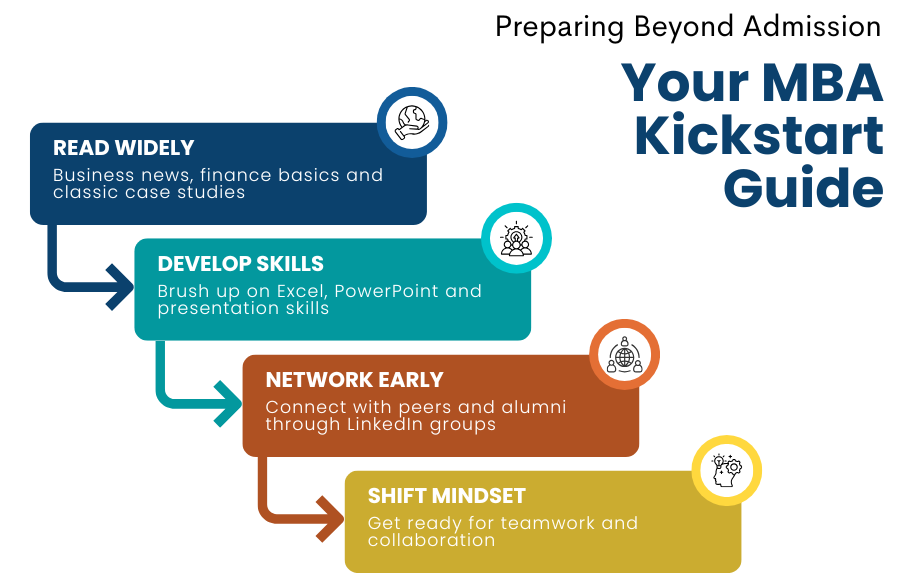
Preparing Beyond Admission- Your MBA Kickstart Guide
MBA Admission at Mahindra University – The Edge Every Student Looks For
Selecting the MBA is not just joining a business school- it’s all about securing the right platform for your successful future. Mahindra University provides an MBA programme designed for learners who desire more than a degree. It helps students to gain global exposure, industry-driven skills and confidence to lead.
Why you should choose Mahindra University’s MBA-
Future-ready curriculum with a focus on digital business, sustainability and leadership
Global immersion programme across various regions
Industry integration via case studies, simulations and partnerships
Career support, such as internships, CV building workshops and mock interview sessions
Proven outcomes with the highest package of 16 LPA
Mahindra University ensures that the student experience is beyond academics. This transformative journey helps every learner to develop networks, enhances leadership skills and experiences global exposure.
Synopsis
Instead of seeing an MBA admission as a hurdle, consider it your first learning experience. This will help you learn to manage time, prioritise tasks and present with clarity. Every step from exam preparation to interviews develops the discipline you will require in this programme.
If you want to take your first step in the MBA admission process, start exploring the programme at Mahindra University. This is the place where you begin your leadership journey with its global exposure, industry-driven curriculum and strong career excellence. Apply now!
Frequently Asked Questions
What is the process of MBA admission? You can break it down into four steps- pre-application phase, application phase, interview phase and post-application phase.
What are important documents required for MBA admission? These are crucial documents that you must have- academic transcripts, test scorecards, proof of work experience, identity documents and certificates from key extracurricular activities.
How can I prepare for MBA admission interview round? You should prepare these three essential things that will pass your interview session. It includes common questions, preparation, body language and staying calm.
Published On: August 26, 2025 Why do some students turn into startup founders while others wait for job offers? What changes in mindset, education or opportunity push one toward building instead of applying?
This question matters not just for career choices, but for shaping economies.
In India, the youth are not just a demographic detail. They are the engine of growth. More than half the population is under 25. That’s not just a number. It’s a wave of energy, ideas and ambition waiting to be channelled.
A generation ago, the goal was simple: get a stable job. For the young people of this new generation, that goal no longer seems a worthy achievement. They want to take chances and create their own endeavours. So, the real question is: how do you turn your business idea into a real company before 25?
This is where BBA Entrepreneurship makes its mark. It does not just prepare one to pass exams or clear interviews. It helps one shape ideas into real ventures.
This article walks through how structured learning and the right mindset can turn students into founders. Not someday but now!
From Dreaming Careers to Designing Companies
A few decades back, ambition meant a good government job or a multinational name on a CV.
Today, ambition wears a different look. It means building something that others want to work for.
That’s not a trend. That’s a shift.
In India, startups like OYO, Ola, Zerodha, etc didn’t wait for their founders to hit 30. These ventures were started by students or fresh graduates. What changed? The answer is structured knowledge, early exposure and the courage to build.
The BBA Entrepreneurship programme reframes college from being a pitstop before employment to a launchpad for venture creation. Here’s what that shift looks like in action:
Traditional Path: Degree → Job Hunt → Salary
Entrepreneurial Path: Degree → Idea Building → Team Creation → Business Launch
This shift demands a new way to look at higher education.
For high school students today, the university isn’t just a degree provider. It’s the first real testbed for their ideas. Choosing a BBA Entrepreneurship programme puts one right in the middle of that action.
The Power of Youth: Why Fresh Ideas Beat Old Playbooks
People often say, “Experience matters.” It does. But not always in innovation.
Some of the most disruptive ideas don’t come from those with decades of experience. They come from those who ask, “Why are we still doing it this way?”
That’s what students bring to the table – fresh thinking, fewer assumptions and the courage to question.
Look at the list of ventures started by young founders:
Flipkart – started by two engineers who had just quit their jobs
Physics Wallah – built by a teacher who began with free YouTube classes
boAt – born out of the problem of expensive audio products
These aren’t exceptions. These are examples of what can happen when raw ideas meet execution.
India’s strength lies in its demographic dividend. Over 65% of the population is under 35. But this energy needs direction. One cannot build without tools.
A structured programme like BBA Entrepreneurship gives one:
Mentorship from real founders
Courses in design thinking, finance, leadership
Access to incubators and pitch events
Real-world projects that test ideas in live markets
It turns scattered creativity into focused creation.
The right question is not “Can one start at 18?” The right question is “Why wait?”
With platforms like Startup India, Atal Innovation Mission and university-level support systems, students don’t have to wait for permission. They need a roadmap and BBA Entrepreneurship offers that.
Learning to Lead, Not Just to Pass Exams
One can memorise a business textbook. But one cannot memorise how to lead. That’s why people say: Leadership is built, not borrowed.
In the context of startups, a founder is not just a product builder. A founder is a team shaper, a decision-maker and a culture carrier. This is where most traditional education falls short. It rewards right answers, not right actions.
BBA Entrepreneurship fills that gap. Students are trained not only to ideate, but to lead projects, form teams, manage failures and present to real investors.
Here’s how leadership training looks inside these programmes:
Core Area
Skill Built
How It’s Taught
Financial Literacy
Decision-making
Through simulations and live projects
Design Thinking
Problem-solving
With case studies and hands-on workshops
People Management
Team building
Through role plays, startup internships
Strategic Thinking
Vision and execution
In capstone projects with real feedback
The programme is not just about understanding business. It is about understanding self, team and market dynamics and leading through all of it.
Building Tomorrow’s Economy from Today’s Campus
Today, the role of a university has changed and so campuses look more like startup hubs than classroom blocks. It’s no longer only about lectures and grades. It’s about creating early-stage ventures, testing prototypes and building networks that lead to real markets.
In India, many universities run strong incubation programmes. These aren’t theoretical spaces; various startups have emerged from such environments. Students now have access to:
Startup accelerators within the college
Pre-seed funding rounds
Founder mentorship networks
Industry partnership projects
A BBA Entrepreneurship course gives one access to all this from day one. It brings together theory, application and mentorship in a way traditional business degrees cannot.
One learns:
How to validate an idea before building it
How to structure a pitch that attracts funding
How to work in lean teams and scale carefully
How to think of customers as early testers, not just buyers
A student doesn’t just leave with a degree. One leaves with a business plan, a prototype or even a live product. That is real readiness.
Mahindra University – Nurturing the Next Generation of Entrepreneurs
The BBA Entrepreneurship programme is a great way to start the entrepreneurial journey. But choosing the right university to pursue this course is also highly important.
This is where the BBA Entrepreneurship & Family Business programme of Mahindra University really stands out as an ideal option for tomorrow’s business leaders. This programme smoothly integrates theory and practice through practical projects, business model simulations and connects with experienced professionals to provide students with real-world experiences.
The entire course is geared to provide students with the necessary skills, tools and perspectives to succeed as independent entrepreneurs and sustain successful family businesses.
Conclusion
Turning an idea into a venture used to be rare. Now, it’s possible, structured and within reach.
In India, where the majority of the population is aspirational youth, one cannot afford to treat entrepreneurship as a side track. It must be central. When students start building early, they don’t just change their own futures. They create jobs and disrupt industries.
This is where the BBA Entrepreneurship programme proves its worth. Choosing BBA Entrepreneurship is not just about studying business. It is about stepping into a new kind of responsibility as a builder, a leader and a market-maker.
If you are ready to build your own venture and make your name in the list of young Indian business entrepreneurs, then Mahindra University is here to guide you and shape your path. Gear up and apply now for the BBA Entrepreneurship & Family Business programme.
FAQs
How does entrepreneurship education connect with real jobs? Every startup needs people who understand markets, products and growth. Even if one doesn’t start a company, employers value the mindset and skills taught in BBA Entrepreneurship.
Why should one choose BBA Entrepreneurship after Class 12? BBA Entrepreneurship prepares students to not just be an employee but to be an employer and create employment for others. The course integrates core business skills with startup thinking, real-world exposure and leadership development.
Can a student really become a founder before 25? Yes. With the right training, access and support, many already have. BBA Entrepreneurship gives one a structure to test ideas early and turn them into viable models.
What makes BBA Entrepreneurship different from a regular BBA? A traditional BBA focuses on business operations. A BBA Entrepreneurship course focuses on how to start, scale and sustain ventures. It includes startup finance, design thinking and incubation support.
Published On: August 25, 2025 Picture this- a courtroom where a defence lawyer challenges a piece of evidence, but here is the twist. An AI legal assistant helps to cross-check numerous case precedents, which flag potential inconsistencies within seconds. On the other hand, a cross-border trade dispute is resolved because of a blockchain ledger that confirms every transaction without any human error or missing files.
These are not any futuristic fantasies!
This is how technology is actually rewriting the rules of legal practice today. It indicates the time when a legal strategy often depends on technological fluency. And this transformation demands professionals who are well-versed in both languages- code or law!
But how can you get this expertise? That’s exactly what B.Tech.-LL.B. delivers. The programme is designed to combine the technical expertise of engineering with legal education.
Explore how it’s revolutionising the legal world!
Digital Shift in Legal Industry
Legal practice has always been seen as a paper-heavy or precedent-driven field. But now it is changing rapidly. According to the American Bar Association’s 2024 Legal Report, 73% law firms utilise cloud-based legal tools and 85% of legal litigators depend on e-filing systems.
In the current time, courts, law firms and corporate legal teams are adopting advanced technologies-
These rapid transformations are not just improving efficiency- they are redefining how justice is delivered and how legal professionals are trained.
Tech-Fluency is Non-Negotiable for Lawyers
In a world where headlines are all about cybercrime, data breaches and digital transactions, lawyers cannot afford to be tech-illiterate.
But what does tech fluency mean in today’s world?
Having a technical expertise means-
Understanding significant data privacy frameworks- GDPR and India’s Digital Personal Data Protection Act
Navigating cybercrime laws to protect sensitive client information
Analysing digital evidence via encrypted devices or blockchain ledgers
In simple words, having technology expertise is no longer a “nice to have” skill in law- it’s become the foundation of effective practice in this digital era.
B.Tech. LL.B.- The Bridge Between Code and Courtroom
Don’t assume that B.Tech. LL.B. programme is the same as a traditional law degree. The course is designed to equip students with technical as well as legal expertise.
Technical Skills
Legal Skills
Programming Languages- Python or Java
Constitutional Law
Database Management & Data Analytics
Corporate & Commercial Law
Blockchain Fundamentals & Smart Contracts
Intellectual Property Rights
AI Applications in Legal Research
Cyber Law & Digital Evidence Handling
This fusion imparts graduates with a strong command of technology’s legal frameworks and prepares them to interact directly with the innovations transforming law’s future.
New-Age Lawyer’s Career Map
B.Tech.- LL.B. graduates can explore a diverse range of high-paying and high-demand career roles. Beneath are some pathways for students-
Cybersecurity & Data Privacy Specialist
Intellectual Property & Technology Law Expert
Corporate Legal Advisor for Tech Firms
Blockchain & Fintech Legal Consultant
Legal Tech Founder
These roles offer a lucrative career with the opportunity to lead advancements and expand access to justice.
Legal Pitfalls and Ethical Dilemmas in the Digital Age
The combination of law and technology brings some drawbacks. That’s why future lawyers need to be prepared for handling-
Digital Evidence Authenticity
Data Confidentiality
Bias in AI Tools
Cybersecurity Threats
Cross-Border Jurisdiction Issues
Intellectual Property in Emerging Tech
Automated Decision-Making Transparency
Digital Divide & Access to Justice
Ethical Use of Predictive Analytics
These are daily challenges that the industry encounters. In modern legal practice, lawyers should know how to address these issues with legal insight and technical understanding.
Envisioning the Future of Law and Innovation
The legal industry will witness a significant transformation in the upcoming years. This is where B.Tech.- LL.B. programme prepares you for the future.
Graduates will be equipped to-
Design AI regulations for innovation and ethical safety balance
Draft laws for metaverse property rights
Advise on quantum computing security frameworks
The programme blends legal reasoning with technical problem-solving, ensuring that justice evolves in step with innovation.
Shaping Tech-Driven Legal Leaders- B.Tech.–LL.B. (Hons.) at Mahindra University
The School of Law at Mahindra University offers a six-year industry-backed B.Tech.–LL.B. (Hons.) dual degree that combines advanced engineering with rigorous technical education. This interdisciplinary programme equips you to navigate and shape the evolving landscape.
Below are some key highlights of the course-
Integrated and industry-backed dual-degree programme
Designed for tomorrow’s legal‑tech professionals
Focus on project‑based learning, case studies, internships and legal‑tech engagement
Experienced faculty, advanced facilities and collaborative learning environments
Prepares students to steer via complex legal frameworks, while leveraging engineering acumen
If you want to start your journey where law meets technology, the B.Tech.–LL.B. programme is the right fit for you. It prepares you to become a tech-savvy legal leader in this dynamic world.
Conclusion- B.Tech. LL.B. Graduates as Legal Innovators
Justice in the digital world requires more than an understanding of case laws. It demands legal professionals with tech-savvy legal minds who can adapt, innovate and ensure fairness. But how can you become a tech legal leader?
If you are seeing yourself working at this intersection, the B.Tech.–LL.B. course is the right start. Mahindra University offers an integrated and industry-backed programme that prepares you to become a legal innovator in this digital era.
FAQs
Why is tech fluency a must for lawyers? The lawyers should be tech-literate in this digital era because of cybercrime, data breaches and digital transactions.
What are the popular careers after B.Tech. LL.B.? The course opens an extensive range of career pathways such as Data Privacy Specialist, Intellectual Property Expert, Corporate Legal Advisor, Blockchain & Fintech Legal Consultant and Legal Tech Entrepreneur.
Which technologies are used in legal industry? Law firms and teams are integrating emerging technologies such as AI legal research, smart contracts via blockchain, e-filing systems and virtual hearings.
Published On: August 25, 2025 Water levels are falling, heatwaves are stretching longer, antibiotics are beginning to fail and more than 800 million people still go to bed hungry each night. The 21st century has made one thing very clear: the systems we’ve depended on, our food chains, health systems and industrial models, are not enough to solve the scale or speed of today’s global challenges.
This is where the collaboration of biology and technology, ‘The Biotechnology’, steps in not as an alternative, but as a necessity. It brings scale, speed as well as specificity qualities that today’s global problems demand.
Biotech offers a systems-level response to challenges that are both global and urgent. It is now taking the centre stage to tackle problems from finding a cure for dangerous diseases to producing high-yield crops. The tools of biotechnology may be microscopic, but the outcomes are massive.
The constant growth in biotech solutions and its increasing demand has introduced a new form of economy – The Bioeconomy.
According to a press release of PIB, India’s bioeconomy was just $10 billion in 2014, became $165.7 billion in 2024 and is expected to reach $300 billion by 2030, with a 17.9% growth. Its contribution to GDP has reached 4.25%, and with it, the sector’s influence now spans policy, industry, research and workforce development.
What was once a specialised field has become foundational. The conversation is no longer about whether biotechnology matters. It’s about how deeply we integrate it into the solutions the world urgently needs.
Reinventing Global Healthcare with Biotech: From Disease Detection to Personalised Cures
Diseases today don’t always knock on the door first. They spread fast, change form and slip past standard defences.
Biotech solutions in healthcare are proving vital to understand the behaviour of diseases, the biology of the cause (understanding the biology of the virus or bacteria causing the problem), develop solutions, and in the end, produce them on a large scale for mass treatment.
Here are some of the examples:
mRNA vaccine platforms helped stop COVID-19 faster than any vaccine before. India rolled out genome sequencing labs to support rapid tracking of variants and focus on studies related to COVID-19, powered by biotech.
CRISPR gene editing is not just a buzzword. It’s cutting out faulty genes linked to disorders like sickle cell disease, offering real chances at lifelong treatment.
Biosensors now detect early signs of conditions like cancer, sometimes before symptoms even begin.
Biotechnology is also solving global challenges in diagnostic deserts – places without lab access or enough doctors.
Startups and research groups have rolled out:
Low-cost, paper-based test strips for infections
Mobile labs that run DNA tests in remote districts
AI-backed imaging tools for rural clinics
Each solution gives a new level of access. And with it, the chance to prevent, not just treat, the disease.
How Biotechnology Is Reshaping Sustainable Agriculture
The combined population of the world has already crossed the 8 billion mark in the year 2024 and it is rapidly heading toward 10 billion (expected to hit the mark in the year 2058). But, land, water and other necessary resources are limited, and in fact, many of them are gradually being depleted.
The food and water scarcity is not a hidden problem. The constantly increasing pollution is not an unknown fact. And, all these causes are creating multiple kinds of problems for humankind.
So, what’s the solution?
Well, the field of biotechnology has raised its hand to encounter some of the existing problems and one of those is providing a solution to feed the whole world.
Biopesticides and biofertilisers
Genetically modified (GM) crops
Lab-grown or plant-based proteins
These examples illustrate how biotech can address multiple problems simultaneously.
How Industrial Biotech is Contributing to Fighting Climate Problems
Industrial biotech is working to address global issues concerning pollution, carbon emissions and resource limitation. It is primarily focused on processes that produce less waste, consume less energy and harness nature rather than working against it.
Biotech isn’t only about what we make. It’s also about how we make it. The concept of the 3Rs, “Reduce, Reuse, Recycle”, has taken on new meaning in labs and factories that follow biomanufacturing protocols.
Reduce energy and water use with smart fermentation systems.
Reuse biomass waste to create value-added materials.
Recycle carbon and nutrients through biological loops.
Industrial biotech does not only clean up messes, but at the same time, it also creates fewer messes to start with.
Reimagining Epidemic Preparedness and Clean Energy Through Biotechnological Breakthroughs
Health crises don’t stay local, climate issues ignore borders and energy shortages stall economies. Biotechnology is stepping up here, not just to patch holes but to reset systems.
Biotech solutions for epidemic response:
Modular vaccine platforms can now be adapted quickly for new diseases.
Rapid antigen kits built with synthetic biology offer results within minutes.
AI-trained diagnostic tools read CT scans or blood patterns faster than lab staff.
All these were seen during COVID-19. And many stayed in use afterwards.
Low-cost and easy-to-use diagnostic kits (based on biotechnological tools) are already being deployed in rural health centres. They help in the early detection of diseases such as dengue or typhoid, leading to saving lives at remote places where hospitals are far away.
Biotech solutions for sustainable energy:
Algae farms are producing bio-hydrogen, a clean fuel alternative.
Microbial fuel cells turn waste into power – small scale, but effective in remote settings.
Enzymatic reactions are replacing energy-heavy methods in chemical industries.
India’s Strategic Push for Bioeconomy and Current Position in the World
India is no longer just part of the global biotechnology race; it’s helping set the pace.
As per PIB, India contributes nearly 60% of the world’s vaccine production and is home to the second-highest number of USFDA-approved manufacturing plants outside the US.
Some indicators of India’s rising leadership:
Metric
Value
Biotech Startups in 2021
3,500+
Projected Startups by 2025
10,000+
Biotech Parks (DBT-supported)
9
Bio-incubators (BIRAC-supported)
73
Startup funding by BIRAC
₹2,128 crore+
India’s Rank
3rd in Asia, Top 12 globally
With the formal launch of the BIO-E3 policy on 24th August 2024, the government signalled a clear commitment to linking biotech with national priorities: job creation, sustainability and global competitiveness.
From Genes to Genius: Mahindra University Empowers Tomorrow’s Biotech Leaders with Integrated M.Tech. in Biotechnology
The demand for biotech professionals is only going to skyrocket in the future. Governments are shaping the policies to propel the bioeconomy and solve various critical global issues. If you are enthusiastic about working in a field where Biology and Technology converge and serving humanity through innovative research and solutions, this is the perfect time to explore the field of biotechnology.
If your future goals are aligned with this, you are probably questioning what the best next step should be.
Your journey to fuel your passion, build the future and lead the next biotech revolution starts at Mahindra University.
Mahindra University offers a 5-year Integrated M.Tech. in Biotechnology programme that concentrates on the scientific and technological factors associated with biotechnology resources and processes in the sustainable production of bio-products in health and pharmaceuticals, agriculture, food and feed, environmental remediation, etc.
The Integrated M.Tech. in Biotechnology programme is focused on developing a robust scientific workforce and preparing students for employment in biotechnology research, industry or management and as a good foundation for going on to further studies.
Conclusion
Biotechnology is shaping real-world solutions where traditional systems fall short. From personal medicine & public health to village farms & large factories, it is now promptly solving global challenges with precision, power and practicality.
Whether one wants to work on climate change, nutrition, or new medicines, biotechnology gives a clear path. And that path grows stronger as more minds join in. This is not only about science. It’s about service: serving the planet and the people on it.
If you’re ready to step into a domain where science changes lives and careers shape nations, Mahindra University is where your journey begins.
Gear up and apply now for the 5-Year Integrated M.Tech in Biotechnology programme.
FAQs
Is biotechnology good for the environment? Biotechnology reduces pollution, reduces waste and facilitates circular systems in energy and manufacturing. It provides support to the planet rather than harm.
Is biotechnology only about making GM crops or vaccines? No. It includes food security, climate tech, bioenergy, waste treatment and sustainable industry processes.
Are biotech solutions actually being used in India? Yes, there are biofuel, biopesticide and rapid diagnostics projects happening in several states in India.
Published On: July 29, 2025 Design is intelligence made visible!
A good design is more than just being visually attractive- it’s about thinking deliberately and strategically. Can you believe how many design lovers there are in India today? The explosive growth in the design field has transformed due to technology advancements, customer needs and conditions and industry needs.
As we know, the design industry is continuously evolving, so too must the education for future professionals. This will completely change the way designers approach their work and lead to a revolution in design education. Traditional learning models are also evolving into-
Innovation-Led Education
Interdisciplinary Models
Emerging Technologies
Blending Design Thinking
Real-World Problem Solving
These changes are also paving the new career pathways.
Let’s explore the evolving dynamics of design education as well as emerging career paths in this sector.
Shift Toward Innovation‑led Design Education
If you are a design freak who wants to build a career in this exciting industry, the Design Innovation programmes are the starting point for you. However, the transformation towards an innovation-led education is redefining the way we solve problems or work processes, with an emphasis on a proactive, user-centred approach.
The approach involves-
Integrating design thinking methodologies
Fostering multidisciplinary collaboration
Encouraging business mindsets
This equips students to help drive an impactful change in diverse industries.
Next Wave of Design- Prepare for What’s Coming
The future of the design world is changing because of emerging technologies with an emphasis on user-centred design and sustainability. Here are the key trends-
Technology Integration Technology has become a crucial aspect of designing as it is not limited to traditional models. The augmented reality, virtual reality and artificial intelligence technologies have become an essential aspect of workflows. This will help designers to work with new tools for creativity and problem-solving.
Human-Centred Design Understanding user needs and preferences is essential for efficient design solutions. Also, user-centred thinking ensures that products and experiences resonate with end-users.
Sustainability & Ethical Design Public awareness of environmental problems is increasing daily. That’s why professionals are incorporating sustainable practices and ethical considerations to promote social accountability and lessen environmental footprint.
Innovation in Design Education Unlocks New Career Opportunities
This drastic shift towards innovation-led education is not only transforming the way design is taught, but it’s changing the career landscape for designers. Traditional design roles are evolving to meet the requirements of the technologically advanced and socially conscious market.
New fields of the Design Industry
Sustainable Design– Sustainability has become a central aspect of most business practices. This means companies are actively looking for designers who are capable of creating eco-friendly solutions.
Interaction and Experience Design– Due to the rise of immersive technologies, the demand for interaction and experience designers is also booming. PwC’s report identified a 25% year-on-year growth in this field, driven by industries seeking to enhance user experiences.
Virtual and Augmented Reality Design– According to the report, the AR and VR market is forecasted to reach a value of $96.32 billion by 2029. This highlights that the demand for designers is rising especially for those with expertise in these technologies to offer immersive experiences.
These new career fields provide wide opportunities for designing career growth.
How Students Can Leverage Innovation-Led Design Education?
Innovation-led learning is more than what you think. It’s about developing technological advancements, but also promotes a business mindset and creative thinking ability.
Here are some crucial aspects of how students can leverage this transformative education-
Skill development
Networking and industry connections
Continuous learning and adaptation
This will benefit learners to build a successful career in the field of design.
Pioneering Design Innovation with Mahindra University Programmes
The School of Design Innovation is shaping the future of design education by shifting its focus from traditional learning modules to design innovation. Mahindra University is offering industry-focused B.Des , M.Des and Ph.D. in Design Innovation , aiming to foster and groom young minds to drive the future. The university’s emphasis on design thinking for innovation is a combination of understanding people’s requirements, creative ideas, technology adaptation and crafting solutions.
Here’s what sets Mahindra University apart-
Design Thinking as Core Methodology
Experiential Learning for Innovation
Real-World Problem-Solving
Strong Industry Connections
Cutting-Edge Technology Integration
Experienced Faculties and Researchers
Well-Equipped Labs and Studios
Shape the future of design innovation and make a lasting impact across industries and communities with Mahindra University programmes.
Conclusion
Innovation-led education is building the future of design. It is reframing the way and creating new career opportunities such as sustainable design, UI/UX and immersive technology. Students who learn the design via this model are competent to tackle today’s challenges.
The design landscape is continuously transforming and innovation in education is the key to thriving. If you also want to make an impactful career in this field, join Mahindra University. The design innovation programmes here equip you with the knowledge and skills for a successful career in the evolving world.
FAQs
How can I leverage innovation-led education? You can leverage this education model with skill development, industry & networking connections and continuous learning & adaptation.
What are the emerging trends of the design future? The trends are technology integration, user-centred design, sustainable design and cross-disciplinary collaboration.
Which course should I pursue for a career in design? You can start by pursuing a Bachelor’s in Design and after your graduation, you can pursue a Master’s and Ph.D. in Design.
We use cookies to ensure that we give you the best experience on our website. If you continue to use this site we will assume that you are happy with it.