















In Summary: An MBA syllabus is a two-year, four-semester curriculum that builds core business knowledge from marketing, finance, operations to organisational behaviour and analytics in 1st Year, before letting students specialise through electives in 2nd Year. Every accredited MBA course follows this broad core-plus-elective pattern, though the exact subject mix, credit load and specialisation options vary by institution.
Table of Contents
- Introduction
- What Is the MBA Syllabus?
- What Does the MBA Syllabus Cover?
- What Are MBA Semester-Wise Subjects?
- What Are the Popular MBA Specialisations?
- Why Does the MBA Syllabus Structure Matter?
- How Is the MBA Syllabus Taught?
- Who Should Study This Syllabus?
- Studying the MBA Course at Mahindra University
- Conclusion
- FAQs
Most applicants research MBA rankings and fees long before they ask the one question that actually shapes their two years on campus: what will I study and when? That gap matters more than it used to. According to the India Skills Report 2026, MBA graduates remain India’s most employable degree, standing at 72.76%, ahead of B.E./B.Tech (70.15%), MCA (68.25%) and every other domain tracked in the report. Yet that edge isn’t automatic: Recruiters are increasingly filtering for candidates who pair management thinking with technical, data-driven skills, not generalists alone.
The reason lies in what today’s MBA programmes actually teach. Modern curricula are designed to move beyond business theory, combining management fundamentals with analytics, technology, leadership and industry-focused learning that employers actively seek.
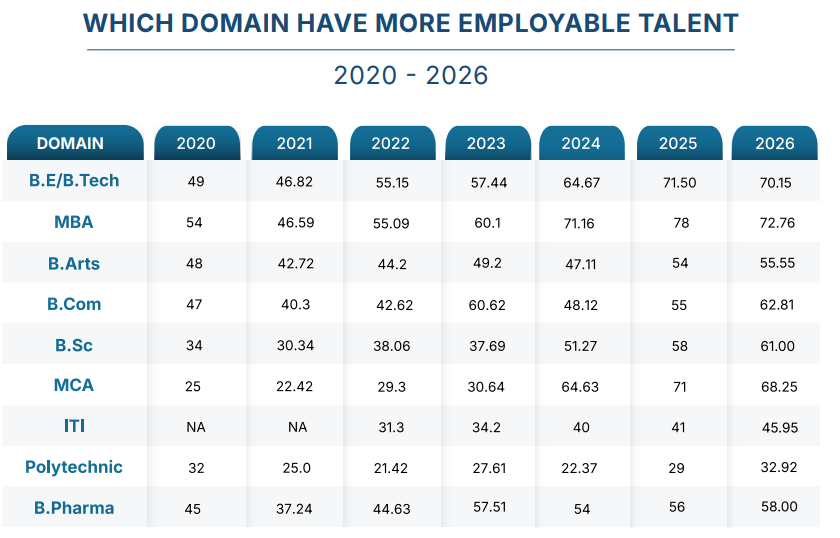
Image Source: India Skills Report 2026
An MBA syllabus is the semester-by-semester roadmap of core subjects, electives and specialisations that guides this learning journey. This blog breaks the syllabus down year by year, subject by subject and shows how institutions have structured their MBA course around that shift.
What Is the MBA Syllabus?
An MBA syllabus is the officially prescribed set of subjects, credits and learning outcomes a business school delivers across a Master of Business Administration programme. It is typically split into a common core (1st Year) that every student takes regardless of interest area and a specialisation track (2nd Year) chosen based on career goals.
Quick Facts:
| Attribute | Typical Value |
|---|---|
| Duration | 2 years / 4 semesters |
| Core Subjects | 10-14 (spread across Semesters 1-2) |
| Specialisation Options | 3-8, depending on the institute |
| Credits (approx.) | 90-105 total |
| Assessment Mix | Exams, case studies, projects, internships |
| Mandatory Components | Summer internship, capstone/major project |
Most MBA programmes admit students with a bachelor’s degree in any discipline, provided they clear an entrance test such as CAT, MAT, XAT or GMAT or the institute’s own entrance exam.
What Does the MBA Syllabus Cover?
The MBA syllabus structure follows a “broad-then-deep” logic: Build a shared foundation first, then let students specialise once they understand how each business function connects to the others.
| Year | Focus | What Happens |
|---|---|---|
| 1st Year (Sem 1-2) | Common Core | Every student studies the same core management subjects without any electives |
| 2nd Year (Sem 3-4) | Specialisation | Students pick up to two specialisations; 4th semester usually includes a capstone project or internship |
This is why two students from the same MBA batch can graduate with very different subject transcripts. The 1st Year foundation is identical, but 2nd Year diverges completely based on chosen specialisation.
What Are MBA Semester-Wise Subjects?
Semester 1 & 2: Core Subjects
These subjects are compulsory for every MBA student, irrespective of their eventual specialisation.
| Subject | What It Covers |
|---|---|
| Marketing Management | Consumer behaviour, market research, product and pricing strategy |
| Financial & Managerial Accounting | Reading financial statements, budgeting, cost analysis |
| Organisational Behaviour | Workplace dynamics, leadership styles, team management |
| Managerial Economics | Demand-supply analysis, pricing decisions, market structures |
| Corporate Finance | Capital budgeting, valuation, risk management |
| Business Statistics & Analytics | Quantitative methods, probability, data-driven decision-making |
| Operations & Supply Chain Management | Production planning, logistics, quality control |
| Business Communication | Corporate writing, presentations, negotiation |
Semester 3 & 4: Electives and Specialisation Subjects
Once the core is complete, students select up to two specialisations. A typical elective mix looks like this-
| Specialisation | Sample Electives |
|---|---|
| Finance | Investment & Portfolio Management, Financial Modelling & Valuation, M&A and Corporate Restructuring |
| Marketing | Digital Marketing & Analytics, Brand Management, Sales & Distribution Management |
| Human Resource Management | Talent Acquisition, Performance & Compensation Management, Labour Laws & Industrial Relations |
| Operations & Supply Chain | Supply Chain Design, Logistics Management, Total Quality Management |
| Business Analytics | Data Visualisation (Tableau/Power BI), Predictive Analytics, Machine Learning for Business |
The 4th Semester typically closes with an industry internship, a capstone project or both, which is why it’s called the practical bridge between classroom learning and the workplace.
What Are the Popular MBA Specialisations?
The specialisation you choose in 2nd Year has a direct bearing on your first job. Four options currently dominate demand in India:
- Business Analytics- Data visualisation, predictive modelling, business intelligence are among the fastest-growing skill areas globally.
- Finance- Corporate finance, investment analysis, financial modelling; consistently the most hireable MBA domain across BFSI, NBFCs and fintech.
- Digital Business- E-commerce operations, CRM systems, digital transformation for both online-first and traditional businesses.
- Human Resource Management- Talent strategy, HR analytics, labour law and compensation design for a hybrid, technology-driven workforce.
For a deeper look at career paths and salary bands within each specialisation, see our detailed guide on top MBA specialisations in 2026.
Why Does the MBA Syllabus Structure Matter?
A syllabus is only as good as the outcomes it produces. At Mahindra University’s School of Management, the MBA curriculum is deliberately built around what the School calls the “AIM” framework- Application, Industry Readiness and Market Relevance:
- Application- Case studies, simulations and hands-on projects so learning is tested in real-world contexts, not just exams.
- Industry Readiness- Expertise in digital business, analytics and sustainability, aligned to what the School describes as Industry 5.0 demands.
- Market Relevance- The curriculum is updated on a rolling basis to track current trends rather than staying static year to year.
This kind of structured, outcome-linked design matters because the market is shifting fast-
GMAC’s Application Trends Survey found that two-year, full-time MBA programmes are the only MBA format showing consistent growth in both domestic and international applications. While degrees closely tied to specialisation, such as data-analytics master’s, are the sole specialised programme type holding steady demand.
In other words, applicants are voting with their feet for full MBA programmes that still build strong functional depth in analytics and technology, not away from them.
How Is the MBA Syllabus Taught?
A well-designed MBA syllabus is delivered, not just written down. Here’s how the teaching format typically breaks down across a two-year programme:
- Case-based Classroom Teaching- Real business scenarios replace pure lecture-and-exam formats.
- Simulations and Live Projects- Students apply frameworks to actual business problems, often with industry partners.
- Internships- A mandatory summer internship between 1st Year and 2nd Year gives practical exposure before specialisation begins.
- International Immersion- Some programmes, including Mahindra University’s, make a global immersion trip compulsory; the most recent cohort visited Germany, engaging with companies including BMW Welt, Siemens and Agile Robotics and attending workshops at the Technical University of Munich on Industry 4.0 and design thinking.
- Capstone Project- A final-semester project or dissertation that consolidates learning from both core and elective subjects.
Who Should Study MBA Syllabus?
Not every MBA syllabus suits every learner. Broadly, the ideal candidate profile looks like this:
- A fresh graduate or young professional in any discipline- the MBA syllabus assumes no prior business background.
- Someone with good analytical skills, since Business Statistics, Managerial Economics and Financial Accounting appear in the 1st semester itself.
- A curious mind and willingness to learn, given the pace of change- AI Tools and Applications, ESG frameworks and FinTech electives are newly entering MBA syllabi across institutions in 2026.
- Candidates comfortable with a structured, full-time schedule, since staying focused on a rigorous two-year timetable (rather than a slower distance format) tends to produce stronger placement outcomes.
Elevate Your Management Career with Mahindra University’s MBA Programme
Mahindra University’s MBA, offered by its School of Management, prepares students for leadership roles in business and industry by blending analytical rigour, experiential learning and real-world application. The programme is built around the same AIM framework (Application, Industry Readiness and Market Relevance) that shapes the syllabus structure described above and it backs that design with measurable outcomes from its first graduating group.
Key Highlights of the MBA Programme:
| Metric | Details |
|---|---|
| Highest CTC Secured | ₹16 LPA |
| Top Quartile Average CTC | ₹15 LPA |
| Average CTC | ₹11 LPA |
| Specialisations Offered | Business Analytics, Digital Business, Finance, Human Resource Management |
| Global Academic Alliances | Cornell University (undergraduate), Frankfurt School of Finance & Management (graduate) |
| Faculty Mix | Professors from IIM Lucknow, IIM Jammu and industry veterans from Tata Motors, Hero MotoCorp and L&T |
What makes the MBA syllabus distinct here-
- Core courses in strategy, finance, marketing and operations build strong managerial foundations in 1st Year, before electives and focus areas let students tailor their learning to emerging business domains in 2nd Year.
- Case studies, field engagements and capstone projects bridge theory with practice throughout the programme, rather than being confined to a single final-semester module.
- A fully residential campus culture fosters collaboration, peer interaction and leadership development alongside the syllabus; students experience the AIM framework, not just study it.
- A 3-week international immersion module at a partner institution abroad is a compulsory part of the curriculum; the most recent cohort’s immersion was in Germany.
Explore the official MBA programme page for detailed information on admissions and specialisations.
Conclusion
An MBA syllabus is the starting point for building the skills employers expect. It shapes your understanding of business fundamentals before you specialise. A curriculum that blends management with technology, analytics and real-world application can better prepare graduates for today’s evolving job market.
Mahindra University’s AIM-based MBA syllabus is designed with that goal in mind. From a strong management foundation to industry-focused specialisations and hands-on learning, it equips students with the knowledge and practical experience needed to succeed in today’s business landscape.
Ready to see the full specialisation list and eligibility criteria? Apply now!
FAQs
An MBA syllabus spans four semesters over two years: 1st Year covers core subjects like Marketing, Finance, Operations and Organisational Behaviour, while 2nd Year offers specialisation electives such as Business Analytics, Finance, Digital Business or HR Management, usually ending in a capstone project or internship.
An MBA is rigorous rather than inherently difficult. Most of the challenge comes from managing a heavy workload of case studies, group projects and quantitative subjects like Business Statistics simultaneously, not from any single subject being unusually hard.
Not entirely. Subjects like Business Statistics, Managerial Economics and Corporate Finance do require comfort with numbers, but a large part of the MBA syllabus is conceptual and case-based rather than mathematical.
Finance remains the most consistently hireable domain, while Business Analytics is currently the fastest-growing in demand; the right choice depends on individual career goals and existing skill strengths.
The core foundation stays broadly similar across institutions, but specific electives, emerging-topic coverage (AI, ESG, FinTech) and specialisation options can vary meaningfully, so it’s worth checking each university’s current syllabus directly.
Most MBA programmes include 10-14 core subjects taught in the first year, spread across two semesters, before specialisation electives begin in 2nd Year.
The subject list is largely similar, but a full-time MBA syllabus is delivered over two intensive years with mandatory internships and immersion components, while part-time and distance formats spread the same core content over a longer timeline with fewer practical components.
Yes, most MBA programmes, including Mahindra University’s, accept a bachelor’s degree in any discipline, provided the candidate clears an accepted entrance test (CAT, GMAT, GRE or MUMET) and meets the institute’s eligibility criteria.