

Home / Undergraduate / Page 4

B.Tech in Aerospace Engineering

A 4-year undergraduate programme enabling engineers to design, develop and optimise aircraft, spacecraft and aerospace systems for the future.

B.Tech in aerospace engineering overview 

We prepare students to excel in aerodynamics, propulsion, and structures, leveraging expert faculty and a strong research ecosystem to launch careers in advanced aerospace engineering. Students experience:

Progression into aerospace-specific domains

such as aerodynamics, propulsion and structural engineering, contextualised within India’s aerospace ecosystem.

Hands-on engineering labs

design-drawing and project-based modules enabling students to apply theoretical aerospace principles.

Career-oriented training

aligned with the rapidly growing aerospace industry and research in India, giving students access to future mobility, defence and space initiatives.

Strong grounding

in mathematics, chemistry and engineering with a combination of courses like Calculus, Mechanics and Engineering Drawing.

Programme details

Academic structure

Our faculty combines academic depth with real-world expertise, guiding students through both fundamental theory and applied innovation

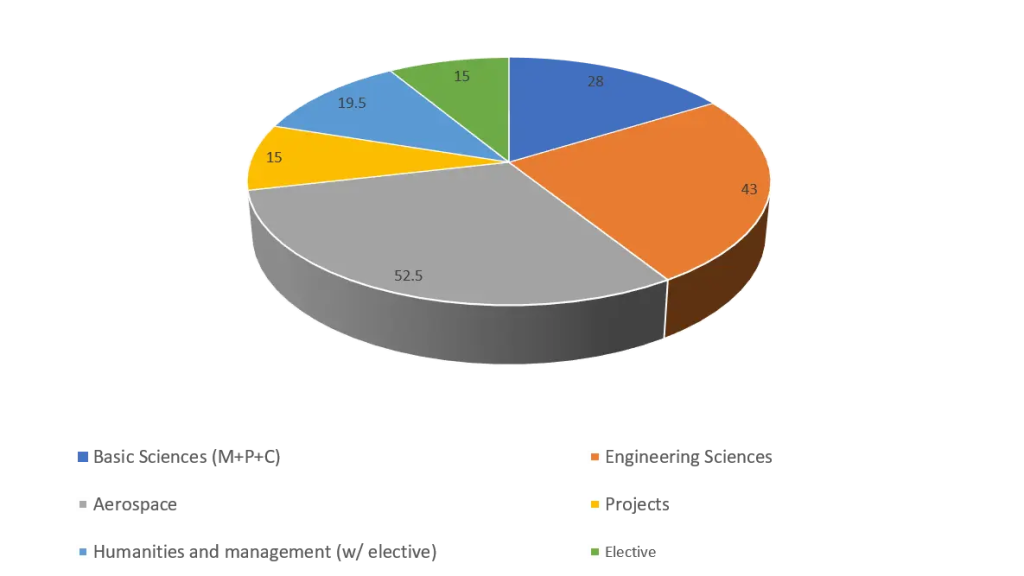
  • Credit structure: Basic Sciences (28 credits), Engineering Sciences (43 credits), Aerospace (52.5 credits), Projects (15 credits), Humanities & Management (19.5 credits), Electives (15 credits), Total 173 credits. 
  • Total credits & degree requirement: The programme requires not less than 165 credits to be awarded a B.Tech degree.
  • Duration: 4 years / 8 semesters
  • Core vs Professional phases: The first two years constitute the “Core Program,” and the last two years the “Professional Program,” with electives introduced in the latter phase.
CourseL-T-PCredits
Mathematics I (Calculus & ODEs)4-1-25
Chemistry I2-1-23
Introduction to Electrical/Electronics Engg w/ lab2-1-22
Engineering Drawing1.5
Mechanics2-1-23
Earth & Environmental Sciences2-0-02
Intro. to Entrepreneurship0-0-31
Media Project0-0-31.5
English3-0-03
French I0-2-00.5
CourseL-T-PCredits
Mathematics II (Linear Algebra & Complex)3-1-24
Physics I with Lab2-1-24
Chemistry II with Lab2-0-23
Thermodynamics2-1-23
CAE Design1-0-32.5
Intro to Computing2-2-24
Workshop Practice0-0-21
Entrepreneurship Practice0-0-21
Professional Ethics0-1-01
French II0-2-00.5
CourseL-T-PCredits
Mathematics III (Probability & Stats)3-1-24
Physics II with Lab3-1-25
Data Structures & Algorithms2-2-25
Introduction to Aerospace Engineering2-0-02
Fluid Mechanics3-1-24
Solid Mechanics2-1-23
Lean Start-up0-0-31
Principles of Economics3-0-01.5
French III0-2-00.5
CourseL-T-PCredits
Numerical Methods3-0-24
Aerospace Structures3-1-24
Aerodynamics-I (Low Speed)2-1-23
Finite Element Method2-0-23
Fluid & Solid Mechanics Lab2
Financial Accounting3-0-01.5
Design Thinking1-0-22
French IV0-2-00.5
CourseL-T-PCredits
Heat & Mass Transfer3-1-24
Flight Dynamics & Aircraft Performance3-0-24
Aerodynamics-II (Compressible Flow)3-1-24
CFD for Aerospace Engineers3-0-24
Propulsion-I (Rocket)3-0-03
Aerodynamics Lab1.5
Elective / HSS~2
French V (Optional)~0.5
CourseL-T-PCredits
3rd Year Project3
Orbital Mechanics & Space Dynamics3-0-03
Propulsion-II (Aircraft)3-0-03
Aerospace Control & Guidance3-0-03
Vibrations3-0-03
Propulsion Lab1
Aeromodelling Workshop~2
Elective I3
French VI0
CourseL-T-PCredits
Aerospace Materials & Processes3-0-03
Aircraft Design2-0-23
Space Vehicle Design2-0-23
Control Systems Lab1
Elective II & III~6
Year-4/1 Project1-4-33
French VII0
CourseL-T-PCredits
Elective IV3
Elective V3
Final Project II9
French VIII0

Expected programme output

  • To be able to understand the basic engineering concepts with theoretical foundation in mathematical/physical modelling and software engineering.
  • To be able to understand and apply various concepts of mechanical design, electronics design and control.
  • To have the ability to apply engineering methods and tools to specify and develop mechanical components and systems in the context of mechatronics.
  • To have the ability to apply the engineering methods and tools and master the related skills in the process of developing mechatronic systems and products.
  • To have the ability to apply engineering methods and tools to, specify and develop analog and digital electronic circuits, specify and develop embedded hardware and software in a mechatronic context.

FAQs

By covering aerodynamics, propulsion, and structures alongside engineering design projects, the curriculum mirrors the technical demands of the aerospace sector.

Laboratory sessions, computer-aided design and mechanics workshops give students early exposure to aerospace applications and simulations.

An emphasis on experiential learning, project work and strong foundational sciences ensures graduates possess both breadth and depth of knowledge.

Students are prepared for roles in aircraft design, defence technology, propulsion systems, unmanned aerial vehicles and research institutions.

The project-based framework encourages students to design creative engineering solutions while developing collaboration and leadership skills essential to the industry.
Start your journey with us

Home / Undergraduate / Page 4

B.Tech in Mechanical Engineering

A 4-year undergraduate programme empowering engineers to design, manufacture and optimise the machines and systems that drive industry and innovation.

B.Tech in mechanical engineering overview

Our program takes students beyond conventional mechanics to explore advanced design, manufacturing and systems thinking. With a curriculum grounded in core disciplines like thermodynamics, fluid and solid mechanics, materials science and machine design, we prepare professionals capable of leading in sectors from automotive to aerospace and sustainable systems. Students experience:

Modular learning

in machine design, fluid and solid mechanics, and manufacturing engineering to build versatile technical fluency.

Combined foundations

in mechanics, thermodynamics and material science with hands-on workshop practice and computer-aided engineering design.

Access to advanced labs

and simulation-tools with design thinking projects that mirror real-world engineering challenges.

Pathways into various sectors

such as automotive, aerospace, energy, robotics and advanced manufacturing, as well as options for research and innovation.

Programme details

Programme objectives

  • Develop a passion for continuous learning and the ability to adapt to evolving technologies and challenges.
  • Establish themselves as professionals who apply their knowledge to address and solve complex technical and societal problems.
  • Strive to become effective leaders and entrepreneurs, demonstrating strong social awareness, emotional intelligence and a commitment to driving positive change.

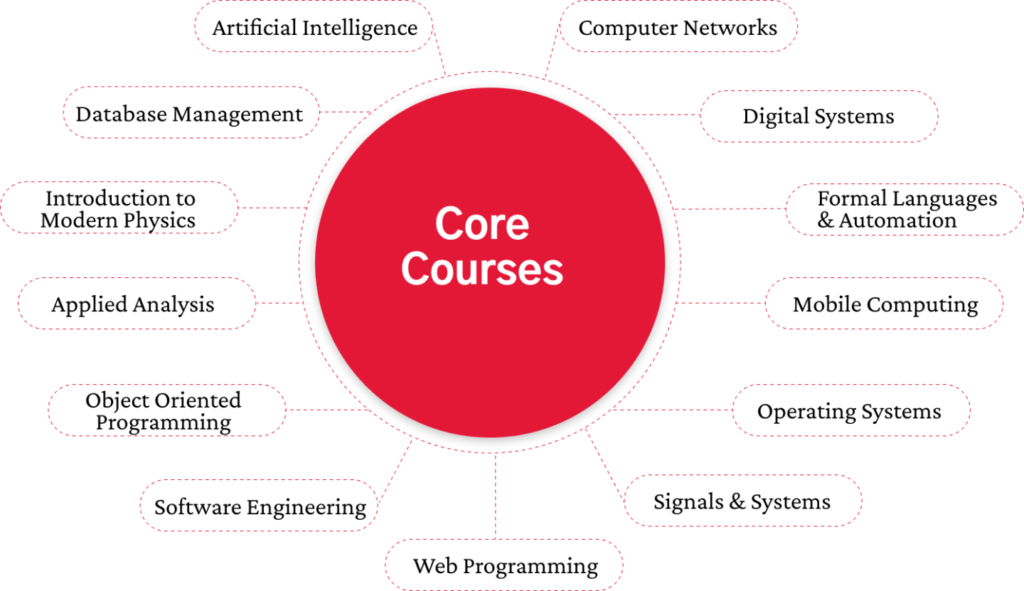
Core courses

  • Computer-aided engineering design
  • Transport phenomena
  • Manufacturing processes I and II
  • Mechanics of solids
  • Theory of mechanisms and machines
  • Introduction to materials science
  • Applied fluid dynamics and heat transfer
  • Design of machine elements
  • Experimental analysis
  • Multiphysics
  • Thermal engineering
  • Finite element methods
  • Structural dynamics and acoustics
  • Control theory
  • Industrial engineering
CourseL-T-PCredits
Calculus & ODE4-1-05
Chemistry – I2-1-03
Introduction to Electrical & Electronics Engg w/ Lab2-1-24
Engineering Drawing0-0-31.5
Earth & Environmental Sciences2-0-02
Mechanics2-1-03
English0-3-03
Media Project0-0-31.5
French I0-2-00.5
Introduction to Entrepreneurship0-0-31
CourseL-T-PCredits
Linear Algebra & Complex Analyses3-1-04
Physics – I2-1-24
Chemistry / Biology2-0-23
Thermodynamics2-1-03
Computer Aided Engineering Design1-0-32.5
Introduction to Computing2-1-24
Workshop Practice0-0-21
Entrepreneurship Practice0-0-21
Professional Ethics0-1-01
French II0-2-00.5
CourseL-T-PCredits
Probability & Statistics3-1-04
Physics – II3-1-25
Data Structures & Algorithms2-2-25
Introduction to Materials Sciences2-0-23
Thermal Engineering3-1-04
PDEs for Engineers (7 weeks)2-0-01
Lean Start-up0-0-31
Principles of Economics (7 weeks)3-0-01.5
French III0-2-00.5
CourseL-T-PCredits
Numerical Methods for Engineers3-0-24
Fluid Mechanics3-1-04
Solid Mechanics2-1-03
Theory of Mechanisms & Machines3-0-24
Manufacturing Engineering4-0-04
Financial Accounting (7 weeks)3-0-01.5
Design Thinking1-0-22
French IV0-2-00.5
CourseL-T-PCredits
Fluid & Solid Mechanics Lab0-0-21
Measurement & Instrumentation2-0-23
Heat & Mass Transfer3-1-04
Design of Machine Elements3-1-04
Metrology & CAM2-0-23
Introduction to Robotics3-0-03
Stream Course I3-0-03
HSS/Management Elective I2-0-22
French V (Optional)0-2-00
CourseL-T-PCredits
Machine Learning3-1-04
Vibrations3-0-03
Heat, Energy, & Vibration Lab0-0-31.5
Stream Course II3-0-03
Open Elective I3-0-03
HSS/Management Elective II2-0-02
Systems Engineering Project0-1-43
Introduction to Professional Development2-0-02
French VI (Optional)0-2-00
CourseL-T-PCredits
Industrial Engineering & Operations Research3-1-04
Stream Course III3-0-03
Open Elective II3-0-03
Control Theory3-0-03
HSS/Management Elective III2-0-02
Year-4 Project0-1-43
French VII (Optional)0-2-00
CourseL-T-PCredits
Stream Course IV3-0-03
Open Elective III3-0-03
Year-4 Project0-5-89
French VIII (Optional)0-2-00

FAQs

The programme blends classical engineering principles with modern technologies, empowering students to innovate in sustainable design, manufacturing, and advanced materials.

Students experience immersive, hands-on learning in state-of-the-art design and manufacturing labs, supported by expert faculty and real-world industry collaborations.

Through design challenges, multidisciplinary projects, and innovation-led competitions, students learn to turn ideas into practical engineering solutions.

Graduates are equipped for careers across automotive, aerospace, robotics, and energy sectors, with strong analytical and design foundations valued globally.

The emphasis on experiential learning, digital simulation tools, and sustainable engineering practices ensures graduates are not just skilled professionals but responsible innovators.

Start your journey with us

Home / Undergraduate / Page 4

B.Tech in Computation & Mathematics

A 4-year undergraduate programme integrating the precision of mathematics with the power of computation to prepare students for scientific & analytical careers.

B.Tech in computation & mathematics overview

We develop problem-solvers who unite theory and computation to drive real-world innovation, grounded in mathematics, algorithms, and scientific computing for impact across AI, data science, optimisation, and quantitative research. Students experience:

Course grounded firmly

in advanced mathematical disciplines such as linear algebra, complex analysis, enabling conceptual mastery beyond routine engineering maths

Experiential computational

and programming training through data structures, graph algorithms, cryptography and computational biology, all taught alongside mathematical models

Interdisciplinary specialisation

including advanced electives in quantum computing, computational biology, and cryptography enable exploration of frontier scientific domains

Research and innovation

culture through mathematical modelling projects, research internships, and capstone collaborations, to develop analytical creativity and industry-ready expertise

Programme details

Academic structure

Our academic structure is designed to establish robust foundations, followed by increasing specialization in later years.

  • Duration: 4 years / 8 semesters
  • Total credits & degree requirement: The programme requires not less than 165 credits to be awarded a B.Tech degree.
  • Focus areas:
    • Data Science/Data Analytics
    • Financial Mathematics
    • Cryptography
    • Quantum computing
    • Drug Design
CourseL-T-PCredits
Mathematics – I (Calculus & ODE)4-1-05
Chemistry – I2-1-03
Introduction to Electrical Engineering2-1-24
Engineering Drawing0-0-31.5
Earth & Environmental Sciences2-0-02
Thermodynamics2-1-03
Media Project1-0-21.5
English & Humanities – I1-2-24
French Language & Culture – I0-2-00
CourseL-T-PCredits
Mathematics – II3-1-04
Physics – I2-1-24
Chemistry – II2-0-23
Electronics2-1-24
Introduction to Computer Science2-1-24
Discrete Mathematics2-0-02
Introduction to Computing Workshop0-0-21
Professional Ethics0-1-01
French – II0-2-00
CourseL-T-PCredits
Probability & Statistics3-1-04
Data Structures3-0-24
Graph Algorithms / Real Analysis**3-0-03
Programming Workshop0-0-21
Lean Start-up0-0-31
Economics (Fractal)3-0-01.5
French – III0-2-00.5
CourseL-T-PCredits
Numerical Methods3-0-24
Theory of Computation3-0-03
Advanced Mathematics / Computational Elective*3–4
Programming / Workshop0-0-21
Design Thinking1-0-22
French – IV0-2-00.5
Financial Accounting3-0-01.5
CourseL-T-PCredits
Design & Analysis of Algorithms3-0-24
Database Management Systems3-0-24
Operating Systems3-0-24
Elective I3-0-03
Elective II3-0-03
HSS Elective I2-0-02
CourseL-T-PCredits
Elective III3-0-03
Elective IV3-0-03
Professional Development & Employability Skills2-0-02
3rd Year Project0-1-43
HSS Elective II2-0-02
French – VI (Optional)0-2-00
CourseL-T-PCredits
Elective V3-0-03
Elective VI3-0-03
Final Year Project – Phase I0-0-189
HSS Elective III2-0-02
French – VII (Optional)0-2-00
CourseL-T-PCredits
Elective VII3-0-03
Elective VIII3-0-03
Final Year Project – Phase II0-4-109
French – VIII (Optional)0-2-00

FAQs

The programme is designed to build dual expertise, nurturing students who can think mathematically and code computationally. This rare combination enables them to excel in data science, AI, quantitative finance, research, and advanced analytics roles across industries.

This programme is ideal for curious, analytical thinkers who enjoy logic, problem-solving, and exploring how mathematical theory powers modern technology. It develops both conceptual understanding and practical application, preparing students for innovation-led careers.

While traditional computer science focuses primarily on coding, computation & mathematics deepens students’ understanding of the mathematical principles driving algorithms and models. This gives them a strong conceptual edge in high-end computational research and emerging tech domains.

Students engage in research internships, mathematical modelling workshops, and interdisciplinary capstone projects in collaboration with Mahindra University’s research centres and industry partners, offering real-world exposure from early on.

Graduates are well-prepared for careers in data science, operations research, financial analytics, cybersecurity, AI research, and academia. Many also pursue advanced studies at leading international universities.

Start your journey with us

Home / Undergraduate / Page 4

B.Tech in Electronics & Computer Engineering

A 4-year interdisciplinary program that integrates electronics, computer science, and engineering fundamentals to prepare students for the evolving tech landscape.

B.Tech in electronics & computer engineering overview

We prepare students to design and integrate intelligent electronic and computing systems that power modern digital products and platforms. The programme develops system-level thinkers who can work across hardware and software boundaries, translating complex requirements into robust, scalable solutions. Students experience:

Interdisciplinary mastery

across electronics, computer science, and systems engineering, enabling them to tackle diverse technological challenges.

Practical innovation

with extensive lab sessions, hands-on projects, and workshops translate theoretical knowledge into tangible solutions.

Industry-ready skills

enriched via a curriculum focuses on emerging technologies, equipping students for careers in AI, IoT, embedded systems, and beyond.

Global exposure

and opportunities for international collaboration and research help students develop a worldwide perspective and adaptability.

Programme details

Programme specific outcomes

  • PSO1: Apply principles of mathematics, basic sciences, electronics and computer engineering to identify, formulate and solve complex interdisciplinary engineering problems.
  • PSO2: Design and develop innovative solutions that integrate electronic hardware and computational systems while considering performance, cost-effectiveness, sustainability and societal needs.
  • PSO3: Select and apply modern engineering tools for the analysis, design, simulation and implementation of integrated electronic and computational systems, recognising their limitations.
  • PSO4: Design and conduct experiments, analyse and interpret data from electronic and computational systems, and derive meaningful conclusions for complex hardware–software integration problems.
  • PSO5: Demonstrate the ability to excel in competitive events, projects and research activities in the field of electronics and computer engineering at national and international levels.

Academic structure

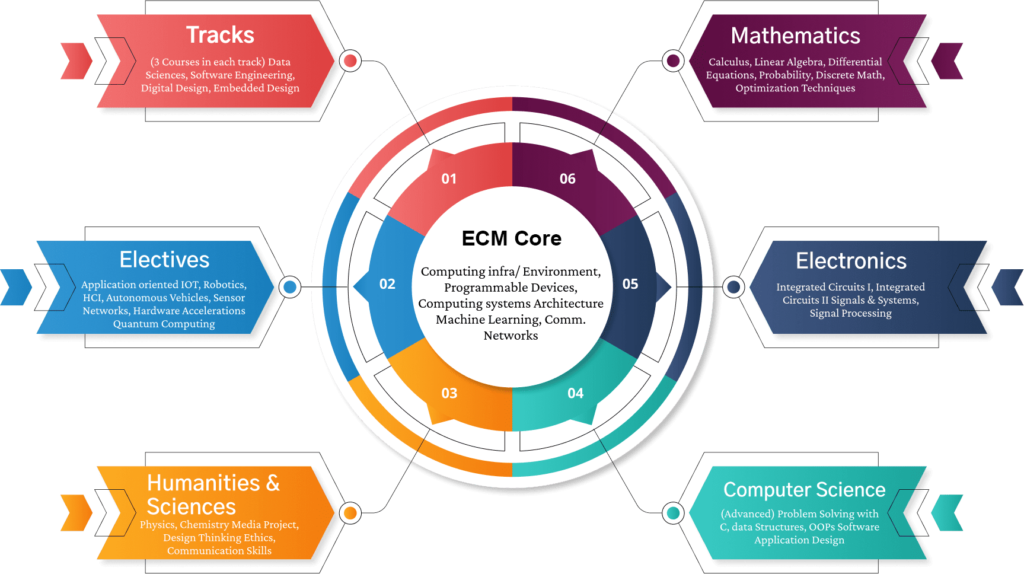
Programming and algorithms: Courses include problem solving in C, data structures, object-oriented programming, advanced problem solving, design and analysis of algorithms, and software application design.

Electronics fundamentals: Core courses such as electrical and electronic circuits, digital electronics, signals and systems, and signal processing.

Integrated hardware–software systems: Courses covering computing infrastructure, programmable devices, computing systems architecture, machine learning, and computer and communication networks.

Humanities and management: An interdisciplinary humanities track including management electives and design thinking.

  • Digital design: VLSI design, hardware acceleration and low-power IC design.
  • Data science: Data management and warehousing, deep learning and big data technologies.
  • Embedded systems: Real-time systems, hardware–software co-design and embedded programming.
  • Software engineering: Software construction, testing and verification.
  • Intelligent, connected and autonomous vehicles
  • Internet of Things (IoT) system design
  • Cyber-physical systems
  • Mixed reality systems
  • Human–computer interaction
  • Robotics and automation
  • Hardware-accelerated machine learning
  • Smart systems
CourseL-T-PCredits
Math I – Calculus & ODE4-1-05
Earth and Environmental Sciences2-0-02
Fundamentals of Drawing & Practice0-0-42
Introduction to Computer Science2-1-24
Learning to Learn1-0-22
Photography I: Still and Moving Images1-0-43
Introduction to Media and Communication1-0-22
French I0-2-00.5
CourseL-T-PCredits
Math II – Linear Algebra, Complex Analysis3-1-04
Physics – I2-1-24
Discrete Mathematical Structures2-0-02
Data Structures2-2-25
Visual Communication and Graphic Design0-1-43
Professional Writing1-0-01
Professional Ethics1-0-01
Introduction to Game Design1-0-43
French II0-2-00.5
CourseL-T-PCredits
Math III – Probability and Stats3-1-04
Design and Analysis of Algorithms3-1-04
Optimization Techniques for AI3-0-03
Object Oriented Programming2-0-23
Introduction to Computation and Media2-0-02
Computer Graphics2-0-23
Media Production0-0-84
Economics (Fractal)3-0-01.5
French III0-2-00.5
CourseL-T-PCredits
Math IV – Numerical Methods3-0-24
Theory of Computation3-0-03
Machine Learning with Python3-0-24
Programming Workshop0-0-21
Modelling and Animation2-0-44
Advanced Computer Graphics2-0-23
Design Thinking1-0-22
French IV0-2-00.5
Financial Accounting3-0-01.5
CourseL-T-PCredits
Operating Systems3-0-24
DBMS3-0-24
Digital Image Processing2-0-23
Augmented, Virtual & Extended Reality2-0-23
Interactive Sound and Music2-1-24
Elective I3-0-03
HSS Elective I2-0-02
French V (Optional)0-0-00
CourseL-T-PCredits
User Centred Design Methods2-0-23
Data Visualization and Communication2-0-23
Media Psychology2-0-02
Computational Creativity2-0-23
Elective II3-0-03
3rd Year Project0-1-43
Professional Development & Employability Skills2-0-02
HSS Elective II2-0-02
French VI (Optional)0-2-00
CourseL-T-PCredits
Human Computer Interaction2-0-23
Entrepreneurship Practice & Lean Startup Management3-0-03
Elective III3-0-03
Final Year Project – Phase I0-0-189
HSS Elective III2-0-02
French VII (Optional)0-2-00
CourseL-T-PCredits
Elective IV3-0-03
Elective V3-0-03
Final Year Project – Phase II0-4-109
French VIII (Optional)0-2-00

FAQs

Our ECM program combines electronics, computer science, and systems engineering in a carefully designed curriculum, giving students the skills and confidence to become future innovators in technology.

Graduates are prepared for careers in embedded systems, IoT, AI, robotics, hardware-software design, and even higher studies or entrepreneurial ventures.

Both. The program ensures students gain strong expertise in electronics and circuits as well as programming, computational theory, and system design.

Our holistic approach includes mentorship, innovation labs, clubs, and leadership opportunities, helping students develop confidence, teamwork, and problem-solving skills.

Start your journey with us

Home / Undergraduate / Page 4

B.Tech in Artificial Intelligence

A four-year undergraduate programme designed to develop future-ready AI engineers skilled in machine learning, language, vision and large-scale systems who can craft creative AI solutions for real-world problems.

B.Tech in artificial intelligence overview 

We shape innovators to lead the AI revolution, combining theory, application, and research to build intelligent systems that transform industries and society. Students experience:

Interdisciplinary foundations

combining mathematics, data science, and computational intelligence to build strong analytical depth

Immersive learning

through AI labs, live projects, and experimentation with real-world datasets and neural network models

Advanced domains

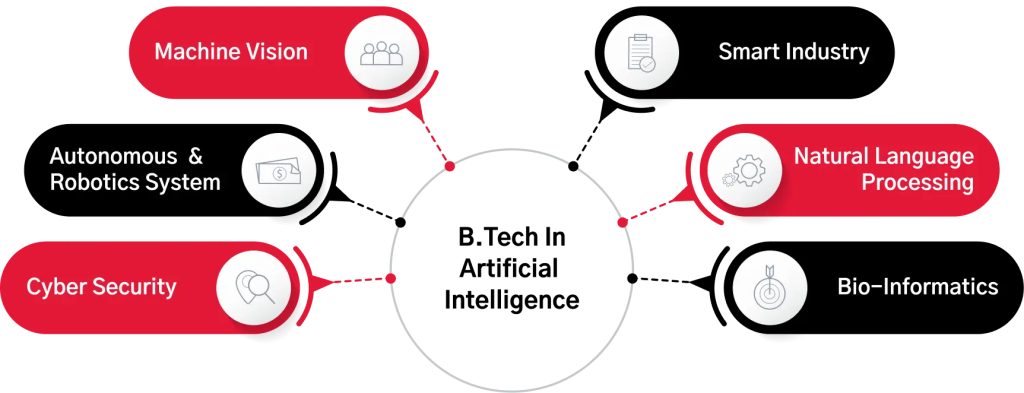
such as deep learning, natural language understanding, robotics, and generative AI explored through electives and research

Global and industry focus

with mentorship from experts, collaborative projects, and exposure to cutting-edge AI innovations shaping the future

Programme details

Academic structure

Our academic structure is designed to establish robust foundations, followed by increasing specialization in later years.

  • Total credits & degree requirement: The programme requires not less than 165 credits to be awarded a B.Tech degree.
    Duration: 4 years / 8 semesters
  • Core vs Professional phases: The first two years constitute the “Core Program,” and the last two years the “Professional Program,” with electives introduced in the latter phase.

Mathematics

  • Multivariate Calculus
  • Linear Algebra & Matrices
  • Probability & Stats
  • Numerical Methods
  • Discreate Maths

Natural sciences & economics

  • Phy- Mechanics
  • Phy-Electromagnetics
  • Biochemistry Electronics
  • EE Basics

Foundational

  • Foundations of NLP Signals & Systems Control Theory
  • Digital Image Processing
  • Artificial Intelligence
  • Machine Learning

Computer science

  • Intro. to C & Python Data Structures D&A of Algorithms
  • Comp. Architecture
  • Operating Systems DBMS & Big Data

Humanities++

  • English & Humanities
  • Media Project Earth & Environment Sciences
  • Intro. Enterprise & Economy

Electives

  • Computational Biology
  • Computational Genomics
  • Information Retrieval
  • BC & Cryptic
CourseL-T-PCredits
Calculus & ODE4-1-05
Chemistry – I2-1-24
Introduction to Electrical Engineering2-1-22
Electronics2-1-22
Introduction to Computing2-1-14
Earth & Environmental Sciences2-0-02
Introduction to Entrepreneurship0-0-31
Media Project0-0-31.5
English3-0-03
French I0-2-00.5
CourseL-T-PCredits
Linear Algebra & Complex Analysis3-1-04
Physics – I2-1-24
Biology3-0-03
Data Structures2-2-25
Discrete Mathematics2-0-02
AI & Humanity1-0-01
Entrepreneurship Practice0-0-21
Workshop Practice0-0-21
Professional Ethics0-1-01
French II0-2-00.5
CourseL-T-PCredits
Probability & Statistics3-1-04
Physics – II3-1-25
Optimization Techniques for AI3-0-03
Design & Analysis of Algorithms2-1-24
Signals & Systems3-1-04
Lean Startup1-0-01
Economics (7 weeks)3-0-01.5
French III0-2-00.5
Programming Workshop0-0-20.5
CourseL-T-PCredits
Numerical Methods3-0-24
Digital Logic & Computer Architecture3-1-04
Machine Learning with Python3-0-24
Artificial & Computational Intelligence2-1-24
Theory of Computation3-0-03
Design Thinking1-0-22
Financial Accounting3-0-01.5
French Language & Culture0-2-00.5
Programming Workshop0-0-20.5
CourseL-T-PCredits
Design & Analysis of Algorithms2-1-24
Operating Systems3-0-24
Database Management Systems3-0-24
Computer Networks (Lite)1-0-22
Foundations of NLP2-0-23
Digital Image Processing2-0-23
Humanities / Management Elective1-2-02
Programming Workshop0-0-21
CourseL-T-PCredits
Big Data Analytics3
High Performance Computing3
Neural Networks & Deep Learning3
AI Elective I3
AI Elective II3
Elective I3
Year 3 Project2
Professional Development & Employability Skills2
Humanities / Management Elective2
CourseL-T-PCredits
Computational Sequence Modelling3
AI Elective III3
AI Elective IV3
Elective II3
Elective III3
Year 4 Project (Phase I)3
Humanities / Management Elective2
CourseL-T-PCredits
Elective IV3
Elective V3
Year 4 Project (Phase II)10

FAQs

From dedicated AI and Robotics labs to live industry projects, hackathons, and internships, students actively apply their learning to real-world problems. The programme also includes experiential courses where students design and deploy AI models using contemporary tools and frameworks.

AI students are encouraged to explore research early on through faculty-guided projects, access to specialised centres such as the Mahindra University AI Research Lab, and participation in global AI competitions and conferences. The programme cultivates a strong research mindset alongside technical excellence.

Students can choose electives in areas such as Natural Language Processing, Computer Vision, Reinforcement Learning, and Generative AI, enabling them to tailor their education towards fast-evolving AI domains and industry needs.

Through partnerships with leading tech firms and start-ups, the curriculum stays updated with emerging trends. Guest lectures, mentorships, and collaborative projects ensure students gain direct exposure to industry practices and future-ready.

The project-based framework encourages students to design creative engineering solutions while developing collaboration and leadership skills essential to the industry.
Start your journey with us

Home / Undergraduate / Page 4

B.Tech in Computer Science Engineering

A 4-year undergraduate program developing computer scientists through a curriculum focused on real-world problem-solving, and industry collaboration.

B.Tech in computer science overview 

Our programme builds expertise beyond just coding. The curriculum is structured to give students deep knowledge of computational theory and software design, ensuring they graduate as innovators who can architect complex digital solutions. Students experience:

Foundational mastery

of algorithms, data structures, and computational theory for programming excellence

Hands-on development

with coding labs, software projects, and building full-stack applications

Cutting-edge specialisations

in AI, Cybersecurity, and Data Science through advanced electives and research

Industry-aligned innovation

via hackathons, capstone projects, and internships solving real-world problems

Programme details

Programme objective

  • Graduates will be able to identify and solve complex problems of the future and contribute to advancing the frontiers of computer science.
  • Graduates will develop original ideas and build technology-driven solutions that simplify processes and improve quality of life.
  • Graduates will demonstrate entrepreneurial thinking and advance their careers through continuous development of professional, communication and analytical skills.

Academic structure

Our academic structure is designed to establish robust foundations, followed by increasing specialization in later years.

  • Duration: 4 years / 8 semesters
  • Total credits & degree requirement: The programme requires not less than 165 credits to be awarded a B.Tech degree.
CourseL-T-PCredits
Math I – Calculus & ODE4-1-05
Earth and Environmental Sciences2-0-02
Fundamentals of Drawing & Practice0-0-42
Introduction to Computer Science2-1-24
Learning to Learn1-0-22
Photography I: Still and Moving Images1-0-43
Introduction to Media and Communication1-0-22
French I0-2-00.5
CourseL-T-PCredits
Mathematics – II3-1-04
Physics – I2-1-24
Chemistry – II2-0-23
Electronics2-1-24
Introduction to Computer Science2-1-24
Workshop Practice0-0-20
Introduction to Enterprises & Economy2-1-03
Professional Ethics0-1-01
French Language & Culture – II0-2-00
CourseL-T-PCredits
Probability & Statistics3-1-04
Optimization Techniques for AI3-0-03
Signals & Systems3-1-04
Design & Analysis of Algorithms2-1-24
Lean Start-up1-0-01
Principles of Economics3-0-01.5
French – III0-2-00.5
CourseL-T-PCredits
Machine Learning with Python3-0-24
Artificial & Computational Intelligence2-1-24
Theory of Computation3-0-03
Digital Logic & Computer Architecture3-1-04
Financial Accounting3-0-01.5
CourseL-T-PCredits
Design & Analysis of Algorithms2-1-24
DBMS3-0-24
Operating Systems3-0-24
Microprocessors & Interfacing3
Object Oriented Programming3
CourseL-T-PCredits
Big Data Analytics3
Computer Networks3
Software Engineering3
High Performance Computing3
Professional Development & Employability Skills2
CourseL-T-PCredits
Distributed Systems3
Compiler Design3
Cryptography & Network Security3
Elective I3
Elective II3
CourseL-T-PCredits
Advanced Electives3–4
Final Year Project6+
French Language & Culture (Optional)0-2-00

FAQs

The CSE curriculum is designed around 11 core departmental courses (40 credits) covering algorithms, data structures, databases, cryptography, and machine learning. It blends strong theoretical grounding with application-driven labs and projects, ensuring graduates are industry-ready from day one.

Students can pursue five professional and open electives (15 credits) in areas like High-Performance Computing, Data Mining, Information Security, Graphics, and Embedded Systems, allowing them to tailor their expertise toward emerging technologies.

The CSE programme encourages research from the undergraduate level, with faculty-mentored projects, capstone work, and access to research labs in AI, Robotics, and Computational Systems. Students are guided by Ph.D. faculty from top global institutions.

With a 12:1 student-faculty ratio, fully residential campus, and project-based learning culture, CSE students experience personalized mentorship, vibrant peer learning, and a collaborative atmosphere ideal for growth and innovation.

Start your journey with us

Home / Undergraduate / Page 4

Bachelor of Technology (B.Tech)

A 4-year residential programme combining École Centrale’s curriculum, cutting-edge labs, and industry connections to build global engineers.

B.Tech at Mahindra University overview 

Our B.Tech goes beyond conventional engineering education. This programme is structured to give students both academic depth and applied experience, ensuring they graduate as problem-solvers ready for global industries. Students experience:

A rigorous academic framework

Delivering a globally benchmarked curriculum co-designed with École Centrale, France.

Practical exposure

through labs, internships, and industry-led problem solving.

A vibrant campus life

that nurtures leadership, innovation, and collaboration.

Global opportunities

via exchange programmes, visiting faculty, and international collaborations.

Specialisations

Shape your career path through specialisations that unite cutting-edge technology with engineering fundamentals.

B.Tech in VLSI Design & Technology

B.Tech in Nanotechnology

B.Tech in Mechatronics Engineering

B.Tech in Electronics & Communication Engineering

B.Tech in Electrical and Computer Engineering

B.Tech in Data Science

B.Tech in Computational Biology

B.Tech in Civil Engineering

B.Tech in Biotechnology

B. Tech in Aerospace Engineering

B.Tech in Mechanical Engineering

Academic structure

Our faculty combines academic depth with real-world expertise, guiding students through both fundamental theory and applied innovation.

  • Credit structure:
    Basic sciences (47 credits), basic engineering (28 credits), humanities, social & creative sciences (15 credits), enterprise sciences (10 credits).
  • Departments offer core and elective courses, labs, projects, and workshops. For example, in computer science engineering (CSE), there are ~11 departmental core courses (40 credits), plus ~5 electives (≈15 credits) covering areas like network computing, embedded systems, graphics & interfaces, information security, data mining, and machine learning.
  • Total course duration: 4 years / 8 semesters
  • Core vs professional phases: The first two years constitute the “Core Program,” and the last two years the “Professional Program,” with electives introduced in the latter phase.

MU Vision

  • Train multi-skilled leaders capable of reflection as well as innovation, committed to inclusive and sustainable progress
  • Aim for interdisciplinary academic excellence by integrating the study of science and technology with liberal arts that cover humanities, ethics, and philosophy, and design thinking
  • Balance education with experience through entrepreneurial projects to solve complex challenges facing society

An international faculty roster, possessing a rich industry-academic background, global exposure, and research focus, ensures that the curricula remain contemporary, constantly evolving, and aligned to the global business and industry needs.

International programme

A truly international program with a focus on the natural, creative, and engineering sciences.

cross-cultural

Environment of unique cross-cultural immersion for students, faculty, and staff.

research

A research-driven program with close links to industry.

residential program

Mandatory 100% residential program.

internships

International Exchange Program with mandatory internships.

Inter-disciplinary

An interdisciplinary approach with a blend of humanities, social sciences, management, and philosophy.

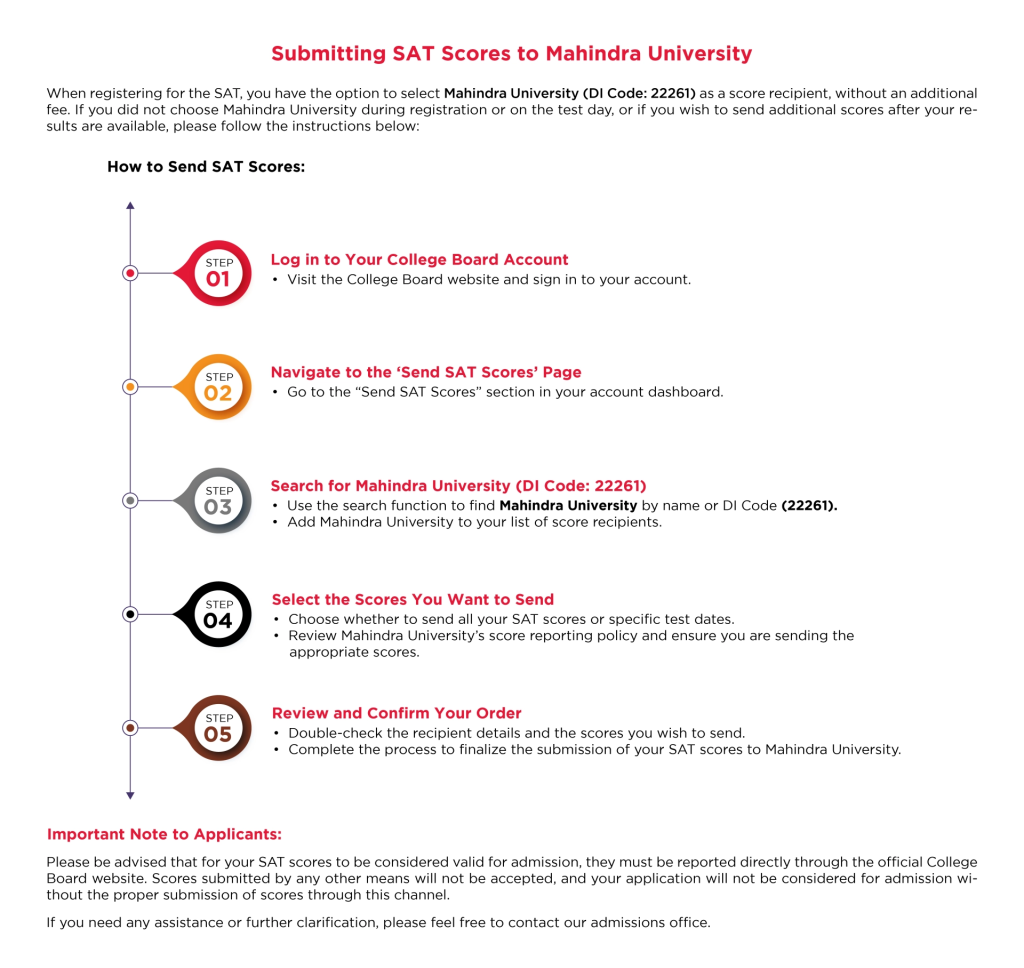
Submitting SAT scores

FAQs

Four years (8 semesters), including core, electives, labs, projects and internships.

Yes, hostel stay is mandatory for all B.Tech students.

JEE (Main), SAT (Subject / general), ACT. For some specialisations, particularly Biotechnology or Integrated options, additional PCB scores (Physics, Chemistry, Biology) may be required.

Yes, applicants through the SAT /ACT and, for certain specialisations, will undergo a technical & aptitude-based interview.

Yes, all fees (academic, hostel, etc.) are subject to annual revision.

Start your journey with us

Make an enquiry Chat with a student