Published On: December 29, 2025 Finishing an MBA is a big milestone. Whether you’ve just graduated or you’re about to graduate, one question that comes to your mind is: “What to do next?”
An MBA degree gives you plenty of options in finance, consulting, marketing, product roles, operations or even starting your own business. The problem isn’t a lack of opportunity, but choosing the right path. Each one comes with different salaries, perks and opportunities. What works brilliantly for one individual can feel completely different for another.
That’s why guessing, copying peers or chasing high-salary careers alone often leads to regret. You need more clarity, not just raw information.
In this blog, we’ll explore popular career options after an MBA, their salaries, required skills and the evolving job market. You’ll also discover how to align your MBA specialisation, interests and long-term goals to make an informed decision.
Top Career Options after MBA
After earning your MBA, you have more job opportunities than most other graduates. Companies want MBA professionals because they understand business, can solve problems and know how to lead teams. Here are the most popular and profitable career paths you can choose-
Career Options Comparison Table
Career Path
Average Salary (India)
Best For
Key Skills Needed
Investment Banking
₹12-25 LPA
Number lovers, high-energy people
Financial analysis, Excel, long hours
Management Consulting
₹10-20 LPA
Problem solvers, travelers
Analytical thinking, presentations
Marketing Manager
₹8-18 LPA
Creative minds, people persons
Creativity, data analysis, communication
Product Manager
₹12-22 LPA
Tech-interested strategists
Tech basics, user focus, decision making
Operations Manager
₹8-15 LPA
Process improvers, organisers
Process optimisation, logistics
Entrepreneurship
Varies widely
Risk takers, idea people
Everything + self-discipline
Finance Careers These include investment banking, financial planning and corporate finance roles. You’ll work with money, analyse companies and help businesses make smart financial decisions.Popular roles: Investment Banker, Financial Analyst, Finance Manager
Management Consulting Consultants are problem-solvers. Companies pay you to find their problems and fix them. You’ll work on different projects, travel often and learn about many industries.Popular roles: Management Consultant, Strategy Consultant, Business Analyst
Marketing & Brand Management If you like creativity mixed with strategy, marketing is for you. You’ll build brands, run campaigns and figure out what customers want.Popular roles: Brand Manager, Digital Marketing Manager, Product Marketing Lead
Product Management Product managers are like mini-CEOs of a product. You decide what features to build, work with engineers and make sure customers love what you create.Popular roles: Product Manager, Senior Product Manager, Product Lead
Operations & Supply Chain Keep businesses running smoothly. You’ll manage how products get made and delivered, cut costs and improve processes.Popular roles: Operations Manager, Supply Chain Manager, Process Excellence Manager
Entrepreneurship Use your MBA knowledge to start your own business. It’s risky but can be very rewarding if you have a good idea and strong dedication.Path: Startup Founder, Business Owner, Entrepreneur
How to Choose the Right Career Path after MBA
Picking a career after an MBA isn’t about what pays the most. It’s about what fits YOU best.
Here’s how to make the right choice-
Step 1: Know Your MBA Specialisation
Identify the different specialisations available in your MBA programme and explore what each entails.
Step 2: Match Your Interests with Market Demand
Research current job trends and industries to find a specialisation that aligns with your passions and has strong growth potential.
Step 3: Consider the Lifestyle
Think about the work-life balance, job locations and hours that come with different specialisations to ensure they fit your personal goals.
Step 4: Leverage Your Network
Engage with alumni and professionals in your areas of interest to gain insights and advice on the various specialisations available.
Step 5: Try Before You Decide
Participate in internships or shadowing opportunities to get a real feel for the work associated with your potential specialisation.
Market Outlook for MBA Graduates
The job market for MBA graduates in 2026 is strong, but it’s also competitive. Let’s look at what’s happening and where the opportunities are.
Current Job Market for MBA Graduates
The good news:
Indian companies are hiring more MBA graduates than ever
Startups are offering competitive salaries
Remote work has opened international opportunities
Digital transformation is creating new roles
The reality check:
Top companies still prefer graduates from premier B-schools
Competition is high – you need to stand out
Salaries vary a lot based on college and city
Some industries (like retail) pay less than others
Beyond your MBA degree, employers want these skills:
Data analysis: Know Excel, SQL basics or Power BI
Digital marketing: Understand SEO, social media, paid ads
Communication: Write clear emails and present confidently
Tech basics: Understand how software and apps work
Leadership: Show examples of when you led teams
Transform Your Career with a World-class MBA at Mahindra University
The MBA programme at Mahindra University’sSchool of Management offers a transformative experience structured around the “AIM” framework—Application, Industry Readiness and Market Relevance. The programme prioritises industry readiness, equipping graduates with expertise in digital business, analytics and sustainability, essential for success in the ever-evolving landscape of Industry 5.0.
Why Choose Mahindra University for MBA?
Industry-Ready Specialisations – Choose from Business Analytics, Finance, Digital Business or HR Management to align with your career goals.
Strong Placement Record – Average CTC of INR 11 LPA with the highest package at INR 16 LPA, backed by comprehensive career development support.
Guaranteed Internships – Mandatory summer internship between first and second year at well-known companies.
Global Career Edge – An international immersion programme adds global exposure to your resume, making you stand out to employers.
Future-Focused Skills – Curriculum designed for Industry 5.0 with emphasis on Analytical & Critical Thinking and Communication, the skills employers are actively seeking.
The curriculum is continuously updated to reflect the latest trends, ensuring that students emerge with skills that are both relevant and future-ready, positioning them for success in their careers.
Conclusion
An MBA is a significant investment of time and money, but it opens doors that can completely change your professional trajectory. Whether you choose finance, consulting, marketing or start your own business, the key is to pick something that matches your skills and interests, not just what pays the most. Remember these points to ensure your success:
Start exploring options early (during your MBA, not after)
Use your network – seniors, alumni and professors
Get internship experience to test different fields
Don’t stress if your first job isn’t perfect – you can always switch later
Keep learning even after MBA – market changes fast
Your MBA gives you the foundation. What you build on it is up to you!
FAQs
What jobs can you get after an MBA? MBA graduates can work as managers, consultants, analysts, marketers, HR professionals and product managers across industries.
What are the highest-paying jobs after an MBA? Investment banking, management consulting, product management, corporate strategy, private equity and senior leadership roles offer the highest MBA salaries.
Is an MBA worth it in 2026? Yes. MBA is worth it in 2026 due to the high demand for management professionals with strategic business skills.
How long does it take to get a job after an MBA? Most MBA graduates secure placements within three to six months through campus hiring, internships, networking and industry projects.
What if I don’t have work experience before an MBA? Freshers can pursue an MBA with strong academic credentials to enhance employability through internships, live projects and skill-based specialisations.
Can I switch industries after an MBA? Yes. MBA enables industry switching by building transferable skills, domain knowledge and professional networks across multiple sectors.
Published On: December 29, 2025 Considering a career in law immediately after completing your Class 12? You’re not alone. Thousands of students each year choose to pursue LL.B. after 12th through integrated five-year programmes that combine undergraduate studies with professional legal education. As India’s legal sector continues to expand with growing demand for corporate lawyers, litigation specialists and legal consultants, starting your law journey early can give you a significant competitive advantage.
To help you out, this comprehensive guide covers everything you need to know about pursuing LL.B. after 12th, including eligibility criteria, entrance examinations, fee structures, course duration, career prospects and specialisation options available in 2026. Let’s get started!
LL.B. after 12th: Key Takeaways
Aspect
Details
Programme Types
B.A. LL.B., B.B.A. LL.B., B.Tech. LL.B.
Course Duration
5 years (10 semesters)
Eligibility
10+2 from any stream, 45-60% marks
Main Entrance Exams
CLAT, AILET, LSAT India, University-specific exams
To pursue LL.B. after 12th, candidates must fulfil specific eligibility requirements set by universities and the Bar Council of India (BCI):
Criteria
Requirement
Educational Qualification
10+2 or equivalent from a recognised board
Stream
Any stream (Science, Commerce, Arts)
Minimum Marks
45-60% aggregate (General Category)
Minimum Marks (Reserved)
40-45% aggregate (SC/ST/OBC)
Age Limit
Generally under 20 years (varies by university)
Entrance Exam
Mandatory for most reputed institutions
Subject Requirements
No specific subject is mandatory
LL.B. Course Duration after 12th
The LL.B. course duration after 12th is 5 years, divided into 10 semesters. This integrated programme structure ensures comprehensive legal training combined with undergraduate education.
Programme Component
Duration
Focus Area
Academic Years
5 years (10 semesters)
Theory + Practical Training
Semester System
6 months each
Continuous evaluation
Internships
10-20 weeks (cumulative)
Practical legal exposure
Moot Courts
Throughout programme
Courtroom simulation
Total Duration
5 years
Complete programme
Each semester includes theoretical classes, practical training sessions, internship opportunities, moot court competitions, legal aid clinics and dissertation work. The five-year structure allows for a deeper understanding of legal concepts whilst developing practical skills essential for legal practice.
Types of LL.B. Courses after 12th
Students can choose from various integrated LL.B. programmes after 12th, each combining legal studies with different undergraduate disciplines:
Integrated LL.B. Programmes
Programme
Full Form
Focus Area
Ideal For
B.A. LL.B.
Bachelor of Arts and Bachelor of Legislative Law
Humanities, Social Sciences, Law
Students interested in social justice, human rights and policy
B.B.A. LL.B.
Bachelor of Business Administration and Bachelor of Legislative Law
Business Management, Corporate Law
Aspiring corporate lawyers, legal consultants
B.Com. LL.B.
Bachelor of Commerce and Bachelor of Legislative Law
Commerce, Taxation, Corporate Law
Students with a commerce background
B.Sc. LL.B.
Bachelor of Science and Bachelor of Legislative Law
Science, Technology, Law
Science stream students interested in law
B.Tech. LL.B.
Bachelor of Technology and Bachelor of Legislative Law
Technology, Intellectual Property, Law
Tech-savvy legal professionals
Specialisation Options
Students pursuing LL.B. after 12th can specialise in various legal domains during their course:
Constitutional Law
Corporate Law & Company Law
Criminal Law & Criminology
Family Law & Personal Laws
Intellectual Property Rights (IPR)
Cyber Law & Information Technology
Environmental Law
International Law & Human Rights
Tax Law & GST
Labour & Industrial Law
LL.B. Entrance Exams after 12th
Admission to reputed law schools for pursuing LL.B. after 12th requires clearing the entrance examinations. Here are the major law entrance exams for 2026: National Level Entrance Exams
Exam Name
Full Form
Conducting Body
Expected Exam Date 2026
Application Period
CLAT
Common Law Admission Test
Consortium of NLUs
May 2026
December 2025 – March 2026
AILET
All India Law Entrance Test
National Law University, Delhi
May 2026
February – April 2026
LSAT India
Law School Admission Test
Pearson VUE
Multiple dates (May-July 2026)
Ongoing registration
Fees for LL.B. after 12th
LL.B. course fees vary significantly based on institution type, location, infrastructure and facilities provided. Here’s a comprehensive breakdown: Fee Structure by Institution Type
Institution Type
Annual Fees
5-Year Total Cost
National Law Universities (NLUs)
₹1,50,000 – ₹3,00,000
₹7,50,000 – ₹15,00,000
Government Law Colleges
₹20,000 – ₹1,00,000
₹1,00,000 – ₹5,00,000
Private Universities
₹1,00,000 – ₹4,00,000
₹5,00,000 – ₹20,00,000
Deemed Universities
₹2,00,000 – ₹5,00,000
₹10,00,000 – ₹25,00,000
Scholarship Opportunities: Many institutions offer merit-based scholarships, need-based financial aid and fee waivers for economically disadvantaged students. Research scholarship options before finalising your admission.
LL.B. Career Scope & Salary Insights
Pursuing LL.B. after 12th opens diverse career opportunities in both public and private sectors with excellent earning potential. Popular Career Options After LL.B.
Job Role
Work Setting
Average Salary
Key Responsibilities
Litigation Lawyer
Courts, Law Chambers
₹4 – 10 LPA
Court appearances, case arguments
Corporate Lawyer
MNCs, Law Firms
₹6 – 20 LPA
Contract drafting, corporate compliance
Legal Advisor
Companies, Organisations
₹5 – 12 LPA
Legal consultation, risk assessment
Public Prosecutor
Government
₹4 – 8 LPA
Criminal prosecution, court representation
Legal Analyst
Research Firms, Think Tanks
₹3 – 7 LPA
Legal research, policy analysis
Judiciary Services
Courts (Civil Judge, Magistrate)
₹8 – 15 LPA
Adjudication, judgement delivery
Legal Journalist
Media Houses
₹3 – 8 LPA
Legal reporting, analysis writing
Company Secretary
Corporate Sector
₹6 – 15 LPA
Corporate governance, compliance
Higher Education Options After LL.B.
After completing their LL.B. after 12th, graduates can pursue advanced qualifications:
Programme
Duration
Career Benefit
LL.M. (Master of Laws)
1-2 years
Specialisation in specific legal fields
MBA
2 years
Business management with legal expertise
Judicial Services
Varies by state
Career as a Civil Judge/Magistrate
Ph.D. in Law
3-5 years
Academic & research positions
Foreign Legal Qualifications
1-3 years
International legal practice
Discover Future-Ready Law Programmes at Mahindra University
Mahindra University, a leader in innovative educational practices, is dedicated to transforming teaching and learning to develop law professionals who contribute positively to society. The university offers five-year integrated undergraduate programmes backed by a diverse and flexible curriculum and pedagogy taught by distinguished faculty.
Integrated Law Programmes Offered at Mahindra University
As society’s needs continue to evolve, the significance of legal education is becoming increasingly apparent, shaping public thought and contributing to societal well-being. The School of Law at Mahindra University offers students a platform to understand the true purpose of law and to engage actively in a just, civilised and progressive society.
Conclusion
Pursuing LL.B. after 12th through a five-year integrated programme is an excellent choice for students committed to building a career in law. With multiple entrance examination options and a diverse range of specialisations, aspiring lawyers have numerous pathways to enter this noble profession.
The LL.B. course duration after 12th spans five years, providing ample time to develop strong legal foundations, practical skills and professional networks. Whether you choose B.A. LL.B., B.B.A. LL.B. or innovative programmes like B.Tech. LL.B., the legal profession offers stable employment, competitive salaries and opportunities to make a meaningful societal impact.
Start your preparation for LL.B. entrance exams early, research your preferred institutions thoroughly and choose a programme that aligns with your career aspirations. With dedication, the right education and practical training, you can build a rewarding legal career that shapes justice and governance.
FAQs
What is the starting salary after LL.B.? Fresh LL.B. graduates typically earn ₹3-6 LPA. Salaries vary based on employer type, location, specialisation and individual skills. Corporate lawyers generally earn higher starting salaries.
Can I do LL.B. after 12th? Yes, you can pursue LL.B. after 12th through five-year integrated programmes like B.A. LL.B., B.B.A. LL.B., B.Com LL.B. or B.Tech. LL.B., offered by various universities across India.
What is the LL.B. course duration after 12th? The LL.B. course duration after 12th is 5 years (10 semesters), which includes theoretical classes, practical training, internships and moot court participation.
What percentage is required for LL.B. after 12th? Generally, candidates need 45-60% aggregate marks in Class 12 (40-45% for SC/ST/OBC categories). Specific requirements vary by institution.
Which stream is best for LL.B. after 12th? Students from any stream (Science, Commerce,= or Arts) can pursue LL.B. after 12th. Choose based on your interests and the integrated programme you wish to pursue.
What are the main entrance exams for LL.B. after 12th? Major entrance exams include CLAT (Common Law Admission Test), AILET (All India Law Entrance Test), LSAT India, MH CET Law and university-specific exams such as Mahindra University Law Entrance Test (MULET).
Is CLAT mandatory for LL.B. after 12th? CLAT is mandatory for admission to National Law Universities (NLUs). However, many private universities and state institutions conduct their own entrance examinations.
What is the average LL.B. course fee after 12th? LL.B. course fees after 12th range from ₹1,00,000 to ₹4,00,000 per year in private universities, while government institutions charge ₹20,000 to ₹1,00,000 annually.
Can I become a lawyer immediately after completing LL.B.? After completing LL.B., you must clear the All India Bar Examination (AIBE) conducted by the Bar Council of India to practice as an advocate in Indian courts.
What is the difference between B.A. LL.B. and B.B.A. LL.B.? BA LL.B. focuses on arts, humanities and social sciences alongside law, while B.B.A. LL.B. emphasises business administration and corporate law. Choose based on your career interests.
Published On: December 8, 2025 If you’re looking to find the best MBA college in Hyderabad, you are already on the right track for having a very fulfilling management career. In just the past half a decade, the demand for MBA graduates has grown from 47% in 2021, to 78% in 2025, indicating a dramatic shift in the employability rate in the management related career paths, both domestic as well as international.
Hyderabad has been the hub of engineering for years. But, there is more to the city. IT is also home to some of the country’s best management and business schools, offering a variety of experiences and knowledge for the success of your career.
However, given the different choices at hand, it can be quite a task to finalise a good MBA college. The content below will help you understand the different criteria to find the business school of your dreams.
MBA Colleges in Hyderabad: Key Highlights
Educational Qualifications
Undergraduation/Post Graduation in any discipline by any accredited/recognised University.
Final year students can apply by providing proof of completion at the time of admission.
Qualifying Percentage
A Minimum of 50% aggregate is required to compete.
45% for reserved categories like SC/ST.
Entrance Exam Requirements (if any)
TSICET
CAT
XAT
MAT
GMAT
CMAT
Similar Exams.
Work Experience requirements (if any)
Some Business Schools require 1-5 years of work experience.
Depends from college to college.
Why Pursue an MBA in Hyderabad?
Hyderabad has evolved far beyond its reputation for historical landmarks and IT corridors. Today, not only does it stand as one of India’s fastest-growing hubs for management education, but also boasts an increase in management related career verticals throughout its corporate network.
Hence, choosing an MBA college in Hyderabad offers students a one stop access to its diverse academic options, a straightforward career ladder and a high quality lifestyle, which are essential for building a strong career foundation.
Some reasons why Hyderabad is a top destination for MBA aspirants are: A Thriving Job Market and Tech Hub
Leading corporates, tech giants and consulting firms consistently induct new management recruits to work with their ever-growing client base.
An extensive and established network of working professionals open to networking, collaborations and mentorships.
Emerging startups offering promising management roles to match their vision of success.
Strong Corporate Exposure Some of the best MBA colleges in Hyderabad maintain constant ties with startups, MNCs and major firms, leading to better placements, high quality internships and more. Excellent Return on Investment (ROI) When we compare the MBA fees against the placement records, the MBA colleges in Hyderabad have proven to have excellent ROI. Diversity Within MBA Specialisations Some of the best MBA colleges in Hyderabad offer a variety of relevant specialisations, like Business Analytics,Finance,Digital Business and Human Resource Management. Growing Startup and Innovation Ecosystem
City of emerging ideas and startups.
Vibrant entrepreneurial culture.
Ease of establishing new business ventures.
Easy collaboration and approachability of emerging tech driven firms.
Thus, by choosing Hyderabad as your destination for postgraduation, students gain access to not just quality education, but also a thriving professional environment, global and national exposure, as well as long term career advancement.
Factors to Consider When Choosing an MBA College in Hyderabad
We know it can be a tough decision to choose your dream MBA course. There are a lot of intricate factors involved. However, to make things easy, here is a consolidated list of factors to weigh and consider to better help you choose the right MBA college in Hyderabad.
Ranking
Checking the ranking of the MBA college will help you determine its overall proficiencies.
Alumni network
A strong and competent alumni network indicates placement and success rate of an MBA course.
Faculty
A specialised and credible faculty leads to higher teaching retention and better understanding, indicating higher chances of success after graduation.
Placements
The quality of placements and number of companies coming to an MBA college.
Affordability and scholarships
The affordability of an MBA college and the quality of scholarships that it offers, is a good indicator for its approachability.
Location
The location and locality of an MBA college is essential for better connectivity and ease of living.
Accreditation
Accreditations like NAAC and AICTE.
Extracurricular activities and clubs
Along with the technical and educational aspects, cultural and quality-of-life aspects of an educational institution matters equally, to ensure holistic growth of an individual.
Fee Structure
A reasonable and affordable fee structure is important to determine if an MBA college is right for you.
Global Exposure
The amount of global exposure and interconnectivity.
Placement records
A successful and consistent placement record is a badge of honor for any MBA college, which helps in shortlisting a good MBA course.
Possibilities for internships
The number of companies offering internships as well as the quality of internships being.
Campus infrastructures and facilities
The quality of life offered by the MBA college, along with various facilities like local connectivity, medical facilities, amenities, recreational zones, green area cover.
Curriculum
The relevancy, practicality and ease-of-understanding of an MBA college’s curriculum.
Industry exposure
The level of industry exposure, hands-on analysis and expert interactions an MBA college conducts.
Understanding these factors might help you determine the most suitable MBA college for you in Hyderabad.
MBA Colleges in Hyderabad – Eligibility Criteria
A lot of MBA aspirants wonder what the eligibility criteria for an MBA course is. Here is a list of some of the most common requirements of most MBA colleges in Hyderabad.
Graduation Pre-Requisites
At least an undergraduate degree in any discipline from an accredited college/university.
Qualifying Competitive Exams
TSICET / CAT / XAT / MAT / GMAT / CMAT / OTHER
Personal Interviews
Personal interviews of the candidates to determine their proficiencies.
Group Discussions
Group discussions of multiple candidates to determine collaboration, compatibility and assertiveness required for an MBA course.
Statement of Purpose (SOP)
SOP written by the student to determine their aspirations and articulations.
Extra Co-Curriculars
Extra co-curricular certifications to determine the holistic ambitions of the student.
This list might help you better understand the eligibility criteria for most MBA courses in Hyderabad. However, some colleges have a few extra or different requirements sometimes. Hence, it is essential to also check the websites of the specific colleges that you want to apply to.
MBA Entrance Exams and Admission Process in Hyderabad
The selection criteria for an MBA course depends on the students’ score in competitive exams (CAT, XAT, TSICET, MAT, GMAT, CMAT, Etc). Sometimes, in cases where students have not sat for the mentioned (or similar) exams, the university lets them qualify using their own entrance exams. Other times, this second set of competitive exams can be another qualifying round to be cleared on top of giving the exams.
This is followed by Personal Interviews and Group Discussions. Some business schools use Personal Interviews and Group Discussions interchangeably, while some incorporate both as two separate qualifying rounds.
Since no two business schools are the same, it is advised that you go through the admission processes mentioned in the school’s website, to avoid any confusions.
Step into Leadership with Mahindra University’s MBA Programme
Mahindra University, Hyderabad is a multidisciplinary institution in India committed to nurturing future leaders. With a strong focus on academic rigour, industry relevance and specialising fields like engineering, business and law, Mahindra University emerges as a hub of innovation for the greatest minds of tomorrow.
The Mahindra University’s School of Management, a member of the Association to Advance Collegiate Schools of Business (AACSB), aspires to be a new–age business school and strives to achieve excellence across undergraduate and post-graduate levels. The School offers a comprehensive MBA programme that has been carefully curated and built using the “AIM” framework.
“AIM” stands for:
Application- integration of various elements like case-studies, simulations and hands-on projects, enabling real world applications of the student’s education.
Industry Readiness- ensuring that students are prepared to face the ever-evolving demands and shifts in the trajectory of their careers.
Market Relevance- ensured through continuous updates in the curriculum in order to align with the changes in trends and innovations, enabling the students to graduate future-ready and relevant in application.
Mahindra University’s School of Management, apart from ensuring state of the art education, fulfills all the criteria for the best MBA college in Hyderabad. With its diverse student base, highly experienced faculty, a strong alumni network, state-of-the-art campus, competitive placements, international collaborations and industry exposure, it is a testament of excellence, taking its place as one of the best MBA colleges in Hyderabad.
Moreover, to provide students global exposure, Mahindra University also has academic partnerships with top universities like:
Frankfurt School of Finance and Management
La Trobe University
Cornell’s SC Johnson College of Business
University of Houston’s C.T. Bauer College of Business
The University of Melbourne
University of Florida
Virginia Tech
With the average placement CTC for the MBA course being 11LPA and the highest being 16LPA, the University’s MBA course placements show high competency, creating national opportunities and competent thought leaders.
Conclusion
Finalising the best MBA college in Hyderabad requires a clear clarity about your career aspirations along with the quality of education you aim to seek. Some factors that make Hyderabad a promising professional destination is its thriving tech industry, strong connectivity and a student friendly environment.
While choosing an MBA course, you should consider an MBA college’s accreditation, curricular relevance, placement and CTCs, faculty expertise, affordability and its industry exposure. Mahindra University’s School of Management, thanks to its AIM-based learning approach, the global partnerships, experienced faculty, a robust placement record and a future-forward curriculum designed to tackle real world problems, offers a competitive and future-ready learning environment for aspiring leaders.
Explore Mahindra University’s MBA today to take the first step towards your successful management career.
Frequently Asked Questions (FAQs)
Who is Eligible for an MBA Course? A student with an undergraduate degree in any discipline with at least 50% aggregate, has completed relevant competitive exams like TSICET / CAT / XAT / MAT / GMAT / CMAT and has some work experience, is eligible for an MBA course.
Is an MBA Course Still Worth Doing in 2026? Yes, doing an MBA course is still relevant and can help in career advancements, higher salaries and networking. It is also lucrative for those wanting career transitions.
What is the Cost of an MBA Course in Hyderabad? The cost of an MBA course in Hyderabad is 8L-18L.
Does enrolling in an MBA Course Lead to a Salary Increment? Generally, you can expect a nearly 50-70% increase in your salary after completing an MBA course.
Published On: December 8, 2025 Let’s face it- figuring out what to do after completing your class 12 or BBA programme is not that easy.
This small decision shapes your future, career direction and also the lifestyle you will build. But that is where most students find themselves stuck between too many opinions and little real information.
You will find that everyone says different things. Like-
Do BBA, it’s great for business.
No, you should pursue B.Com as a safer option.
MBA is a better choice.
With all these opinions, it is not easy to discover which is right or not. The only question that comes to your mind again and again is
Does the BBA programme actually have a good scope?
So the answer is clear- the scope after BBA today is expanding and more exciting than ever before. Businesses are growing, startups are scaling fast as well as digital roles are increasing; this is where industries demand skilled management professionals who match their requirements. That means students come across various roles in marketing, finance, HR and many others.
In this blog, you will actually know about career opportunities, salaries, job roles and everything that helps you achieve success after BBA.
Why Do Students Prefer BBA Instead of B.Com, BA or BMS?
As we know, BBA stands for Bachelor of Business Administration, which is a 3 year undergraduate level programme focused on business management and leadership. During the course, students will learn how organisations work and different aspects of business like marketing, finance, HR, etc.
Not only this, there are several reasons that gain students’ attention for the BBA course over other programmes.
More practical and skill-oriented
Multiple internships and industry-exposure opportunities
Opens wider job options immediately after graduation
Suitable for both government and private sector careers
Who Should Choose a BBA?
It’s a fact that selecting a programme becomes much easier when you match your interests.
If you’re someone who
Choose fields like
Loves numbers and solving analytical problems
Finance / Business Analytics / Accounting / Consulting
Enjoys creativity and brand storytelling
Marketing / Digital Marketing / Brand Strategy
Enjoys working with people and communicating
HR / Sales / Business Development
Likes organising, planning, and fixing processes
Operations / Supply Chain / Project Management
Takes risks and believes in ideas
Entrepreneurship / Startups / Family Business
Career Scope After BBA Across India
Students can make a choice between multiple career pathways, which completely depend on their goals and skills. When it comes to scope after a BBA course, the journey is not the same for everyone and that is what makes this programme unique.
Jobs in the Private Sector Corporate roles across marketing, HR, banking, consulting, operations, sales and finance.
Government Jobs Banking, UPSC, railways, defence and public sector undertakings.
Entrepreneurship Start your business or contribute to a high-growth startup.
Jobs Abroad & Migration International placements, global internships or study abroad programmes.
It is clear that the scope after BBA is flexible and broad for students.
Top Career Opportunities After BBA Course
Let’s explore the top in-demand career roles for BBA graduates today-
Job Role
Description
Average Entry Salary (INR)
Future Growth
Management Trainee
Trains across departments to understand organisational functions
3-6 LPA
Leadership positions
Marketing Executive
Works on campaigns, customer reach and brand growth
3-5 LPA
Brand Manager, CMO
HR Executive
Handles hiring, onboarding, payroll, and team experience
3-6 LPA
HRBP, HR Head
Financial Analyst
Manages financial data and helps decision-making
4-8 LPA
Investment & Finance
Business Development Executive
Builds partnerships and revenue
3-7 LPA
Sales / Strategic growth
Operations Executive
Manages processes and workflows
3-6 LPA
Supply Chain Lead
Digital Marketing Specialist
Manages advertising, SEO, social media
3-7 LPA
Growth & Performance roles
Data Analyst
Uses data for business improvements
4-10 LPA
Business/Data Manager
Banking Executive
Customer support, accounts, lending
4-8 LPA
Retail / Corporate banking
Entrepreneur
Runs own startup
Variable
Startup ecosystem
Product Management Associate
Works on tech product strategy and development
6-12 LPA
Product Manager
Customer Success Associate
Improves client experience and retention
4-8 LPA
Customer Success Manager
Top Recruiting Sectors and Companies Hiring BBA Graduates
The scope after BBA is wide and there are numerous top leading industries that want to hire skilled graduates. Sectors Hiring BBA Students
IT & Technology
BFSI
Consulting
E-commerce
FMCG
Retail
Hospitality
Healthcare
Logistics
Popular Recruiters
Deloitte
TCS
Wipro
Infosys
HDFC
Amazon
Swiggy
Accenture
Reliance
ICICI
Kotak
Flipkart
Tata Group
Salary Expectations After Completing BBA Course
You can explore endless high-paying career opportunities when it comes to scope after BBA. It is also true that the salaries vary depending on your location, performance, industry as well as specialisation.
Here is a general overview-
Entry-level- Rs 2.5–5 LPA
Mid-level (3–5 years)- Rs 6–10 LPA
Senior roles (8+ years)- Rs 12–20 LPA and above
Higher Studies options after BBA Programme
If you want to pursue higher education after your BBA, numerous options are available. Let’s take a look at some of them-
Course
Ideal For
Outcome / Sector
MBA / PGDM
Leadership aspirants
Corporate leadership
Business Analytics
Data-centric minds
Consulting / Data science
Digital Marketing
Creative thinkers
Media, branding, content
CA / CS / CFA
Finance-focused students
Investment / finance roles
Law / LLB
Legal interest
Corporate & business law
Future Scope After BBA in India and Globally
The future of BBA students is bright. As we know, India’s economy grows rapidly and startups, digital transformation and global expansion create new opportunities.
Emerging Fields
Product Management
Business & Data Analytics
Customer Success Management
AI & Business Integration
Venture Capital and Entrepreneurship
Sustainability & ESG Management
Shape a Future-Ready Business Career Through BBA at Mahindra University
If you want a BBA course that offers more than just academics, Mahindra University stands out with its global exposure, industry-ready training and strong placement outcomes.
How does Mahindra University help students achieve a rewarding career?
Industry-aligned BBA curriculum designed for modern business challenges
Specialisations in high-demand fields like Applied Economics & Finance, Computational Business Analytics and Digital Technologies
Global academic collaboration with Cornell University’s SC Johnson School of Business, USA
Experiential learning through case studies, simulations, internships and live industry projects
Advanced labs such as Centre of Entrepreneurship & Innovation for learning
Strong placement support backed by the Mahindra Group ecosystem and industry recruiters
Join Mahindra University’s BBA course to get a combination of global exposure, practical business training, good placements as well as a supportive learning environment.
Conclusion
The scope after BBA is growing at a rapid pace due to India’s increasing business growth and the rise of new start-ups in India. A BBA Degree will provide you with a variety of jobs in both the private and public sectors, opportunities for International Jobs, Entrepreneurial Ventures and strong salary growth. When combined with the right combination of skills and experience, your BBA Degree will help you to create a rewarding, long-term career.
If you want to achieve a high-paying and successful career after BBA, apply now at Mahindra University, where you will get the skills and knowledge to lead confidently in the real business world.
FAQs
Why do students prefer BBA over B.Com? Students prefer BBA due to various reasons- practical and skill-oriented, internships, industry-exposure opportunities, wider job options and suitable for both government and private sector careers.
Is there any scope after BBA? Yes, BBA students have a good scope after completing their programme. This is because India’s economy is growing rapidly and startups, digital transformation and global expansion create new opportunities.
Where can I make a career after BBA? You can explore a variety of career pathways across diverse industries like Finance, HR, marketing and many more.
Published On: November 26, 2025 When a field built on breaking news becomes the news itself- you know a shift is happening.
For years, people saw journalism as a glamorous path, but students today look at it very differently. Even The Times of India recently pointed out that some universities noticed fewer applicants and that says a lot about how quickly the field is changing. The reason behind this decline is that many young aspirants question-
Outdated curriculum
Limited print opportunities
Growing crisis in credibility
As the traditional model struggles, the new media landscape is reinventing itself. Digital media has opened up a diverse range of new career paths- everything from multimedia reporting and content strategy to podcasting, data-driven storytelling and even social media journalism.
Amid this shift, a Masters in Journalism and Mass Communication is still relevant. But only when it pairs with skills designed for a digital ecosystem. In this blog, you will explore how the MJMC degree benefits students to build agile and future-ready careers in the modern media world.
Why Journalism is Undergoing a Shift
The journalism world doesn’t look the same way it did five years ago. Students who are on their way to enter this field can easily identify the gaps between what traditional media offers and what digital platforms demand. This significant transformation comes from several factors, such as-
Decline in Traditional Newsroom Jobs- Many companies emphasise a digital team instead of a large editorial floor.
Changing Audience Behaviour- Nowadays, audiences don’t wait for the morning newspaper and the 9 PM bulletin. Now they can scroll, swipe and watch the news on the go.
Credibility and Trust Challenges- Misinformation spreads rapidly online as well as audiences grow more sceptical.
What Today’s Youth Expect from Journalism Education
Students who want to pursue a Masters in Journalism and Mass Communication expect practical aspects more than theory. Here are some crucial things that every learner demands from the university-
Updated, Industry Aligned Curriculum Young aspirants want an MJMC programme syllabus that includes digital storytelling, social media strategy, influencer communication as well as data literacy. It aligned with the digital media world requirements that help them thrive in this competitive landscape.
Exposure to Digital Tools and Platforms Every student wants to gain practical experience during their studies so that they can be well-prepared. They prefer programmes that help them to use-
Editing software
Analytics dashboards
CMS tools
Audio and video production equipment
Practical, Newsroom-Style Training Universities should focus on experiential learning so that learning is not limited to lectures. Students want simulated newsrooms, digital labs and hands-on content production. They want to learn by creating, not just by listening.
Opportunities for Internships and Real-World Projects You will be surprised that today’s youth value internships more than ever. They search for universities that connect them with media houses, digital agencies as well as content studios. Also, an opportunity to work on real-world projects to strengthen confidence and portfolios.
Rise of Digital-Native Media Careers for MJMC Graduates
After completion of the Masters in Journalism and Mass Communication programme, the digital boom creates new job opportunities.
Here are some departments and agencies where graduates are found valuable-
Digital and multimedia news desks
AI desks in news organisations
Investigative and data desks at news organisations
Entertainment production houses and over-the-top (OTT) streaming platforms
Documentary film producers
Corporate filmmakers
Commercial filmmakers
Creative, production, media and account divisions at advertising agencies
Special visual effects (VFX) and animation production houses
Public relations consultancies
Why is Masters in Journalism and Mass Communication Still Relevant in the Digital Age?
Apart from rapid industry changes, students still choose the MJMC course because of many reasons- structure, depth and direction. Below are some primary reasons why students consider this programme relevant-
Broad, Interdisciplinary Learning A MJMC programme integrates journalism, communication, digital media, public relations, advertising and storytelling, allowing you to pursue career opportunities across a variety of sectors.
Strong Foundation in Storytelling While technology and tools are always changing, storytelling is embedded in the practice of journalism. A good programme will improve storytelling techniques that strengthen your ability to write, observe, identify angles and communicate effectively in a variety of formats.
Exposure to Journalism and Mass Communication Fields Therefore, you will have a strong understanding of everything from reporting and editing to branding and corporate communications, making you more employable and adaptable.
Ability to Specialise in Digital Media Most universities will now offer advanced electives like data journalism, advanced multimedia, digital production and influencer communication.
Essential Digital Skills an MJMC Student Will Gain
If you want to gain a successful career in the modern media, you need to develop strong digital skills. Here are some crucial ones you will develop during the Masters in Journalism and Mass Communication programme-
Skill
Why It Matters
Video editing & mobile journalism
Helps you create quick, platform-ready stories
SEO-led content creation
Improves visibility and search ranking
Social media analytics
Helps you understand audience behaviour
Podcast production basics
Supports the rising audio content trend
Data visualisation tools
Makes complex information easier to understand
Digital newsroom workflows
Prepares you for fast-paced publishing
Ethical reporting practices
Builds trust and credibility
How are Universities Updating Their MJMC Curriculum?
Now, several universities are working on reshaping their Masters in Journalism and Mass Communication curriculum to meet the pace of the digital media world.
Industry Collaborations Partnering with digital newsrooms, content studios as well as social media companies to offer better exposure.
New-Age Electives Students can now explore-
Digital storytelling
AI in media
Social media reporting
Visual communication
Influencer marketing
Hands-on Labs and Studio Training Modern campuses invest in-
Newsrooms
Video and audio studios
Editing labs
Green screens
Podcasting rooms
Live Projects, Internships & Capstone Projects These assignments will help students develop strong portfolios for the future. Workshops with Journalists/Content Creators These sessions will provide updated knowledge about industry trends, challenges as well as career paths.
Tips for Students Planning to Pursue Masters in Journalism and Mass Communication
If you are thinking of applying for the MJMC course, you have to consider some significant tips.
Choose a university with strong digital infrastructure
Look for updated curricula that match industry requirements
Build a portfolio from the very first semester
Stay active on platforms like LinkedIn, YouTube or Medium
Network with professionals from media, advertising and digital sectors
Looking for a Digital-Driven Masters in Journalism and Mass Communication? Mahindra University Sets the Benchmark
If you are looking for a future-focused MJMC programme in this digital world, Mahindra University is the one to choose. The School of Digital Media and Communication offers an MA in Journalism and Mass Communication (MJMC) course which prepares graduates to be righteous, responsible, competent and globally acceptable. The course is designed with a focus on ethical, practical and digitally-savvy storytelling to develop graduates who are conceptually strong and industry-ready.
Let’s look at the key highlights that make Mahindra University stand out-
Curriculum designed around three strands- News Media & Journalism, Filmmaking & Media and Digital Media & Communication Management
Global partnerships with the University of Florida and Virginia Tech in the USA, La Trobe University in Australia and École Centrale of France
One social sector internship and two specialised industry internships
Workshops and masterclasses in super-specialised areas (e.g., “Gaming”, “AI in media production”)
Field visits, industry reports as well as guest sessions
Choose the Mahindra University MJMC programme that is perfectly aligned with digital trends in the media landscape.
Conclusion
The journalism field is not dying- it’s evolving into something bigger, faster and more creative. The digital media world unlocks new opportunities and students who embrace digital media can actually build successful careers. By choosing the right Masters in Journalism and Mass Communication course, you are able to shape stories, influence conversations and leave your mark in this ever-changing world.
If you are ready to build a rewarding career in the digital media world, explore Mahindra University’s MJMC course that offers a digital-focused curriculum and experiential learning. Apply now!
FAQs
How are universities updating their MJMC curriculum? Many colleges work on industry collaborations, new-age electives, hands-on labs, studio training, live projects, internships, capstone projects and many more.
How long does it take to complete the MJMC course? The duration of Masters in Journalism and Mass Communication is 2 years.
What digital skills will graduates develop with MJMC? Students will gain core skills- video editing & mobile journalism, podcast production basics, data visualisation tools, digital newsroom workflows, ethical reporting practices, etc.
Published On: November 26, 2025 Headline of the future? India is set to become the world’s next creative hub and it’s already happening. But how?
The Delhi government is developing a policy to support the animation, visual effects, comics and gaming industries. As per the report by The Times of India, the Delhi government’s new policy aims at attracting talent, studios and startups to the capital, making it a centre for visual storytellers, digital artists and design thinkers alike.
By supporting young innovators, this government initiative could redefine how creativity is nurtured and recognised in our communities. India’s creative world is moving fast, with artists now building virtual spaces so real- they’re hard to tell apart from life itself. Design is finding new meaning every day and that’s not just in fashion or interiors but also in sectors like gaming, visual media, product innovation and sustainable design practices.
With creativity carrying so many industries forward, there has never been a better time to become a designer. Ready to begin your future in design? Getting a Bachelor of Design degree might just be the step you need to take.
The Rise of the Creative Economy in India
There is a rapid expansion in India’s creative economy. Starting with animation studios in Mumbai to design labs in Bengaluru, creativity is becoming a booming business. India is now being seen as a growing player among the global creative industries such as product design, digital design, gaming and sustainability. Also, the rise of innovation led by design has touched almost every sector, covering technology, fashion, architecture, retail and even manufacturing. This reflects that design is no longer limited to the decoration part, as now it sets the direction.
According to industry insights, the design sector continues to grow at a steady pace as companies are adapting design thinking to solve modern problems. This rise isn’t just about the opportunities, but also about the reinvention of industries, ideas and careers.
Why Design is the Future: Industries Redefined by Creativity
India’s creative wave is transforming how industries work and connect with people. Let’s look at where a B.Des degree is making the biggest impact today.
Animation and VFX India is emerging as a global production hub. Starting with HQ animation for international films to realistic visual effects in OTT platforms, design professionals are shaping this field like never before.
Gaming and AR/VR The gaming and immersive experience industry is also experiencing significant growth. Designers now build 3D worlds and with that engage millions of users every day. AR and VR are not just for entertainment purposes but are also changing how we learn, shop and interact.
Product and Industrial Design Innovation done for users in mind is reshaping how interaction is done with everyday objects. A good design ensures that the function justifies its appeal in every aspect.
UI/UX Design Every app and platform we use depends on design thinking. UI/UX designers create experiences that are simple and easy to understand so that everyone can experience them equally.
Sustainable Design Eco-friendly designs have become the core of modern designs. Creativity is driven by sustainability and the proof for it is green architecture, upcycled fashion and biodegradable materials.
No matter what the medium is, design acts as the invisible force behind everything that feels modern, functional and human.
The Power of a Bachelor of Design Degree
A Bachelor of Design degree serves as the foundation for you if you want your creative passion to be a meaningful profession. It combines creativity, research and technical knowledge together, which gives students the confidence to experiment and innovate.
During this programme, students explore advanced projects using new tools and techniques. They learn to think across disciplines like graphic, product design, communication and experience design.
Design thinking is at the centre of every project you will put your hands on. It teaches students to analyse problems, empathise with users and craft creative solutions. A BDes doesn’t just teach you to design — it teaches you to think differently.
Skills You Gain with a Bachelor of Design Degree
A Bachelor of Design degree enhances your skills so that you’re prepared for diverse creative careers. You will gain-
Visual communication and storytelling- lets you convey ideas clearly and beautifully.
Design software mastery- allows practical learning using advanced tools- Adobe Suite, Figma, Rhino, Blender and more.
Digital design and prototyping- lets you turn your ideas into real and testable creations.
Design strategy and user research- helps you understand what users want and why it matters.
Collaboration and presentation skills- very vital for working in creative teams.
Creative innovation and critical thinking- equips you with skills that push boundaries and inspire change.
These skills take you far beyond studios and classrooms so that you can prepare yourself for leadership roles in industries that value creativity, adaptability and fresh ideas.
Career Opportunities after a B.Des. Degree
Graduates with a Bachelor of Design degree can get vast opportunities across a multitude of industries. Look at some of the promising career paths-
Graphic Designer or Art Director Creates branding, advertising, digital campaigns to build a meaningful connection with audiences.
Product Designer Designs consumer goods, tech devices, sustainable products- and help make everyday life better.
UX/UI Designer Shapes user experiences across apps, websites and digital platforms.
Animation and VFX Artist Works in film, gaming or television, crafting visuals that bring stories to life.
Fashion Designer Develops designs that influence trends and express creativity through apparel.
Design Consultant Helps organisations innovate through design-led thinking and by using creative problem-solving.
As India positions itself as a global design hub, these careers can no longer be considered niche — they’re the future of innovation.
Why Now is the Best Time to Pursue a B.Des Degree
As you can see, there is a boom for designers on a global level and there are initiatives like the Delhi government’s plan to make the city a hub for animation and VFX. That is a reason compelling enough to step into designing and following your passion. Also, India is investing heavily in creative industries. There are global trends such as “AI-assisted design, digital fabrication and eco-conscious creativity” that are shaping the future of designing.
Design has become a mainstream career for many as it combines imagination with impact. It allows professionals to build sustainable, tech-driven and visually powerful solutions. For those who dream in ideas, sketch possibilities and see beauty in innovation — there’s never been a better moment to be a designer.
Discover Your Creative Future at Mahindra University
Step into this world of innovation combined with artistic expression at Mahindra University’s School of Design Innovation. The interdisciplinary four-year Bachelor of Design (BDes) degree offered by the School is designed with the aim of fostering and grooming young minds to drive the future. The curriculum is curated with a focus on the design and innovation of products and services, which align with the global business requirements.
Key Highlights of the Programme
Emphasis is on teaching Design Thinking for innovation
International faculty roster with rich industry-academic background
Global exposure and research focus for creative thinking
Contemporary curricula that are frequently reviewed and updated
Well-equipped Design Labs & Studios for experiential learning
Partnership with the Pininfarina Design Academy in Torino, Italy and Shenoy Innovation Studio, IDC IITB
Field visits, cross-cultural art and design boot camps for better industry insights
Have a look at the programme structure for better understanding-
Year
Focus / Theme
Summary
1st Year
Foundation courses & Design Thinking immersion
Establishes core design skills: sketching, material exploration, visual principles, history, and introduces design thinking.
2nd Year
Honing the design innovation process & elective-choices
Students choose specialisation tracks, e.g., Industrial Design, Interaction Design, Communication Design, Apparel Design and deepen discipline-specific learning, systems thinking, project work and electives.
3rd Year
Emerging Technologies & Deep Dives in electives
Students explore emerging fields such as AI and advanced prototyping.
4th Year
Thesis project focused on industry sector areas
Capstone phase: industry-linked projects, internships, thesis work in real-world settings aligned with sectoral challenges.
Lead the next generation of design innovators in India with this course. Begin Your Journey with Mahindra University’s Bachelor of Design programme that gives you the support, guidance as well as direction to turn your creative ideas into reality. Let your ideas shape the future at Mahindra University.
Conclusion
Design happens to be everywhere we go. The world of creativity is growing super fast and India is helping make that happen. There are exciting educational resources and programmes awaiting aspiring designers from diverse institutions! Seize this wonderful opportunity to showcase your unique talent in this vibrant design industry.
Take the first step into the Bachelor of Design and build your future. Mahindra University is a great place to start. It is a place where ideas come alive as well as your imagination can go wild.
FAQs
Who is eligible for applying in this course? Anyone who has finished their +2 and is interested in niches that count as design, art or innovation is eligible to apply.
What is a Bachelor of Design degree? It’s a four-year course where students learn how to create basically. It can be anything like products, visuals or even experiences using their creativity and design thinking.
What’s there to learn in a BDes programme? You’ll learn a lot more about design and yes, that includes design thinking, digital tools, product design and even how to bring creative ideas to life through projects and teamwork.
What jobs are available after this course? You can work in various fields after completing a BDes. Jobs that are common and available are those of a graphic designer, product designer, UX/UI designer, fashion designer or even start your own design business.
Why should I study at Mahindra University? Mahindra University helps students learn with the help of real projects, a vivid international exposure and excellent guidance from expert mentors. It can be the perfect place for beginning your design journey.
Published On: October 30, 2025 Think of bacteria cleaning oil spills. Imagine crops that grow without harming the earth. Now picture genetic codes helping doctors cure the incurable. Sounds futuristic?
But now it’s all happening!
Thanks to biotechnology.
In the past decade, biotechnology has not just been about test tubes and petri dishes. It has moved nearly to every sector- agriculture, healthcare, environmental conservation or artificial intelligence. The result?
The shift has created an enormous global demand for biotechnologists. According to Grand View Research, the global biotechnology market is forecasted to reach USD 3.88 trillion by 2030, growing at a CAGR of 13.96%.
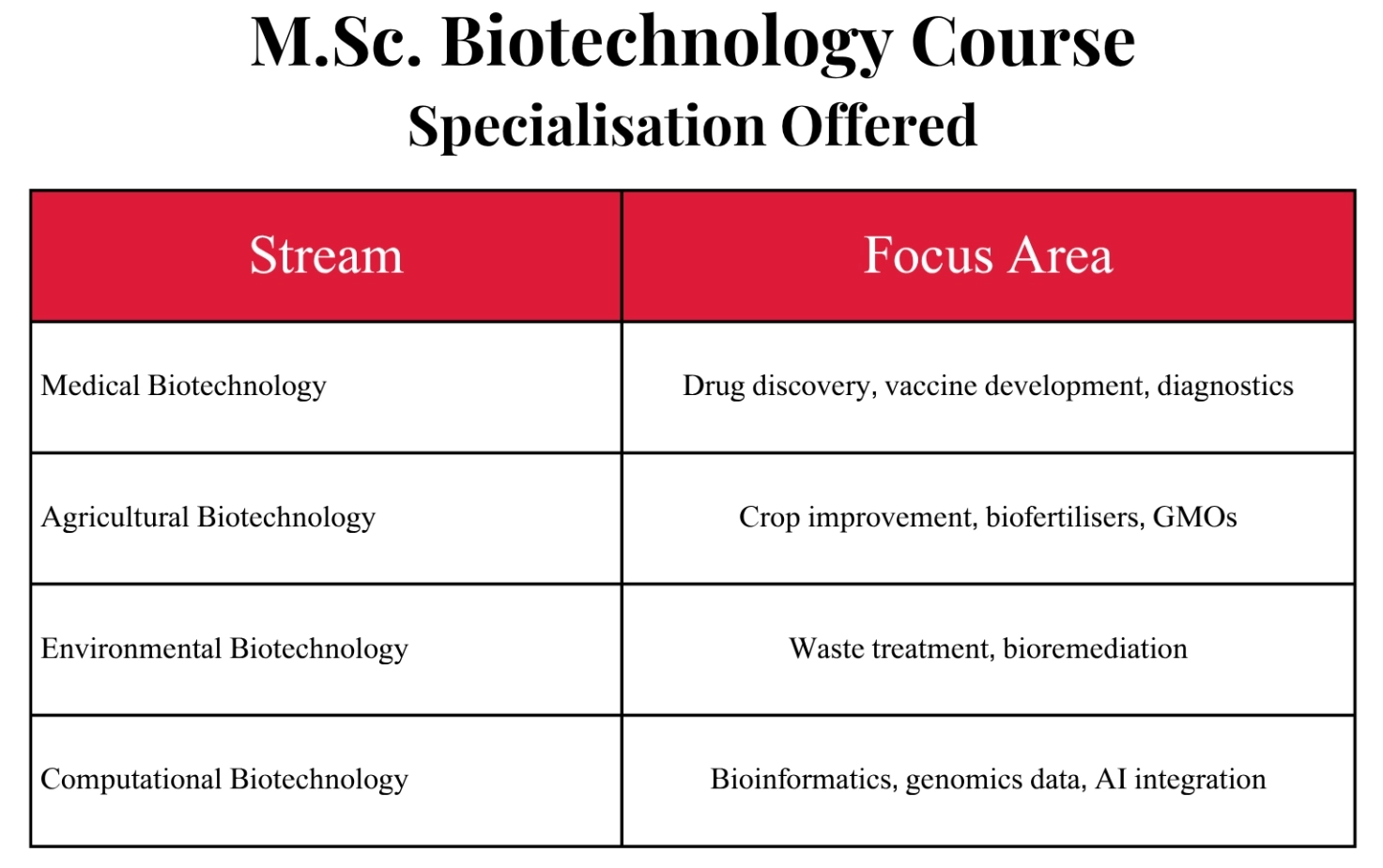
That’s why pursuing M.Sc. Biotechnology to enhance your skills and advance your knowledge helps you to enter this most dynamic industry today. Here in this blog, learn about how this programme shapes scientific thinkers into innovators!
Is M.Sc. Biotechnology Worth It? Here’s Why the Answer Is Yes
Biotechnology is transforming at an unparalleled pace. The field has witnessed everything from CRISPR-based gene editing to biofuel innovation to personalised medicine and is experiencing a scientific revolution.
Pursuing a B.Sc. Biotechnology helps you build a foundation and it often limits graduates to entry-level roles. On the other hand, M.Sc. Biotechnology allows you to learn deeper and teaches you how to apply molecular techniques, design experiments and interpret complex biological data. This is what the industries actually look for when hiring experts.
What You Learn in M.Sc. Biotechnology Course?
The curriculum combines biology, chemistry as well as technology to prepare innovators who can build and innovate.
Core Scientific Skills
Molecular biology and genetic engineering
Biochemistry and microbiology
Immunology and cell culture techniques
Bioprocess engineering and industrial biotechnology
Cross-disciplinary & Soft Skills
Data analysis using computational tools
Scientific communication and presentation
Project management and teamwork
Ethical research and regulatory understanding
Top Career Paths and Job Opportunities After M.Sc. Biotechnology
Industry/ Sector
Roles
Key Responsibilities
Research & Academics
Research Scientist Lab Technician
Conduct experiments Publish findings Innovate new technologies
Start your venture in health, agri-tech and diagnostics
How M.Sc. Biotechnology Prepares You for These Careers?
All the modules, labs and internships of the M.Sc. Biotechnology programme develops practical readiness for real-life roles
In Capstone projects, analytical thinking and independence in researching topics are developed
Industry linkages and internships provide professional experience
Working on group projects to gain real leadership experience and teamwork skills
Workshops and conferences provide networking and publication opportunities
The interrelated aspects of theory, practice and exposure prepare you with the skills and experience required by the global biotechnology sector.
Salary Insights and Global Job Market Outlook in Biotechnology
Biotechnology offers promising pay scales and global employability.
Level
Average Annual Salary
Entry-Level
4-6 LPA
Mid-Level
7-12 LPA
Senior-Level
15-25 LPA+
From Bangalore and Hyderabad to Boston and Zurich, some of the world’s biggest biotech clusters are expanding rapidly, backed by new research centres and startup parks.
Every Career Has Hurdles- Here’s How to Tackle Them in Biotechnology
This field has its own challenges. Research funding can be competitive and keeping up with rapid technological changes needs constant learning.
Here are some things that help you stay updated-
Stay updated with new scientific publications
Do internships early and network actively
Attend seminars and work across fields
Continue your education via certifications and online modules
Your success in biotechnology not only lies in knowledge but also in adaptability and curiosity.
Tips for Students Considering M.Sc. Biotechnology
Before you enrol, you have to follow these helpful tips for the right choice-
Select your specialisation based on your interest and career goals
Search for universities with strong lab infrastructure and industry linkages
Plan your research early with internships and a dissertation
Build your portfolio through publications, conferences and technical skills
A strong academic foundation and proactive approach can set you apart.
Innovate, Discover and Lead with Mahindra University’s M.Sc. Biotechnology
If you want to build a career in biotechnology, the M.Sc. Biotechnology programme at Mahindra University is perfect, where academic excellence meets world-class innovation.
What differentiates it from other institutions is its strong partnership with Dr Reddy’s Laboratories, one of the most respected pharmaceutical companies in India. As a result, students will be exposed to industry-level biologics research, production technologies and regulatory frameworks – this means that they are graduating as industry-ready professionals.
Here’s what makes a difference to the M.Sc. Biotechnology at Mahindra University-
Industry-Integrated Curriculum
Advanced Research & Lab Facilities
Mentorship from Experts
Career-Focused Training
Global Perspective
You don’t just study at Mahindra University– you learn to innovate, lead with purpose and make your mark in a rapidly expanding field.
Conclusion
Biotechnology is changing all aspects of life, especially when it comes to decoding the DNA all the way to designing sustainable solutions. An M.Sc. Biotechnology doesn’t just prepare you with a study of science – it prepares you for a world of possibilities across industries, research and innovation.
If you are interested in the life sciences and want a career in a field that will be sustainable and meaningful to the world, take your next step with Mahindra University! Consider M.Sc. Biotechnology programmes at your university and get to know faculty and mentors, and prepare yourself for a new life!
FAQs
What core scientific skills will I gain during M.Sc. Biotechnology course? You will gain skills in molecular biology and genetic engineering, biochemistry and microbiology, immunology and cell culture techniques, bioprocess engineering and industrial biotechnology.
What is the average salary of an M.Sc. Biotechnology? The starting salary of a graduate is 4-6 lakhs per annum and after some experience and at a senior level, the salary will be around 15-25 LPA+.
How M.Sc. Biotechnology prepares students for this field? The course provides capstone projects and internships, which help students gain practical insights. They also connect with industry experts, join collaborative research and attend conferences.
Published On: October 30, 2025 The world’s growth story has always been powered by engineers. From building dams and steel plants to creating global IT platforms and now leading innovations in digital infrastructure, space tech, EVs and semiconductors.
But there is something changing now.
The economy is moving from doing to designing and from servicing to inventing. What started with service delivery is now about invention, ownership and transformation.
And what does that mean for you?
It means that the undergraduate degree in engineering may give you an opportunity to work, but to get a better job profile, more lucrative salary and lead the new technological advancement projects, you need to be a master of something, not a jack of all trades.
This is why now B.Tech. graduates are moving towards M.Tech. courses
If you are also one of those people who are thinking about doing M.Tech. But have some doubts in your mind, like is it really a good step to take? If yes, then which specialisations are highly rewarding? Then you’re asking the right question.
This blog addresses such queries and helps you make a decision about doing M.Tech., as well as helps you choose the right specialisation that fits your career aspirations.
M.Tech. After B.Tech. – Is This the Right Decision?
Choosing between an early job and a specialised degree is a real dilemma. Both ways have their own outcomes, but which one suits your goals?
If you dedicate your two years to the master’s degree, is it going to pay you in future? The answer is absolutely yes.
5 Drivers That Make M.Tech. Courses High-Paying
These five points explain why some M.Tech. courses pay more and why companies look for these graduates.
Skill Scarcity
Chips, controls, power systems, applied AI, etc, there are fewer experts than needed in every domain.
Capital Intensity
Projects involving electric vehicles, grids, hospitals and manufacturing lines carry high costs and errors can cost millions and billions. That’s why a specialised skill is paid well.
Policy-Backed Demand
Fields like semiconductors, clean energy and secure public infrastructure are backed by government policies.
Research-to-Product Pathways
Tech. programmes offer access to real research facilities, labs and industry projects, which help you build a powerful portfolio.
Global Roles and Mobility
M. Tech. graduates who have published papers and have a strong project portfolio get priority in R&D roles and Ph.D. programmes.
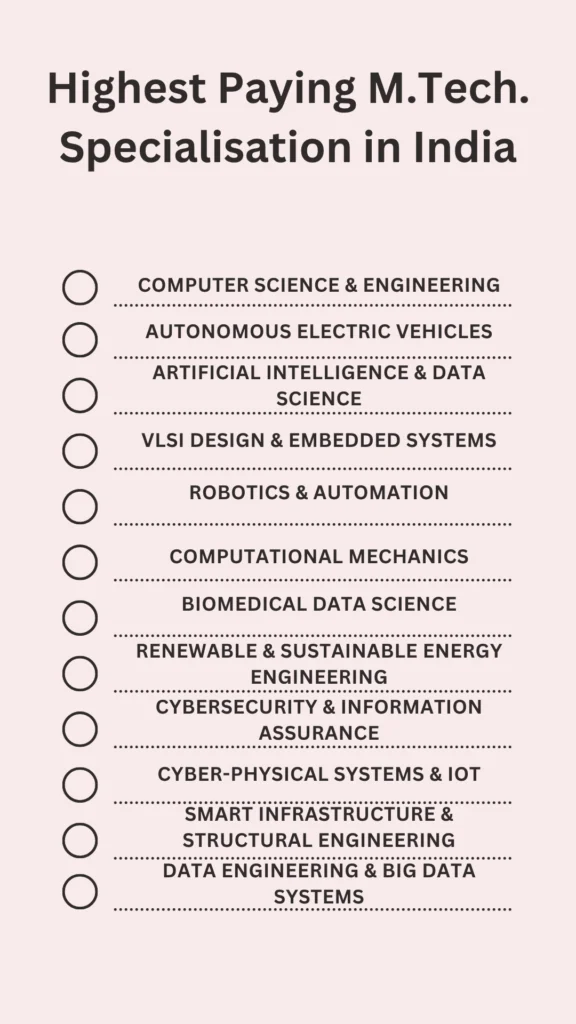
Top High Paying M.Tech. Courses in India
Computer Science & Engineering
Where it’s used
Digital public infrastructure (UPI, Aadhaar, etc.)
Fintech platforms and core banking
Scalable SaaS products and cloud-native services
Core competence
Distributed systems
Operating systems and storage internals
Secure coding, performance tuning
Fault tolerance and system reliability
Entry roles & growth ladder
Platform Engineer / SRE
System Software Developer
Principal Architect / Staff Engineer
Autonomous Electric Vehicles
Where it’s used
EV Original Equipment Manufacturers
ADAS integration companies
Battery management system development
Gigafactories and EV R&D labs
Core competence
Vehicle control systems
Perception and localisation
Battery thermal and charge management
Safety-critical software and certification
Entry roles & growth ladder
BMS Engineer / Control Systems Engineer
Functional Safety Developer
Autonomy Systems Lead
Artificial Intelligence & Data Science
Where it’s used
Public health (triage, diagnostics)
Financial analytics and credit risk
Supply chain optimisation
Language translation systems
Core competence
Machine learning & statistical reasoning
Deep learning for vision and NLP
MLOps and production pipelines
Causal inference and experimentation
Entry roles & growth ladder
ML Engineer / AI Engineer
Data Science Tech Lead
AI Research Engineer
VLSI Design & Embedded Systems
Where it’s used
Semiconductor design companies
Embedded firmware for consumer electronics
Automotive and industrial electronics
Fabless SoC development
Core competence
RTL design and verification
Physical design and timing closure
Firmware on RTOS platforms
Power/performance trade-off engineering
Entry roles & growth ladder
RTL Design Engineer
Verification / Physical Design Engineer
SoC Lead Architect
Robotics & Automation
Where it’s used
Industrial automation and smart factories
Warehouse robotics and logistics
Hospitals and medical robotics
Defence and agriculture systems
Core competence
Robot kinematics and control
Computer vision and localisation
Motion planning and safety protocols
Human–robot interaction (HRI)
Entry roles & growth ladder
Robotics Engineer / Integrator
Motion Planning Developer
Autonomy and HRI Architect
Computational Mechanics
Where it’s used
Aerospace, automotive and civil engineering
Energy and structural simulations
Medical device design
Core competence
Finite element modelling
Computational fluid dynamics
Verification and validation
Structural optimisation and material simulation
Entry roles & growth ladder
CAE Analyst
Design Verification Lead
R&D Specialist
Biomedical Data Science
Where it’s used
AI-powered diagnostics and hospital systems
Omics research and bioinformatics
Public health platforms
Core competence
Biostatistics and data cleaning
ML for imaging, genomics and patient data
Clinical validation and privacy protocols
Entry roles & growth ladder
Health Data Scientist
Clinical AI Engineer
Bioinformatics Lead
Renewable & Sustainable Energy Engineering
Where it’s used
Solar and wind power plants
Battery Energy Storage Systems
Microgrids and hybrid energy systems
Green hydrogen projects
Core competence
Power systems and smart grids
Renewable resource modelling
Converter control and system integration
Techno-economic feasibility and lifecycle analysis
Entry roles & growth ladder
Renewable Systems Engineer
Grid Integration Specialist
Energy Operations Lead
Cybersecurity & Information Assurance
Where it’s used
Banks and digital finance
Utilities and OT networks (power, water, telecom)
Defence, transportation and healthcare IT
Core competence
Cryptography and secure protocols
Network and app security
OT (Operational Tech) and ICS protection
Threat intelligence and incident response
Entry roles & growth ladder
Security Analyst / AppSec Engineer
OT Security Specialist
Cyber Defence Architect
Cyber-Physical Systems & IoT
Where it’s used
Industrial IoT and automation
Agri-tech and smart farming
Smart buildings and logistics
Fleet and asset tracking
Core competence
Sensor interfacing and embedded design
Edge computing and fail-safe mechanisms
Time-Sensitive Networking
Resilience and Over-the-Air updates
Entry roles & growth ladder
Embedded Systems / IoT Engineer
CPS Integration Lead
Reliability or Solution Architect
Smart Infrastructure & Structural Engineering
Where it’s used
Metro projects and high-rises
Seismic zones and long-span bridges
Ports, tunnels and smart cities
Core competence
Seismic and performance-based design
BIM (Building Information Modelling)
Digital twin modelling
Lifecycle cost optimisation
Entry roles & growth ladder
Structural Design Engineer
SHM Analyst
BIM/Digital Twin Lead
Data Engineering & Big Data Systems
Where it’s used
Banking and e-commerce platforms
Mobility and smart transport
Healthcare, governance and CPS back-ends
Core competence
Distributed data systems
Real-time and batch processing
Data modelling, governance, lineage tracking
Entry roles & growth ladder
Data Engineer / Platform Engineer
Data Infrastructure Architect
MLOps and Analytics Ops Lead
Planning for M.Tech. Course After B.Tech.? Start Your Journey at Mahindra University
Mahindra University embodies the ‘Rise of the New Engineer’, a bold, future-ready vision realised through a landmark collaboration between Tech Mahindra, École Centrale Paris and Jawaharlal Nehru Technological University Hyderabad.
Pursuing your M.Tech. course at Mahindra University gives you access to world-class infrastructure, a cutting-edge research facility and mentorship opportunities, which prepare you to be an impactful engineer.
M.Tech. Specialisations Offered at Mahindra University
Computer Aided Structural Engineering
Transportation Engineering
Artificial Intelligence & Data Science
Autonomous Electric Vehicles
VLSI Design & Embedded Systems
Advanced Wireless Communication
Systems Engineering
Robotics
Computational Mechanics
Bio Medical Data Sciences
The purpose of these M.Tech. programmes is to create post-graduate engineers who can respond effectively to global engineering challenges and can incorporate new technologies that will define the future
Synopsis
The high paying M.Tech. courses in India are built around one core principle: offering knowledge and skill depth that solves real problems.
Across domains, from chip design to energy systems, from cybersecurity to smart infrastructure, what separates high-value roles isn’t just domain knowledge, but the ability to translate theory into working systems under constraints of scale, safety and complexity.
If you’re choosing M.Tech. after B.Tech., don’t just pick what’s popular; pick a domain that’s not just in demand, but also aligns with your career aspirations.
Mahindra University offers a variety of M.Tech. courses, choose your specialisation and apply now!
FAQs
Can M.Tech. help me go abroad? Yes, especially with published work, standard contributions and projects under reputed faculty.
Which M.Tech. specialisation pays the most right now? Computer Science, AI & Data Science, Cybersecurity and VLSI top the list. Freshers with the right skills and relevant projects in their portfolio can earn even more than 25 lakh rupees per year.
Is M.Tech. better than taking a job right after B.Tech.? It depends. If you want depth, R&D, or global roles, then M.Tech. is worth it. If you’re looking at entry-level roles, then a job after B.Tech. is the correct option.
Published On: October 14, 2025 Every year, a large number of students graduate in various fields and reach a career crossroad where they face some career-defining questions, like – should they pursue an MBA? Prepare for civil services? Start a job? Or is there something more purposeful?
This is where LLB after graduation stands out, especially for those who want to explore the career opportunities in the law domain.
The law has an impact on every aspect of life. Whether we talk about technology, environment, health, media, finance or policy, everything is governed by and operates under the rule of law. Therefore, LLB post-graduation is not simply a programme for those who want to be lawyers – it is a way into a meaningful and future-ready career for everyone.
Digitalisation, stricter compliance and globalisation have made legal understanding essential across fields. Whether you’re a commerce graduate, a tech professional or someone with a degree in science or social work, a legal career gives you a new lens.
The LLB course is now a choice for thinkers, problem-solvers and those looking for work that matters.
Breaking the Myth: LLB is Not Just for Arts Graduates
There’s an old belief that law is only for students from the Humanities.
That’s no longer true. Today’s legal challenges need minds from every stream.
A B.Sc graduate with an interest in genetics or pharma law is perfect for IPR law. A B.Com graduate often finds strength in corporate or tax law. An engineer builds a sharp career in cyber law, AI regulation or data privacy.
Here’s how students from different backgrounds fit into the law:
Graduate Stream
Strong Legal Career Options
B.Sc.
Environmental Law, IPR, Health Law
B.Com, BBA
Corporate Law, Taxation, Banking Law
B.Tech.
Cybersecurity Law, Tech Regulations
Journalism, Media
Legal Reporting, Media Law
Psychology, Sociology
Family Law, Criminology, Human Rights
Top institutions in India are now seeing an increase in students with science, commerce and even engineering degrees enrolling in their LLB courses.
The Eligibility Criteria and Admission Process for the LLB Course after Graduation
You don’t need a law background to get started.
If you’ve completed a recognised undergraduate degree in any stream with at least 50-60% marks, you’re eligible for the LLB course. There’s no upper age limit for taking admission in this programme.
Admission Routes:
Entrance Exams LSAT is the entrance exam you can prepare for admission into the LLB course after graduation.
Merit-Based Entry Some private and autonomous law universities offer admission based on graduation score and a personal interview.
Breaking Down the Curriculum of a 3-Year LLB Course After Graduation
Subjects You Will Learn in the LLB Course:
Jurisprudence
Law of Torts
Law of Contracts
Criminal Law
Constitutional Law
Family Law
Bhartiya Sakshya Adhiniyam
Administrative Law
Civil Procedure Code & Law of Limitation
Alternate Dispute Resolution
Civil Procedure Code & Law of Limitation
Interpretation of Statues
Labour and Industrial Law
Public International Law
Company Law
Principles of Taxation
Drafting, Pleading and Conveyancing
Competition Law
Intellectual Property rights
Sustainability and Environmental Law
Cyber Laws
Banking & Insurance Laws
Professional Ethics
Internet Laws
Teaching Style That Works:
Socratic Method
Case Study Analysis
Legislative Reviews
Hands-On Training:
Moot Courts
Internships
Legal Clinics
Mediation Workshops
Exploring the Career Opportunities After the LLB Course
The three-year LLB course after graduation opens the gate to lucrative career roles for you. You can work across various domains and earn a very good salary.
Conventional Roles You Can Explore:
Advocate
Judge (Judiciary Exams)
Legal Advisor
Public Prosecutor
Legal Researcher
New-Age Careers Gaining Popularity:
In-house Counsel
Legal Journalist
Policy Analyst
Human Rights Officer
Legal Educator
Legal Operations Lead
Compliance Officer
Dispute Resolution Expert
A law degree doesn’t narrow your path. It widens your impact.
And that’s why more graduates are choosing the LLB course, not just to build careers, but to build legacies.
Specialisations That Are Shaping the Future of Legal Practice
The legal world is not standing still. It’s changing fast, pulled by global challenges and local realities.
Choosing a specialisation after enrolling in an LLB course helps you stay relevant and focused. It also sharpens your edge in a competitive job market.
The most sought-after areas today are not the same as they were a decade ago. They’ve shifted from courtroom arguments to tech regulations, privacy laws and cross-border trade.
Top Specialisations for LLB Graduates:
Cyber Law
Environmental Law
Data Protection Law
Corporate Law
Business Laws
Criminal Law
International Law
Intellectual Property Law
Civil & Private Law
Public Law
In India, courts and companies are actively hiring professionals in these areas. Around the world, top universities focus heavily on these specialisations too.
If you plan to study further, this foundation will help with higher studies like LLM or research work. You can also boost your skills with short diplomas or certifications in niche areas.
By picking the right path early, you give your LLB after graduation more direction and value.
Kickstart Your Legal Journey with LLB Hons at Mahindra University
In legal education, the right beginning makes all the difference.
For those considering an LLB after graduation, the question isn’t just where to study, but where your legal journey will be shaped with relevance, rigour and reach.
At Mahindra University’s School of Law, this journey begins not with textbooks alone, but with a vision that law is a living discipline meant to question, to guide and to empower.
The three-year LL.B. course at Mahindra University is meticulously crafted for graduates who are ready to think deeply, act ethically and lead across industries. It offers direction in a world defined by legal complexity and cross-sector collaboration.
What Makes Mahindra University Ideal for the LL.B. Course After Graduation
Vibrant blend of Industry and Academics.
Research and experimental-based pedagogy.
Exceptional interface with emerging technologies in the legal domain.
Student exchange programme with international universities/institutions.
Availability of wide domains in law.
Exclusive industry-backed upskills and certifications.
Trending Specialisations You Can Pursue
Corporate Law
Business Laws
Criminal Law
International Law
Intellectual Property Law
Civil & Private Law
Public Law
At Mahindra University, law is seen as a tool for leadership, and your LL.B. degree becomes a platform for relevance, voice and impact.
Synopsis
Doing an LLB after graduation is not just about a job switch, but it’s a career pivot with long-term meaning. Law teaches you how to think clearly, speak with power and act with fairness and prepares you to lead in business, in public life, in community service and other areas. If you’re a graduate wondering what to do next, ask a simple question to yourself: Do you want a career that blends intellect, ethics and impact? If your answer is yes, then start your legal journey with a three-year LL.B. course after graduation at Mahindra University. Apply Now!
FAQs
Can I apply for a 3-year LLB course after 12th? No, only graduates can apply for the three-year LLB programme. You can apply for 5-year integrated courses after 12th.
What’s the average salary after a three-year LLB? It depends on your path. Freshers in litigation start around three to six lakh rupees per year. Corporate roles may begin at five to ten lakh rupees per year. Judiciary and government roles offer structured pay and growth.
What is the course duration of the LLB? The LLB is a 3-year degree course, divided into 6 semesters.
Published On: September 26, 2025 Today, the media industry is far broader and evolving faster than ever.
A media degree is not just a ticket to the newsroom- it’s a passport to some of the fastest-growing and unexpected careers. Many students often think they will become a journalist, news anchor or maybe work in PR. But it’s not true!
Let’s see how.
India’s Media & Entertainment sector is on a strong rise- it’s expected to grow at 9.7% annually and touch US$73.6 billion by 2027. For students, this means career options are expanding well beyond the newsroom or TV studio.
This allows graduates to shape careers that exist or didn’t even exist a decade ago. Whether you are pursuing a BA in Journalism and Mass Communication or an MA in Journalism and Mass Communication, this blog will help you explore a diverse range of career opportunities!
The Media Landscape- India and Beyond
Nowadays, the media industry is no longer confined to print and television. The scenario is changing, here is how-
Students who wish to enter this space should see it as a dynamic and flexible field full of possibilities if they are willing to adapt.
Key Skills from a Media Degree That Set You Apart
Both BA and MA programmes in Journalism and Mass Communication help you develop a strong foundation and essential skills. This is what you will gain during the courses-
Extra Skills– Digital Literacy, Social Media Analytics, Project Management, Creative Ideation and Collaboration
And the best part? The skills you gain in the media don’t stop at journalism. They carry over into marketing, entertainment, consulting and even tech—opening doors far beyond the newsroom.
Exploring Careers After a BA in Journalism and Mass Communication
A. Traditional Roles 1. Reporter/Sub-editor ₹1.7-18.2 LPA starting salary Work for newspapers, online portals, or magazines 2. Radio Jockey ₹1-7 LPA starting salary Great for those with strong voice modulation and presentation skills 3.Photojournalist/Photographer ₹2-6.2 LPA depending on specialisation and portfolio Work for media, fashion or advertising 4. Anchor/Presenter ₹2.2-24 LPA starting salary Work especially in regional and national TV channels B. Digital/New Media Roles Content Writer / Blogger Salary- ₹2.5–5 LPA Entry roles in digital marketing agencies, startups or as freelancers Social Media Coordinator / Specialist Salary- ₹3–6 LPA Manage online brand presence and campaigns Junior Video / Multimedia Producer Salary- ₹3–5 LPA Work with YouTube channels, OTT, or production houses Podcast / Vlog Creator Income varies widely, often freelancing with ad revenue and sponsorships C. Other Career Paths You May Not Have Thought of Copywriting Advertising Assistant Event Management Public Events Support Media Research Audience Insights Corporate Communication
Freelancing Platforms/Remote Content Work
How Can You Prepare for These Roles During the BA Course?
You have to follow some crucial things to be well-prepared for the programme- Take internships early and across sectors Build a portfolio — blogging, vlogging or even photography counts Learn tools — Adobe Premiere, Canva or Google Analytics Network actively — take small gigs — to gain exposure
Career Opportunities with an MA in Journalism and Mass Communication
A. Advanced Roles Senior Content Editor- ₹6-12 LPA. Lead editorial teams. Broadcast Producer- ₹7-15 LPA. Work with TV and OTT production houses. Investigative Journalist- ₹5-10 LPA with scope for global recognition. Media Policy Expert- ₹6-10 LPA, which is often tied to think tanks and policy institutes. B. Strategic and Managerial Roles Media Planner or Strategist- ₹5-9 LPA. Manage ad campaigns and content strategy. Director of Communications- ₹10-18 LPA. Leadership role in corporates or agencies. Content Strategy Lead- ₹7-14 LPA. Guide longer digital content plans. Brand Journalism- ₹6-12 LPA. Create brand-centric storytelling. C. Emerging Media Roles Digital Analytics / Insights Specialist- ₹6-10 LPA. Combine media with data. UX / Content Design- ₹5-9 LPA. Write for apps, websites and digital products. Media Law Roles- ₹7-12 LPA. Legal + media expertise. Academic / Research Roles- ₹6-9 LPA. Teach or research in universities. Foreign Correspondent- ₹8-15 LPA. Global career with travel opportunities.
How to Make the Most of an MA?
Pick a specialisation that sets you apart
Focus on advanced internships that provide leadership exposure
Publish research or collaborate on projects
Attend teaching or guest lectures for academic credibility
BA vs MA- What’s the Difference?
Aspects
BA in Journalism & Mass Communication
MA in Journalism & Mass Communication
Roles
Entry-level reporting, digital content, support roles
Specialist, leadership, strategy-driven roles
Salary Range
₹2.5-6 LPA
₹6-15+ LPA
Focus
Building foundations & hands-on skills
Deep specialisation and leadership
Ideal For
Students starting their career journey
Professionals seeking growth, expertise and leadership
Take the Next Step in Your Media Journey with Mahindra University
Thinking of a career in media? Mahindra University gives you more than classroom learning—it brings in projects, internships, and even global exposure. This mix helps students sharpen real skills and explore opportunities in every corner of the media world.
Courses in Media Offered by Mahindra University
BA in Journalism and Mass Communication
It is an undergraduate course that blends reporting, storytelling, digital production as well as hands-on training with emerging technologies. Students gain exposure to the industry through internships, workshops and live projects.
MA in Journalism and Mass Communication
A postgraduate course includes advanced learning, with a strong focus on digital media, media law, strategic communication and leadership roles. Students are guided by experienced faculty and also get many benefits from advanced studios and labs.
You have a chance to turn your passion into a lucrative profession by starting your journey in media with Mahindra University. Explore and gain the right skills with programmes offering practical exposure and confidence to thrive in today’s media world.
Conclusion- Select Your Career Path Which Meets Your Goals
Pursuing a media degree won’t lock you up in a single room- it opens up a diverse range of opportunities. Whether you’re studying a bachelor’s degree or a master‘s, you will explore roles across traditional, digital and emerging industries. If you’re looking to take the next step, start with identifying completely new career paths.
Check out media courses at Mahindra University- BA in Journalism and Mass Communication and MA in Journalism and Mass Communication. Get expert mentorship, global exposure and real-world learning that will train you to lead and innovate in the media industry!
FAQs
What are high-paying career roles after MA in Journalism and Mass Communication? You can secure roles like senior editor, broadcast producer, investigative journalist, media strategist, content strategy lead, UX content design, etc.
What is the highest salary after BA in Journalism? You can explore a wide range of career pathways after a BA — reporter, sub-editor, radio jockey, photojournalist, anchor, content writer and many more.
Which is best, BA or MA in Journalism and Mass Communication? The best depends on your career goals, prior education as well as desired depth of knowledge. These factors help you to identify which one is best for your career.
We use cookies to ensure that we give you the best experience on our website. If you continue to use this site we will assume that you are happy with it.