











Department of Electrical & Computer Engineering
Building strong foundations in electrical systems, computers, and intelligent technologies that power modern engineering.
Department overview
The department of Electrical and Computer Engineering at Mahindra University focuses on developing engineers with a strong grounding in core electrical sciences, electronics, and system-level thinking. The programme balances theoretical depth with hands-on learning, enabling students to work across traditional and emerging domains of electrical engineering.

Strong engineering fundamentals
A rigorous foundation in circuits, signals, systems, electro-magnetics, and electronic devices.

Integrated theory and practice
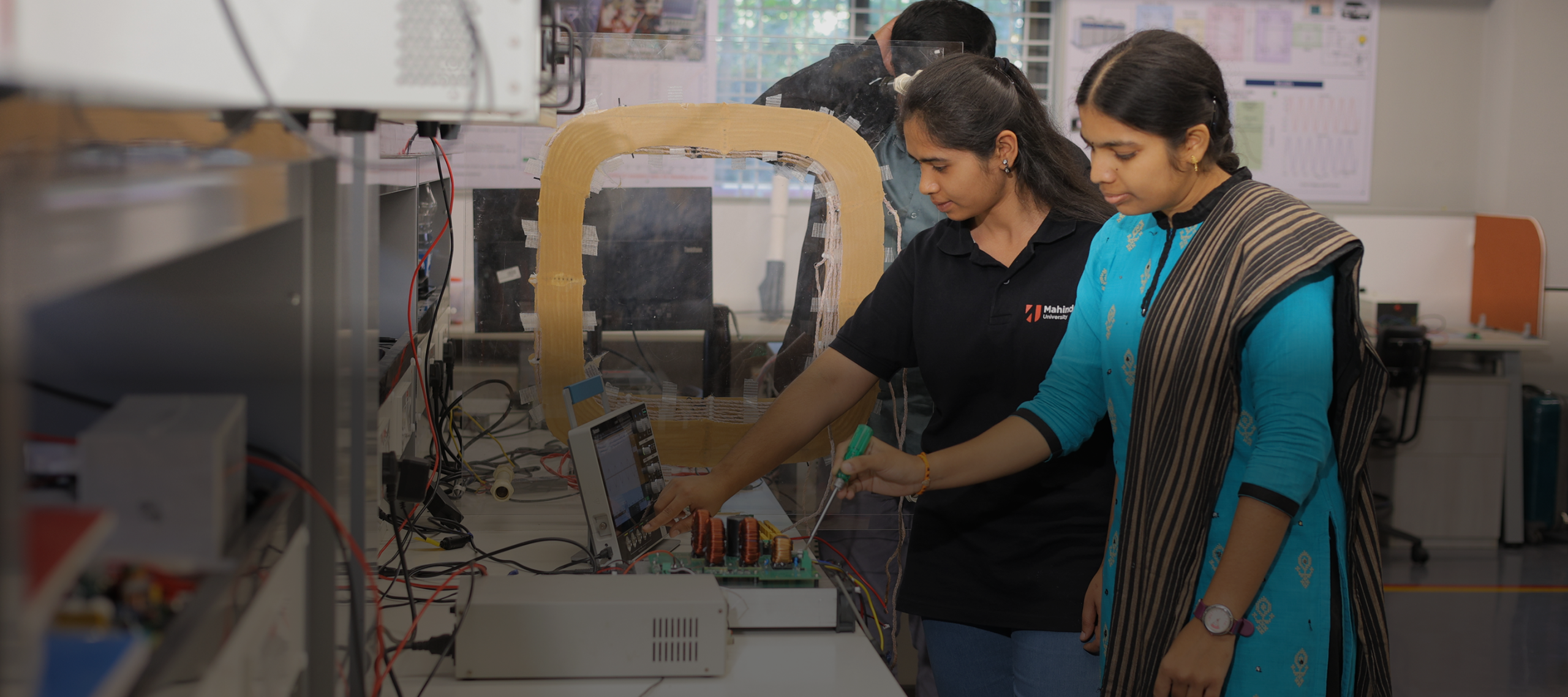
Laboratory courses and design projects that translate concepts into working systems.

Exposure to emerging technologies
Learning pathways that include communication systems, embedded systems, automation, and power technologies.

Project-driven learning
Multiple departmental projects that build problem-solving, design, and implementation skills.
Department details
Vision
To build a vibrant learning and research environment that prepares students in electronics, communication, computing, VLSI, wireless technologies, and intelligent electric mobility to become capable engineers and innovators, who can adapt to changing technologies and contribute meaningfully to industry and society.
Mission
- M1: To provide best in class education in electronics, communication, computing, VLSI, embedded systems, wireless technologies, and intelligent electric mobility through strong fundamentals, hands-on learning, and modern engineering tools.
- M2: To promote innovation, interdisciplinary research, and industry collaboration in emerging domains such as autonomous electric vehicles, advanced wireless systems, semiconductor design, quantum computing and other areas.
- M3: To develop ethically responsible, globally competent engineers with leadership skills and a commitment to lifelong learning and sustainable technological solutions and a view towards societal development.
Philosophy
The programme is structured to progress from fundamentals to application, enabling students to build depth while developing the ability to work across domains.
- Industry and research readiness: the curriculum prepares students for professional practice as well as advanced study and research.
- Foundational learning: early coursework establishes a strong base in mathematics, physics, and core electrical engineering principles.
- Systems thinking: courses emphasise understanding how components, subsystems, and networks interact within complex electrical and electronic systems.
- Hands-on design: laboratories and projects focus on experimentation, prototyping, and validation of engineering ideas.
Learning environment and facilities
Students have access to dedicated laboratories that support learning and experimentation in areas such as:
- electrical machines and power systems
- electronic circuits and devices
- control systems and automation
- communication and signal processing
- embedded and digital systems
These facilities support coursework, design projects, and independent exploration under faculty guidance.
Program educational objectives (PEOs)
- PEO 1 – Professional Competence
Graduates will apply the fundamentals of electronics, communication, computing, and signal processing to design and develop solutions for real-world engineering problems in industry, academia, or entrepreneurship.
- PEO 2 – Career Growth, Leadership & Teamwork
Graduates will pursue successful careers in core and interdisciplinary domains, higher education, or research, and function effectively as individuals, team members, or leaders in multidisciplinary professional environments.
- PEO 3 – Innovation & Problem Solving
Graduates will demonstrate the ability to innovate, analyze complex systems, and develop efficient solutions using modern engineering tools and emerging technologies.
- PEO 4 – Ethics & Lifelong Learning
Graduates will always uphold professional ethics, contribute responsibly to society, and engage in lifelong learning to keep pace with technological advancements.
Core courses
- Advanced VLSI design
- Digital signal processing
- Digital electronics and microprocessors
- Electromagnetic theory
- Linear IC design
- Material sciences
- Networks & filters
- Optical communication
- Power electronics
Aspire to be a ‘next-gen engineer’ equipped to take on the challenges and opportunities of an automated world at MU!
Programs offered
Explore future-ready specialisations crafted to equip you with skills for thriving in emerging industries like AI, SaaS, and advanced engineering fields.
Meet the faculty
Our faculty combines academic depth with real-world expertise, guiding students through both fundamental theory and applied innovation.