















If you are exploring your chances at BBA admission, you have already noticed that requirements, fees and specialisations differ significantly from one institution to the next. There is no standard BBA since what you study, who accepts you and what it costs all depend on the specifics of the programme you choose.
This guide essentially walks you through what most reputable BBA programmes expect, what your options look like and how to decide whether a BBA is the right move for you right now.
What is a BBA?
A BBA is a three-year undergraduate degree covering the fundamentals of business like accounting, marketing, finance, strategy and operations. Depending on the specialisation, it can also pull in data science, economics or entrepreneurship. Think of it as a broad but grounded starting point for a business career.
BBA Course at a Glance
| Aspect | Details |
|---|---|
| Degree | Bachelor of Business Administration |
| Duration | 3 Years |
| Level | Undergraduate |
| Minimum Eligibility | Class 12th with 75-80% aggregate |
| Streams Accepted | Commerce, Science or Mixed |
| Admission Route | Merit-based; CUET / SAT scores considered |
| Specialisations | Digital Technologies, Finance & Economics, Entrepreneurship, General Management, etc. |
| Fee Range | INR 8 – 16 Lakh |
| Starting Salary | INR 4 – 6 LPA |
| Next Step After BBA | MBA or Direct Employment |
Who Can Apply? Eligibility Criteria for BBA Admission
Most reputable BBA programmes follow a similar eligibility baseline. Here is what you can generally expect-
- Stream– Commerce and Science students are the usual applicants, but mixed-stream backgrounds are generally fine too. Very few programmes actually lock out a stream entirely, so do not rule yourself out before checking.
- Marks– The unofficial bar sits somewhere around 75-80% in Class 12th. Some programmes are stricter, some are more relaxed. Your aggregate matters, but so does where you got it.
- Entrance tests– CUET and SAT scores are accepted at many institutions, but not all. Plenty of programmes skip the entrance exam entirely and go straight to academic record plus interview. Worth checking before you spend months preparing for a test that the college does not even ask for.
- Mathematics– Only matters if you are going after data, finance or analytics tracks. General management and entrepreneurship? Usually no Maths requirement at all.
- International boards– Completed IB, Cambridge or AP? You will need a UGC Equivalence Certificate before most Indian universities will process your application. Sort this early, as it takes time.
- Interview– Almost every selective programme ends with one. Not a formality. They want to know why business, why now and whether you have thought about it beyond “good career options.”
These are general guidelines. Individual programmes may be stricter or more flexible, so always check the official eligibility criteria before applying.
BBA Specialisations — What Are Your Options?
Choosing a specialisation is often more important than choosing a BBA itself. Think about which of these tracks genuinely excites you before you start comparing universities. Here are a few options-
1. Digital Technologies & Data Science
Covers IT applications, software thinking and data science in a business context. Great if you enjoy analytics and want to work at the intersection of tech and business. Mathematics in Class 12th is often required for this track.
2. Finance & Economics
Focuses on investment analysis, financial modelling and economic policy. Suits students who are comfortable with numbers and want to move into banking, consulting or financial services. Mathematics is usually a prerequisite.
3. Entrepreneurship & Family Business
Designed for students who want to build something, whether that means launching a start-up or stepping into an existing family enterprise. No Mathematics prerequisite in most cases.
4. General / Core Management
A flexible track that covers all business basics without a heavy focus on one area. It’s a great option if you’re unsure about your career path, allowing you to decide later.
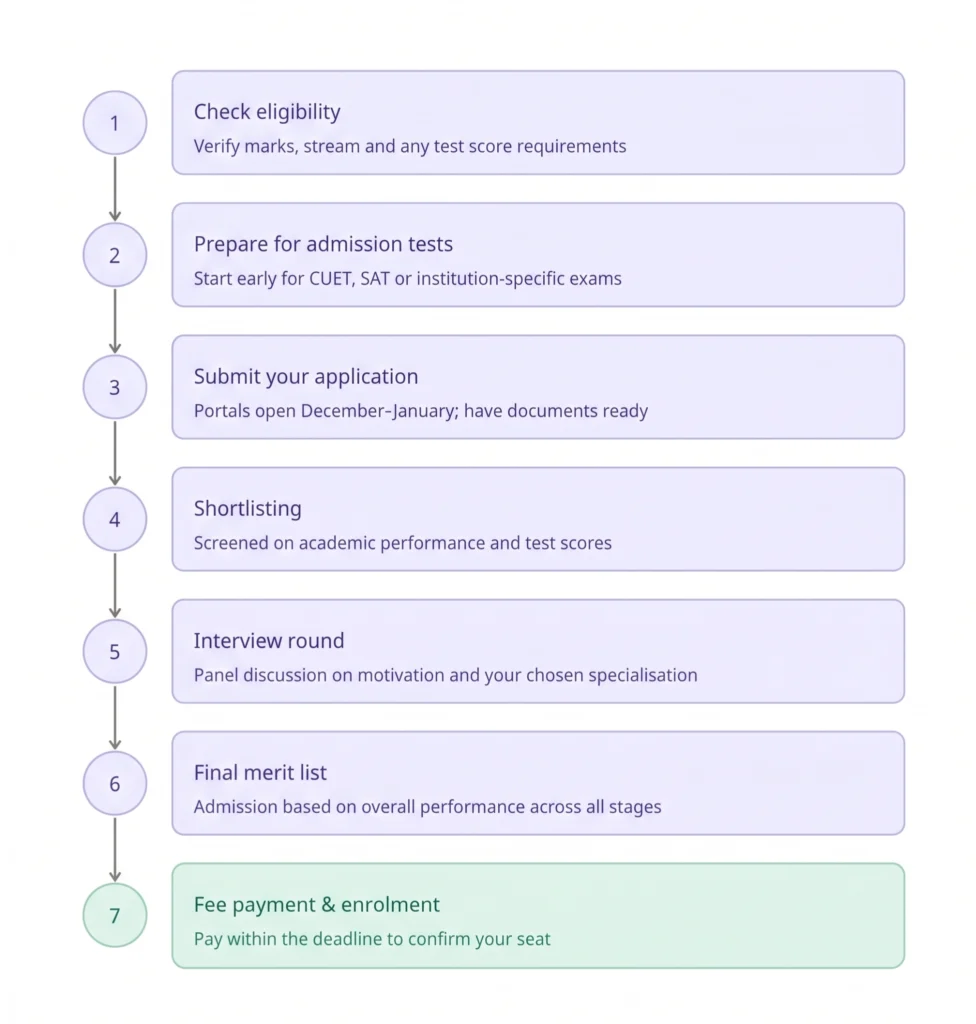
How BBA Admission Works: A Step-by-Step Roadmap
The BBA application process is more structured than it seems. Most universities follow the same broad sequence — from eligibility checks to final enrolment — so knowing what comes next keeps you ahead at every stage.
BBA Fees and Value for Money: What You Are Actually Paying For
A BBA does not come with a salary guarantee. What you pay for is the environment, the network and the opportunities — what you do with them is on you.
Private BBA programmes in India vary widely in cost — and that gap is not random. Fees shift based on the institution, campus infrastructure and what is bundled in, from accommodation to internship support to global faculty access.
| Factor | Details |
|---|---|
| Programme fee range | INR 8 – 16 lakh over 3 years |
| What drives the cost up | Campus facilities, global faculty, internship support and accommodation |
| Entry-level salary post-BBA | INR 6 – 10 LPA (varies by specialisation, institution and effort) |
| What actually affects your salary | Specialisation chosen, institution attended, internships and networks built |
| Next step that evolves you | An MBA significantly improves long-term earning potential |
| The honest truth | The degree opens the door; the three years you spend inside determine what’s on the other side |
Who Should Apply? A Practical Checklist
A BBA is a good fit if most of the following apply to you-
- You are interested in business but not yet ready to commit to a narrow specialisation
- You scored 75% or above in Class 12th and meet the stream requirements of your target programme
- You want a structured, recognised degree that gives you a foundation for either employment or an MBA
- You are open to the overlap between business and technology
- You want to complete your undergraduate degree in India without sacrificing curriculum quality
Discover Why Mahindra University’s BBA Programme is Your Pathway to Success!
If you are looking for a BBA course that combines academic rigour with genuine global exposure, Mahindra University’s programme is one worth adding to your shortlist.
The curriculum has been developed in partnership with Cornell University’s SC Johnson College of Business, meaning the content is reviewed against global standards, not just domestic ones. The specialisations on offer are Digital Technologies, Computational Business Analytics, Applied Economics & Finance, Infrastructure Management and Entrepreneurship & Family Business.
- Open intake- Accepts Class 12th students from any stream (Mathematics is required for the Applied Economics & Finance and Computational Business Analytics specialisations)
- Merit-based admission- 80% OR equivalent from IB or other approved boards. Not mandatory, but valid SAT/ CUET scores are also considered for admission.
- Global exposure- Student immersion at Cornell’s Ithaca campus and access to international faculty mentoring
- Intentional cohort size- Small, carefully selected cohorts give you closer access to expert faculty and like-minded peers
Conclusion
A BBA can be a genuinely strong foundation for a career, for an MBA or for starting something of your own. But it rewards you in proportion to what you put in and which programme you choose. Start by being honest and questioning yourself-
- Do you meet the eligibility bar?
- Do any of the specialisations genuinely excite you?
- Is the institution reputed for its campus placements?
If you agree to all these, that means it’s feasible for you to move forward with your decision. If Mahindra University’s BBA matches what you are looking for, then check the current intake details, application timeline and specialisation-specific requirements on the official programme page and apply now.
FAQs
- What is the eligibility for BBA admission?
Most programmes require at least 75-80% in Class 12th. Commerce, Science and mixed-stream students are generally eligible. Some specialisations, particularly those involving data or finance, require Mathematics in Class 12th. - What are the main BBA specialisations?
The most common tracks are Digital Technologies and Data, Finance and Economics, Entrepreneurship and Family Business and General Management. - How much does a BBA cost in India?
Private BBA programmes typically cost between INR 8 lakh and INR 16 lakh over three years. - What is the Cornell partnership in Mahindra’s BBA?
Mahindra University’s BBA curriculum has been developed in collaboration with Cornell University’s SC Johnson College of Business.