






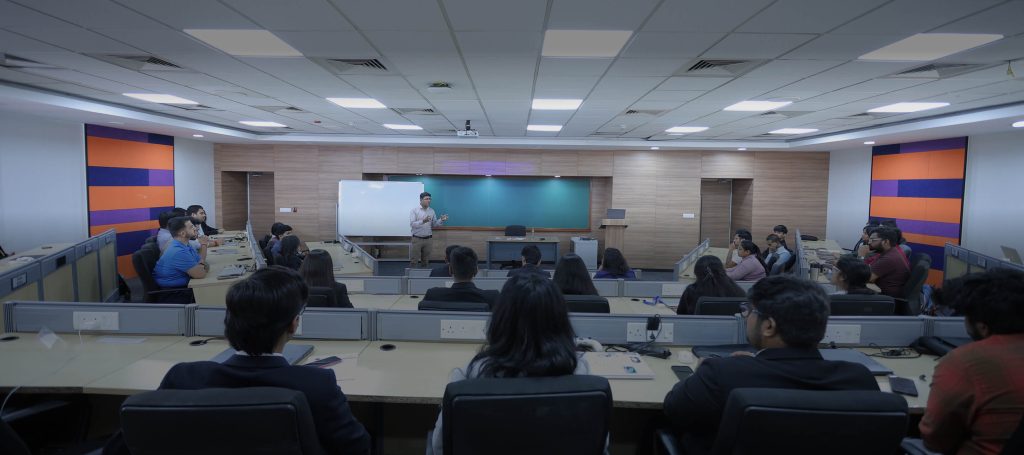
B.Tech in Data Science
A 4-year undergraduate programme empowering students to transform vast data into actionable insights through technology, statistics and domain knowledge.
B.Tech in data science overview
We prepare students to turn data into insight, combining mathematics, statistics, computer science, and ethics with hands-on experience in real-world tools and industry applications across finance, healthcare, and e-commerce.We prepare students to turn data into insights. Students experience:

Core foundational learning
in mathematics, statistics and computing in early semesters, setting the stage for advanced analytic work

Practical workshops & labs
in Python, R, MATLAB and data visualisation, students become adept at working with real datasets

Evolving curriculum
with machine learning, big data, optimisation techniques and data-visualisation, enabling specialisation and depth

Professional development
through live projects, industry internships and a capstone project in the final year, ensuring graduates are workplace-ready
Programme details
Academic structure
Our academic structure is designed to establish robust foundations, followed by increasing specialization in later years.
- Total credits & degree requirement: The programme requires not less than 165 credits to be awarded a B.Tech degree.
- Duration: 4 years / 8 semesters
| Course | L-T-P | Credits |
|---|---|---|
| Mathematics I (Calculus & ODE) | – | – |
| Python | – | – |
| Introduction to Electrical & Electronics Engineering | – | – |
| Earth and Environmental Sciences | – | – |
| Introduction to Computing | – | – |
| English | – | – |
| Media Project | – | – |
| French I | – | – |
| Introduction to Entrepreneurship | – | – |
| Course | L-T-P | Credits |
|---|---|---|
| Linear Algebra | – | – |
| Classical and Quantum Mechanics | – | – |
| Biology | – | – |
| Digital Logic Design & Computer Architecture | – | – |
| Data Structures and Algorithms | – | – |
| Discrete Mathematical Structures | – | – |
| Entrepreneurship Practice | – | – |
| Professional Ethics | – | – |
| French II | – | – |
| Course | L-T-P | Credits |
|---|---|---|
| Probability Data Engineering | – | – |
| Signals and Systems | – | – |
| Operating Systems | – | – |
| Foundations of Data Science | – | – |
| Programming Workshop | – | – |
| Data Science Workshop: R Programming | – | – |
| Lean Start-up | – | – |
| Principles of Economics | – | – |
| French III | – | – |
| Course | L-T-P | Credits |
|---|---|---|
| Numerical Methods | – | – |
| Artificial Intelligence | – | – |
| Computational Methods for Statistics | – | – |
| Optimization Techniques for AI | – | – |
| Data Visualization | – | – |
| Data Science Workshop: MATLAB | – | – |
| Design Thinking | – | – |
| Financial Accounting | – | – |
| French IV | – | – |
| Course | L-T-P | Credits |
|---|---|---|
| Object-Oriented Programming | – | – |
| Machine Learning | – | – |
| Information Retrieval | – | – |
| Big Data Analysis | – | – |
| Program Elective 1 | – | – |
| Program Elective 2 | – | – |
| Liberal Arts Elective 1 | – | – |
| Programming Workshop | – | – |
| Web Technology Workshop | – | – |
| French V (Optional) | – | – |
| Course | L-T-P | Credits |
|---|---|---|
| Data Mining | – | – |
| Software Engineering | – | – |
| Program Elective 3 | – | – |
| Program Elective 4 | – | – |
| Program Elective 5 | – | – |
| Programming Workshop | – | – |
| Data Visualization Workshop | – | – |
| Introduction to Professional Development | – | – |
| Liberal Arts Elective 2 | – | – |
| French VI (Optional) | – | – |
| Course | L-T-P | Credits |
|---|---|---|
| Program Elective 6 | – | – |
| Program Elective 7 | – | – |
| Program Elective 8 | – | – |
| Program Elective 9 | – | – |
| Liberal Arts Elective 3 | – | – |
| Project | – | – |
| French VII (Optional) | – | – |
| Course | L-T-P | Credits |
|---|---|---|
| Project | – | – |
| French VIII (Optional) | – | – |
FAQs
The curriculum blends computing, mathematics, statistics and ethics, with applied projects and internships, so students graduate with both knowledge and practical experience.
Yes, the programme places strong emphasis on hands-on workshops in Python, R and MATLAB, data-mining and visualisation, plus live projects with real datasets.
Absolutely. Graduates are positioned for careers as data analysts, engineers or AI specialists, and are also prepared for higher studies in analytics, business intelligence or data science.
By embedding applied learning, industry internships, and modules in emerging areas such as big data and machine learning, the programme ensures graduates stay agile and current.
