












B.Tech in Electronics and Communication Engineering (ECE)
A 4-year undergraduate programme designed to build engineers fluent in electronics, communication systems and hands-on hardware-software integration.
B.Tech in ECE overview
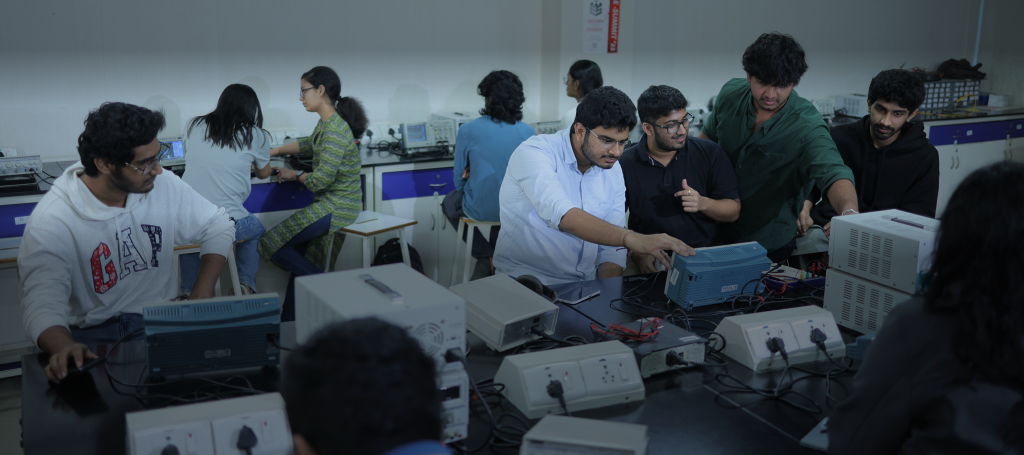
We prepare students to design, build and optimise the electronic and communication systems that power modern technology: from embedded devices and semiconductor hardware to wireless networks and signal processing applications. The programme blends strong engineering fundamentals with hands-on laboratory work and real-world problem solving. Students experience:

Cultivating an engineering mindset
focused on designing, analysing and improving real-world electronic and communication systems.

Strong exposure
to applied problem-solving through labs, projects and system-level thinking rather than isolated components.

Flexibility to shape
individual interests as technologies evolve, rather than being locked into narrow specialisations.

Preparation for diverse technology-driven
roles across core engineering industries, product development and emerging digital sectors.
Programme details
Academic structure
Our academic structure is designed to establish robust foundations, followed by increasing specialization in later years.
- Total credits & degree requirement: The programme requires not less than 165 credits to be awarded a B.Tech degree.
- Duration: 4 years / 8 semesters
| Course | L-T-P | Credits |
|---|---|---|
| Calculus and ODE | 4-1-0 | 5 |
| Quantum Chemistry & Spectroscopy | 2-1-2 | 4 |
| Introduction to Computing | 3-0-2 | 4 |
| Earth and Environmental Sciences | 2-0-0 | 2 |
| Introduction to Electrical Engineering | 2-1-2 | 4 |
| English | 0-3-0 | 3 |
| Media Project | 1-0-2 | 1.5 |
| French – I | 0-2-0 | 0.5 |
| Introduction to Entrepreneurship | 0-0-2 | 1 |
| Course | L-T-P | Credits |
|---|---|---|
| Linear Algebra and Complex Analysis | 3-1-0 | 4 |
| Classical & Quantum Mechanics | 2-1-2 | 4 |
| Introduction to Biology | 3-0-0 | 3 |
| Data Structures | 3-0-2 | 4 |
| Discrete Mathematical Structures | 3-0-0 | 3 |
| Introduction to Electronics | 2-1-2 | 4 |
| Entrepreneurship Practice | 0-0-2 | 1 |
| Professional Ethics | 0-1-0 | 1 |
| French – II | 0-2-0 | 0.5 |
| Course | L-T-P | Credits |
|---|---|---|
| Probability and Statistics | 3-1-0 | 4 |
| Electromagnetics & Optics | 3-1-2 | 5 |
| Signals and Systems | 3-1-0 | 4 |
| Digital System Design | 3-0-2 | 4 |
| Network Analysis and Synthesis | 3-1-0 | 4 |
| Lean Start-up | 0-0-3 | 1 |
| Principles of Economics | 1-1-0 | 1.5 |
| French – III | 0-2-0 | 0.5 |
| Course | L-T-P | Credits |
|---|---|---|
| Electromagnetic Waves | 3-1-0 | 4 |
| Random Processes for Electrical Engineering | 3-1-0 | 4 |
| Analog Circuits | 3-1-2 | 5 |
| Control Systems | 2-1-0 | 3 |
| Design Thinking | 1-0-2 | 2 |
| Financial Accounting | 1-1-0 | 1.5 |
| French – IV | 0-2-0 | 0.5 |
| Course | L-T-P | Credits |
|---|---|---|
| Introduction to VLSI Design | 3-0-3 | 4.5 |
| Communication Theory and Systems | 3-0-2 | 4 |
| Programmable Devices | 3-0-2 | 4 |
| Digital Signal Processing | 2-1-2 | 4 |
| Machine Learning | 3-0-0 | 3 |
| Liberal Arts Elective I | 2-0-0 | 2 |
| French – V (optional) | 0-2-0 | 0.5 |
| Course | L-T-P | Credits |
|---|---|---|
| Principles of Wireless Communication | 3-0-0 | 3 |
| Computing Systems Architecture | 3-0-0 | 3 |
| Communication Electronics | 3-0-2 | 4 |
| Computer and Communication Networks | 3-0-0 | 3 |
| Program Elective I | 3-0-0 | 3 |
| Program Elective II | 3-0-0 | 3 |
| Liberal Arts Elective II | 2-0-0 | 2 |
| Introduction to Professional Development | 2-0-0 | 2 |
| French – VI (optional) | 0-2-0 | 0.5 |
| Course | L-T-P | Credits |
|---|---|---|
| Embedded Hardware Project | 0-0-6 | 3 |
| Optical Communication | 3-0-0 | 3 |
| Program Elective III | 3-0-0 | 3 |
| Program Elective IV | 3-0-0 | 3 |
| Research Project Phase I | 0-0-6 | 3 |
| Liberal Arts Elective III | 2-0-0 | 2 |
| French – VII (optional) | 0-2-0 | 0.5 |
| Course | L-T-P | Credits |
|---|---|---|
| Research Project Phase II | 0-0-24 | 12 |
| French – VIII (optional) | 0-2-0 | 0.5 |
FAQs
The curriculum combines strong fundamentals with advanced subjects in electronics and communication, supported by practical lab work – equipping students for evolving industry demands.
Yes. Core subjects include laboratory components and the semester structure is designed to provide strong practical exposure alongside theoretical learning.
Electives allow students to deepen their knowledge in specific electronics and communication areas of interest, helping them tailor their expertise.
Graduates are well placed for roles in electronics, communication systems design, embedded systems, or further study and research in related fields.
Through a curriculum that emphasises laboratory work, applied learning, electives, and exposure to industry practice, the programme prepares graduates to adapt and lead in the field.
