








M.Tech in Computational Mechanics
A two-year postgraduate programme focused on numerical methods, simulation and programming for advanced engineering analysis.
M.Tech in computational mechanics overview
The programme prepares engineers to model and solve complex solid, fluid and dynamic problems using modern computational techniques. Students experience:

Core computational methods
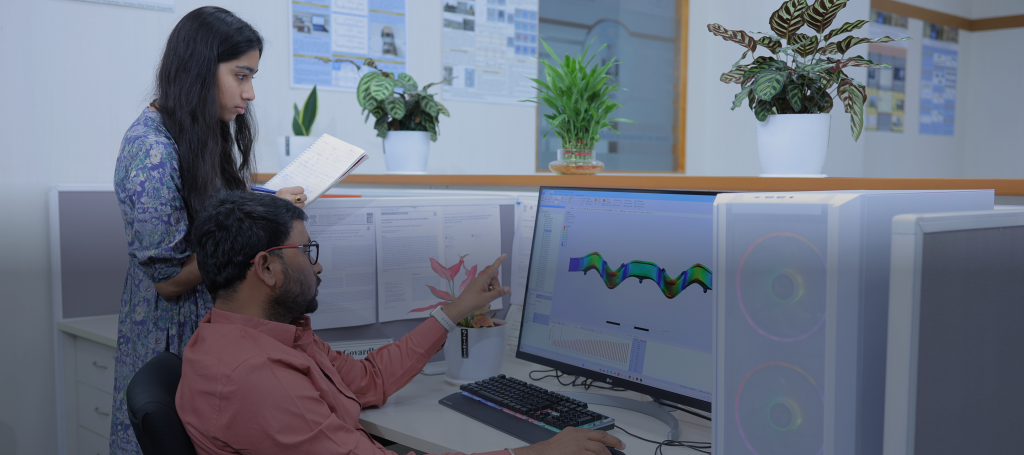
Learning numerical methods, Python programming, finite element methods and computational fluid dynamics.

Solids, fluids and dynamics
Courses covering applied solid mechanics, fluid mechanics, vibrations and computational dynamics.

Multiphysics and advanced simulation
Exposure to coupled problems, data analysis and advanced applications such as non-linear FEM and turbulent flows.

Industry and research immersion
Extended project, internship or thesis work focused on real computational mechanics problems.
Programme details
About the programme
The two-year M.Tech in Computational Mechanics is offered by the Department of Mechanical and Aerospace Engineering, École Centrale School of Engineering, Mahindra University.
The programme focuses on three key areas:
- Programming and computational modelling
- Widely used computational methods such as FEM and CFD
- Coupled problems and multiphysics analysis
A distinctive feature of the programme is the strong emphasis on practical training, with extended laboratory and project work designed to address real-world industry problems. The curriculum has been developed with input from industry experts across multiple sectors.
Students also gain exposure to advanced topics through core and open electives, including:
- Turbulent flows
- Non-linear finite element methods
- Engineering optimisation
Approximately one-third of the total 62 programme credits are dedicated to extended industry internships or original research projects under faculty supervision. The second year provides an opportunity for a full-time industry internship, enabling students to gain hands-on experience and understand professional expectations in solving industry-relevant challenges.
Programme outcomes
Graduates of the programme will be able to:
- Understand the product development lifecycle and adapt to modern engineering development processes.
- Develop computational models by capturing the relevant physical phenomena of engineering problems.
- Validate designs using appropriate experimental methods and data analysis techniques.
- Develop additional computational models or programming frameworks for specialised engineering applications.
The curriculum balances coursework across solid mechanics, fluid mechanics, dynamics, programming and data analysis.
Students complete mandatory core courses in:
- Programming fundamentals
- Computational methods for solids, fluids and dynamics
Elective courses allow students to deepen expertise in selected areas, while emerging topics such as multiphysics modelling and data-driven analysis are integrated into the curriculum.
The programme structure enables students to undertake an extended internship or research project during the second year, strengthening both academic and industry exposure.
| Course | L-T-P | Credits |
|---|---|---|
| Numerical Methods | 3-0-0 | 3 |
| Programming with Python | 0-0-3 | 1.5 |
| Finite Element Methods and Lab | 3-0-2 | 4 |
| Computational Fluid Dynamics and Programming | 3-0-2 | 4 |
| Applied Solid Mechanics* | 3-0-0 | 1.5 |
| Applied Fluid Mechanics* | 3-0-0 | 1.5 |
| Introduction to Systems Engineering* | 3-0-0 | 1.5 |
| Course | L-T-P | Credits |
|---|---|---|
| Multiphysics | 2-0-1 | 2.5 |
| Computational Dynamics and Vibrations | 3-0-2 | 4 |
| Programming FEM | 0-0-2 | 1 |
| CFD Lab | 0-0-2 | 1 |
| Communication Skills and Technical Writing | 2-0-0 | 2 |
| Experimental Methods and Statistics* | 3-0-0 | 1.5 |
| Elective I | 3-0-0 | 3 |
| Course | L-T-P | Credits |
|---|---|---|
| Elective II* | 6-0-0 | 3 |
| Elective III* | 6-0-0 | 3 |
| Thesis / Internship / Project | 0-0-28 | 7 |
| Course | L-T-P | Credits |
|---|---|---|
| Thesis / Internship | 0-0-30 | 15 |
| Course | L-T-P | Credits |
|---|---|---|
| Turbulent Flows | 3-0-0 | 3 |
| Compressible Flows | 3-0-0 | 3 |
| Reacting Flows | 3-0-0 | 3 |
| Turbo Machinery | 3-0-0 | 3 |
| Special Topics in Fluid Mechanics I | 3-0-0 | 3 |
| Special Topics in Fluid Mechanics II | 3-0-0 | 3 |
| Nonlinear FEM | 3-0-0 | 3 |
| Materials Modelling | 3-0-0 | 3 |
| Fracture and Fatigue | 3-0-0 | 3 |
| Composite Materials | 3-0-0 | 3 |
| Design Optimization | 3-0-0 | 3 |
| Machine Learning | 3-0-0 | 3 |
Eligibility
- Candidates must hold a full-time bachelor’s degree from a recognised university or institute with a minimum aggregate of 60% marks or equivalent grade.
- B.E./B.Tech. in Mechanical, Aerospace, Civil or Chemical Engineering** with a valid GATE score is required.
- Candidates appearing for their final semester examination are also eligible to apply.
Note: Candidates from Civil or Chemical Engineering backgrounds may be required to complete a bridge course before the start of the M.Tech programme.
Admission process
- GATE-qualified candidates: Applicants with a valid GATE score and a percentile of 80 or above will be invited for an interview as part of the admission process.
- Non-GATE candidates: Applicants without a valid GATE score, or with a percentile below 80, must appear for a written test conducted by ECSE–Mahindra University, followed by an interview for shortlisted candidates.
Note: Deserving candidates may receive a stipend in accordance with university policy.
Career opportunities
Graduates of the programme can pursue roles such as design engineer, mechanical engineer, analysis lead or research engineer across industries including:
- Defence and aerospace
- Automotive and electric vehicles
- Materials processing and manufacturing
- Energy and renewable technologies
- Engineering services and consulting.
FAQs
It focuses on FEM, CFD and multi-physics methods used in design and analysis roles across industries.
Students work extensively with simulation tools through lab-linked courses and applied projects.
Yes. The curriculum begins with numerical methods and python programming before advancing to complex simulations.
Mechanical, aerospace, civil and chemical engineering graduates are eligible.
Graduates move into design, analysis and research roles in aerospace, automotive, energy, manufacturing and consulting.
