











M.Tech in Computer Aided Structural Engineering
A two-year postgraduate programme focused on advanced modelling, simulation and analysis of complex civil structures.
M.Tech in computer aided structural engineering overview
To integrate the strengths of computer science with structural engineering to deliver robust, accurate, efficient and sustainable solutions for current and future infrastructure challenges.

Advanced structural modelling
Learning non-linear, static and dynamic analysis through computational and numerical methods.

Hands-on laboratory exposure
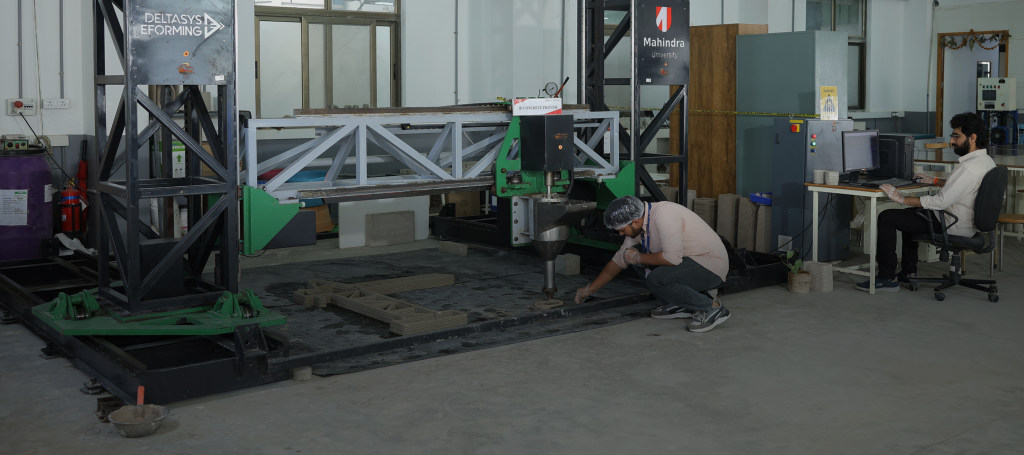
Practical work in structural engineering, structural dynamics and SHM laboratories to study real structural behaviour.

Large-scale simulation and computing
Exposure to high-performance computing for finite element simulations and advanced structural analysis.

Industry and research immersion
Capstone projects and internships addressing real structural engineering and infrastructure challenges.
Programme details
Why choose the Computer-Aided Structural Engineering programme at Mahindra University
The M.Tech in Computer-Aided Structural Engineering (CASE) programme provides in-depth training in mathematical modelling and computational methods for analysing complex structural systems. The curriculum covers areas such as non-linear analysis, static and dynamic structural analysis, and integrates analytical thinking with programming skills.
This interdisciplinary approach enables students to solve complex design and analysis problems involving various materials and structural systems.
Link : MU Test Syllabus
Convergence of AI and structural engineering
Emerging technologies are transforming the construction and infrastructure sectors. The programme introduces students to advanced applications such as:
- AI-assisted construction, 3D-printed housing and prefabricated concrete structures.
- Monitoring structural issues including moisture intrusion, corrosion, settlement and structural deficiencies.
- Structural health monitoring (SHM) using image analysis to detect cracks and structural damage.
- Building Information Modelling (BIM) for integrating data across the lifecycle of infrastructure—from design and construction to maintenance and demolition.
- Use of AI, IoT and data analytics to optimise construction processes, reduce delays and improve infrastructure performance.
Core strengths
- Faculty: Doctoral faculty trained at leading institutions across the world.
- Research ecosystem: Research centres such as the Centre for Sustainable Infrastructure and Systems (CSIS) and the Centre for Artificial Intelligence.
- Experimental facilities
- Structural engineering laboratory
- Structural health assessment and monitoring laboratory
- Structural dynamics laboratory
- Computing infrastructure: High-performance computing facilities, wireless innovations laboratories and a 5G design studio.
- Collaborations: Active collaborations with industry partners and national and international universities.
Programme-specific outcomes
- Develop analytical, computational and programming skills required to analyse and design sustainable solutions for infrastructure challenges in both new and ageing civil structures.
- Equip students with the expertise needed to pursue careers as design consultants, entrepreneurs or researchers in structural engineering and related fields.
- Provide exposure to advanced technologies such as AI, BIM, IoT and 3D printing for monitoring, repair, retrofitting and sustainable infrastructure development.
- Develop analytical, computational and programming skills required to analyse and design sustainable solutions for infrastructure challenges in both new and ageing civil structures.
- Equip students with the expertise needed to pursue careers as design consultants, entrepreneurs or researchers in structural engineering and related fields.
- Provide exposure to advanced technologies such as AI, BIM, IoT and 3D printing for monitoring, repair, retrofitting and sustainable infrastructure development.
Programme educational objectives (PEOs)
- Develop proficiency in fundamental and advanced principles of structural engineering to analyse and solve civil infrastructure problems for sustainable environments.
- Expose students to emerging technologies and innovations that support research-driven applications in structural engineering.
- Prepare graduates for professional leadership, teamwork, lifelong learning and successful careers in the structural engineering domain.
Eligibility
- Candidates must have completed a full-time bachelor’s degree from a recognised university or institute with a minimum aggregate of 60% marks or equivalent grade.
- B.E./B.Tech. in Civil Engineering is mandatory, along with a valid GATE score in Civil Engineering.
- Candidates appearing for their final semester examination are also eligible to apply.
Admission process
- GATE-qualified candidates: Applicants with a valid GATE score and a percentile of 80 or above will be invited for an interview as part of the admission process.
- Non-GATE candidates: Applicants without a valid GATE score, or with a percentile below 80, must appear for a written test conducted by ECSE–Mahindra University, followed by an interview for shortlisted candidates.
FAQs
It focuses on simulation-based analysis and design methods used in consulting, infrastructure and research roles.
Students work extensively in structural, dynamics and monitoring laboratories alongside computational simulation tools.
Yes. Programming is integrated into coursework, with structured support to build confidence alongside analysis skills.
Civil engineering graduates with a minimum of 60% aggregate and a valid GATE score.
Yes. The final year emphasises thesis and project work, providing a strong base for doctoral studies.
