




M.A. in Journalism and Mass Communication (MJMC)
A 2-year postgraduate programme that builds strong conceptual foundations and practical expertise in journalism, media production and strategic communication in a digital age.
M.A. in journalism and mass communication overview
The M.A. in Journalism and Mass Communication equips students with critical and practical skills across journalism, media, digital communication and strategic storytelling. Designed by the School of Digital Media and Communication, the programme combines theory with hands-on media practice to prepare graduates for responsible and informed roles in the evolving media landscape. Students experience:

Broader subject coverage
Including media ethics, digital journalism, media theory and practical reporting, to build strong conceptual and technical grounding.

Hands-on experience
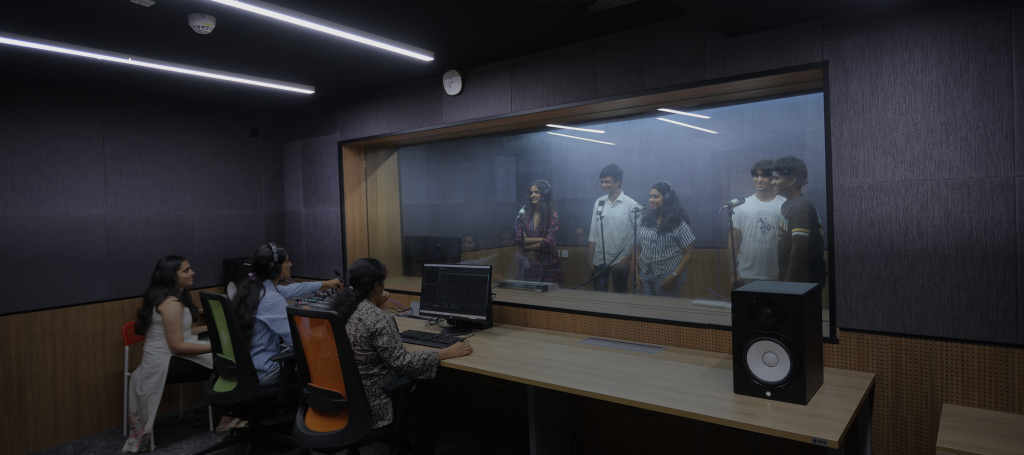
through media projects, content creation and digital media training that mirror real-world newsroom demands.

Academic exposure beyond the classroom
Engage regularly with seminars, workshops and collaborative assignments that connect academic knowledge with evolving media trends.

Individual mentoring
Ongoing faculty guidance to refine communication, research and critical thinking skills that prepare students for the media industry or academic work.
Programme details
Strands of study
The MJMC programme offers students the opportunity to explore specialised areas within media and communication that share common competencies while requiring distinct skill sets. All degree programmes begin with a set of foundational courses that include several practice-based modules.
During this phase, students engage with diverse learning methods such as lectures, laboratory sessions, fieldwork, independent study, library research, guest lectures and guided self-learning. The curriculum helps students understand the practical complexities of the field while strengthening their conceptual grounding in journalism, filmmaking and communication management. This integrated approach prepares graduates who are technologically proficient, ethically grounded and equipped with both conceptual and practical skills.
The curriculum includes the following strands of study:
- News media and journalism
- Filmmaking and media
- Digital media and communication management
The academic experience is further strengthened through exposure to industry and societal practices. Practitioners and faculty guide students through simulations and real-world scenarios common to the media industry. These experiences include:
- Social sensitisation internship
- Industry internship within one of the programme strands
- Programme-end internship in a specialised domain
- Field visits and industry reports
- Guest lectures by industry professionals
- Workshops and masterclasses in specialised areas (for example, gaming and AI in media production)
- Iterative independent projects and practice-based work.
Assessment
Assessment is designed to track each student’s evolving understanding throughout the programme. Continuous evaluation helps measure learning progress while providing constructive feedback. These assessments contribute to the final grade and are based on clearly defined, measurable outcomes.
Regular class participation and attendance are important components of learning, as they enable students to engage actively with concepts and discussions. While examinations are conducted, the programme places greater emphasis on continuous learning and practical engagement.
Course instructors, in consultation with the Dean, determine the syllabus and grading structure. Each assessment component contributes to the final grade to encourage consistent student engagement throughout the semester.
Typical grading distribution
- Research / role-play / debate / presentations / flipped classes – 20%
- Class quizzes / in-class tests / assignments – 25%
- Midterm examination – 15%
- Semester-end examination or final project – 30%
- Class participation – 10%
Assessment methods may vary depending on the course and instructor. Participation is an essential component of evaluation, and attendance may be used as an indicator of active engagement in class discussions.
The programme uses percentage-based evaluation rather than fixed score points. Each graded component—such as assignments, presentations or examinations—is evaluated initially as if it were out of 100 and later weighted according to its assigned percentage.
This approach encourages balanced responses and avoids unnecessary emphasis on answer length or scoring structure. It also allows instructors flexibility in designing meaningful assessments that prioritise learning outcomes rather than rigid grading formats.
With the increasing availability of AI-generated content, the programme emphasises assessment formats that reflect genuine student understanding. Greater focus is placed on in-class evaluations, including presentations, discussions, tests and examinations.
While plagiarism detection tools are available, the primary objective of assessment is to understand each student’s individual learning progress. Faculty members are encouraged to design innovative evaluation methods that prioritise original thinking and authentic student work.
The pedagogical and investigative framework of the programme is guided by five overarching goals. While these goals apply across undergraduate and postgraduate offerings at the School of Media and Communication (SDMC), their depth and application vary according to the academic level.
1. Building competencies
Develop professionals with strong critical thinking, ethical grounding and rigorous practice. The programme emphasises competency beyond technical skills, enabling students to analyse problems, question established practices and develop innovative solutions.
2. Understanding contemporary media practices
Adopt a student-centred approach that connects academic learning with real-world media environments. Engagement with industry practitioners, internships and applied learning activities help students bridge the gap between theory and professional practice.
3. Nurturing communicative societies
Prepare students to understand social realities and the rapidly evolving communication ecosystem. Social sensitisation initiatives expose students to diverse communities and perspectives, encouraging responsible and socially aware communication practices.
4. Practising interdisciplinarity
Integrate media and communication studies with insights from social sciences, humanities and technology. This interdisciplinary perspective equips students to address complex challenges in modern communication environments.
5. Progressive learning approach
Adopt a structured learning model that moves from broad foundational concepts to specialised knowledge. This progressive approach enables students to develop deeper understanding and practical expertise over time.
Aligned with the broader programme philosophy, the MJMC programme aims to achieve the following outcomes:
1. Critical thinking: Develop professionals and researchers who challenge conventional approaches and explore innovative solutions.
2. Understanding change: Equip students to navigate evolving technological, social, cultural and policy environments within the media ecosystem.
3. Interdisciplinary learning: Encourage broad-based knowledge combined with specialised expertise across communication domains.
4. Enabling emerging media societies: Leverage new technologies to support interactive, personalised and diverse communication systems.
5. Diverse learning methods: Promote experiential learning through classroom engagement, fieldwork and student-led projects.
The MJMC programme combines structured academic learning with professional exploration. Over four semesters, students progress from foundational coursework to specialised and output-driven learning.
- Semesters 1 and 2: Broad foundational courses across media and communication domains.
- Semesters 3 and 4: Specialised learning with increasing emphasis on independent or collaborative projects that demonstrate analytical and creative competencies.
Internships form an essential component of the programme and help bridge academic learning with professional practice. Students gain hands-on experience through structured industry and social engagements.
The programme includes:
- Social sector internship or initiative (4–6 weeks) at the end of the first semester
- Mandatory industry internship (10–12 weeks) at the end of the second semester
- Optional industry internship during or after the final semester
The social sensitisation internship provides students with exposure to diverse social environments, enabling them to understand broader societal contexts and responsibilities as communication professionals.
Internship performance is assessed through organisational feedback and student presentations reflecting their learning and professional experience.
The school supports students in transitioning to professional careers through structured placement assistance. A dedicated placement committee facilitates industry connections and recruitment opportunities. While placements are not guaranteed, students receive guidance to prepare for careers in the communication industry.
| Course Title | Credits |
|---|---|
| History and Growth of Communication | 2 |
| Contemporary Media Business | 2 |
| Communication Research I | 2 |
| Visual Literacy | 3 |
| Media Psychology | 2 |
| Journalism and News | 3 |
| Audiovisual Communication | 2 |
| Brands, Advertising, and Strategic Communication | 3 |
| Course Title | Credits |
|---|---|
| Social Sensitization Internship | 5 |
| Communication Research II | 3 |
| Writing for Media I | 3 |
| Project Management in Mediated Communication | 3 |
| Social Media | 3 |
| Media Theory | 3 |
| Media Policy, Law | 2 |
| Media Ethics | 2 |
| Course Title | Credits |
|---|---|
| Industry Internship I (8 weeks) | 9 |
| Writing for Media II | 3 |
| Media Production I | 5 |
| Documentary Film Production | 5 |
| Integrated Strategic Communication I | 5 |
| Specialized Communication | 3 |
| Course Title | Credits |
|---|---|
| Media Production II | 5 |
| Media, Society and Culture | 2 |
| Integrated Strategic Communication II | 5 |
| Media Entrepreneurship | 3 |
| Final Project | 9 |
Eligibility:
- Graduate in a 3 or 4-year degree programme from Indian (CGPA 6/10) or foreign university (GPA 3.5/4) with 60% marks in core subjects and 60% in language subjects.
- Degree should be in an area that is core: Journalism, Mass communication, Media studies, Advertising, Public relations, Communication management, Digital media, Computational media.Or a related domain:
- Any subject in Arts, Humanities or Social Sciences
- Such as sciences, engineering, etc.
- Some work experience is welcome but not necessary.
Admission process:
Admission test followed by interview where a statement of purpose and other documents will be required for final evaluation.
Fee structure (per annum):
| Component | Amount |
|---|---|
| Academic fees | ₹ 2,00,000 |
| Hostel charges (optional) | ₹ 2,10,000 |
| Caution deposit* | ₹ 20,000 |
*Refundable at the end of study or graduation. All fees are subject to revision each year.
Teaching Assistantship
Students awarded a Teaching Assistantship based on their application, test, and/or interview performance as part of the PG admission process will be eligible to receive assistantship support of approximately Rs. 42,000 per month, comprising the following:
- Monthly Stipend: A stipend of Rs. 21,000 per month will be credited directly to the student’s registered bank account.
- Boarding & Lodging: Free on-campus boarding and lodging facilities, valued at approximately Rs. 21,000 per month, will be provided as per the standard campus amenities available to students. In case a student opts to be a day scholar, no equivalent monetary compensation shall be provided in lieu of these facilities.
Teaching Assistantship (TA) duties, as assigned by the Institute, will be mandatory for all eligible students.
Important dates:
| Event | Date |
|---|---|
| Last Date to Apply for 1st round of Admissions | May 11, 2026 |
| 1st round of Personal Interviews | May 18, 2025 |
| Last Date for receipt of Applications for Admission | 31-Jul’26. |
*Dates and schedules are subject to change.
The MJMC programme prepares graduates for three broad pathways: industry practice, research careers and entrepreneurship.
Many careers in media and communication involve project-based work. Whether in journalism, filmmaking, advertising, public relations or digital communication, professionals are expected to manage projects from ideation to execution. As a result, graduates develop strong skills in coordination, storytelling, analysis and production.
Research training is an integral component of the programme. Students develop the ability to investigate problems systematically, apply analytical methods and generate new insights. This research-oriented approach encourages independent thinking and prepares students for both professional practice and advanced academic pursuits.
Graduates may pursue roles across a wide range of organisations and sectors, including:
News and media organisations
- Digital and multimedia news desks
- Investigative and data journalism teams
- Social media desks at news platforms
- Business, sports, culture, health and environment reporting teams
- AI-enabled newsrooms
Digital and content industries
- Digital content and marketing agencies
- Web content and SEO development firms
- Podcast production studios
- AR/VR/XR storytelling and immersive media agencies
Film, entertainment and creative industries
- Entertainment production houses and OTT platforms
- Documentary and commercial film production
- Visual effects (VFX) and animation studios
- Game design studios
Communication and corporate sectors
- Advertising agencies (creative, production and media teams)
- Public relations consultancies
- Corporate communication and brand communication divisions
- Corporate filmmaking and CSR divisions
Research and development
- Research foundations and think tanks
- Non-governmental organisations (NGOs)
- Publishing houses
Higher education
- Ph.D. programmes in journalism studies, media studies, communication studies and related disciplines.
FAQs
Graduates with a recognised bachelor’s degree (3 or 4 years) in core media fields or related domains such as arts, humanities, social sciences, digital media and communication can apply, provided they meet the 60% entry requirement.
Yes. The curriculum blends theoretical study with practical media work in digital, broadcast and multimedia formats to ensure industry-relevant skills.
Graduates may work in journalism, media production, digital communication, public relations, content strategy, media research and allied communication roles.
Yes. Merit-based and need-based scholarships and financial aid options are offered; details are provided in the official admission notifications.
