









Quick facts
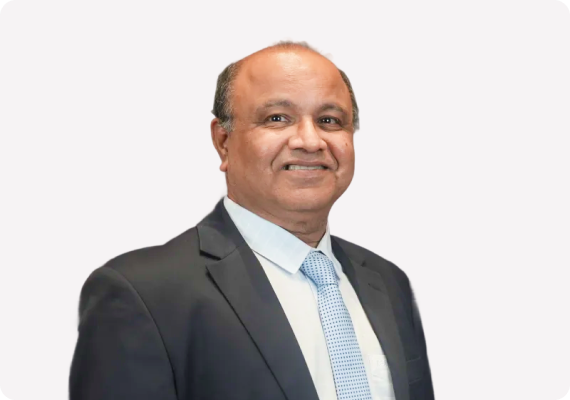
Dr. Ram Mohan Vemuri is a Professor and Head of the Electronics and Computer Engineering Department at Mahindra University, bringing around 30 years of semiconductor industry experience in microprocessor and SoC design and EDA tool development, primarily from his long tenure at Intel and earlier work at LSI Logic. He holds a Ph.D. and M.S. in Electrical and Computer Engineering from the University of Cincinnati, plus M.Tech and B.Tech degrees from IIT‑BHU, and his early research focused on applying genetic algorithms to multichip module partitioning, placement, and layer assignment, with current interests in applying machine learning techniques to design/verification tools and creating low‑cost computer designs for developing countries.
Publications
No publications added yet.
Research
No Research Interests added yet.
Ram Mohan Vemuri
Professor & HOD
Professor Ram Mohan Vemuri has thirty years of work experience at the technical and management levels in the semiconductor industry. After his Ph.D. Dr. Vemuri joined LSI Logic Corporation working on the development of the then industry leading Electronic Design Automation (EDA) tools. For the last 25 years Dr. Vemuri worked at Intel Corporation in Portland, Oregon where he started on the initial Pentium 4 processor. He worked on the design of various microprocessor products and SoC products and development of automation tools to help with the design and validation. Dr. Vemuri took voluntary retirement as a Senior Manager from Intel in December 2021 to repatriate to India and join as a professor at Mahindra University.
- Ph.D. from the department of Electrical and Computer Engineering at the University of Cincinnati, Cincinnati, Ohio. Dissertation Title: “Genetic Algorithms for Partitioning, Placement, & Layer Assignment for Multichip Modules”.
- M.S. from the department of Electrical and Computer Engineering at the University of Cincinnati, Cincinnati, Ohio. Thesis Title: “Active Noise Control Using Adaptive Filtering”.
- M.Tech. in Systems Engineering from IIT-BHU
- B.Tech. in Electrical Engineering from IIT-BHU
- Ram Vemuri and Ranga Vemuri, “ MCM Layer Assignment Using Genetic Search”, Electronic Letters, vol. 30, no. 20, pp. 1635-1637, Sep 1994.
- Ram Vemuri and Ranga Vemuri, “Genetic Algorithm for MCM Partitioning”, Electronics Letters, vol. 30, no. 16, pp.1270-1272, August 1994.
- Ram Vemuri et al., “Multicomponent Synthesis System”, Proposal written for the US Air Force Write Laboratories, which received funding under contract number F33615-91-C-1811 (1994)
- Ram Vemuri et al., “Partitioning for multicomponent synthesis from VHDL specifications”, Proceedings of the VIUF Spring 1993, April 1993
- Ranga Vemuri, Nand Kumar, Ning Ren and Ram Vemuri, A Multicomponent Synthesis Environment for VHDL Specifications Proceedings of the VHDL Spring 1993 Conference, pp. 1-18, VHDL International, Ottawa, April 1993.
- Ram Vemuri et al., “An Integrated Multicomponent Synthesis for MCMs.”, published in IEEE Computer, 26(4) 1993
- Ram Vemuri, Robert Hoffa, and Ranga Vemuri, “An application of genetic algorithms to solve the layer assignment problem in multi chip modules”, presented and published in the Proceedings of IEEE International Conference on Systems, Man, and Cybernetics, October 1992
- Ram Vemuri et al., “Benchmarks for high level synthesis,” Technical Report TM-DDE-91-11, Laboratory for Digital Design Environments, University of Cincinnati, November 1991
- Ram Vemuri and Narasimharao B. P. R. “Knowledge Economy and Corporate Education”, chapter in the book Evolving Corporate Education Strategies for Developing Countries: The Role of Universities. Published by IGI Global, Hershey, PA USA (1990)
- Ram Vemuri, and Ranga Vemuri, “Genetic Synthesis: Performance driven logic synthesis using genetic evolution”, presented and published in the Proceedings of First Great Lakes Symposium on VLSI, March 1990, Kalamazoo MI
ORCID ID: 0009-0003-9576-4045
- October 2021- Present, Professor & HOD, Electronics and Computer Engineering, Mahindra University
- 1997 – 2021 Worked at Intel Corporation in Hillsboro, Oregon
- 1994 – 1997 Worked at LSI Logic Corporation in Milpitas, California
Areas of Research Interest are Integration of AI/ML techniques for EDA tools, analysis of designs, and creation/optimization of designs.
