








Home / Undergraduate / Page 2

BBA-LL.B. (Honours)

A 5-year integrated undergraduate degree combining business administration with legal studies to prepare graduates for careers at the intersection of law, policy and corporate practice.

Programme overview 

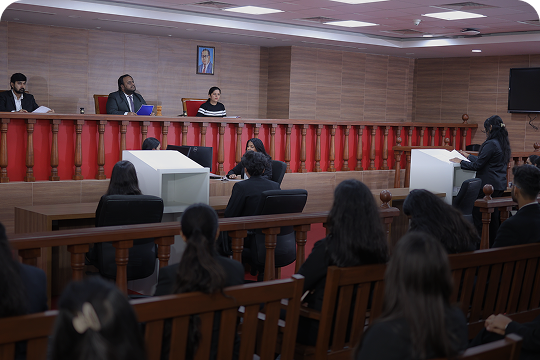
Mahindra University’s BBA LLB (Hons.) programme blends core business education and legal training to build confident professionals ready for corporate law, regulatory roles, consultancy and governance-focused careers. Students develop analytical rigour, practical legal insight and leadership skills through classroom learning, moot courts and experiential projects.

Interdisciplinary learning

Integrated coursework in business administration and law that develops broad professional competence. 

Real-world engagement

Learning through case scenarios, moot courts and applied legal tasks connected to business contexts. 

Analytical and communication skills

Training in logical reasoning, advocacy, negotiation and professional communication. 

Career flexibility

A foundation for roles in legal practice, corporate advisory, compliance, consulting and public policy.

Programme details

MU’s vision

  • Train multi-skilled leaders capable of reflection and innovation, committed to inclusive and sustainable progress.
  • Pursue interdisciplinary academic excellence by integrating the study of science and technology with the liberal arts, including humanities, ethics, philosophy and design thinking.
  • Balance academic learning with real-world experience through entrepreneurial projects that address complex societal challenges.
  • An international faculty with strong industry and academic backgrounds, global exposure and research expertise ensures that the curriculum remains contemporary, continuously evolving and aligned with global business and industry requirements.

Eligibility

Candidates aspiring to the BA LL.B. programme must meet the prescribed eligibility criteria and demonstrate the required academic background. Admission is based on performance in recognised law entrance examinations and other specified requirements.

Academic eligibility

  • 10+2 or equivalent from a recognised statutory board with a minimum of 60% aggregate marks across all subjects, or an equivalent grade for students from IB or other approved boards, as per AICTE/UGC norms.

Entrance examination requirement

Applicants must satisfy one of the following:

  • A valid CLAT 2026 examination score (exact cut-off score or All India Rank will be announced after the results are declared), or
  • A valid LSAT score, or
  • Qualification in the Mahindra University Law Entrance Test 2026 (MULET 2026).

Important : all applicants to undergraduate programmes who have completed Class 12 under the IB, Cambridge or any other international curriculum must submit a UGC equivalence certificate by 30 August 2026. Failure to do so will result in automatic cancellation of admission.


MULET 2026 examination pattern

The test consists of 90 multiple-choice questions, distributed as follows:

  • English knowledge and skills – 20 questions
  • Logical reasoning – 25 questions
  • General knowledge and current affairs – 20 questions
  • Mathematics – 15 questions
  • Legal reasoning – 10 questions

Total marks: 90 (each question carries 1 mark)
Negative marking: 0.25 marks will be deducted for every incorrect answer.

Sr. No.Subject CodeSubject Name
1BB-1101Legal Methods & Legal Research
2BB-1102Law of Torts
3BB-1103English-I
4BB-1104Marketing and Strategic Management
5BB-1105Economics-I
6BB-1106Management Principles and Practices of Accounting
Sr. No.Subject CodeSubject Name
1BB-1201Law of Contracts-I
2BB-1202English-II
3BB-1203Financial Management
4BB-1204Moot Court: Clinical Paper-I
5BB-1205Legal and Constitutional History
6BB-1206Economics-II
Sr. No.Subject CodeSubject Name
1BB-2101Law of Contracts-II
2BB-2102Criminal Law-I: Bhartiya Nyaya Sanhita
3BB-2103Constitutional Law-I
4BB-2104Family Law-I
5BB-2105International Business Management
6BB-2106Moot Court: Clinical Paper-I
Sr. No.Subject CodeSubject Name
1BB-2201Constitutional Law-II
2BB-2202Family Law-II
3BB-2203Jurisprudence
4BB-2204Criminal Law-II: Bhartiya Nagrik Suraksha Sanhita
5BB-2205Political Science-III
6BB-2206Economics-III
S. No.Subject CodeSubject Name
1BA-3101International Trade Law
2BB-3102Property Law
3BB-3103Company Law – I
4BB-3104Administrative Law
5BB-3105Interpretation of Statutes
6BB-3106Alternate Dispute Resolution: Clinical Paper – II
S. No.Subject CodeSubject Name
1BB-3201Bhartiya Sakshya Adhiniyam
2BB-3202Civil Procedure Code & Law of Limitation
3BB-3203Company Law – II
4BB-3204Land Laws
5BB-3205Competition Law
6BB-3206Intellectual Property Rights
S. No.Subject CodeSubject Name
1BB-4101Labour & Industrial Law – I
2BB-4102Public International Law
3BB-4103Private International Law
4BB-4104Optional I
5BB-4105Optional II
6BB-4106Optional III
S. No.Subject CodeSubject Name
1BB-4201Labour & Industrial Law – II
2BB-4202Principles of Taxation
3BB-4203Drafting, Pleading and Conveyance: Clinical Paper – III
4BB-4204Optional IV
5BB-4205Optional V
6BB-4206Optional VI
S. No.Subject CodeSubject Name
1BB-5101Environmental Law
2BB-5102Professional Ethics: Clinical Paper – IV
3BB-5103Honours Paper I
4BB-5104Honours Paper II
5BB-5105Honours Paper III
S. No.Subject CodeSubject Name
1BB-5201Honours Paper IV
2BB-5202Honours Paper V
3BB-5203Honours Paper VI
4BB-5204Honours Paper VII
5BB-5205Honours Paper VIII

Fee structure (per annum):

CategoryAmount
Academic fees₹4,00,000
Hostel charges₹1,70,000
Caution deposit*₹20,000

*Refundable at the end of study or graduation.

Note: Hostel stay is not mandatory for students enrolled in the B.A. LL.B. (Hons.) and BBA LL.B. (Hons.) programmes. All fees are subject to revision each year. Accommodation will be provided in accordance with the University’s standard norms. During the first academic year, all students will be allotted triple-occupancy rooms. From the second year onwards, students may have the option to choose double or triple occupancy, subject to availability, with hostel fees applicable according to the type of accommodation allotted.

Important dates

Aspiring students may apply for admission to the B.A. LL.B. programme to pursue a comprehensive legal education. Applicants are advised to review the eligibility requirements carefully and ensure timely submission of their applications.

Admission milestone*Date
Last date to apply for the next round of admission9th May 2026
Mahindra University Law Entrance Test (MULET 2026)To be announced
Last date for receipt of applications09th July 2026

*Dates and schedules are subject to change

FAQs

The BBA LL.B. (Hons.) is a five-year integrated undergraduate programme that combines business administration with legal education. Students complete both degrees together over ten semesters, developing expertise in law while gaining a strong foundation in management and business practices.

The programme integrates business and law subjects. Business courses include management fundamentals, financial accounting, economics, communication, and computer applications, while legal courses cover constitutional law, criminal law, law of torts, company law, property law, family law, and alternative dispute resolution

Graduates can pursue careers in corporate law, legal consulting, compliance, regulatory affairs, policy advisory, and business law practice. Opportunities exist in law firms, multinational companies, consulting firms, financial institutions, and government organisations.

Applicants must have completed Class 12 or equivalent with at least 60% marks (or equivalent grade). Admission is based on a valid CLAT score, LSAT score, or the Mahindra University Law Entrance Test (MULET), along with meeting the university’s admission requirements.

The programme is designed to develop professionals who understand both business and legal frameworks. By combining management education with legal training, students gain interdisciplinary skills that are valuable for roles involving corporate governance, business regulation, and commercial law.

Start your journey with us

Home / Undergraduate / Page 2

B.Tech-LL.B. (Honours)

An integrated dual-degree programme that equips students with interdisciplinary expertise in technology and law.

Programme overview 

The B.Tech-LL.B (Hons) at Mahindra University is a six-year industry-backed integrated dual-degree programme that uniquely combines engineering principles with legal studies. Students gain both technical acumen and legal insight, enabling them to pursue careers in corporate law, intellectual property, compliance, technology policy and related domains. 

Interdisciplinary depth in technology and law

Core engineering principles are blended with essential legal knowledge, including constitutional law, contract law and intellectual property. 

Real-world and industry relevance

Learning is enriched by case studies, projects, internships and interactions that reflect legal-tech challenges. 

Critical analytical capability

The curriculum emphasises logical thinking, problem-solving and decision-making in both technical and legal contexts. 

Career readiness across sectors

Graduates are prepared for roles in law firms, technology companies, regulatory bodies and policy-oriented organisations. 

Programme details

Eligibility and admission

CategoryDetails
Academic QualificationApplicants must meet one of the following criteria:
  • Qualify in JEE (Main) 2026 and be eligible to appear for JEE Advanced 2026Secure a top All India Rank in JEE (Main) 2026 (exact cut-off rank will be announced after declaration of results)Hold a valid SAT Subject Test score (Mathematics, Physics, and Chemistry) with a minimum score of 800
Entrance Test RequirementAll applicants must qualify in the Mahindra University Law Entrance Test 2026 (MULET 2026).
Important NoticeApplicants who have completed Class 12 under IB, Cambridge, or any other international curriculum must submit a UGC equivalence certificate by 30 August 2026. Failure to submit the certificate by the deadline will result in automatic cancellation of admission.
MULET 2026 – Exam Structure
  • Total questions: 90 multiple-choice questionsTotal marks: 90Marking scheme: 1 mark per questionNegative marking: 0.25 marks deducted for each incorrect answer
MULET 2026 – Section-wise Distribution
  • English Knowledge and Skills – 20 questionsLogical Reasoning – 25 questionsGeneral Knowledge and Current Affairs – 20 questionsMathematics – 15 questionsLegal Reasoning – 10 questions

Fee structure

The fee structure for the programme is as follows: 

CategoryAcademic fees (per annum)Hostel charges (all-inclusive)Caution deposit (refundable)
Indian students₹ 5,00,000₹ 1,70,000₹ 20,000

Note: Hostel residence is mandatory for students enrolled in the B.Tech. LL.B. (Hons.) programme. Hostel stay is not mandatory for students enrolled in the B.A. LL.B. (Hons.) and BBA LL.B. (Hons.) programmes. All fees are subject to revision each year.

Important dates

Dates and schedules are subject to change; please refer to official admissions notifications for updates.

  • Last date to apply for next round of admissions:  9th May 2026
  • Mahindra University Law Entrance Test (MULET 2026): 25 January 2026
  • Last date for receipt of applications for admission:  31st July 2026

FAQs

The B.Tech–LL.B. (Hons.) is a six-year integrated dual-degree programme that combines engineering education with legal studies. The curriculum integrates technology subjects with core law courses to prepare students for emerging legal-technology domains.

The programme blends engineering fundamentals with legal education, covering subjects related to computer science and engineering alongside legal disciplines such as constitutional law, contract law, intellectual property law, and dispute resolution. It also addresses emerging fields like AI regulation, data protection, blockchain, and cyber law.

Graduates can pursue careers in technology law, intellectual property rights (IPR), corporate legal advisory, cyber law, regulatory policy, compliance, and legal consulting. Opportunities exist across law firms, technology companies, government agencies, research organisations, and policy institutions.

Applicants must qualify through recognised entrance routes such as JEE (Main) or submit valid SAT or ACT scores, along with meeting the university’s academic eligibility requirements in Class 12. Final admission may also involve additional evaluation steps as specified by the university.

The programme is designed to address the growing intersection between technology and law, preparing professionals who understand both engineering systems and legal frameworks. This interdisciplinary approach equips graduates to tackle complex issues involving emerging technologies, regulation, and digital governance.

Start your journey with us

Home / Undergraduate / Page 2

4-year BBA (Honours) in Hospitality Management

A full-time undergraduate programme that develops business leadership, operational expertise and hospitality insight for a globally dynamic service sector. 

Programme overview 

The BBA (Hons) in hospitality management at Mahindra University provides students with a comprehensive blend of business fundamentals and hospitality operations. The curriculum is designed to equip learners with strategic thinking, operational knowledge, and real-world exposure relevant to hospitality, tourism, event management, food and beverage operations, and guest experience management. 

Integrated business and hospitality learning

Foundational management principles combined with hospitality practices that reflect industry standards. 

Applied hospitality insight

Exposure to service performance, operational excellence, and customer engagement strategies. 

Technology and analytics in services

Modules such as hospitality analytics and digital tools introduce data-driven decision-making in service environments.

Leadership and innovation

Opportunities to build leadership capability, entrepreneurial thinking, and sustainable business practices.

Programme details

Students of the BBA (Hons.) in hospitality management receive a robust foundation in business and hospitality principles, blending theoretical frameworks with practical experience to excel in the industry. The BBA (Hons.) curriculum integrates advanced, industry-relevant topics such as

Hospitality analytics for data-driven decisions
Equipping students to harness data-driven insights for strategic decision-making.

AI and new technology for hospitality leaders
Leveraging AI and emerging technologies to enhance guest experiences and operational efficiency

Asset and investment management
Understanding the financial, operational, and strategic aspects of managing hospitality ventures.

Design thinking in hospitality
Applying design thinking to improve guest interactions, service design, and business processes.

Dual-track specialisation for focused expertise

In the final years, students choose between two specialised pathways to align with their career goals. The hospitality management track focuses on business and hotel operations, finance and strategy, while the culinary arts and management track is designed for entrepreneurs in the food and beverage sector, with a focus on innovation and business acumen. A distinctive blend of cutting-edge business and hospitality topics ensures students are at the forefront of industry innovation, including:

  • Business planning and start-up strategy: Developing comprehensive business plans and go-to-market strategies for new ventures in the hospitality sector.
  • Revenue management: Mastering strategies for optimising revenue and profitability through dynamic pricing, inventory control, and demand forecasting.
  • Psychobiology of taste and appetite: Applying principles of sensory analysis and consumer psychology to menu engineering, marketing, and the creation of profitable dining concepts.
  • Global café concepts: Analysing business models and operational strategies for successful international and local café and beverage enterprises.
  • Delivery-driven culinary ecosystems: Mastering the business of off-premises dining, including ghost kitchens, delivery logistics, and technology platforms.
  • Culinary pharmacology: Exploring the intersection of culinary arts and pharmacology, focusing on the medicinal properties of foods, herbs, and spices.
  • Culinary biotechnology: Understanding genetic engineering, plant-based meats, fermentation technology, and food fortification to develop healthier and more sustainable food solutions.

Our international pathway programme is a premier opportunity for students aiming for a career on the world stage. This structured 3+1 pathway allows you to build a strong foundation with three years of study in the BBA (Hons.) in hospitality management programme at Mahindra University before transferring seamlessly to one of our esteemed international partner institutions for your final year.

This unique arrangement provides a comprehensive and deeply immersive global education. Students will not only adapt to a new academic environment but also gain first-hand experience of a different culture, preparing them for the nuances of international business.

Upon successful completion of the programme, students will graduate with two prestigious qualifications:

  • A BBA (Hons.) in hospitality management from Mahindra University.
  • A diploma or certification from the international partner institution.

This dual qualification significantly enhances the professional profile, demonstrating cross-cultural adaptability, academic resilience and a commitment to global excellence, giving graduates a distinct advantage in the competitive international job market.

Bridge the gap between theory and real-world practice with our international business immersions. These intensive, two-week programmes are designed to provide a 360-degree view of the hospitality industry in a key international market. More than just a tour, these immersions are a carefully curated blend of corporate access and cultural integration.

Programme highlights:

  • Corporate and operational deep dives: Students gain exclusive access to the headquarters and flagship properties of leading international hotel groups, innovative restaurant chains, and key industry corporations. Through guided tours and interactive sessions with senior management, students learn directly about their business models, operational strategies, and the challenges they face in a global context.
  • Cultural and lifestyle integration: True business insight comes from understanding the customer. Our immersions include activities designed to explore the local culture, lifestyle, and consumer habits. This provides a crucial framework for understanding why certain business practices succeed and how services are tailored to different cultural expectations.
  • Culinary bootcamp: Students can immerse themselves in the heart of a global culinary destination through our international culinary bootcamps. These dynamic, hands-on programmes are designed to provide a deep and authentic understanding of how food shapes culture, business, and community in a specific international location. During these bootcamps, local markets are explored, techniques are mastered under the guidance of regional culinary experts, and a strategic business and cultural investigation is undertaken.

By participating in these immersions, students develop a practical, on-the-ground understanding of global business, returning with invaluable insights that cannot be taught in a classroom

Foundational cross-departmental internship

In the fourth semester, all students undertake a mandatory internship. This foundational experience is designed to provide a comprehensive, 360-degree view of a full-service hospitality enterprise. Students are rotated through key departments, including front office, food and beverage service, housekeeping, and sales. Through this cross-departmental exposure, a holistic management perspective is developed, along with an understanding of how each business unit contributes to overall success.

Specialisation internship

In the eighth semester, an optional internship is available. This capstone experience is designed to be undertaken within the student’s chosen area of specialisation—either hospitality management or culinary management. An opportunity is provided to refine advanced skills within a specific professional niche, such as revenue management, asset management, or food and beverage concept development. This internship is intended to build deep expertise and often serves as a direct pathway to full-time employment upon graduation.

In the final years of the programme, students can tailor their studies to their career ambitions by choosing one of two specialised tracks. This allows for deep, focused learning within their chosen area of the hospitality industry.

Hospitality management track: This track is designed for students aiming for leadership roles in business and hotel operations, finance, and strategy. It focuses on the core business aspects of managing large-scale enterprises.

Culinary management track: Ideal for aspiring entrepreneurs and innovators in the food and beverage sector. It blends culinary passion with business acumen, with a focus on product development, consumer trends and the management of food-centric businesses.

Eligibility criteria

Mahindra University outlines clear eligibility criteria for the BBA (Hons.) in Hospitality Management. The program ensures applicants have the right academic foundation. Candidates are advised to review the prescribed eligibility criteria before applying.

Students under the Indian category

  • 10+2 or equivalent from any statutory board with 80% OR equivalent grade for the students from IB or other approved boards. OR
  • Valid NCHM JEE entrance examination score. OR
  • Qualify in Mahindra University Hospitality Management Entrance Test-2026 (MUHET 2026)

Followed by group discussion/panel interview for shortlisted candidates

Important: All Applicants to UG programmes who have completed Class 12 under IB, Cambridge, or any other international curriculum must submit a UGC Equivalence Certificate by 30 August 2026. Failure to do so will result in automatic cancellation of admission.

Students under the POI/NRI category

  • 10+2 or equivalent from any statutory board with 80% OR equivalent grade for the students from IB or other approved boards. OR
  • Valid NCHM JEE entrance examination score. OR
  • Qualify in Mahindra University Hospitality Management Entrance Test-2026 (MUHET 2026)

Followed by group discussion/panel interview for shortlisted candidates

For the BBA (Applied Economics & Finance) and BBA (Computational Business Analytics) programmes, Mathematics is mandatory in 12th grade.

Fee structure

Mahindra University outlines clear eligibility criteria for the BBA (Hons.) in Hospitality Management. The program ensures applicants have the right academic foundation. Candidates are advised to review the prescribed eligibility criteria before applying.

Students under the Indian category

Academic feesRs. 6,00,000 Per Annum
Hostel chargesRs. 1,70,000 Per Annum
Caution deposit (refundable at the end of study and graduation)Rs 20,000

Students under the POI/NRI category

Academic feesUSD 9,000 Per Annum
Hostel chargesUSD 3,000 Per Annum
Caution deposit (refundable at the end of study and graduation)USD 400

Note: Hostel residence is mandatory for all students enrolled in the BBA (Hons.) in Hospitality Management & all fees are subject to revision every year. Accommodation shall be provided in accordance with the University’s standard norms. During the first academic year, all students will be allotted triple-occupancy rooms. From the second year onwards, students may opt for double or triple occupancy, subject to availability, with hostel fees applicable to the allotted accommodation type.

Important dates

Last Date to Apply for next round of Admissions30th July 2026
Next round of Personal InterviewsTBA

*Dates and schedules are subject to change

FAQs

The degree spans four academic years as a full-time undergraduate program. 

Yes. All students in this programme are expected to reside on campus as part of the residential model.

Admission may be based on NCHM JEE, MUHET, or equivalent qualifications per the eligibility criteria.

Yes. Applied hospitality training, analytics and service operations are core components of the learning experience.

Students have opportunities for real-world engagement through internships and global exposure components within the curriculum. 

Start your journey with us

Home / Undergraduate / Page 2

5 Year Integrated M.Tech in Computer Science Engineering

An integrated programme that develops deep technical expertise in computing, algorithms and advanced engineering systems for future technology careers.

Programme overview 

The five-year integrated B.Tech + M.Tech in computer science & engineering combines undergraduate and postgraduate study into a continuous academic pathway. It is designed to prepare students with both solid foundations in computing and advanced capabilities in specialised and research-oriented aspects of computer science. 

Fundamental computing and engineering

Strong grounding in computer science principles, mathematical reasoning and engineering fundamentals.

Advanced technology learning

Exposure to key areas such as algorithms, machine learning, systems and security as part of the integrated master’s component.

Research capability development

Opportunities to engage in project, laboratory and design work that build analytical depth and problem-solving skills.

Preparation for careers and higher study

Integrated depth that supports roles in the software industry, research labs or further academic study.

Programme details

Programme objective

  • Graduates will identify and address complex challenges of the future, contributing to the advancement of computer science.
  • Graduates will develop original ideas and build technology-driven solutions that simplify processes and improve quality of life.
  • Graduates will demonstrate entrepreneurial thinking and advance their careers through continuous development of professional, communication and analytical skills.

Programme structure

The integrated structure is organised progressively to build breadth and depth:

  • Years 1–2: foundational phase: core courses in mathematics, fundamentals of computing, engineering sciences and introductory computer science.
  • Years 3–4: professional phase: advanced computing topics, software and systems engineering, data and algorithm courses aligned with industry needs.
  • Year 5: master’s phase: specialised advanced coursework and an integrated research/design project under faculty supervision.

The design ensures continuity between undergraduate breadth and postgraduate depth in computing.

Sr. No.Course CodeCourse TitleLTPCredits
1MA 1101Mathematics-I (Calculus & ODE)4105
2CH 1101 / CH1103Chemistry I + Lab2124
3EE 1101Intro to Electrical Engineering2122
4EE 1105Electronics2122
5CS 1101Introduction to Computing2124
6HS 1102Media Project1021.5
7HS 1101English0303
8HS 1104Intro to Entrepreneurship0031
9HS 1103French – I0200.5
Sr. No.Course CodeCourse TitleLTPCredits
1MA 1202Mathematics-2 (Linear Algebra, Complex Analysis)3104
2PH 1202Physics-I2124
3BI 1201Biology3003
4CS 1201Data Structures3125
5CS 1202Discrete Mathematical Structures2002
6ME 1202Workshop Practice0021
7CE 1101Earth and Environmental Sciences2002
8HS 1201Entrepreneurship Practice0021
9HS 1202Professional Ethics0101
10HS 1203French-II0200.5
Sr. No.Course CodeCourse TitleLTPCredits
1MA 2103Mathematics-3 (Probability & Statistics)3104
2PH 2102Physics-II3125
3CS 2101Optimization Techniques for AI3003
4CS 2102Design and Analysis of Algorithms3024
5EE 2101Signals and Systems3104
6CS 2104Programming Workshop0020.5
7HS 2101Lean Start-up0031
8HS 2102Principle of Economics3001.5
9HS 2103French-III0200.5
Sr. No.Course CodeCourse TitleLTPCredits
1MA 2208Mathematics-4 (Numerical Methods)3024
2CS 2201Digital Logic Design & Computer Architecture3104
3CS 2202Machine Learning3003
4CS 2102Artificial Intelligence3003
5CS 2204Theory of Computation3003
6CS 2205Programming Workshop0020.5
7HS 2201Design Thinking1022
8HS 2202Financial Accounting3001.5
9HS 2203French-IV0200.5
Sr. No.Course CodeCourse TitleLTPCredits
1CS 3101Compiler Design3003
2CS 3102Operating Systems3024
3CS 3103Database Management Systems3024
4CS 3105Object-Oriented Programming2023
5CS 3106Microprocessors and Interfacing2023
6CS 3107Digital Image Processing3003
7Liberal Arts Elective I2002
8CS 3104Programming Workshop0021
9HS 3102French-V (Optional)0200.5
Sr. No.Course CodeCourse TitleLTPCredits
1CS 3205Computer Networks3024
2CS 3206Software Engineering2023
3CS 3223Neural Networks & Deep Learning3003
4Elective I3003
5Elective II3003
6HS 3201Introduction to Professional Development2002
7Liberal Arts Elective II2002
8HS 3202French (Optional)0200.5
Sr. No.Course CodeCourse TitleLTPCredits
1CS 4101Distributed Systems3024
2CS 4103Cryptography & Network Security3003
3CS 4104Computational Intelligence & Evolutionary Computing3003
4CS 5104Mathematics for AI & Data Science3003
5Elective III3003
6Elective IV3003
7Liberal Arts Elective III2002
8HS 4101French – VII (Optional)0200.5
Sr. No.Course CodeCourse TitleLTPCredits
1CS 5203Natural Language Processing3003
2CS 5202Computer Vision3003
3CS 5209Advanced Algorithms3003
4Elective V3003
5Elective VI3003
6Elective VII3003
Sr. No.Course CodeCourse TitleLTPCredits
1CS 4121Computational Sequence Modelling3003
2CS 4122Reinforcement Learning3003
3Elective VIII3003
4Elective IX3003
5CS 5208Dissertation0066
Sr. No.Course CodeCourse TitleLTPCredits
1CS 5301Dissertation001818
Total Credits18
Course CodeElective Title
CS3220GPU Programming
CS3227Introduction to Robotics
CS3225Computational Biology
CS3226Control Systems
CS3224Recommender Systems
CS4106Wireless Sensor Networks
CS4107Computability and Complexity Theory
CS4108Quantum Computing and Quantum Machine Learning
CS4157Deep Learning
CS4110High Performance Computing
CS3201Big Data Analytics
CS4222Social Computing
CS4221Internet and Society
CS4223Performance Models of Computing Related Systems
CS4224Advanced Computer Networks
CS4225Enterprise Software Architecture
CS4187Game Theory
CS4189Medical Image Analysis
CS4285Foundations of Immersive Technology
CS4286Foundations of Cybersecurity and Privacy
CS4122Reinforcement Learning
CS4123Computational Genomics
CS4104AI in Industry 4.0

FAQs

It is a five-year, full-time integrated degree that awards both a B.Tech and M.Tech in computer science & engineering upon completion. 

Yes. The master’s component includes advanced coursework and research or project work under supervision.

The integrated pathway offers a continuous and deeper academic experience, reducing overall duration while building both undergraduate fundamentals and postgraduate specialisation.

Yes. The integrated master’s component positions graduates well for doctoral study in computing and related fields.

Yes. Mahindra University’s engineering programmes, including the integrated degree, follow a fully residential model.

Start your journey with us

Home / Undergraduate / Page 2

Bachelor of Design (B.Des) in Design Innovation

A 4-year, fully residential programme at MU School of design innovation curated to build creative confidence, design thinking skills, and global exposure.

B. Des overview 

Our B.Des in design innovation programme prepares students to solve real-world challenges by blending creativity with technology, business, and social insight. The programme combines studio practice, industry projects, and global immersion, giving graduates the ability to design for impact in a fast-changing world. Students experience:

Purpose-driven design

From day one, with students working in immersive studios to turn ideas into prototypes that solve real problems

Cross-discipline learning

Blending design with technology, business, and liberal arts to nurture versatile innovators

Global exposure

Through international exchanges, visiting faculty, and industry collaborations that connect students to worldwide design practice

Impactful capstone thesis

That showcases creativity, research, and problem-solving in a professional portfolio recognised by industry

Programme details

Academic structure

  • The Bachelor of Design Innovation is a four-year / eight-semester full-time undergraduate programme delivered by the School of Design Innovation.
  • Proposed intake for the academic year 2026-27*: 60

*Up to a maximum of 15% of the overall intake will be kept for NRI / PIO applicants

  • Core skills: Learn design principles, sketching, material exploration, and foundational design history.
  • Technological exposure: Introduction to tools such as Blender, Photoshop, video editing software, and AI-powered design tools.
  • Hands-on exploration: Engage in creative projects that integrate theoretical knowledge with practical application.
  • Electives: Explore domains such as industrial design, communication design, interaction design, and apparel design.
CoursesDescriptionCredits
The joy of sketching and coloringTo enable students to experience and imbibe the joy of observing, drawing and recording objects and events.3
Nature Human and DesignExamine theories about the origins of life, natural selection and evolutionary design.3
Element of Design and AIExploring the foundations of visual harmony and creative expression.3
Design ThinkingChakku’s 7 Concerns of Design Thinking for Innovation3
Design TinkeringPractical hands-on learning by unraveling the art and science behind daily products.3
Design Exploration Project – 1Exploring the complete journey of a product life cycle along with small scale enterprises.6
CoursesDescriptionCredits
Visualization and SketchingTo imagine more and sketch beyond3
History of DesignUnderstanding the Past, Designing the Future3
Sustainable DesignTo Rethink, Reuse, and Reconnect by exploring sustainability through hands-on design interventions3
Design Exploration – 1Introduction to Interaction design and Apparel design3
Design Exploration – 2Introduction to Industrial Design and Communication Design3
Design Project – 2Understanding the constraints of grass-root enterprises to design practical interventions.6

Discipline-specific learning: Choose from industrial design, communication design, interaction design or apparel design.

Systems-based thinking: Work on interdisciplinary projects that address real-world challenges.

Advanced tools: Develop expertise in tech modelling, AR/VR, sustainable materials, animation and motion graphics.

CoursesTrackDescriptionCredits
Intro to PhotographyCommonLearning the fundamentals of photography, composition, lighting, and visual storytelling.3
User ResearchCommonUnderstanding user needs through observation, interviews, and research methods.3
Form StudiesCommonExploring form, structure, proportion, and aesthetics in design.3
Engineering Principles & DesignIndustrialApplying basic engineering principles to design and product development.3
Bio-mimicry & CreativityIndustrialDrawing inspiration from nature to develop innovative design solutions.3
UI Cognitive ErgonomicsInteractionUnderstanding human cognition to design intuitive user interfaces.3
Usability EvaluationInteractionEvaluating the usability and user experience of products and interfaces.3
Basic Graphic DesignCommunicationExploring typography, color, layout, and visual communication principles.3
Animation BasicsCommunicationLearning the principles of motion, timing, and animated storytelling.3
Fashion Illustration and SketchingApparelDeveloping fashion sketching and garment visualization techniques.3
Textile and Pattern-making MasteryApparelExploring textile materials, surface patterns, and pattern-making techniques.3
Design Project – 3CommonApplying the complete design process to solve real-world challenges from startups.6
CoursesTrackDescriptionCredits
Typography and LayoutCommonExploring typography, layout, and visual hierarchy for effective communication.3
Human Factors in DesignCommonUnderstanding human capabilities and limitations in design.3
Design for InclusivityCommonDesigning accessible and inclusive products, services, and experiences.3
Application of AI in designCommonExploring AI tools and workflows to enhance the design process.3
Material and Manufacturing processIndustrialUnderstanding materials and manufacturing methods for design applications.3
User Experience DesignInteractionDesigning meaningful and user-centered digital and physical experiences across Screens, AR/VR & CUI.3
Pitch Deck DesignCommunicationCreating compelling presentations to communicate design ideas effectively.3
Technology and FashionApparelExploring the integration of emerging technologies in fashion design.3
Design Project – 4CommonDeveloping innovative design solutions through a medium-scale industry linked project.6

Emerging technologies: Explore emerging fields such as artificial intelligence and advanced prototyping.

Strategic thinking: Develop skills in entrepreneurship, service design and innovative problem-solving.

Elective deep dives: Tailor your learning in areas such as medical devices, game design, advertising, animation, graphic design or couture fashion.

CoursesTrackDescriptionCredits
System DesignCommonDesigning integrated systems that address complex user and business needs.3
Design Innovation ManagementIndustrialManaging innovation through design strategies and collaborative practices.3
Advance Computer Aided DesignIndustrialDeveloping advanced 3D modeling and digital design skills.3
Smart Product Design (Industrial)IndustrialDesigning intelligent industrial products with emerging technologies.3
AR/VR InterfacesInteractionCreating immersive interfaces for augmented and virtual reality experiences.3
Digital Game DesignInteractionDesigning engaging gameplay, mechanics, and interactive experiences.3
Smart product design (Interaction)InteractionDeveloping interactive smart products focused on tangible interactions and electronics.3
Advanced Graphic DesignCommunicationExploring advanced visual communication and branding techniques.3
Film Theory and AppreciationCommunicationUnderstanding cinematic language, storytelling, and film analysis.3
Motion GraphicsCommunicationCreating dynamic visual content through animation and motion design.3
Advance Draping and ConstructionApparelMastering garment draping and advanced construction techniques.3
Branding, Merchandising & PackagingApparelDeveloping brand identity through merchandising and packaging design.3
Smart Product Design (Apparel)ApparelDesigning innovative apparel integrated with smart electronic and wearable technologies.3
Design Project – 5CommonSolving complex design challenges through interdisciplinary projects.9
CoursesTrackDescriptionCredits
Industry Exposure Internship ProjectCommonGaining professional experience through industry-based design practice.3
Qualitative Design Research MethodsCommonApplying qualitative methods to understand users and design contexts.3
Advanced Materials & ManufacturingIndustrialExploring advanced materials and modern manufacturing processes.3
Sustainable Design ManagementIndustrialIntegrating sustainability principles into design and innovation practices.3
Tangible Games DesignInteractionDesigning interactive games using physical and tangible interfaces.3
Emerging Trends in Interaction TechnologyInteractionExploring next-generation interaction technologies and applications.3
Semantics & Communication theoryCommunicationUnderstanding meaning, perception, and communication in design.3
3D AnimationCommunicationCreating three-dimensional animations for storytelling and visualization.3
Digital Fabric DesignApparelDeveloping digital textile patterns and fabric surface designs.3
Style & AccessoriesApparelExploring fashion styling and accessory design principles.3
Design Project – 6CommonDelivering a comprehensive design project integrating research, innovation, and execution.9
CoursesDescriptionCredits
Project-aligned online course – 1Building specialized skills through an online course aligned with the project.3
Industry project and internship (Capstone 1)Solving real-world industry challenges through an internship and capstone project.18
CoursesDescriptionCredits
Project-aligned online course – 2Advancing project expertise through a specialized online learning experience.3
Graduation Project (Capstone 2 or
continuation of Capstone 1)
Executing a comprehensive graduation project demonstrating design knowledge and innovation.18

Eligibility:

10+2 or equivalent from a recognised statutory board with a minimum of 80% marks or an equivalent grade (for students from IB or other approved boards).

A valid score in the 2026 entrance examinations of UCEED, NID or NIFT.

Followed by Panel Interview for shortlisted candidates.

Important: Applicants to undergraduate programmes who have completed Class 12 under the IB, Cambridge or any other international curriculum must submit a UGC Equivalence Certificate certificate by 30 August 2026. Failure to do so will result in automatic cancellation of admission.

Fee structure (per annum):

CategoryAcademic feesHostel charges (boarding & lodging – triple occupancy)Caution deposit*
Indian category₹ 5,00,000₹ 1,70,000₹ 20,000
PIO / NRI categoryUSD 9,000USD 3,000USD 400

Note: Hostel residence is mandatory for all students enrolled in the B.Des programme. Accommodation shall be provided in accordance with the University’s standard norms. During the first academic year, all students will be allotted triple-occupancy rooms. From the second year onwards, students may have the option to opt for double or triple occupancy, subject to availability, with hostel fees applicable as per the allotted accommodation type.

Important dates

MilestoneDate
Last date to apply for next round of admissions9th May 2026
next round of personal interviews11th May – 15th May 2026
Last date for receipt of applications for admission 31st July 2026

Note: Dates and Schedules are subject to change.

FAQs

It is a four-year full-time undergraduate degree delivered over eight semesters. 

Yes. You can apply based on your 10+2 marks (80% aggregate), followed by a panel interview. Entrance scores such as UCEED, NID, or NIFT also strengthen eligibility. 

Yes. Hostel residence is mandatory for all B.Des students as part of the full-time programme requirement. 

In later years, students choose from disciplinary tracks including industrial design, communication design, interaction design and apparel design. 

The curriculum includes collaborative projects, intermediate-level interdisciplinary work, internships and a final capstone thesis developed in partnership with industry contexts. 

Start your journey with us

Home / Undergraduate / Page 2

B. Tech in Civil Engineering for Working Professionals

A three-year undergraduate programme designed for employed diploma holders to advance their engineering qualifications while balancing work commitments, through a flexible weekend-based curriculum.

Programme overview 

This programme enables practising civil engineers with a diploma and industry experience to earn a B.Tech degree in civil engineering through a schedule that accommodates professional responsibilities. You will deepen your technical expertise and expand your ability to plan, design, construct and manage infrastructure projects, while integrating academic learning with workplace practice. Students experience:

Weekend-friendly learning

Classes are scheduled on weekends and holidays so you can pursue academic progression without interrupting your current employment. 

Applied engineering curriculum

You build on your practical knowledge with structured coursework in core civil engineering domains including structural concepts, materials, construction methods and analysis, adapted for working professionals. 

Professional growth and application

Designed to encourage to directly apply skills and frameworks learnt in class to real-world challenges at work, sharpening both competence and problem-solving. 

Career continuation and advancement

Completing this degree boosts your formal credentials while you continue working, positioning you for roles with greater responsibility or leadership in infrastructure, construction and engineering consulting.

Programme details

Academic structure

The B.Tech for Working Professionals is structured to balance work and study over three years / six semesters. Classes are primarily conducted on weekends, allowing you to maintain employment while completing a recognised undergraduate degree. 

You will progress from foundational civil engineering concepts to more advanced topics, integrating theory, design principles and practical applications.

Course
Mechanical Properties of Materials
Modern Surveying and Digital Cartography
Concrete Technology
Fluid Mechanics and Hydraulic Machines
Course
Structural Modeling and Behavior
Water Resource and Hydrological Systems
Introduction to Transportation Engineering
Environmental Engineering
Course
Urban Transportation Systems and Planning
Geotechnical Engineering
Reinforced Cement Concrete
Green Buildings and Sustainable Materials
Course
Traffic Engineering and ITS
Geosynthetics and Reinforced Soil Structures
Steel Structures
Industrial Waste Management
Course
Construction Law and Policy
Prestressed Concrete
Construction Planning, Estimating, and Scheduling
PEB / Prefab
Course
Forensic Engineering
Construction Safety Engineering
Remote Sensing and GIS
Dissertation / Thesis

Eligibility:

To be eligible for this programme: 

  • You must hold a diploma in civil engineering with at least 60% aggregate marks.
  • You must have a minimum of two years’ work experience in civil engineering after completing your diploma.
  • Applicants should be employed during the programme to benefit from integrated workplace learning.

Admission process:

  1. Complete and submit the online application via the Mahindra University admissions portal.
  2. Upload academic transcripts, diploma certificate and proof of work experience.
  3. Attend any interview or interaction as requested by the admissions panel.
  4. Receive your offer upon successful review of eligibility criteria and documentation.

Fee structure (per annum):

Fees for this working-professionals programme will be published in the official admission materials for the relevant academic year. Prospective applicants can request a fee schedule from the admissions office or through the admissions portal.

Note: Flexible payment plans or EMI options may be offered at the university’s discretion.

Learning facilities and laboratories:

The Civil Engineering for Working Professionals programme is supported by dedicated civil engineering laboratories that reinforce classroom learning through hands-on application. These facilities are integrated into the weekend-based academic structure, allowing working professionals to gain practical exposure without disrupting their employment.

Students engage with laboratory sessions linked to core civil engineering subjects, enabling them to apply concepts related to materials, structures, surveying and construction practices. The emphasis remains on practical understanding and professional relevance, ensuring that learning connects directly to real-world engineering contexts encountered at work.

Laboratory access is structured to align with the programme’s delivery model, supporting applied coursework, problem-solving exercises and project work throughout the programme.

Where global education meets real-world outcomes

From AI and biotechnology to aerospace and consulting, our graduates are shaping industries worldwide; many joining leading firms, founding start-ups, or pursuing advanced study at top universities

250+

Graduate acceptances

for advanced studies at premium universities across the world

100+

Recruiters

offering career-defining opportunities across industries

20+

Global academic partners

collaborating on exchanges, dual degrees, and joint research initiatives

FAQs

Working professionals in construction and infrastructure roles seeking formal project management training.

Yes. Classes are conducted on weekends to support working professionals.

Graduates move into roles such as project manager, planning engineer, contracts manager and construction management lead.

Yes. Project and dissertation components are aligned with real construction challenges.

The curriculum includes BIM, project management software, analytics tools and digital construction methods.

Start your journey with us

Home / Undergraduate / Page 2

BBA in Entrepreneurship & Family Business

A 3-year undergraduate programme tailored for those who innovate, lead legacy ventures and navigate business growth across generations.

BBA in entrepreneurship & family business overview 

With a focus on recognising opportunities, developing business plans, analysing governance, and executing strategic growth, this programme combines entrepreneurial thinking with family-business dynamics and innovation. Students experience:

Venture creation and incubation exposure

Work on new-venture business plans, apply financial tools and lean-startup methods to transform ideas into actionable ventures.

Family business governance & strategy learning

Analyse case studies, assess governance models, and build leadership capabilities to sustain or scale family enterprises.

Innovation meets technology

Engage with innovation, digital tools, and connected technologies (IoT, AI/ML) to bring fresh thinking into entrepreneurial or family-business settings.

Industry projects and real-world context

Through immersive assignments and practical projects, you apply entrepreneurial and family-business theory to actual business scenarios, enhancing career-readiness.

Programme objectives

CREATING

  • Develop comprehensive business plans for new ventures.
  • Design innovative solutions to common problems faced by new ventures and family businesses.
  • Formulate strategies for new venture growth and sustainability.

EVALUATING

  • Assess the viability of business plans and proposals.
  • Critique the governance structures of family businesses.
  • Judge the effectiveness of leadership styles in entrepreneurial ventures

ANALYSING

  • Analyse case studies of successful and unsuccessful family businesses.
  • Compare different business models and their sustainability for family enterprises.
  • Evaluate the impact of external factors on business operations.

APPLYING

  • Apply business theories to real-world venture creation as well as family business scenarios
  • Demonstrate the use of financial tools in managing a new venture and family business
  • Implement marketing strategies for new business ventures

UNDERSTANDING

  • Explain the principles of business management and their application in family businesses.
  • Summarize the challenges and opportunities unique to family-owned enterprises
  • Describe the role of innovation in entrepreneurship.

REMEMBERING

  • Identify key concepts and terminology related to entrepreneurship and family business.
  • List the steps involved in starting a new business venture.

Academic structure

Our curriculum is built to establish strong foundations, followed by opportunities for specialisation and experiential learning.

  • Duration: 3 years / 6 semesters

Eligibility and admission

Students under the Indian category

  • 10+2 or equivalent from any statutory board with 80% OR equivalent grade for the students from IB or other approved boards.
  • Students with valid SAT/ CUET Scores will also be considered for admission (however, these scores are not mandatory)

Followed by a Panel Interview for Shortlisted candidates

For the BBA (Applied Economics & Finance) and BBA (Computational Business Analytics) programmes, Mathematics is mandatory in 12th grade.

Students under the POI/NRI category

  • 10+2 or equivalent from any statutory board with 80% OR equivalent grade for the students from IB or other approved boards.
  • Students with valid SAT Scores will also be considered for admission (however, these scores are not mandatory)

Followed by a Panel Interview for Shortlisted candidates

For the BBA (Applied Economics & Finance) and BBA (Computational Business Analytics) programmes, Mathematics is mandatory in 12th grade.

 Course NameCredits
Trimester 1Principles of Marketing 13
Mircoeconomics3
Computers and Computing for Business3
Financial Accounting1.5
Introduction to Statistics1.5
 Course NameCredits
Trimester 2Principles of Management1.5
Financial Accounting1.5
Entrepreneurial Thinking and Mindset2
Earth and Environment3
Research Techniques3
Introduction to Statistics1.5
 Course NameCredits
Trimester 3Principles of Management1.5
Business Communications2
Corporate Finance3
Computational Tools for Data & Analysis3
Macroeconomics3
Creativity, Innovation, and Ideation2

SUMMER IMMERSION: ENTREPRENUERSHIP, INNOVATION AND TECHNOLOGY  (4 Credits)

 Course NameCredits
Trimester 4Creating & Developing Business Opportunities3
Strategic Management1.5
Principles of Ecommerce & Marketplaces3
Lean Start-up & Customer Discovery3
UI/UX Design Principles3
 Course NameCredits
Trimester 5Strategic Management1.5
Planning for Entrepreneurs3
Digital Marketing and Social Media Engagement3
Management Information Systems3
Management Accounting3
Building an Entrepreneurial Team & Networking2
 Course NameCredits
Trimester 6Online Advertising, Search (SEO+SEM), Web Analytics3
Supply Chain Management3
Business Communications 2 (Storytelling for Business)3
Entrepreneurial Finance3
Legal Aspects of Start-up3

INTERNSHIP/WORKSHOP/PROJECT (4 Credits)

 Course NameCredits
Trimester 7Customer Experience (CX)3
Marketing Analytics & Social Data Mining3
Elective 1: Family Business Dynamics (or)
                  Managing Early-stage Ventures
3
Elective 2: Family Business Governance (or)
                 Entrepreneurial Marketing
3
 Course NameCredits
Trimester 8Connected Technologies (IOT models, Cloud,
Privacy)
3
Branding & Brand Management3
Capstone Simulation3
Project Work — Phase 1 (New Venture
/ Family Business)
4
 Course NameCredits
Trimester 9Elective 3: Cases in Family Business
Management (or)
Social Entrepreneurship
3
Elective 4: Succession Planning in
Family Business (or)
Attracting & Retaining Talent
3
Principles of Marketing – II (Advt & Media)3
Project Work — Final (New Venture (or)
Family Business Defence)
4

Important dates

Aspiring students can apply for admission to the BBA Entrepreneurship & Family Business program to gain comprehensive knowledge in business management and family enterprise. Candidates are advised to review the important dates and prepare their applications carefully.

Last Date to Apply for next  round of Admissions9th May 2026
Next round of Personal Interviews11th May – 15th May 2026
Last Date for receipt of Applications for Admission09th July 2026

*Dates and Schedules are subject to change

Fee structure (per annum):

Students under the Indian category

Academic feesRs. 6,00,000 Per Annum
Hostel chargesRs. 1,70,000 Per Annum
Caution deposit (refundable at the end of study and graduation)Rs 20,000

Students under the POI/NRI category

Academic feesUSD 10,000 per annum
Hostel charges USD 3,000 Per annum
Caution deposit (refundable at the end of study and graduation)USD 400

Note: Hostel stay is not mandatory for students of BBA programs & all fees are subject to revision every year. Accommodation shall be provided in accordance with the University’s standard norms. During the first academic year, all students will be allotted triple-occupancy rooms. From the second year onwards, students may opt for double or triple occupancy, subject to availability, with hostel fees applicable to the allotted accommodation type.

FAQs

It develops your competencies in identifying new business opportunities, building and scaling ventures, and managing the unique governance and growth challenges inherent in family-owned organisations.

You will engage in business-planning projects, start-up simulations, and apply management and financial tools in practical settings aligned with entrepreneurship or family-business contexts.

Through strategy-oriented modules, governance analysis, leadership team exercises and real venture growth planning, you gain skills to lead, not just manage, business transformation.

Yes. The mix of entrepreneurship, business strategy, finance, innovation and governance equips you with a versatile profile suited for consulting, strategic roles, and corporate leadership beyond purely family-business settings.

While specific international immersion details are part of the broader BBA ecosystem, the curriculum emphasises experiential learning, global case studies and interactions with seasoned professionals, all of which build a global entrepreneurial outlook.

Start your journey with us

Home / Undergraduate / Page 2

BBA in Digital Technologies

A 3-year programme designed for future-ready leaders, integrating business management with digital innovation to help students drive growth and transformation in the modern economy.

BBA in digital technologies overview 

The program equips students with the mindset, analytical tools, and digital expertise required to manage business innovation and transformation. With a focus on integrating business strategy and emerging technologies, it combines management principles with data-driven decision-making to prepare students for dynamic, tech-enabled business environments. Students experience:

Digital Business Foundations

along with a strong base in business operations, marketing, and finance while understanding digital ecosystems shaping the global market.

Technology driven strategy

Learn how to design and implement digital strategies that align with organizational goals and improve business performance.

Innovation and analytics

Engage with technologies like AI, IoT, data analytics, and blockchain to enhance decision-making and innovation.

Industry projects and exposure

Participate in live projects, case studies, and internships that connect theory with real-world business challenges.

Digital technologies and the transformation of the business landscape

“Worldwide it spending is projected to total $3.9 trillion in 2021, an increase of 6.2% from 2020, according to the latest forecast by Gartner, Inc. Worldwide it spending declined by 3.2% in 2020 as cios prioritised spending on technology and services that were deemed ‘mission-critical’ during the initial stages of the pandemic.” – Gartner 2020

“Dentsu Digital Report 2021 reveals that digital media will grow by 20% to reach a market size of ₹18,938 crore by 2021 and, with a cagr of 22.47%, to reach ₹23,673 crore by 2022.” – Business Insider 2020

The digital economy has unlocked new opportunities for the business world, while simultaneously creating new areas of competition in both traditional and emerging sectors of the economy. Companies are increasingly going digital in order to reduce costs, enhance performance, deliver new products and services, and adopt new business models that were not previously possible.

Gartner forecasts worldwide it spending to grow by 6.2% in 2021.

Indian digital media will grow by 20% to reach a market size of ₹18,938 crore by 2021: Dentsu Digital Report 2021.

As organisations adapt to this new reality, they are increasingly seeking employees (at every level) with ‘digital thinking’ who are comfortable with digital tools and technologies, understand the digital landscape, and can apply these skills to everyday work.

BBA digital technologies is specifically designed for students who would like to build a career in the exciting world of digital. It prepares students with digital skills and tools that are highly sought after by industry at every level.

The programme envisions digital skills across five dimensions. The detailed BBA digital technology curriculum is provided at the end of the document. Some of the potential job roles for which students of this programme will be qualified include:

  • Business analyst in IT firms
  • E-commerce analysts and category managers (in e-commerce firms and FMCG firms)
  • Digital marketing strategy and operations (across several industries, both B2B and B2C)
  • Consultants

Programme highlights

Our curriculum is built to establish strong foundations, followed by opportunities for specialisation and experiential learning.

  • Duration: 3 years / 6 semesters
  • Comprehensive business foundations (in Finance, Accounting, Operations, Marketing, OBHR, strategy)
  • Specialise in digital business with focus on information systems, digital marketing, ecommerce, and data analytics and visualization
  • 3 week international immersion in Cornell University, Ithaca, NY
  • Focused on creating industry-ready graduates who can work in ecommerce, digital marketing, business analysis and technology industries

Key differentiators

  • One of the very few BBA programmes of its kind in India that provides a solid grounding in business disciplines as well as in digital technologies.
  • The only programme with an Ivy League collaboration – Cornell University faculty help to design the programme, will teach on the programme, and Cornell will host our students on its Ithaca, NY campus.
  • Focused on creating industry-ready graduates who can work in data-rich industries such as retail (online and offline), fast-moving consumer goods, banking, financial services and insurance (BFSI), consulting, travel and hospitality, etc.
  • We also expect demand for the skills and competencies provided by this programme to grow within the digital start-up ecosystem, technology firms, and the burgeoning e-commerce and digital marketing industry in India.

Who should take this programme?

  • Students with PCM majors who aspire careers in technology without an engineering degree
  • Students with non-PCM majors (Biology, Commerce, etc) who are looking for a career shift into the technology domain including areas related to e-commerce and digital marketing (with a solid foundation for MS programs in Technology/Business, MS in Digital marketing, MS in Business analytics, MS in Cybersecurity)
  • Helpful to students from a family business backgrounds who plan to use this as a springboard for modernization and digitization of their family businesses.

Important details

Eligibility CriteriaMathematics as a subject in +2 level is a prerequisite for this course.
Students having Economics and Statistics as supplementary subjects will have an added advantage.
Good communication skills (verbal and written) will be helpful
Tuition Fee5 Lac/Annum; food, accommodation and international immersion will be extra
SemesterCourse NameCourse CodeCreditsArea
Semester 1Principles of Marketing 1SMCC11403Marketing
Semester 1MircoeconomicsSMCC11103Economics
Semester 1Financial AccountingSMCC11203Finance
Semester 1Introduction to StatisticsSMCC11603MIS & Analytics
Semester 1Business CommunicationsSMCC11002Marketing
Semester 1Computers and Computing for BusinessSMCC12703MIS & Analytics
Semester 1Entrepreneurship & Family Business course 1 [University Level Course]2General Management
Semester 2Corporate FinanceSMCC12303Finance
Semester 2Earth and EnvironmentSMCC11073Economics
Semester 2Research TechniquesBBAD21023Economics
Semester 2Computational Tools for Data & Analysis3MIS & Analytics
Semester 2Principles of ManagementSMCC12503General Management
Semester 2MacroeconomicsSMCC12113Economics
Semester 2Entrepreneurship & Family Business course 2 [University Level Course]SMCC12902General Management
Summer ImmersionENTREPRENUERSHIP, INNOVATION AND TECHNOLOGYSMCC13914
Semester 3UI/UX Design PrinciplesBBAD21733
Semester 3Financial MarketsSMCC22333
Semester 3Principles of Ecommerce & MarketplacesSMCC22423
Semester 33
Semester 3Digital Marketing and Social Media EngagementSMCC21413
Semester 3Strategic ManagementSMCC21843General Management
Semester 4Data Warehousing, BI, and Visualization (Power BI)BBAD21733
Semester 4Online Advertising, Search (SEO+SEM), Web AnalyticsSMCC22333
Semester 4Management Information SystemsSMCC21723MIS & Analytics
Semester 4University level course/VAC/TBD2General Management
Semester 4Business Communications 2 (Storytelling for Business)BBAD21033
Semester 43
Semester 4IRM (Optional)SMCC31073
Semester 4INTERNSHIP/WORKSHOP/PROJECTSMCC23924
Semester 5Connected Technologies (IOT models, Cloud, Privacy)BBPC31761.5
Semester 5Production & Operations ManagementBBPC32681.5
Semester 5Customer Experience (CX)BBAD31453
Semester 5Branding & Brand Management3
Semester 5Marketing Analytics, Social Data MiningBBPC31663
Semester 5Management Consulting MethodsSMCC22803
Semester 5University level course/VAC/TBD2
Semester 6E-Business AnalysisBBAD32493
Semester 6Principles of Marketing – II (Advt & Media)BBAD31443
Semester 6Leadership & TeamworkBBPC31523
Semester 6Advanced Data Analytics using ExcelBBAD32073
Semester 6Business LawBBPC21033
Semester 6Capstone CourseSMCC32063
Semester 6IRM (Optional)SMCC31073
Semester 6PORTFOLIOSMCC32834

Webinar

BBA in digital technologies – shaping the future

FAQs

The programme integrates core business principles with modern digital tools and technologies, preparing students to lead innovation and manage transformation in tech-driven industries.

Yes. Students gain practical experience through projects involving analytics, artificial intelligence, IoT, and digital strategy simulations.

Industry projects and internships form an integral part of the programme, allowing students to apply classroom learning to practical, real-world contexts.

Graduates can work in business analysis, digital marketing, data analytics, consulting, or product management across diverse sectors that value technology-driven business insights.

The university offers mentorship, placement support, and partnerships with leading industries to ensure graduates are prepared for evolving business and technology landscapes.

Start your journey with us

Home / Undergraduate / Page 2

BBA in Computational Business Analytics

A 3-year programme designed to build analytical leadership and digital fluency through to prepare future-ready professionals.

BBA in computational business analytics overview 

Our programme empowers students to merge managerial insight with analytical precision. This programme develops data-driven decision-making skills while fostering strategic thinking, innovation, and leadership. Students experience:

Global learning ecosystem

shaped with Cornell University and international faculty.

Practical business exposure

via live projects, consulting assignments, and internships.

Specialisation driven pathways

in technologies, economics, analytics, entrepreneurship etc.

Leadership development

through student-led clubs, networking events, and campus initiatives.

Programme highlights

Our curriculum is built to establish strong foundations, followed by opportunities for specialisation and experiential learning.

  • Duration: 3 years / 6 semesters
  • Comprehensive business foundations
  • Specialization in business analytics with skills and tools required to be able to work with data scientists as well senior decision makers
  • 3 week international immersion in Cornell University, Ithaca, NY
  • E-Cornell courses
  • Jointly offered by School of Management and School of Engineering

Programme outcome

The student, at the end of the BBA Computational Business Analytics program, will have developed good analytical, statistical and problem-solving skills,the ability to communicate effectively with multiple stakeholders, and in particular act as a bridge between the data scientists and decision makers, knowledge and understanding of coding with a good grasp of programming language such as R, Python, Matlab, etc, data visualization skills, and the ability to use tools such as Tableau, the ability to make recommendations on what decisions to take based on the data analytics.

Key differentiators

  • Backed by the Mahindra Group, reputed conglomerate with US$ 20 billion revenues
  • Only programme with IVY LEAGUE collaboration
  • Supercomputer Lab (NVIDIA DGX-1 computer), with focus on AI and 3D immersive experience (Virtual and Augmented reality)
  • Located in Hyderabad, one of the most important education and technology hubs in India
  • 100+ acre green campus where students can play football, cricket field, tennis, badminton (indoor courts), basketball, volleyball, billiards and snooker, and table tennis

Important details

Eligibility CriteriaMathematics as a subject in +2 level is a prerequisite for this course.
Students having Economics and Statistics as supplementary subjects will have an added advantage.
Good communication skills (verbal and written) will be helpful
Tuition Fee5 Lac/Annum; food, accommodation and international immersion will be extra
SemesterCourse NameCourse CodeCreditsArea
Semester 1Principles of Marketing 1SMCC11403Marketing
Semester 1MircoeconomicsSMCC11103Economics
Semester 1Financial AccountingSMCC11203Finance
Semester 1Introduction to StatisticsSMCC11603MIS & Analytics
Semester 1Business CommunicationsSMCC11002Marketing
Semester 1Computers and Computing for BusinessSMCC12703MIS & Analytics
Semester 1Entrepreneurship & Family Business course 1 [University Level Course]2General Management
Semester 2Corporate FinanceSMCC12303Finance
Semester 2Earth and EnvironmentSMCC11073Economics
Semester 2Research TechniquesBBAD21023Economics
Semester 2Computational Tools for Data & Analysis3MIS & Analytics
Semester 2Principles of ManagementSMCC12503General Management
Semester 2MacroeconomicsSMCC12113Economics
Semester 2Entrepreneurship & Family Business course 2 [University Level Course]2General Management
Summer ImmersionENTREPRENUERSHIP, INNOVATION AND TECHNOLOGYSMCC13914
Semester 3Foundations of Mathematics for AnalyticsBBAC21633
Semester 3Financial MarketsSMCC22333
Semester 3Principles of Ecommerce & MarketplacesSMCC22423
Semester 3Mathematical & Numerical Foundations for Economics and FinanceBBAD21023Economics/Finance
Semester 3Digital Marketing and Social Media EngagementSMCC21413
Semester 3Strategic ManagementSMCC21843General Management
Semester 4Data Warehousing, BI, and VisualizationBBAD21733
Semester 4Basic Econometrics with RBAEF21123
Semester 4Management Information SystemsSMCC21723MIS & Analytics
Semester 4University level course/VAC/TBD2General Management
Semester 4Business Communications 2 (Storytelling for Business)BBAD21033
Semester 43
Semester 4IRM (Optional)SMCC31073
Semester 4INTERNSHIP/WORKSHOP/PROJECTSMCC23924
Semester 5Connected Technologies (IOT models, Cloud, Privacy)BBPC31761.5
Semester 5Production & Operations ManagementBBPC32681.5
Semester 5Marketing Analytics, Social Data MiningBBPC31663
Semester 5Time Series Econometrics and ForecastingBAEF31653
Semester 5Game theory and business applicationBAEF31153
Semester 5Management Consulting MethodsSMCC22803
Semester 5University level course/VAC/TBD2
Semester 6AI and ML Approaches to Decision MakingBBAC32693
Semester 6HR AnalyticsBBAC32533
Semester 6Leadership & TeamworkBBPC31523
Semester 6Supply Chain AnalyticsBBAC32053
Semester 6Business LawBBPC21033
Semester 6Capstone CourseSMCC32063
Semester 6IRM (Optional)SMCC31073
Semester 6PORTFOLIOSMCC32834

FAQs

It combines business management knowledge with advanced data analytics, preparing graduates for strategic roles where data interpretation drives business outcomes.

Yes. The programme includes live business projects, industry internships, and case-based learning that provide tangible exposure to analytics-driven decision-making.

The career services office connects students with top recruiters, supports résumé building and interview preparation, and facilitates networking through industry events.

Students benefit from a three-week immersion at Cornell University, gaining global academic exposure and insight into international business practices.

Through teamwork-based projects, student clubs, and mentorship from experienced faculty, students develop communication, analytical, and leadership competencies essential for managerial roles.

Start your journey with us

Make an enquiry Chat with a student