




Home / Undergraduate / Page 4

B.Tech in Computation & Media

A 4-year programme combining computing, media, design and immersive technologies for careers in digital media and storytelling.

B.Tech in computation & media overview

We prepare students to shape the future of digital media, communication and storytelling through a strong foundation in computing, media theory, design and immersive technologies, blending technical rigor with creative, project-based learning. Students experience:

Integrated media production,

storytelling and communication skills blended with engineering and computing

Hands-on exposure

to immersive technologies, AR/VR, interactive sound and computational creativity

Project-based learning

across media production, human-computer interaction and user-centred design

Preparation for careers

spanning game design, film & video, journalism, advertising, UX/UI and digital media strategy

Programme details

Our academic structure is designed to establish robust foundations, followed by increasing specialization in later years.

  • Credit structure: Basic Sciences, Computing & Engineering, Humanities, Social & Creative Sciences, Media Studies, Design & Enterprise Sciences
  • Total credits & degree requirement: The programme requires not less than 165 credits to be awarded a B.Tech degree.
  • Duration: 4 years / 8 semesters
  • Core vs Professional phases: The first two years constitute the “Core Program,” and the last two years the “Professional Program,” with electives introduced in the latter phase.

Assessment is designed to evaluate students’ progressive understanding throughout the programme. Continuous assessment plays a central role and contributes significantly to the final grade. Evaluation is based on specific, tangible outputs such as projects, presentations and assignments. Active participation is an important component, and students are expected to attend all classes. While examinations are conducted, they carry a relatively smaller weight in the overall evaluation.

Plagiarism is strictly prohibited and will result in a zero grade. Repeated instances may lead to academic suspension or other disciplinary action.

Typical grading distribution

  • Research / role-play / debate / presentations – 20%
  • Class quizzes / in-class tests / take-home assignments – 25%
  • Midterm examination – 15%
  • Semester-end examination or final project – 30%
  • Class participation – 10%

The pedagogical model places strong emphasis on regular participation and continuous evaluation. Limited absences may be permitted at the discretion of the faculty member; however, repeated absences may affect a student’s ability to complete course requirements successfully. Due to the nature of continuous assessment, missed submissions or activities may not always be recoverable, though individual instructors may review exceptional cases.

  • Leverage emerging technologies to enable an interactive, personalised and diverse communication ecosystem.

  • Develop students into specialised, technology-driven storytellers with strong foundations in media and communication.
  • Adopt continuous assessment while reinforcing in-class evaluation methods.
  • Encourage learning through multiple formats, including classroom instruction, mentoring and simulated practice, culminating in student-led projects.
  • Prepare students to operate in an evolving media environment shaped by changing technologies, policies and professional practices.
  • Emphasise both conceptual understanding and practical application in advanced semesters, supported by engagement with academic research and industry experts.
  • Enable students to undertake a specialised capstone project by the end of the programme.
  • Provide structured exposure to social and industry environments through guided experiential learning under faculty supervision.
  • Offer three internships during the programme: a social sector internship or initiative, two mandatory industry internships, and one optional internship.

Students gain exposure to social and industry practices through structured learning experiences under faculty supervision. The programme includes multiple internship opportunities: a social sector internship or initiative, at least one mandatory industry internship, and one optional internship. These experiences help bridge the gap between academic concepts and real-world practice.

Graduates typically pursue careers in fields such as news media, film, television, game design, advertising, public relations and related industries. The programme also introduces elements of entrepreneurship as part of the advanced curriculum.

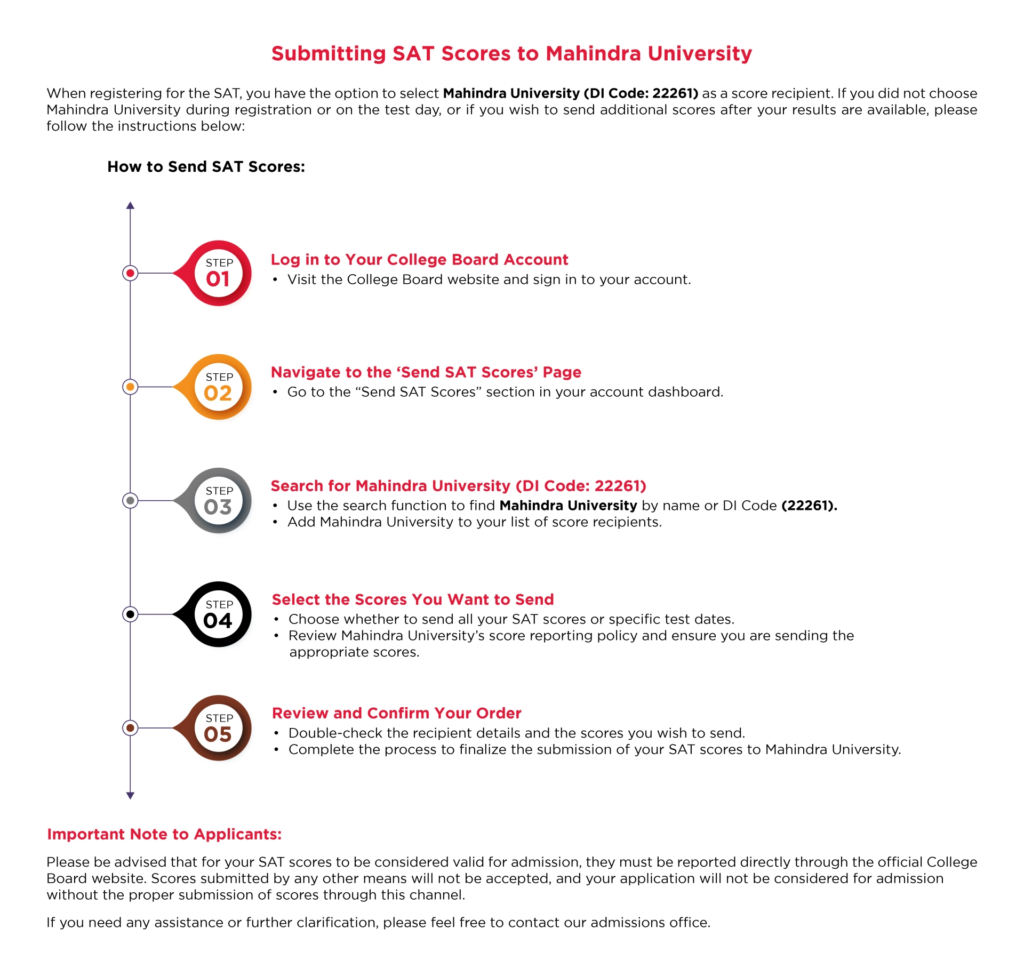
Submitting SAT scores

CourseL-T-PCredits
Math I – Calculus & ODE4-1-05
Earth and Environmental Sciences2-0-02
Fundamentals of Drawing & Practice0-0-42
Introduction to Computer Science2-1-24
Learning to Learn1-0-22
Photography I: Still and Moving Images1-0-43
Introduction to Media and Communication1-0-22
French I0-2-00.5
CourseL-T-PCredits
Math II – Linear Algebra, Complex Analysis3-1-04
Physics – I2-1-24
Discrete Mathematical Structures2-0-02
Data Structures2-2-25
Visual Communication and Graphic Design0-1-43
Professional Writing1-0-01
Professional Ethics1-0-01
Introduction to Game Design1-0-43
French II0-2-00.5
CourseL-T-PCredits
Math III – Probability and Stats3-1-04
Design and Analysis of Algorithms3-1-04
Optimization Techniques for AI3-0-03
Object Oriented Programming2-0-23
Introduction to Computation and Media2-0-02
Computer Graphics2-0-23
Media Production0-0-84
Economics (Fractal)3-0-01.5
French III0-2-00.5
CourseL-T-PCredits
Math IV – Numerical Methods3-0-24
Theory of Computation3-0-03
Machine Learning with Python3-0-24
Programming Workshop0-0-21
Modelling and Animation2-0-44
Advanced Computer Graphics2-0-23
Design Thinking1-0-22
French IV0-2-00.5
Financial Accounting3-0-01.5
CourseL-T-PCredits
Operating Systems3-0-24
DBMS3-0-24
Digital Image Processing2-0-23
Augmented, Virtual & Extended Reality2-0-23
Interactive Sound and Music2-1-24
Elective I3-0-03
HSS Elective I2-0-02
French V (Optional)0-0-00
CourseL-T-PCredits
User Centred Design Methods2-0-23
Data Visualization and Communication2-0-23
Media Psychology2-0-02
Computational Creativity2-0-23
Elective II3-0-03
3rd Year Project0-1-43
Professional Development & Employability Skills2-0-02
HSS Elective II2-0-02
French VI (Optional)0-2-00
CourseL-T-PCredits
Human Computer Interaction2-0-23
Entrepreneurship Practice & Lean Startup Management3-0-03
Elective III3-0-03
Final Year Project – Phase I0-0-189
HSS Elective III2-0-02
French VII (Optional)0-2-00
CourseL-T-PCredits
Elective IV3-0-03
Elective V3-0-03
Final Year Project – Phase II0-4-109
French VIII (Optional)0-2-00

Eligibility:

  • Must have passed 10+2 (or equivalent) from a recognised board, with physics, chemistry and mathematics in 12th grade are eligible.
  • Minimum aggregate of 60% or equivalent in 10+2 for candidates applying through JEE / SAT / ACT. 
  • One of the following accepted test scores:
    • Qualify JEE (Main) and be eligible to write JEE Advanced (or achieve top All India Rank in JEE Main)
    • Valid SAT Subject Test scores (Mathematics, Physics, Chemistry), minimum 1800
    • Valid SAT Test Score (minimum 800)
    • Valid ACT composite score (minimum 18)
  • For applications via SAT / ACT, a technical & aptitude-based interview may be required. 

Fee structure (per annum):

CategoryAcademic feesHostel chargesCaution deposit *
Indian Students₹ 5,00,000₹ 1,70,000₹ 20,000 
PIO / NRI StudentsUSD 9,000USD 3,000USD 400 

*Refundable at the end of study or graduation. Hostel stay is mandatory for B.Tech students. Fees are subject to revision each year.

Important dates

Admission milestoneDate
Last date to apply for the next round of admissions9th May 2026
Next round of personal interviews11th May – 15th May 2026
Last date for receipt of applications for admission09th July 2026

Dates are subjected to changed.

FAQs

It is intentionally balanced. Students build strong computing foundations (programming, algorithms, graphics) while also developing creative skills in media production, design and storytelling. Graduates are expected to be technically competent and creatively fluent.

Graduates work in roles such as UX/UI designer, game designer, interactive media developer, data visualisation specialist, media technologist, product designer, digital content strategist, or pursue higher studies in media technology, HCI or design.

No. A background in physics, chemistry and mathematics at the 10+2 level is sufficient. Creative skills are developed progressively through coursework and projects during the programme.

While computer science focuses primarily on software systems and computation, this programme applies computing to media, communication and human-centred design. It emphasises storytelling, interaction, visual communication and immersive experiences alongside core computing.

Yes. The curriculum includes multiple studio-based courses, media labs, interdisciplinary projects, internships and a final-year capstone project, ensuring students graduate with a strong portfolio of real-world work.

Start your journey with us

Home / Undergraduate / Page 4

B.Tech in Civil Engineering

A 4-year undergraduate programme equipping engineers to design, build and sustain the infrastructure of tomorrow.

B.Tech in civil engineering overview

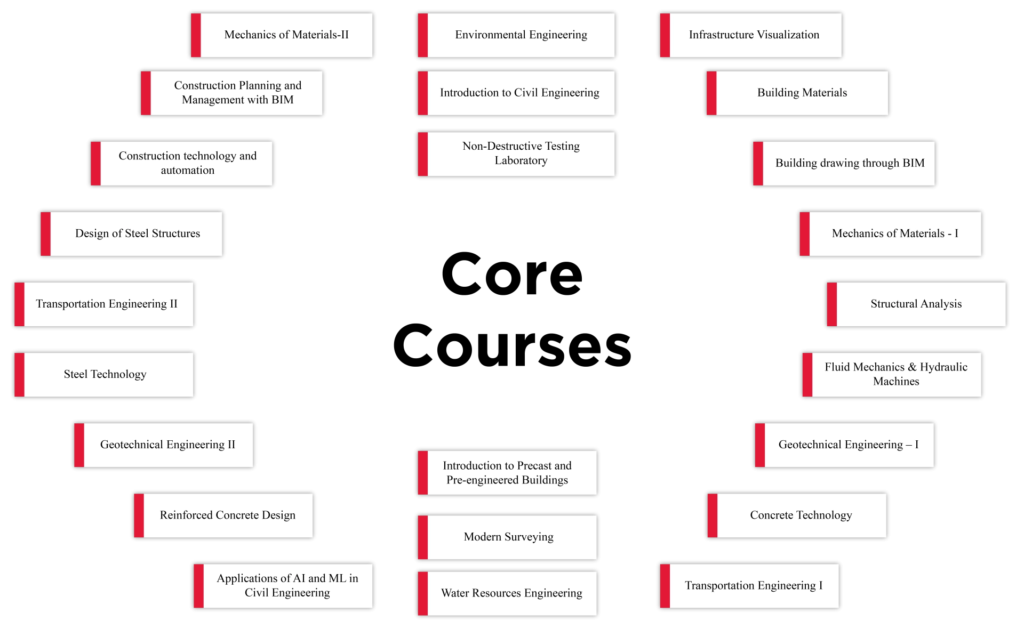
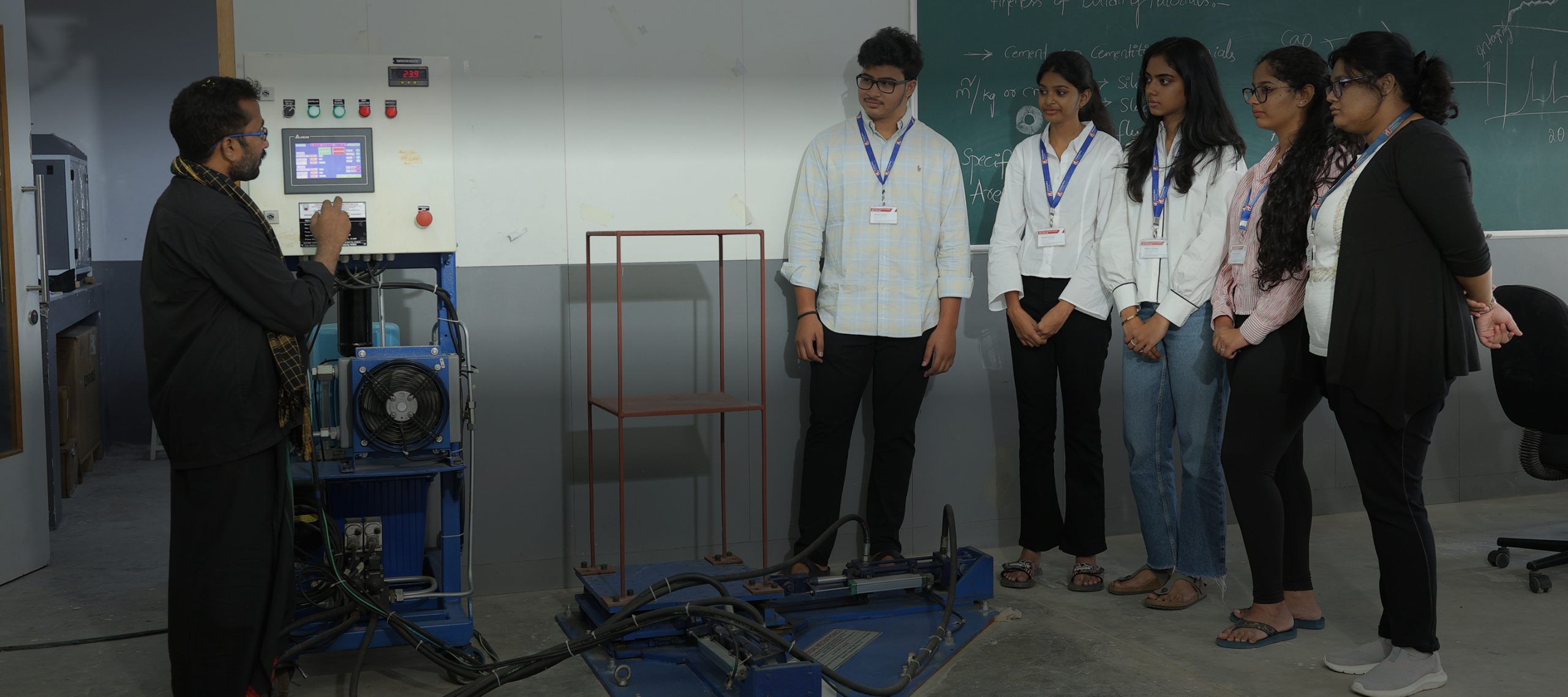
We prepare students to shape the future of infrastructure and urban systems through a strong foundation in structures, geotechnics, transportation, water resources, and environmental engineering, blending technical depth with practical project experience. Students experience:

Comprehensive grounding

in core civil engineering domains such as mechanics of soils and fluids, structural analysis, transportation engineering and surveying

Project-based learning

and departmental projects give students practical experience in construction technology and civic systems

Choice of electives

enabling focus on specialisations such as geotechnical, structural, environmental or water-resources engineering

Exposure to contemporary

infrastructure challenges and technologies, inspiring graduates to design resilient, sustainable and efficient built environments

Programme details

Objectives

  • Equip students with a strong scientific foundation and creative engineering mindset to address complex problems with a global perspective.
  • Develop critical analytical skills required to plan, design, build, maintain and rehabilitate infrastructure for a sustainable future.
  • Promote interdisciplinary understanding and the effective use of appropriate technologies to address real-world implementation challenges.
  • Foster clear communication and ethical leadership while working collaboratively in diverse teams.
  • Encourage adaptability to evolving global needs through continuous learning and lifelong professional development.

Vision

  • Train civil engineers of excellence instilling scientific thinking and responsive leadership for ensuring innovative and sustainable development.

Mission

  • Impart a comprehensive and inclusive knowledgebase for arriving at innovative solutions for practical problems while ensuring environmental protection, safety, and economy.
  • Advance interdisciplinary and sustainable research and development for the ever-increasing and challenging needs of the built infrastructure of the future.
  • Inculcate in students an entrepreneurial thought through industrial interaction while enabling them to turn out to be ethical leaders in the profession of civil engineering.

PEOs

PEO1Equip the students with the basic scientific thought for a creative engineering background to address problems with a global comprehension and perspective
PEO2Im Impart critical analytical skills required to plan, design, construct, maintain and rehabilitate infrastructure needs for a sustainable future
PEO3Ensure interdisciplinary comprehension of projects using appropriate technologies to meet the implementation challenges faced by society
PEO4Capable to communicate and exhibit ethical leadership qualities while working in diverse teams
PEO5Adopt to changing global needs by constantly updating their knowledge through Continued acquisition lifelong.

Academic structure

Our academic structure is designed to establish robust foundations, followed by increasing specialization in later years.

  • Credit structure: Basic Sciences (47 credits), Basic Engineering (28 credits), Humanities, Social & Creative Sciences (15 credits), Enterprise Sciences (10 credits)
  • Total credits & degree requirement: The programme requires not less than 165 credits to be awarded a B.Tech degree.
  • Duration: 4 years / 8 semesters.

MoUs

FAQs

The curriculum emphasises current topics such as sustainable construction, environmental systems, transportation and water-resources, ensuring students are ready for real-world infrastructure challenges.

Yes, students undertake multiple departmental projects, leveraging labs, field work and construction technology modules to apply engineering in practice.

Electives in structural, geotechnical, environmental and transport engineering allow students to tailor their learning and prepare for roles in design firms, consultancy, public works or research.

By integrating courses on smart infrastructure, sustainable materials, environmental systems and project management, the programme equips graduates to lead in tomorrow’s built environment.

Graduates are well-positioned for roles in infrastructure development, consultancy, construction management, urban planning, environmental and water-resource engineering, as well as further study.

Start your journey with us

Home / Undergraduate / Page 4

B.Tech in Biotechnology

A 4-year undergraduate programme combining biology, engineering and innovation to create professionals in life-sciences technologies.

B.Tech in biotechnology overview

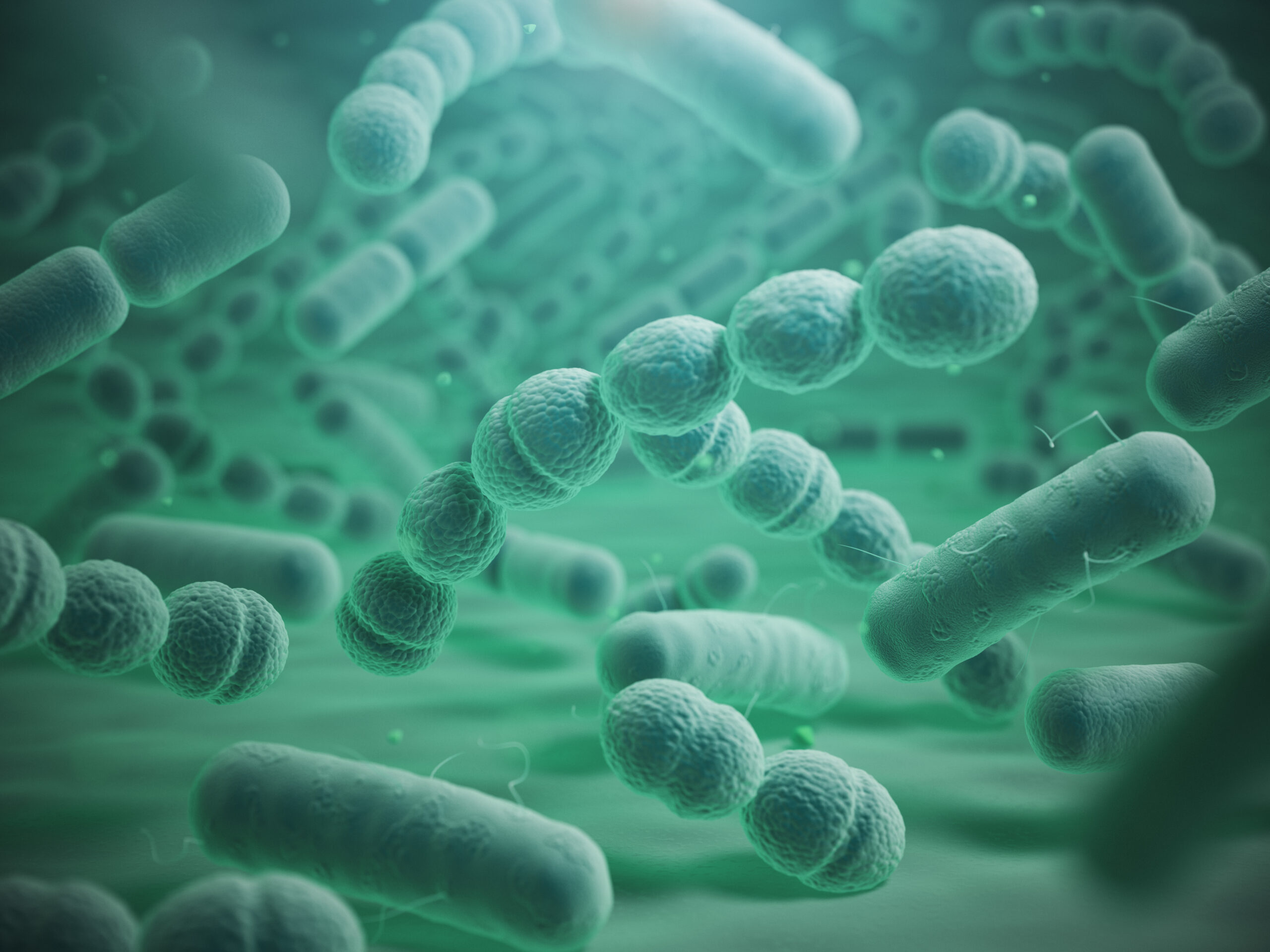
We immerse students in genomics, gene editing, synthetic biology, precision medicine, and biomanufacturing, empowering them to drive breakthroughs in healthcare, agriculture, materials, and food technology. The B.Tech Biotechnology programme combines biological sciences with engineering principles to prepare students for innovation in healthcare, agriculture, and industrial biotechnology. Students also have the option to continue into an integrated five-year M.Tech Biotechnology programme after completing the four-year B.Tech.

Deep exposure

to genomics, gene editing (CRISPR), synthetic biology and precision medicine, giving students advanced biological-engineering expertise.

A structured curriculum

where by Semester IV you’re already tackling OMIC technologies, upstream processing and AI/data science for bio-technologists.

Practical training

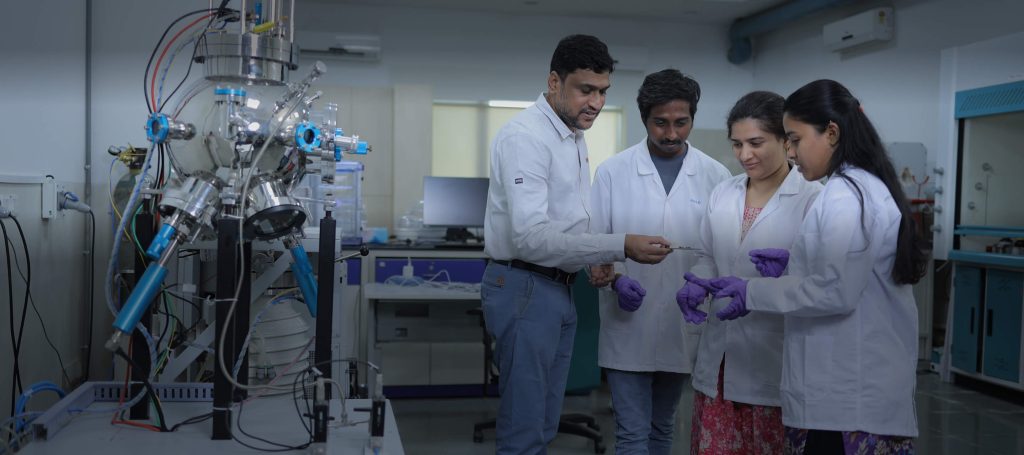
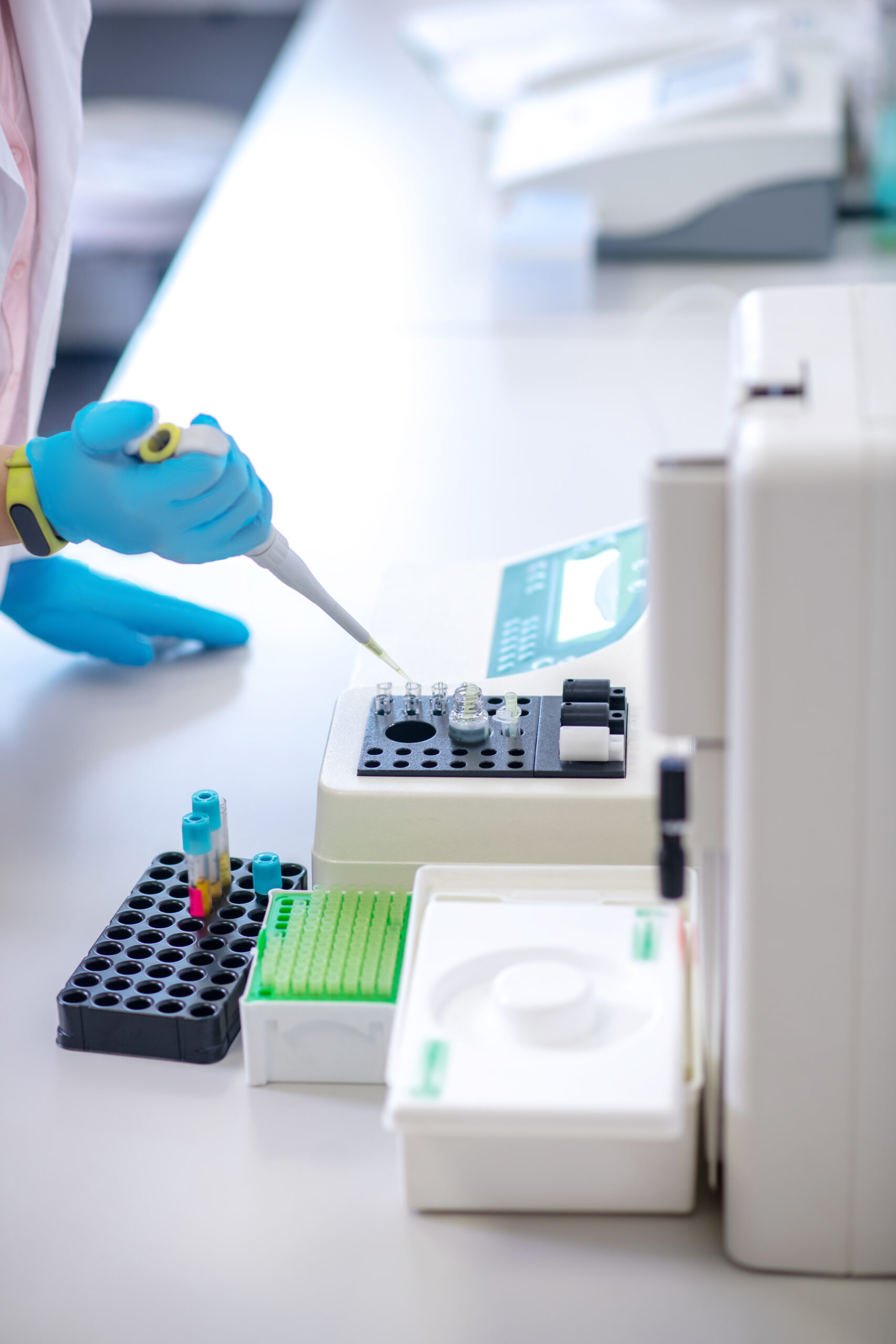
in bio-manufacturing, cell culture, micro-fluidics and biomaterials students work with systems that bridge biology and engineering.

Career-forward focus

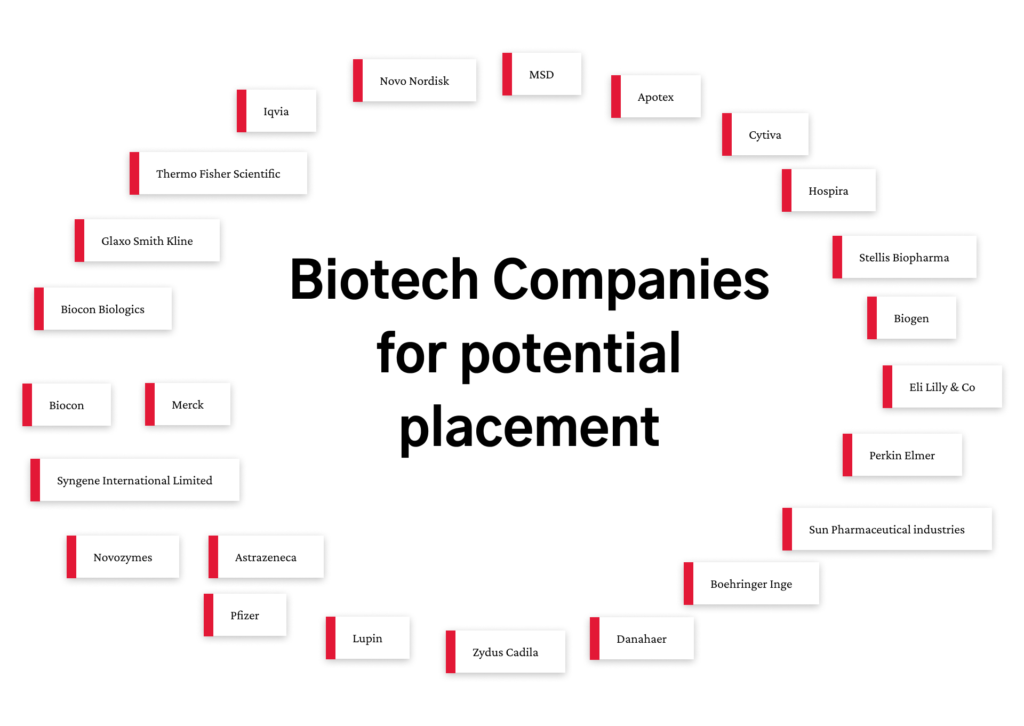
with scope for specialisation in environment, food, pharmaceuticals, industrial biotech and research.

Programme specialisations

Pharmaceutical biotechnology

Focuses on the development of biologic drugs such as antibodies, vaccines and nucleic-acid therapies using molecular biology, protein engineering and bioprocessing technologies.

Green chemicals and bio-products

Explores sustainable alternatives to petrochemical products through biotechnology, including enzymes, biofuels and bio-based industrial chemicals.

Digital agriculture

Applies data analytics, sensors and advanced technologies to optimise crop production, resource use and decision-making in modern agriculture.

Precision medicine

Examines how genomics and biological data can be used to design personalised medical treatments and improve patient outcomes.

Gut microbiome

Studies microbial communities in the human body and their role in health, disease diagnostics and emerging therapeutic applications.

Food processing and nutrition

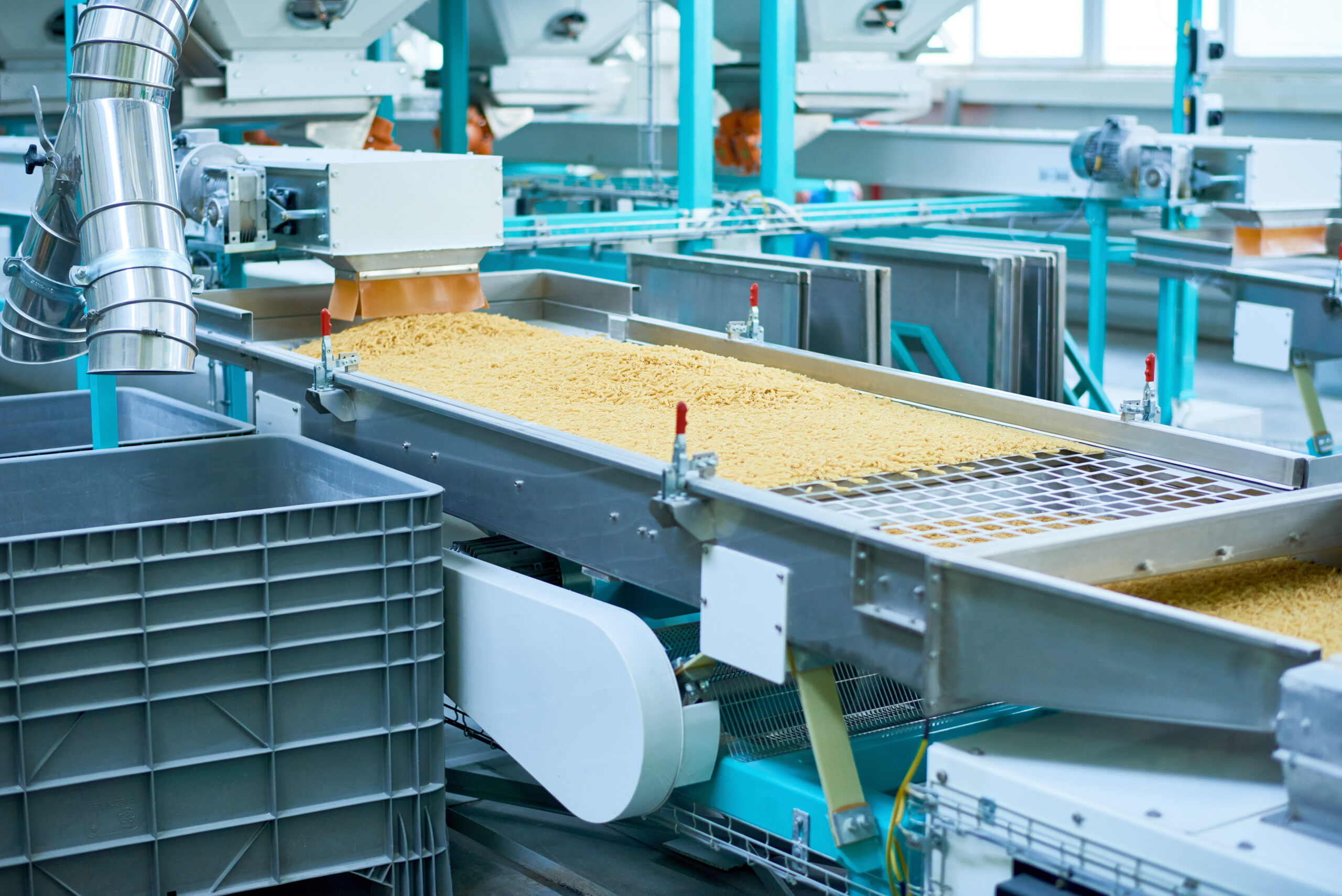
Focuses on technologies that improve food safety, nutritional value and shelf life while supporting sustainable food production.

Biopharmaceutical technology

Covers the development and manufacturing of biologic medicines, integrating molecular biology, drug formulation and bioprocess engineering.

Biomanufacturing and green products

Uses engineered biological systems and fermentation technologies to produce biomaterials, chemicals and therapeutic products sustainably.

Diagnostics and biomarkers

Explores molecular diagnostics and biomarker discovery for early disease detection and improved clinical decision-making.

Programme details

Core technical competencies to be developed through the programme

Genomics
Omics technologies and genome sequencing applications across biotechnology and biomedical research.

Gene editing
Gene cloning, CRISPR-based genome editing, gene therapy, gene silencing, and development of transgenic plants and animals.

Precision medicine
Genomics-driven discovery of drug targets, cell therapies and advanced drug delivery technologies.

Microfluidics
Lab-on-a-chip systems for rapid diagnostics, biopharma screening, disease modelling and point-of-care testing.

Biomanufacturing
Cell culture and fermentation technologies for recombinant production of therapeutics, biomaterials and specialty chemicals.mahindra

Synthetic biology
Engineering biological systems and gene networks to develop cell factories, microbiome-based solutions and cellular agriculture.

Tissue engineering
Regenerative medicine approaches including tissue grafts, organ repair technologies and cultured biomaterials.

AI and big biological data
Application of artificial intelligence in drug discovery, biomarker identification, medical imaging and digital agriculture analytics.

GMP and regulatory affairs
Principles of product quality, safety standards and regulatory frameworks in biotechnology and biopharmaceutical development.

Bioprinting
Bioprinting technologies using bio-inks and biomaterials for medical applications such as tissue constructs and personalised grafts.

  • Technical solution manager
  • Research associate
  • Medical scientist
  • Biomedical engineer
  • Microbiologist
  • R&D and process development scientist
  • Biomanufacturing specialist
  • Bioproduction operator
  • Project assistant
  • Project management engineer
  • Trainee research associate
  • Agricultural consultant
  • Opportunities for higher education abroad

Academic structure

Our academic structure is designed to establish robust foundations, followed by increasing specialization in later years.

  • Credit structure: Basic Sciences (47 credits), Basic Engineering (28 credits), Humanities, Social & Creative Sciences (15 credits), Enterprise Sciences (10 credits)
  • Total credits & degree requirement: The programme requires not less than 165 credits to be awarded a B.Tech degree.
  • Duration: 4 years / 8 semesters
  • Core vs Professional phases: The first two years constitute the “Core Program,” and the last two years the “Professional Program,” with electives introduced in the latter phase.
CourseL-T-PCredits
BT1101/BT1102 – Basic Mathematics /Introduction to Biology*3-0-03
BT1103 – World of BT & CB1-0-01
BT1104 – Chemistry of Biomolecules3-0-24
BT1105 – Biological Systems: Microbes2-0-02
PH1103 – Physics for Biotechnology2-0-23
CE1101 – Earth and Environmental Sciences2-0-02
HS1101 – English0-3-03
HS1102 – Media Project0-0-21.5
ET1101 – Introduction to Entrepreneurship0-0-31
FL1103 – French- I0-2-00.5
Total Credits21
CourseL-T-PCredits
BT1206 – Molecular Genetics3-0-24
BT1207 – Descriptive Statistics2-0-02
BT1208 – Biological Systems: Plants2-0-02
BT1209 – Biological Systems: Animals2-0-02
BT1210 – Biophysics2-0-23
CH1202 – Chemistry-II2-0-23
CS1101 – Introduction to Computing2-1-24
ET1201 – Entrepreneurship Practice0-0-21
HS1202 – Professional Ethics0-1-01
SC1201 – SDGs And Our Career1-0-01
FL1203 – French-II0-2-00.5
Total Credits23.5
CourseL-T-PCredits
BT2111 – Enzymes & Metabolism3-0-24
BT2112 – Microbial Technology2-0-23
BT2113 – Python & Biopython1-0-22
BT2114 – Immune Systems & Immunotechnology3-0-24
BT2115 – Gene Technologies2-0-44
CH2103 – Introduction to Nanotechnology and Nanoscience3-0-03
ET2101 – Lean Start-up (Fractal)0-0-31
HS2102 – Principles of Economics (Fractal)3-0-01.5
SC2102 – Sustainability and AI1-0-01
FL2103 – French-III0-2-00.5
Total Credits24
CourseL-T-PCredits
BT2216 – Omic Technologies3-0-24
BT2217 – Cell Culture Technologies2-0-23
BT2218 – Bioprocess-Upstream Processing3-0-24
BT2219 – AI & Data Science for Biotechnologists3-0-24
BT2220 – Biostatistics2-1-24
HS2201 – Design Thinking1-0-22
HS2202 – Financial Accounting3-0-01.5
SC2201 – Water and Us1-0-01
FL2203 – French- IV0-2-00.5
Total Credits24
CourseL-T-PCredits
BT3121 – Food Processing & Nutrition3-0-24
BT3122 – Bioinformatics & Computational Biology3-0-24
BT3123 – Agriculture Biotechnology3-0-24
BT3124 – Bioprocess- Downstream Processing3-0-24
BT30XX – Elective-I3-0-03
BT30XX – Elective-II3-0-03
HSS Elective – HSS Elective -I2-0-02
Total Credits24.0
CourseL-T-PCredits
BT3225 – Green Biotechnology & Pollution Abetment3-0-03
BT3226 – Bioproducts: QC & Regulatory Affairs2-0-02
BT3227 – Synthetic Biology & Applications3-0-24
BT3228 – Research Methods & IPR2-0-02
BT30XX – Elective-III3-0-03
BT30XX – Elective-IV3-0-03
HS3201 – Introduction to Professional Development2-0-02
HSS Elective – HSS Elective II2-0-02
Total Credits21
CourseL-T-PCredits
BT4129 – Employability Skills1-0-11.5
BT40XX – Elective-V3-0-03
BT40XX – Elective-VI3-0-03
BT40XX – Elective-VII3-0-03
HSS Elective – HSS Elective III2-0-02
Total Credits12.5
CourseL-T-PCredits
PR4000 – Research Project (Industrial Internship/R&D Institute)0-0-3015
Total Credits15
S.No.Electives
1Discovery & Development of Biologics
2Cell & Nucleic Acids Therapeutics
3Molecular Basis of Diseases
4Computer Aided Drug Designing
5Vaccines & Antibodies
6Biomanufacturing Biologics
7Nanobiotechnology & Toxicology
8Cancer Biomarkers
9Biomass to Bioeconomy
10Nanobodies & Healthcare
11Precision Medicine
12Molecular Neuroscience
13Cosmeceuticals
14Aging & Health
15Cancer Biotherapeutics

FAQs

The curriculum integrates molecular biology, genetics and bioprocessing with engineering and computational tools, equipping students for innovation in applied biosciences.

Students receive hands-on training in biomanufacturing, microfluidics, gene editing and biomaterials, building the technical expertise necessary for biotechnology industries.

Graduates contribute to healthcare, pharmaceuticals, agriculture, food technology and environmental sustainability through advanced biotechnological methods.

Project-based learning, exposure to OMIC technologies, and AI applications in biotechnology foster critical thinking and problem-solving.

The inclusion of synthetic biology, precision medicine and data-driven approaches ensures graduates are prepared for next-generation life-science careers.

Start your journey with us

Home / Undergraduate / Page 4

B.Tech in Aerospace Engineering

A 4-year undergraduate programme enabling engineers to design, develop and optimise aircraft, spacecraft and aerospace systems for the future.

B.Tech in aerospace engineering overview 

We prepare students to excel in aerodynamics, propulsion, and structures, leveraging expert faculty and a strong research ecosystem to launch careers in advanced aerospace engineering. Students experience:

Progression into aerospace-specific domains

such as aerodynamics, propulsion and structural engineering, contextualised within India’s aerospace ecosystem.

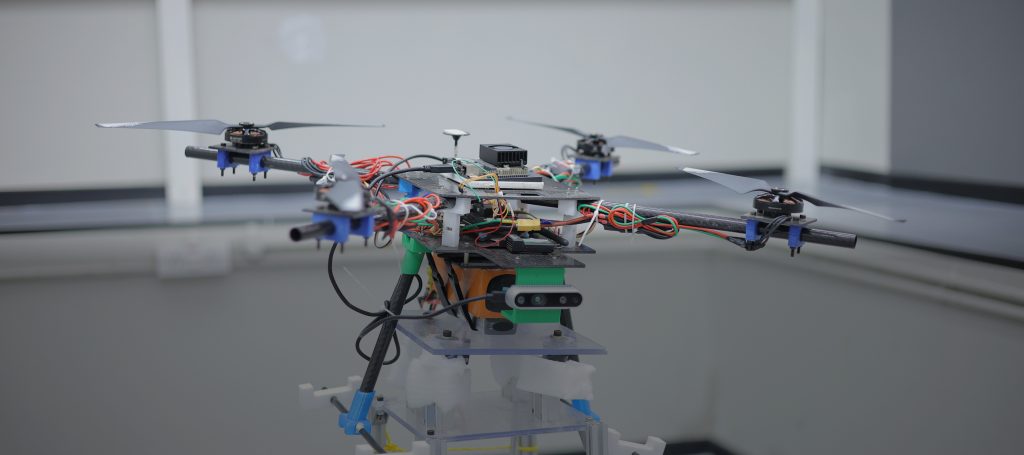
Hands-on engineering labs

design-drawing and project-based modules enabling students to apply theoretical aerospace principles.

Career-oriented training

aligned with the rapidly growing aerospace industry and research in India, giving students access to future mobility, defence and space initiatives.

Strong grounding

in mathematics, chemistry and engineering with a combination of courses like Calculus, Mechanics and Engineering Drawing.

Programme details

Academic structure

Our faculty combines academic depth with real-world expertise, guiding students through both fundamental theory and applied innovation

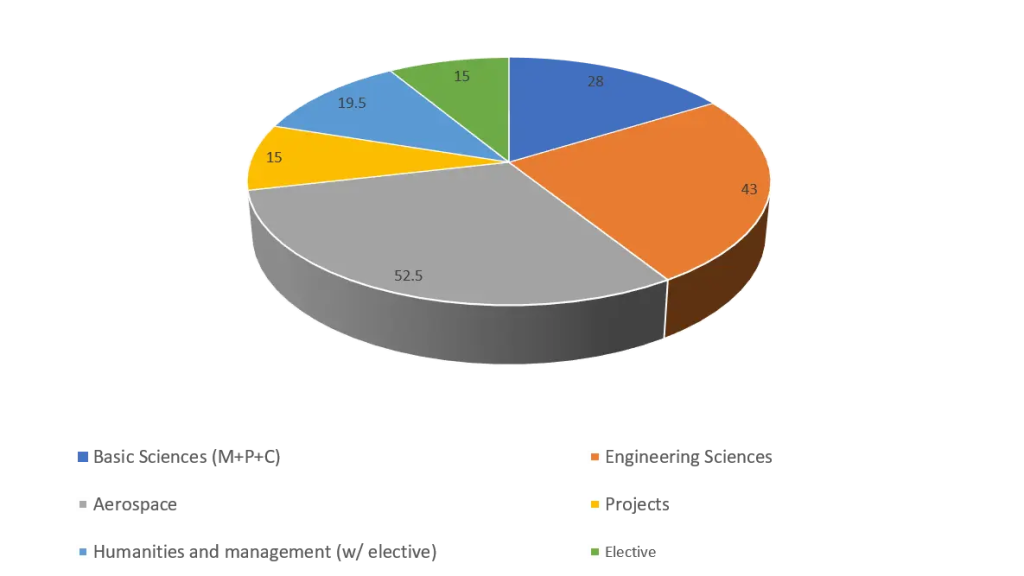
  • Credit structure: Basic Sciences (28 credits), Engineering Sciences (43 credits), Aerospace (52.5 credits), Projects (15 credits), Humanities & Management (19.5 credits), Electives (15 credits), Total 173 credits. 
  • Total credits & degree requirement: The programme requires not less than 165 credits to be awarded a B.Tech degree.
  • Duration: 4 years / 8 semesters
  • Core vs Professional phases: The first two years constitute the “Core Program,” and the last two years the “Professional Program,” with electives introduced in the latter phase.
CourseL-T-PCredits
Mathematics I (Calculus & ODEs)4-1-25
Chemistry I2-1-23
Introduction to Electrical/Electronics Engg w/ lab2-1-22
Engineering Drawing1.5
Mechanics2-1-23
Earth & Environmental Sciences2-0-02
Intro. to Entrepreneurship0-0-31
Media Project0-0-31.5
English3-0-03
French I0-2-00.5
CourseL-T-PCredits
Mathematics II (Linear Algebra & Complex)3-1-24
Physics I with Lab2-1-24
Chemistry II with Lab2-0-23
Thermodynamics2-1-23
CAE Design1-0-32.5
Intro to Computing2-2-24
Workshop Practice0-0-21
Entrepreneurship Practice0-0-21
Professional Ethics0-1-01
French II0-2-00.5
CourseL-T-PCredits
Mathematics III (Probability & Stats)3-1-24
Physics II with Lab3-1-25
Data Structures & Algorithms2-2-25
Introduction to Aerospace Engineering2-0-02
Fluid Mechanics3-1-24
Solid Mechanics2-1-23
Lean Start-up0-0-31
Principles of Economics3-0-01.5
French III0-2-00.5
CourseL-T-PCredits
Numerical Methods3-0-24
Aerospace Structures3-1-24
Aerodynamics-I (Low Speed)2-1-23
Finite Element Method2-0-23
Fluid & Solid Mechanics Lab2
Financial Accounting3-0-01.5
Design Thinking1-0-22
French IV0-2-00.5
CourseL-T-PCredits
Heat & Mass Transfer3-1-24
Flight Dynamics & Aircraft Performance3-0-24
Aerodynamics-II (Compressible Flow)3-1-24
CFD for Aerospace Engineers3-0-24
Propulsion-I (Rocket)3-0-03
Aerodynamics Lab1.5
Elective / HSS~2
French V (Optional)~0.5
CourseL-T-PCredits
3rd Year Project3
Orbital Mechanics & Space Dynamics3-0-03
Propulsion-II (Aircraft)3-0-03
Aerospace Control & Guidance3-0-03
Vibrations3-0-03
Propulsion Lab1
Aeromodelling Workshop~2
Elective I3
French VI0
CourseL-T-PCredits
Aerospace Materials & Processes3-0-03
Aircraft Design2-0-23
Space Vehicle Design2-0-23
Control Systems Lab1
Elective II & III~6
Year-4/1 Project1-4-33
French VII0
CourseL-T-PCredits
Elective IV3
Elective V3
Final Project II9
French VIII0

Expected programme output

  • To be able to understand the basic engineering concepts with theoretical foundation in mathematical/physical modelling and software engineering.
  • To be able to understand and apply various concepts of mechanical design, electronics design and control.
  • To have the ability to apply engineering methods and tools to specify and develop mechanical components and systems in the context of mechatronics.
  • To have the ability to apply the engineering methods and tools and master the related skills in the process of developing mechatronic systems and products.
  • To have the ability to apply engineering methods and tools to, specify and develop analog and digital electronic circuits, specify and develop embedded hardware and software in a mechatronic context.

FAQs

By covering aerodynamics, propulsion, and structures alongside engineering design projects, the curriculum mirrors the technical demands of the aerospace sector.

Laboratory sessions, computer-aided design and mechanics workshops give students early exposure to aerospace applications and simulations.

An emphasis on experiential learning, project work and strong foundational sciences ensures graduates possess both breadth and depth of knowledge.

Students are prepared for roles in aircraft design, defence technology, propulsion systems, unmanned aerial vehicles and research institutions.

The project-based framework encourages students to design creative engineering solutions while developing collaboration and leadership skills essential to the industry.

Start your journey with us

Home / Undergraduate / Page 4

B.Tech in Mechanical Engineering

A 4-year undergraduate programme empowering engineers to design, manufacture and optimise the machines and systems that drive industry and innovation.

B.Tech in mechanical engineering overview

Our program takes students beyond conventional mechanics to explore advanced design, manufacturing and systems thinking. With a curriculum grounded in core disciplines like thermodynamics, fluid and solid mechanics, materials science and machine design, we prepare professionals capable of leading in sectors from automotive to aerospace and sustainable systems. Students experience:

Modular learning

in machine design, fluid and solid mechanics, and manufacturing engineering to build versatile technical fluency.

Combined foundations

in mechanics, thermodynamics and material science with hands-on workshop practice and computer-aided engineering design.

Access to advanced labs

and simulation-tools with design thinking projects that mirror real-world engineering challenges.

Pathways into various sectors

such as automotive, aerospace, energy, robotics and advanced manufacturing, as well as options for research and innovation.

Programme details

Programme objectives

  • Develop a passion for continuous learning and the ability to adapt to evolving technologies and challenges.
  • Establish themselves as professionals who apply their knowledge to address and solve complex technical and societal problems.
  • Strive to become effective leaders and entrepreneurs, demonstrating strong social awareness, emotional intelligence and a commitment to driving positive change.

Core courses

  • Computer-aided engineering design
  • Transport phenomena
  • Manufacturing processes I and II
  • Mechanics of solids
  • Theory of mechanisms and machines
  • Introduction to materials science
  • Applied fluid dynamics and heat transfer
  • Design of machine elements
  • Experimental analysis
  • Multiphysics
  • Thermal engineering
  • Finite element methods
  • Structural dynamics and acoustics
  • Control theory
  • Industrial engineering
CourseL-T-PCredits
Calculus & ODE4-1-05
Chemistry – I2-1-03
Introduction to Electrical & Electronics Engg w/ Lab2-1-24
Engineering Drawing0-0-31.5
Earth & Environmental Sciences2-0-02
Mechanics2-1-03
English0-3-03
Media Project0-0-31.5
French I0-2-00.5
Introduction to Entrepreneurship0-0-31
CourseL-T-PCredits
Linear Algebra & Complex Analyses3-1-04
Physics – I2-1-24
Chemistry / Biology2-0-23
Thermodynamics2-1-03
Computer Aided Engineering Design1-0-32.5
Introduction to Computing2-1-24
Workshop Practice0-0-21
Entrepreneurship Practice0-0-21
Professional Ethics0-1-01
French II0-2-00.5
CourseL-T-PCredits
Probability & Statistics3-1-04
Physics – II3-1-25
Data Structures & Algorithms2-2-25
Introduction to Materials Sciences2-0-23
Thermal Engineering3-1-04
PDEs for Engineers (7 weeks)2-0-01
Lean Start-up0-0-31
Principles of Economics (7 weeks)3-0-01.5
French III0-2-00.5
CourseL-T-PCredits
Numerical Methods for Engineers3-0-24
Fluid Mechanics3-1-04
Solid Mechanics2-1-03
Theory of Mechanisms & Machines3-0-24
Manufacturing Engineering4-0-04
Financial Accounting (7 weeks)3-0-01.5
Design Thinking1-0-22
French IV0-2-00.5
CourseL-T-PCredits
Fluid & Solid Mechanics Lab0-0-21
Measurement & Instrumentation2-0-23
Heat & Mass Transfer3-1-04
Design of Machine Elements3-1-04
Metrology & CAM2-0-23
Introduction to Robotics3-0-03
Stream Course I3-0-03
HSS/Management Elective I2-0-22
French V (Optional)0-2-00
CourseL-T-PCredits
Machine Learning3-1-04
Vibrations3-0-03
Heat, Energy, & Vibration Lab0-0-31.5
Stream Course II3-0-03
Open Elective I3-0-03
HSS/Management Elective II2-0-02
Systems Engineering Project0-1-43
Introduction to Professional Development2-0-02
French VI (Optional)0-2-00
CourseL-T-PCredits
Industrial Engineering & Operations Research3-1-04
Stream Course III3-0-03
Open Elective II3-0-03
Control Theory3-0-03
HSS/Management Elective III2-0-02
Year-4 Project0-1-43
French VII (Optional)0-2-00
CourseL-T-PCredits
Stream Course IV3-0-03
Open Elective III3-0-03
Year-4 Project0-5-89
French VIII (Optional)0-2-00

FAQs

The programme blends classical engineering principles with modern technologies, empowering students to innovate in sustainable design, manufacturing, and advanced materials.

Students experience immersive, hands-on learning in state-of-the-art design and manufacturing labs, supported by expert faculty and real-world industry collaborations.

Through design challenges, multidisciplinary projects, and innovation-led competitions, students learn to turn ideas into practical engineering solutions.

Graduates are equipped for careers across automotive, aerospace, robotics, and energy sectors, with strong analytical and design foundations valued globally.

The emphasis on experiential learning, digital simulation tools, and sustainable engineering practices ensures graduates are not just skilled professionals but responsible innovators.

Start your journey with us

Home / Undergraduate / Page 4

B.Tech in Computation & Mathematics

A 4-year undergraduate programme integrating the precision of mathematics with the power of computation to prepare students for scientific & analytical careers.

B.Tech in computation & mathematics overview

We develop problem-solvers who unite theory and computation to drive real-world innovation, grounded in mathematics, algorithms, and scientific computing for impact across AI, data science, optimisation, and quantitative research. Students experience:

Course grounded firmly

in advanced mathematical disciplines such as linear algebra, complex analysis, enabling conceptual mastery beyond routine engineering maths

Experiential computational

and programming training through data structures, graph algorithms, cryptography and computational biology, all taught alongside mathematical models

Interdisciplinary specialisation

including advanced electives in quantum computing, computational biology, and cryptography enable exploration of frontier scientific domains

Research and innovation

culture through mathematical modelling projects, research internships, and capstone collaborations, to develop analytical creativity and industry-ready expertise

Programme details

Academic structure

Our academic structure is designed to establish robust foundations, followed by increasing specialization in later years.

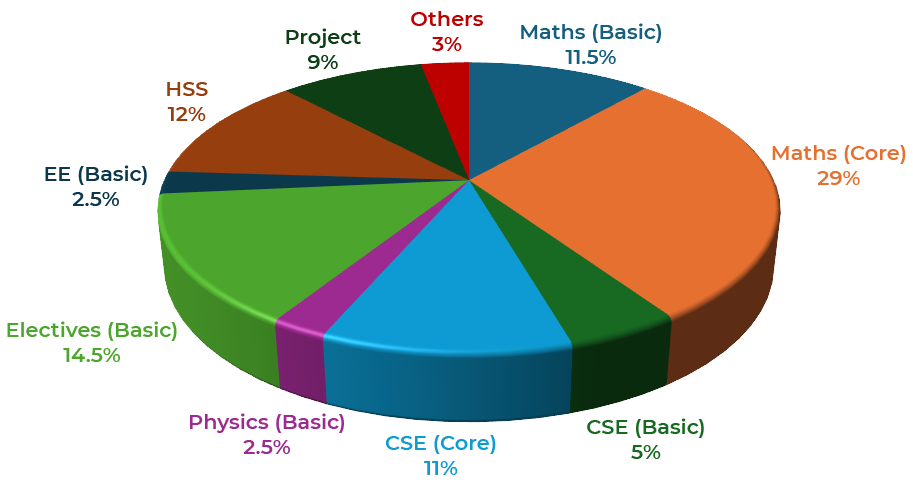
PIE CHART: CREDIT DISTRIBUTION FOR COMPUTATION & MATHEMATICS

PIE CHART CREDIT DISTRIBUTION FOR COMPUTATION & MATHEMATICS
  • Duration: 4 years / 8 semesters
  • Total credits & degree requirement: The programme requires not less than 165 credits to be awarded a B.Tech degree.
  • Focus areas:
    • Data science/Data analytics
    • Financial mathematics
    • Theoretical computer science/Mathematical sciences
    • Cryptography
    • Quantum computing
CourseL-T-PCredits
Calculus & ODE4-1-05
Chemistry – I2-1-03
Chemistry Lab0-0-21
Introduction to Electrical Engineering/Electronics2-1-24
Engineering Drawing0-0-31.5
Earth and Environmental Sciences2-0-02
Mechanics2-1-03
Media Project1-0-21.5
English3-0-03
Introduction to Entrepreneurship0-0-31
French – I0-2-00.5
Total25.5
Course NameL-T-PCredits
MA1202 – Linear Algebra & complex analyses3-1-04
PH1201 – Physics – I2-1-24
BI1202/CH1204 – Biology (1-7 weeks)/ Chemistry (8-14 weeks)3-0-03 (1.5+1.5)
CS1202 – Discrete Mathematics2-0-02
CS1201 – Introduction to Computing2-1-24
ME1202 – Workshop0-0-21
HS1201 – Entrepreneurship practice0-0-21
HS1202 – Professional Ethics0-1-01
HS1203 – French – II0-2-00.5
Total Credits20.5
Course NameL-T-PCredits
MA2103 – Probability and Statistics3-1-04
PH2102 – Physics-II3-1-25
MA2104 – Real Analysis (Only for CM2021 batch)3-0-03
CS2102 – Data Structures (Common for all B. Tech. 2021 batch)3-0-24
MA2105 – Graph Algorithms (Only for CM2021 batch)3-0-03
MA2106 – Algebra (Only for CM2021 batch)3-0-03
MA2107 – Prog. Workshop (R Programming and GPU computing) (Only for CM2021 batch) (Need a lab ELH-11)0-0-21
HS2101 – Learn start-up (Common to all B. Tech. 2021 batch)0-0-31
HS2102 – Economics (Common to all B. Tech. 2021 batch)3-0-01.5
HS2103 – French-III0-2-00.5
Total Credits26
Course NameL-T-PCredits
MA2208 – Numerical Methods3-0-24
MA2209 – Number theory and Cryptography3-0-03
MA2210 – Optimization Techniques3-0-03
CS2204 – Theory of Computation (Common with CSE 2021 Batch)3-0-03
MA2211 – Computer Organization1-0-01
MA2212 – Functional Analysis3-0-03
MA2213 – Stochastic Process3-0-03
HS2201 – Design Thinking1-0-22
HS2202 – Financial Accounting (7 weeks)3-0-01.5
MA2214 – Programming Workshop (R and MATLAB)0-0-21
HS2203 – French – IV0-2-00.5
Total Credits25
Course NameL-T-PCredits
MA3115 – Computational Methods for PDE3-1-04
CS3102 – Operating Systems (Common with CSE 2021 batch)3-0-24
CS3101 – Design and Analysis of Algorithms (Common with CSE 2021 batch)2-1-24
CS3103 – Database Management Systems (Common with CSE 2021 batch)3-0-24
MA3116 – Financial Mathematics3-0-03
MA3117 – Advanced Linear Algebra3-0-03
MA3118 – Prog. Workshop (Python)0-0-21
HS3101 – French – V0-2-00.5
HSS Elective-I2-0-02
Total Credits25.5
Course NameL-T-PCredits
MA3219 – Mathematical Foundations for Machine Learning3-0-24
CS3203 – Computer Networks (Common with CSE2021 Batch)3-0-24
Elective-I3-0-03
Departmental Elective – Core-Elective – I [choose one elective] Calcus of variationas and integral equations3-0-03
HSS-Elective-II2-0-02
HS3202 – French – VI0-2-00.5
HS3201 – Introduction to Professional Development2-0-02
Project-I0-0-33
Total Credits21.5
Course NameL-T-PCredits
MA 4124 – Quantum Computing3-0-03
MA 4125 – Departmnetal-Elective – II [choose one elective] Dynamical Systems/Computational Topology/Galois Theory]3-0-03
Elective-II3-0-03
Elective-III3-0-03
HSS Elective-III2-0-02
Project-II0-0-44
HS 4101 – French – VII0-2-00.5
Total Credits18.5
Course NameL-T-PCredits
Elective-IV3-0-03
Elective – V3-0-03
Project –III0-0-1212
HS 4201 – French – VIII0-2-00.5
Total Credits18.5

FAQs

The programme is designed to build dual expertise, nurturing students who can think mathematically and code computationally. This rare combination enables them to excel in data science, AI, quantitative finance, research, and advanced analytics roles across industries.

This programme is ideal for curious, analytical thinkers who enjoy logic, problem-solving, and exploring how mathematical theory powers modern technology. It develops both conceptual understanding and practical application, preparing students for innovation-led careers.

While traditional computer science focuses primarily on coding, computation & mathematics deepens students’ understanding of the mathematical principles driving algorithms and models. This gives them a strong conceptual edge in high-end computational research and emerging tech domains.

Students engage in research internships, mathematical modelling workshops, and interdisciplinary capstone projects in collaboration with Mahindra University’s research centres and industry partners, offering real-world exposure from early on.

Graduates are well-prepared for careers in data science, operations research, financial analytics, cybersecurity, AI research, and academia. Many also pursue advanced studies at leading international universities.

Start your journey with us

Home / Undergraduate / Page 4

B.Tech in Electronics & Computer Engineering

A 4-year interdisciplinary program that integrates electronics, computer science, and engineering fundamentals to prepare students for the evolving tech landscape.

B.Tech in electronics & computer engineering overview

We prepare students to design and integrate intelligent electronic and computing systems that power modern digital products and platforms. The programme develops system-level thinkers who can work across hardware and software boundaries, translating complex requirements into robust, scalable solutions. Students experience:

Interdisciplinary mastery

across electronics, computer science, and systems engineering, enabling them to tackle diverse technological challenges.

Practical innovation

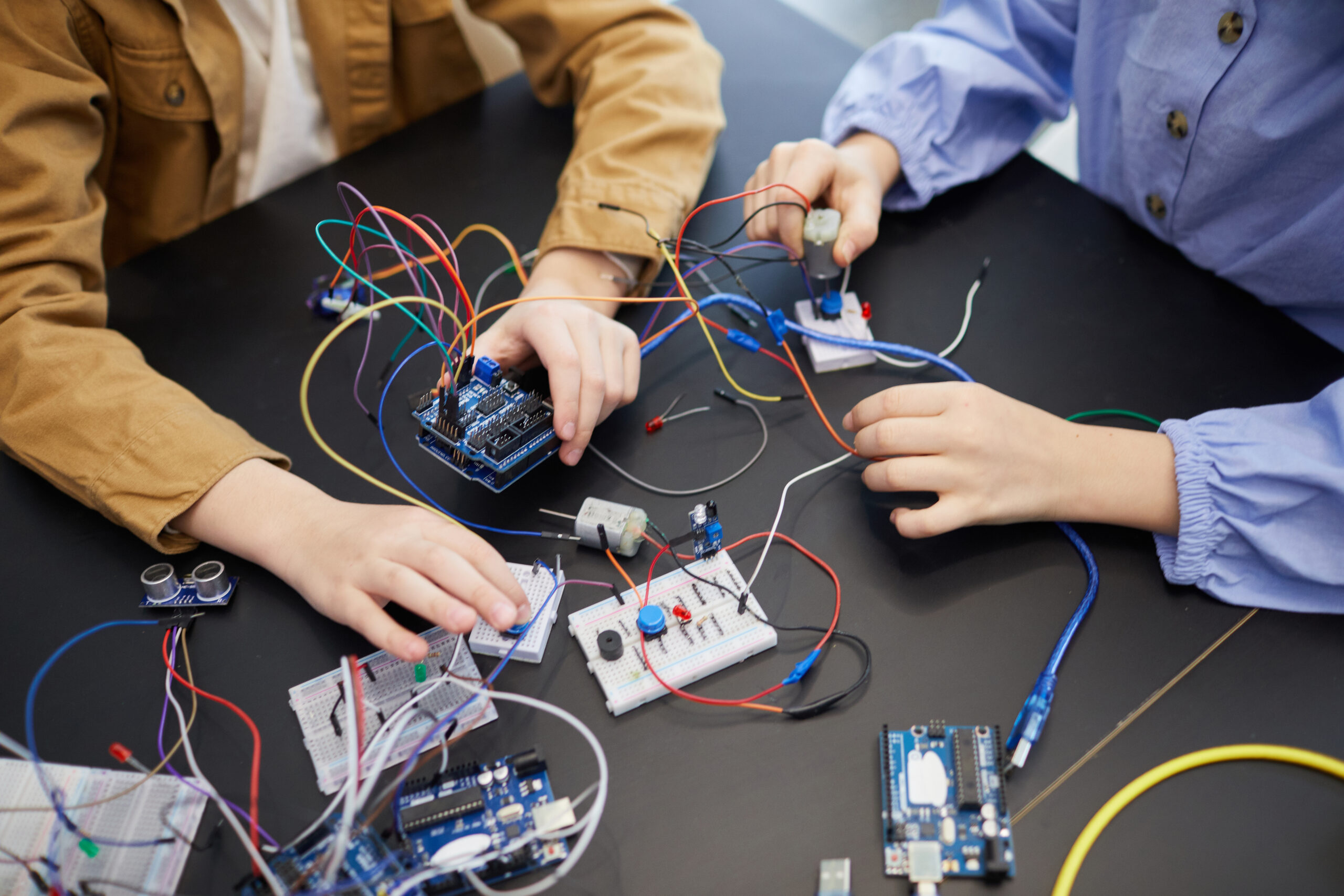
with extensive lab sessions, hands-on projects, and workshops translate theoretical knowledge into tangible solutions.

Industry-ready skills

enriched via a curriculum focuses on emerging technologies, equipping students for careers in AI, IoT, embedded systems, and beyond.

Global exposure

and opportunities for international collaboration and research help students develop a worldwide perspective and adaptability.

Programme details

Programme specific outcomes

  • PSO1: Apply principles of mathematics, basic sciences, electronics and computer engineering to identify, formulate and solve complex interdisciplinary engineering problems.
  • PSO2: Design and develop innovative solutions that integrate electronic hardware and computational systems while considering performance, cost-effectiveness, sustainability and societal needs.
  • PSO3: Select and apply modern engineering tools for the analysis, design, simulation and implementation of integrated electronic and computational systems, recognising their limitations.
  • PSO4: Design and conduct experiments, analyse and interpret data from electronic and computational systems, and derive meaningful conclusions for complex hardware–software integration problems.
  • PSO5: Demonstrate the ability to excel in competitive events, projects and research activities in the field of electronics and computer engineering at national and international levels.

Academic structure

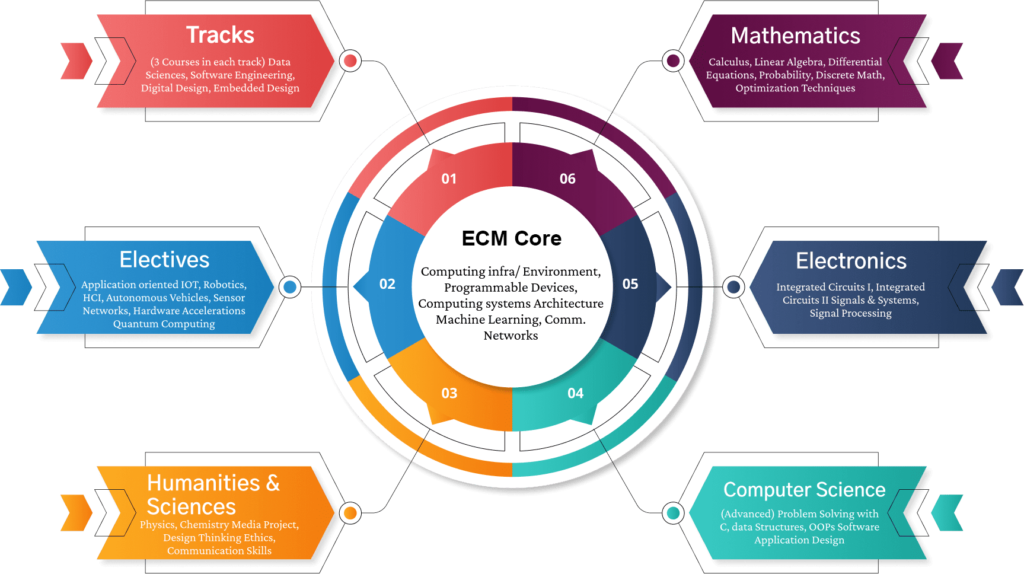
Programming and algorithms: Courses include problem solving in C, data structures, object-oriented programming, advanced problem solving, design and analysis of algorithms, and software application design.

Electronics fundamentals: Core courses such as electrical and electronic circuits, digital electronics, signals and systems, and signal processing.

Integrated hardware–software systems: Courses covering computing infrastructure, programmable devices, computing systems architecture, machine learning, and computer and communication networks.

Humanities and management: An interdisciplinary humanities track including management electives and design thinking.

  • Digital design: VLSI design, hardware acceleration and low-power IC design.
  • Data science: Data management and warehousing, deep learning and big data technologies.
  • Embedded systems: Real-time systems, hardware–software co-design and embedded programming.
  • Software engineering: Software construction, testing and verification.
  • Intelligent, connected and autonomous vehicles
  • Internet of Things (IoT) system design
  • Cyber-physical systems
  • Mixed reality systems
  • Human–computer interaction
  • Robotics and automation
  • Hardware-accelerated machine learning
  • Smart systems
CourseL-T-PCredits
Calculus and ODE4-1-05
Quantum Chemistry & Spectroscopy2-1-24
Introduction to Electrical Engineering2-1-24
Introduction to Computing3-0-24
Earth and Environmental Sciences2-0-02
English3-0-03
Media Project1-0-21.5
French – I0-2-00.5
Introduction to Entrepreneurship0-0-21
Total17-5-1025
CourseL-T-PCredits
Linear Algebra and Complex Analysis3-1-04
Classical & Quantum Mechanics2-1-24
Introduction to Biology3-0-03
Introduction to Electronics2-1-24
Discrete Mathematical Structures3-0-03
Data Structures3-0-24
Entrepreneurship Practice0-0-21
Professional Ethics0-1-01
French – II0-2-00.5
Total16-6-824.5
CourseL-T-PCredits
Probability and Statistics3-1-04
Electromagnetics & Optics3-1-25
Signals and Systems3-1-04
Digital System Design3-0-24
Operating Systems3-0-24
Design and Analysis of Algorithms3-0-24
Lean Startup0-0-31
Principles of Economics1-1-01.5
French – III0-2-00.5
Total19-6-1128
CourseL-T-PCredits
Numerical Methods3-0-24
Communication Systems3-0-24
Analog Circuits3-1-25
Optimization Techniques for AI3-0-03
Theory of Computation3-0-03
Design Thinking1-0-22
Financial Accounting1-1-01.5
French – IV0-2-00.5
Total17-4-823
CourseL-T-PCredits
Introduction to VLSI Design3-0-34.5
Programmable Devices3-0-24
Digital Signal Processing2-1-24
Object Oriented Programming2-0-23
Machine Learning3-0-03
DBMS3-0-24
HSS/ET/Mgmt. Elective I2-0-02
French – V (Optional)0-2-00.5
Total18-3-1124.5
CourseL-T-PCredits
Computing Systems Architecture3-0-03
Computer & Communication Networks3-0-03
Engineering Program Elective I3-0-03
Engineering Program Elective II3-0-03
Introduction to Professional Development2-0-02
French – VI (Optional)0-2-00.5
HSS/ET/Mgmt. Elective II2-0-02
Total16-2-016
CourseL-T-PCredits
Embedded Hardware Project0-0-63
Research Project Phase I0-0-63
Engineering Program Elective III3-0-03
Engineering Program Elective IV3-0-03
HSS/ET/Mgmt. Elective III2-0-02
French – VII (Optional)0-2-00.5
Total8-2-1214
CourseL-T-PCredits
Research Project Phase II0-0-2412
French – VIII (Optional)0-2-00.5
Total0-2-2412

FAQs

Our ECM program combines electronics, computer science, and systems engineering in a carefully designed curriculum, giving students the skills and confidence to become future innovators in technology.

Graduates are prepared for careers in embedded systems, IoT, AI, robotics, hardware-software design, and even higher studies or entrepreneurial ventures.

Both. The program ensures students gain strong expertise in electronics and circuits as well as programming, computational theory, and system design.

Our holistic approach includes mentorship, innovation labs, clubs, and leadership opportunities, helping students develop confidence, teamwork, and problem-solving skills.

Start your journey with us

Home / Undergraduate / Page 4

B.Tech in Artificial Intelligence

A four-year undergraduate programme designed to develop future-ready AI engineers skilled in machine learning, language, vision and large-scale systems who can craft creative AI solutions for real-world problems.

B.Tech in artificial intelligence overview 

We shape innovators to lead the AI revolution, combining theory, application, and research to build intelligent systems that transform industries and society. Students experience:

Interdisciplinary foundations

combining mathematics, data science, and computational intelligence to build strong analytical depth

Immersive learning

through AI labs, live projects, and experimentation with real-world datasets and neural network models

Advanced domains

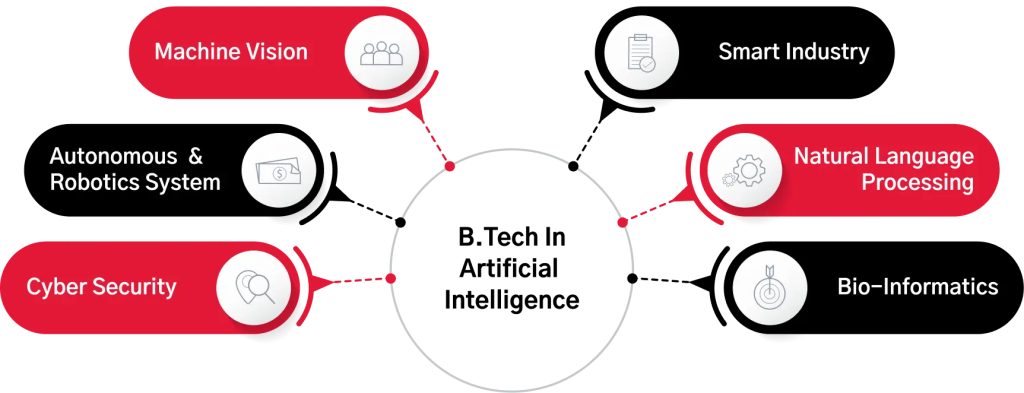
such as deep learning, natural language understanding, robotics, and generative AI explored through electives and research

Global and industry focus

with mentorship from experts, collaborative projects, and exposure to cutting-edge AI innovations shaping the future

Programme details

Academic structure

Our academic structure is designed to establish robust foundations, followed by increasing specialization in later years.

  • Total credits & degree requirement: The programme requires not less than 165 credits to be awarded a B.Tech degree.
    Duration: 4 years / 8 semesters
  • Core vs Professional phases: The first two years constitute the “Core Program,” and the last two years the “Professional Program,” with electives introduced in the latter phase.

Mathematics

  • Multivariate Calculus
  • Linear Algebra & Matrices
  • Probability & Stats
  • Numerical Methods
  • Discreate Maths

Natural sciences & economics

  • Phy- Mechanics
  • Phy-Electromagnetics
  • Biochemistry Electronics
  • EE Basics

Foundational

  • Foundations of NLP Signals & Systems Control Theory
  • Digital Image Processing
  • Artificial Intelligence
  • Machine Learning

Computer science

  • Intro. to C & Python Data Structures D&A of Algorithms
  • Comp. Architecture
  • Operating Systems DBMS & Big Data

Humanities++

  • English & Humanities
  • Media Project Earth & Environment Sciences
  • Intro. Enterprise & Economy

Electives

  • Computational Biology
  • Computational Genomics
  • Information Retrieval
  • BC & Cryptic
CourseL-T-PCredits
Calculus & ODE4-1-05
Chemistry – I2-1-24
Introduction to Electrical Engineering2-1-22
Electronics2-1-22
Introduction to Computing2-1-14
Earth & Environmental Sciences2-0-02
Introduction to Entrepreneurship0-0-31
Media Project0-0-31.5
English3-0-03
French I0-2-00.5
CourseL-T-PCredits
Linear Algebra & Complex Analysis3-1-04
Physics – I2-1-24
Biology3-0-03
Data Structures2-2-25
Discrete Mathematics2-0-02
AI & Humanity1-0-01
Entrepreneurship Practice0-0-21
Workshop Practice0-0-21
Professional Ethics0-1-01
French II0-2-00.5
CourseL-T-PCredits
Probability & Statistics3-1-04
Physics – II3-1-25
Optimization Techniques for AI3-0-03
Design & Analysis of Algorithms2-1-24
Signals & Systems3-1-04
Lean Startup1-0-01
Economics (7 weeks)3-0-01.5
French III0-2-00.5
Programming Workshop0-0-20.5
CourseL-T-PCredits
Numerical Methods3-0-24
Digital Logic & Computer Architecture3-1-04
Machine Learning with Python3-0-24
Artificial & Computational Intelligence2-1-24
Theory of Computation3-0-03
Design Thinking1-0-22
Financial Accounting3-0-01.5
French Language & Culture0-2-00.5
Programming Workshop0-0-20.5
CourseL-T-PCredits
Design & Analysis of Algorithms2-1-24
Operating Systems3-0-24
Database Management Systems3-0-24
Computer Networks (Lite)1-0-22
Foundations of NLP2-0-23
Digital Image Processing2-0-23
Humanities / Management Elective1-2-02
Programming Workshop0-0-21
CourseL-T-PCredits
Big Data Analytics3
High Performance Computing3
Neural Networks & Deep Learning3
AI Elective I3
AI Elective II3
Elective I3
Year 3 Project2
Professional Development & Employability Skills2
Humanities / Management Elective2
CourseL-T-PCredits
Computational Sequence Modelling3
AI Elective III3
AI Elective IV3
Elective II3
Elective III3
Year 4 Project (Phase I)3
Humanities / Management Elective2
CourseL-T-PCredits
Elective IV3
Elective V3
Year 4 Project (Phase II)10

FAQs

From dedicated AI and Robotics labs to live industry projects, hackathons, and internships, students actively apply their learning to real-world problems. The programme also includes experiential courses where students design and deploy AI models using contemporary tools and frameworks.

AI students are encouraged to explore research early on through faculty-guided projects, access to specialised centres such as the Mahindra University AI Research Lab, and participation in global AI competitions and conferences. The programme cultivates a strong research mindset alongside technical excellence.

Students can choose electives in areas such as Natural Language Processing, Computer Vision, Reinforcement Learning, and Generative AI, enabling them to tailor their education towards fast-evolving AI domains and industry needs.

Through partnerships with leading tech firms and start-ups, the curriculum stays updated with emerging trends. Guest lectures, mentorships, and collaborative projects ensure students gain direct exposure to industry practices and future-ready.

The project-based framework encourages students to design creative engineering solutions while developing collaboration and leadership skills essential to the industry.

Start your journey with us

Home / Undergraduate / Page 4

B.Tech in Computer Science Engineering

A 4-year undergraduate program developing computer scientists through a curriculum focused on real-world problem-solving, and industry collaboration.

B.Tech in computer science overview 

Our programme builds expertise beyond just coding. The curriculum is structured to give students deep knowledge of computational theory and software design, ensuring they graduate as innovators who can architect complex digital solutions. Students experience:

Foundational mastery

of algorithms, data structures, and computational theory for programming excellence

Hands-on development

with coding labs, software projects, and building full-stack applications

Cutting-edge specialisations

in AI, Cybersecurity, and Data Science through advanced electives and research

Industry-aligned innovation

via hackathons, capstone projects, and internships solving real-world problems

Programme details

Programme objective

  • Graduates will be able to identify and solve complex problems of the future and contribute to advancing the frontiers of computer science.
  • Graduates will develop original ideas and build technology-driven solutions that simplify processes and improve quality of life.
  • Graduates will demonstrate entrepreneurial thinking and advance their careers through continuous development of professional, communication and analytical skills.

Academic structure

Our academic structure is designed to establish robust foundations, followed by increasing specialization in later years.

  • Duration: 4 years / 8 semesters
  • Total credits & degree requirement: The programme requires not less than 165 credits to be awarded a B.Tech degree.
CourseL-T-PCredits
Calculus & ODE4-1-05
Chemistry – I + lab2-1-24
Introduction to Electrical Engineering2-1-22
Electronics2-1-24
Introduction to Computing2-1-13
Introduction to Entrepreneurship1-0-01
Media Project1-0-21.5
English0-3-03
French – I0-2-00.5
Earth and Environmental Sciences2-0-02
Total Credits26
CourseL-T-PCredits
Linear Algebra & Complex Analyses3-1-04
Physics – I2-1-24
Biology3-0-03
Data Structures2-2-25
Discrete Mathematics2-0-02
Workshop Practice0-0-21
Entrepreneurship Practise0-0-21
Professional Ethics0-1-01
French – II0-2-00.5
Total Credits21.5
CourseL-T-PCredits
Probability and Statistics3-1-04
Physics – II3-1-25
Optimization Techniques for AI3-0-03
Signals & Systems3-1-04
Lean Start-up0-0-31
Principles of Economics (7 Weeks)3-0-01.5
French – III0-2-00.5
Programming Workshop0-0-20.5
Total Credits19.5
CourseL-T-PCredits
Numerical Methods3-0-24
Digital Logic Design and Computer Architecture3-1-04
Machine Learning with Python**3-0-24
Artificial and Computational Intelligence2-1-24
Theory of Computation3-0-03
Design Thinking1-0-22
Financial Accounting3-0-01.5
French – IV0-2-00.5
Programming Workshop0-0-20.5
Total Credits23.5
CourseL-T-PCredits
Design and Analysis of Algorithms3-1-04
Operating Systems3-0-24
Database Management Systems3-0-24
Object Oriented Programming2-0-23
Microprocessors and Interfacing2-0-03
HSS + Mgmt. – Elective – I2-0-02
French – V (Optional)0-2-00
Programming Workshop0-0-21
Total Credits21
CourseL-T-PCredits
Big Data Analytics2-0-23
High Performance Computing2-0-23
Computer Networks3-0-24
Software Engineering2-0-23
Third Year Team Project2
AI Elective – I3-0-03
Elective – I3-0-03
HSS + Mgmt. – Elective – II2-0-02
Intro to Professional Development & Employability Skills2-0-02
French – VI (Optional)0-2-00/0.5
Total Credits25
CourseL-T-PCredits
Distributed Systems3-0-24
Compiler Design3-0-03
Cryptography and Network Security3-0-24
HSS + Mgmt. – Elective – III2-0-02
Elective – II3-0-03
Elective – III3-0-03
Year-4 Project3
French – VII (Optional)0-2-00/0.5
Total Credits22
CourseL-T-PCredits
Elective – IV3-0-03
Elective – V3-0-03
Year-4 Project0-5-810
French Language & Culture – VIII (Optional)0-2-00/0.5
Total Credits16

FAQs

The CSE curriculum is designed around 11 core departmental courses (40 credits) covering algorithms, data structures, databases, cryptography, and machine learning. It blends strong theoretical grounding with application-driven labs and projects, ensuring graduates are industry-ready from day one.

Students can pursue five professional and open electives (15 credits) in areas like High-Performance Computing, Data Mining, Information Security, Graphics, and Embedded Systems, allowing them to tailor their expertise toward emerging technologies.

The CSE programme encourages research from the undergraduate level, with faculty-mentored projects, capstone work, and access to research labs in AI, Robotics, and Computational Systems. Students are guided by Ph.D. faculty from top global institutions.

With a 12:1 student-faculty ratio, fully residential campus, and project-based learning culture, CSE students experience personalized mentorship, vibrant peer learning, and a collaborative atmosphere ideal for growth and innovation.

Start your journey with us

Make an enquiry Chat with a student