











B.Tech in Civil Engineering
A 4-year undergraduate programme equipping engineers to design, build and sustain the infrastructure of tomorrow.
B.Tech in civil engineering overview
We prepare students to shape the future of infrastructure and urban systems through a strong foundation in structures, geotechnics, transportation, water resources, and environmental engineering, blending technical depth with practical project experience. Students experience:

Comprehensive grounding
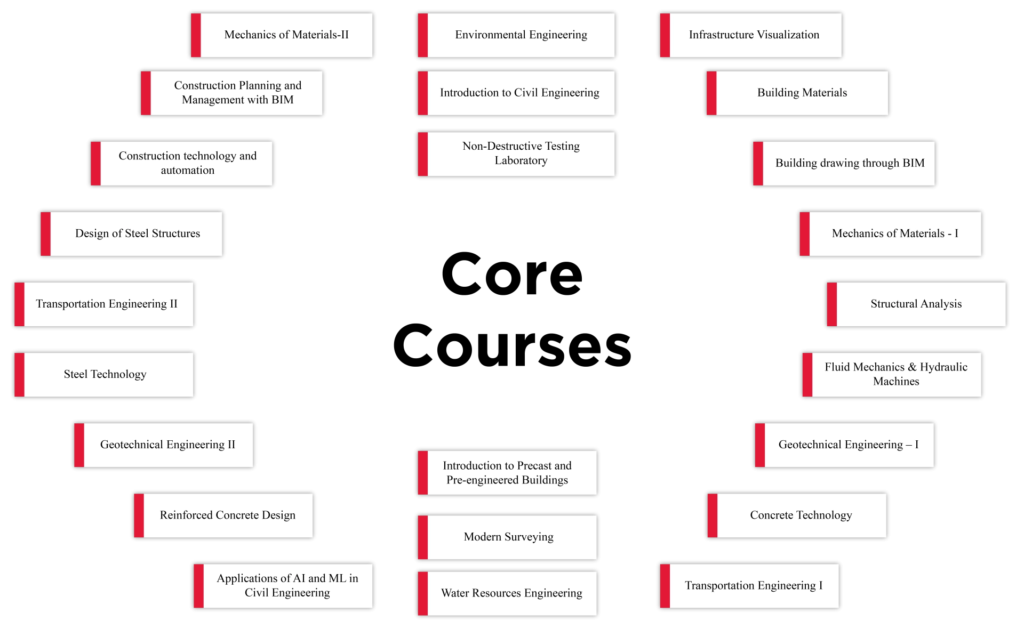
in core civil engineering domains such as mechanics of soils and fluids, structural analysis, transportation engineering and surveying

Project-based learning
and departmental projects give students practical experience in construction technology and civic systems

Choice of electives
enabling focus on specialisations such as geotechnical, structural, environmental or water-resources engineering

Exposure to contemporary
infrastructure challenges and technologies, inspiring graduates to design resilient, sustainable and efficient built environments
Programme details
Objectives
- Equip students with a strong scientific foundation and creative engineering mindset to address complex problems with a global perspective.
- Develop critical analytical skills required to plan, design, build, maintain and rehabilitate infrastructure for a sustainable future.
- Promote interdisciplinary understanding and the effective use of appropriate technologies to address real-world implementation challenges.
- Foster clear communication and ethical leadership while working collaboratively in diverse teams.
- Encourage adaptability to evolving global needs through continuous learning and lifelong professional development.
Vision
- Train civil engineers of excellence instilling scientific thinking and responsive leadership for ensuring innovative and sustainable development.
Mission
- Impart a comprehensive and inclusive knowledgebase for arriving at innovative solutions for practical problems while ensuring environmental protection, safety, and economy.
- Advance interdisciplinary and sustainable research and development for the ever-increasing and challenging needs of the built infrastructure of the future.
- Inculcate in students an entrepreneurial thought through industrial interaction while enabling them to turn out to be ethical leaders in the profession of civil engineering.
PEOs
| PEO1 | Equip the students with the basic scientific thought for a creative engineering background to address problems with a global comprehension and perspective |
| PEO2 | Im Impart critical analytical skills required to plan, design, construct, maintain and rehabilitate infrastructure needs for a sustainable future |
| PEO3 | Ensure interdisciplinary comprehension of projects using appropriate technologies to meet the implementation challenges faced by society |
| PEO4 | Capable to communicate and exhibit ethical leadership qualities while working in diverse teams |
| PEO5 | Adopt to changing global needs by constantly updating their knowledge through Continued acquisition lifelong. |
Academic structure
Our academic structure is designed to establish robust foundations, followed by increasing specialization in later years.
- Credit structure: Basic Sciences (47 credits), Basic Engineering (28 credits), Humanities, Social & Creative Sciences (15 credits), Enterprise Sciences (10 credits)
- Total credits & degree requirement: The programme requires not less than 165 credits to be awarded a B.Tech degree.
- Duration: 4 years / 8 semesters.
MoUs










Gallery

FAQs
The curriculum emphasises current topics such as sustainable construction, environmental systems, transportation and water-resources, ensuring students are ready for real-world infrastructure challenges.
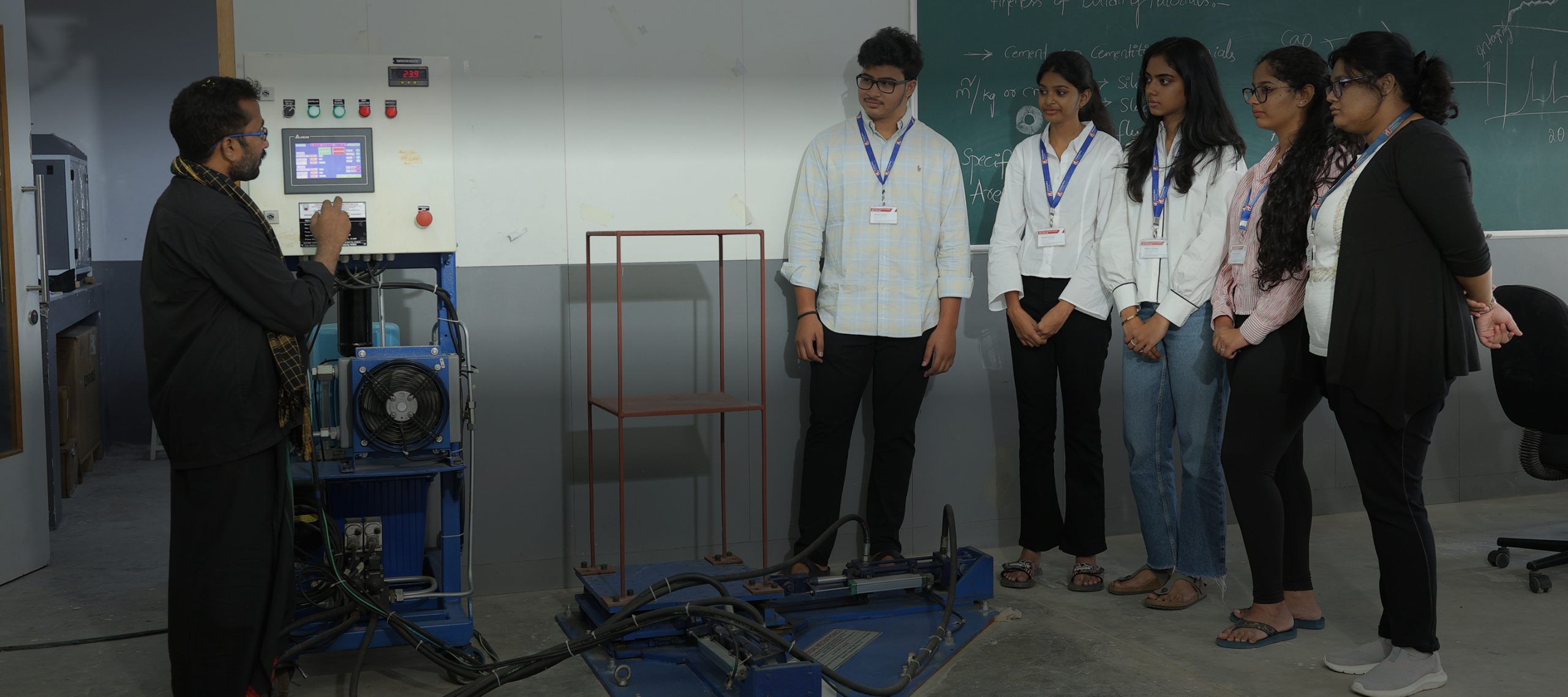
Yes, students undertake multiple departmental projects, leveraging labs, field work and construction technology modules to apply engineering in practice.
Electives in structural, geotechnical, environmental and transport engineering allow students to tailor their learning and prepare for roles in design firms, consultancy, public works or research.
By integrating courses on smart infrastructure, sustainable materials, environmental systems and project management, the programme equips graduates to lead in tomorrow’s built environment.
Graduates are well-positioned for roles in infrastructure development, consultancy, construction management, urban planning, environmental and water-resource engineering, as well as further study.
