






Home / Ecole Centrale School of Engineering

M.Tech in Construction Project Management

A two-year full-time postgraduate programme focused on advanced construction project management, equipping graduates with the knowledge and skills to plan, execute, and manage complex infrastructure projects effectively.

M.Tech in Construction Project Management Overview. 

The programme builds strong foundations in construction engineering and project management, integrating digital technologies and strategic decision-making to prepare students for real-world infrastructure challenges.

Strong construction & management foundations

Advanced learning in project planning, contracts, cost management, risk, and quality in construction environments

Hands-on industry-relevant learning

Exposure to real-world construction workflows, case studies, and practical applications across infrastructure projects.

Digital construction
focus

Application of BIM, construction analytics, automation, and digital project management tools.

Research and industry exposure

Internship and thesis-driven learning supported by industry partnerships and research ecosystem.

Programme details

Programme objective

  • Develop expertise in construction project planning, execution, monitoring, and control
  • Build competencies in contract management, cost management, and procurement
  • Enable application of quality, safety, and risk management practices
  • Foster leadership, communication, and stakeholder management skills
  • Integrate sustainability and ethical practices in project delivery
  • Promote lifelong learning and adaptation to evolving construction technologies

Programme highlights

  • Industry-aligned curriculum integrating engineering, management, and technology
  • Strong focus on digital construction (BIM, analytics, automation)
  • Interdisciplinary electives across infrastructure, sustainability, risk, and transportation
  • Internship and thesis-driven specialisation
  • Access to advanced laboratories and computational facilities
  • Faculty with strong academic and research experience
  • Strong industry partnerships and research ecosystem
  • Outcome-based learning with real-world case studies

Academic structure

The programme is a two-year postgraduate programme (4 semesters) that combines coursework, laboratories, industry exposure, an internship, and a research thesis.

Students complete core courses in construction management, planning, contracts, quality, lean construction, analytics, and optimisation, followed by an internship and thesis for specialisation.

The structured semester-wise curriculum ensures strong foundational knowledge and advanced specialisation.

Career opportunities

Graduates can pursue roles such as:

  • Construction project manager
  • Planning engineer
  • Project controls engineer
  • Contracts manager
  • Cost engineer
  • BIM Manager
  • Infrastructure consultant
  • Construction technology specialist
  • Real estate project manager
  • Risk and quality manager

Employers include EPC firms, infrastructure developers, consulting companies, real estate firms, and technology companies.

Eligibility criteria

  • B.Tech / BE in Civil Engineering from any recognised University/Institute with a Minimum of 60% aggregate marks.
  • Candidates appearing for their final semester exam in the current year are also eligible to apply.

Admission Process

  • Admission for GATE qualified students: applicants with a valid GATE score & percentile score 80 & above will undergo an interview for admission.
  • Admission for non-GATE qualified students: candidates not having valid GATE score or have percentile score less than 80 will have to appear in the written Test to be conducted by ECSE-MU, followed by an interview for the shortlisted candidates.

FAQs

This programme focuses specifically on construction project management, integrating engineering with management practices, digital technologies, and real-world project execution.

Yes, the programme includes an internship and industry-linked projects, supported by strong industry partnerships.

Yes, students gain exposure to BIM, analytics, automation, and digital construction workflows.

Graduates can pursue roles across project management, consulting, infrastructure development, and construction technology.

Yes, the thesis component enables students to pursue research-oriented careers or further doctoral studies.

Start your journey with us

Home / Ecole Centrale School of Engineering

5-yr Integrated M.Tech. in Biotechnology

An integrated programme that builds strong foundations in biological sciences and advanced training in biotechnology for research and industry pathways.

Programme overview 

This programme is designed for students who wish to pursue an in-depth and continuous academic pathway in the life sciences. We integrate undergraduate and postgraduate study, enabling students to build conceptual depth, research capability, and technical competence over five years.

Integrated academic progression

A structured pathway that moves seamlessly from foundational science to advanced biotechnology and research.

Strong life sciences foundation

Core learning in biology, chemistry, mathematics, and related sciences that underpin biotechnology.

Research-oriented training

Exposure to laboratory work, data analysis, and supervised research projects.

Preparation for advanced pathways

Academic grounding that supports doctoral research, industry roles, and interdisciplinary careers.

Programme details

Programme structure

The programme is organised to support gradual academic progression and increasing specialisation.

  • Years 1–2: foundations: core courses in biological sciences, chemistry, mathematics, and introductory biotechnology concepts.
  • Years 3–4: advanced biotechnology: specialised coursework in biotechnology, laboratory techniques, and interdisciplinary applications.
  • Year 5: research and specialisation: advanced electives and a substantial research project or thesis under faculty supervision.

This structure enables students to develop both breadth and depth across life sciences and biotechnology.

Sr. No.Course CodeCourse TitleLTPCredits
1BT 1101 / BT 1102Basic Mathematics / Introduction to Biology*3003
2BT 1103Introduction to Biotechnology2002
3BT 1104Chemistry of Biomolecules3024
4PH 1103Physics for BT & CB3125
5ES 103Earth and Environmental Sciences2002
6HS 1101English0303
7HS 1102Media Project0021.5
8FS 1103French – I0200.5
9HS 1104Introduction to Entrepreneurship0031
Total Credits22
Sr. No.Course CodeCourse TitleLTPCredits
1BT 1205Genetics2124
2BT 1206Biodiversity & Global Conventions1001
3BT 1207Basic Mathematics II3104
4EE 1204Basic Electronics & Applications2124
5CH 1202Chemistry II2023
6CS 1101Introduction to Computing2124
7HS 1201Entrepreneurship Practice0021
8HS 1202Professional Ethics0101
9HS 1203French – II0200.5
Total Credits22.5
Sr. No.Course CodeCourse TitleLTPCredits
1BT 2108Enzymes & Metabolism3024
2BT 2109Microbes & Immune Systems4025
3BT 2110Cell & Molecular Biology3024
4BT 2111Probability & Biostatistics2124
5HS 2101Lean Start-up (Fractal)0031
6HS 2102Principles of Economics (Fractal)3001.5
7HS 2103French – III0200.5
Total Credits20
Sr. No.Course CodeCourse TitleLTPCredits
1BT 2212Omic Technologies3024
2BT 2213Gene Technology2044
3BT 2214Bioprocess Technology3024
4BT 2215AI & Data Science for Biotechnologists3024
5HS 2201Design Thinking1022
6HS 2202Financial Accounting3001.5
7HS 2203French – IV0200.5
Total Credits20
Sr. No.Course CodeCourse TitleLTPCredits
1BT 3116Animal Cell & Tissue Culture Technology2044
2BT 3117Bioinformatics & Computational Biology3024
3BT 3118Agriculture Biotechnology3024
4BT 3119Bioprocess Design & Upscaling3024
5BT 3020Elective – I3003
6BT 3021Elective – II3003
7HSS Elective – I2002
Total Credits24
Sr. No.Course CodeCourse TitleLTPCredits
1BT 3222Synthetic Biology & Applications3024
2BT 3223Food Processing & Nutrition3024
3BT 3224Good Manufacturing & Regulatory Practices1011.5
4BT 3025Elective – III3003
5BT 3026Elective – IV3003
6HS 3201Introduction to Professional Development2002
7HSS Elective – II2002
Total Credits19.5
Sr. No.Course CodeCourse TitleLTPCredits
1BT 4227Green Biotechnology3003
2BT 4228Research Methods & IPR3003
3BT 4027Elective – V3003
4BT 4028Elective – VI3003
5M.Tech CoreCore Course3003
6M.Tech CoreCore Course3003
7HSS Elective – III2002
Total Credits20
Sr. No.Course CodeCourse TitleLTPCredits
1M.Tech CoreCore Course3003
2BT-0000Elective – PG3003
3BT-0000Elective – PG3003
4BT-0000Elective – PG3003
5BT-0000Elective – PG3003
6BT-0000Literature Review3003
7HSS Elective – III2002
Total Credits20
Sr. No.Course CodeCourse TitleLTPCredits
1PR-0000M.Tech Thesis004020
Total Credits20
Sr. No.Course CodeCourse TitleLTPCredits
1PR-0000M.Tech Thesis004020
Total Credits20

Learning outcome

Mahindra University offers an internationally trained faculty with strong industry and research backgrounds. The curriculum is regularly reviewed and updated to remain aligned with global industry and academic standards.

Upon completing the programme, students will be able to:

  • Evaluate biotechnology research and business practices in relation to ethical, inclusive and equitable standards.
  • Formulate research questions and develop solutions to contemporary challenges in biotechnology using a multidisciplinary approach.
  • Apply a range of laboratory techniques to design, conduct and analyse experiments addressing biotechnology problems.
  • Critically assess scientific literature in the context of real-world applications across biotechnology domains.
  • Demonstrate professional networking, leadership, communication and collaboration skills relevant to biotechnology research and industry.

Programme highlights

Flexible and customisable specialisation tracks that allow students to pursue specific areas of interest in biotechnology.

Rigorous scientific training supported by an advanced research thesis.

Hands-on experience through independent research projects at the University or collaborative projects with biotechnology and pharmaceutical industries.

Opportunities to publish research in scientific journals, present at international conferences and file patents.

Continuous mentorship and professional development support throughout the programme.

Interaction with researchers and industry experts through guest lectures and academic collaborations.

A final-year master’s thesis that enables students to develop in-depth research expertise supported by strong laboratory training.

Career avenues

Mahindra University’s location in Hyderabad—one of India’s leading life sciences and pharmaceutical hubs—provides strong industry linkages with biotechnology companies, R&D institutions and global organisations.

Students also benefit from international academic collaborations, enabling exchange opportunities and joint research supervision with faculty from reputed global institutions.

Graduates are prepared for diverse career paths, including:

  • Research scientist roles in laboratories focused on biotechnology applications in medicine, agriculture and industry.
  • Positions in regulatory affairs related to drug approvals and biotechnology products.
  • Management and leadership roles within biotechnology and pharmaceutical companies.
  • Opportunities with organisations investing in biotechnology innovation.
  • Roles supporting biotechnology-related legal and regulatory services.
  • Careers in research and development, process operations, product development and technical sales.
  • Academic careers in scientific research and teaching.

Research and application areas

Biomanufacturing and green products

Applies engineered biological systems to produce chemicals and biomolecules using sustainable, biologically derived processes. The field supports green manufacturing across healthcare, agriculture, food, and specialty chemical industries.

Biopharmaceutical technology

Focuses on the development of biologics such as antibodies, vaccines, and nucleic acid–based therapeutics. The domain spans drug discovery, biosynthesis, formulation, delivery systems, and regulatory pathways.

Diagnostics

Focuses on the development of molecular and analytical tools for early and accurate disease detection. The domain integrates biology, chemistry, engineering, and data analysis to support clinical and public health diagnostics.

Food processing and nutrition

Explores scientific and technological approaches to food preservation, fortification, and processing. Emphasis is placed on improving shelf life, nutritional quality, hygiene, and food security through process optimisation.

Gut microbiome

Studies the role of gut microorganisms in human health and disease, spanning nutrition, immunity, metabolic disorders, and neurological development. The field supports both diagnostic biomarker discovery and therapeutic interventions.

Precision medicine

Centres on tailoring medical treatment based on individual genetic and molecular profiles. The domain integrates genomics, diagnostics, and data analytics to improve treatment effectiveness and reduce adverse outcomes.

Digital agriculture

Applies data, sensors, analytics, and digital platforms to optimise agricultural productivity and sustainability. The focus includes precision farming, decision support systems, and proactive resource management.

Pharmaceutical biotechnology

Applies biotechnological principles to drug development, from molecular design and expression to purification, stability assessment, delivery systems, and clinical translation.

Biomarkers

Centres on identifying and validating biological indicators associated with disease diagnosis, progression, and therapeutic response. The area supports applications in diagnostics, monitoring, and precision medicine.

FAQs

The programme is a five-year, full-time integrated M.Tech degree.

An integrated programme offers academic continuity, early exposure to advanced coursework, and structured preparation for research and higher study.

Yes. Research-led learning and a substantial project or thesis form a core part of the programme, particularly in later years.

Yes. The programme prepares students for doctoral research and advanced academic pathways.

Yes. Laboratory-based learning is integrated across multiple stages of the programme.

Start your journey with us

Home / Ecole Centrale School of Engineering

M.Tech. in Sustainability

The Master’s in Sustainability programme aims to prepare industry-ready professionals and innovative researchers who can address pressing global sustainability challenges.

M.Tech in sustainability overview 

To develop engaged professionals capable of solving real-world sustainability challenges through education, research, innovation and collaboration. This vision aligns with the Centre for Sustainability at Mahindra University, which aims to build a more equitable world where human societies live in harmony with nature.Students will learn to:

Collaborate effectively

in multidisciplinary teams and engage stakeholders through clear and impactful communication.

Analyse the interconnected nature

of climate change, ecosystems, energy systems, built environments and public policy to support environmental, social and economic prosperity.

Evaluate complex sustainability challenges

and design evidence-based strategies using systems thinking and cross-sectoral perspectives.

Apply sustainability knowledge

through fieldwork, case studies, internships and global learning opportunities.

Programme details

Why choose M.Tech in Sustainability at Mahindra University?

World-class faculty: Learn from globally experienced faculty and visiting experts in climate science, green infrastructure, sustainable business and policy.

Hands-on experience: Gain practical exposure through laboratories, fieldwork, internships and real-world projects with industry and community partners.

Interdisciplinary curriculum: The curriculum integrates technical, scientific and social perspectives to address complex sustainability challenges. Courses incorporate tools such as simulations, life cycle assessment, AI/ML applications and systems thinking.

Research opportunities: Participate in applied research with Mahindra University’s centres and laboratories, collaborate with external partners and contribute to research publications.

Focus on employability: Designed to meet the needs of the green economy, the programme emphasises project-based learning, industry exposure and innovation-driven coursework to develop job-ready skills.

Expected career pathways

Graduates of the programme may pursue careers across multiple sectors, including:

  • Consulting firms – sustainability strategy, ESG reporting, climate risk assessment and sustainable operations.
  • International non-profit organisations (NPOs) – climate adaptation, sustainability programmes and global development initiatives.
  • Industry – sustainable manufacturing, environmental compliance, green product development and corporate sustainability.
  • Think tanks and research institutions – sustainability policy research, climate modelling and evidence-based policy recommendations.
  • Academia – teaching, interdisciplinary research and knowledge dissemination.

Programme focus areas

The programme offers foundational courses along with specialised learning across four key areas.

Sustainable ecosystems

This focus area addresses environmental and ecological sustainability challenges such as water resource management, biodiversity conservation and the relationship between demography and business sustainability. It also examines themes including nature-based solutions, climate communication, climate justice and equity, and climate policy, politics and law.

Sustainable energy systems

This track explores the transition to cleaner and more resilient energy systems. Students learn about renewable energy technologies, energy footprint analysis and energy policy frameworks. The curriculum integrates engineering principles with sustainability goals and prepares graduates to lead innovations supporting the global energy transition.

Sustainable built environments

This area focuses on designing and managing environmentally responsible and climate-responsive buildings and urban systems. Topics include building performance simulation, urban land-use dynamics, urban microclimates, green building rating systems and air quality management. Students learn to design climate-resilient built environments using data-driven methods and integrated systems thinking.

Social sustainability and policy

This focus area examines the social dimensions of sustainability, including governance, social justice, community wellbeing and inclusive planning. Students learn participatory methods, stakeholder engagement strategies and policy evaluation frameworks to design equitable and resilient development pathways.

Total credits required to graduate: 67 credits
Total instructional hours: 1,120 hours (14 hours per credit)

S. No.CourseCredits
1Introduction to sustainability2
2Research methods for sustainability3
3Programming for sustainability4
4Environmental economics and sustainable finance3
5Climate solutions3
6Carbon accounting, climate risk and reporting4
7Systems thinking3
S. No.CourseCredits
1Circular economy and life cycle assessment (LCA)4
2Energy systems3
3Sustainable water resource management3
4Business and climate communication2
5Climate policy, politics and law3
6Sustainable manufacturing and supply chain3
7Geospatial analytics for environment3

Summer internship

Students select three electives from the focus areas below.

Focus areaCredits
Social sustainability3
Sustainable built environment3 + 3
Sustainable energy systems3 + 3
Sustainable ecosystems3 + 3
Project / pre-thesis4

Students complete a master’s thesis or internship, focusing on applied research or real-world sustainability challenges.

Career roles

  • Sustainability consultant
  • Sustainability manager
  • Environmental scientist
  • Environmental specialist
  • Sustainability solutions specialist
  • Energy specialist
  • Energy manager
  • Life cycle assessment (LCA) specialist
  • Policy advisor
  • Research associate

Eligibility

Applicants from any undergraduate discipline are welcome, provided they are interested in sustainability and interdisciplinary problem-solving.

Requirements include:

  • A full-time undergraduate degree of four years from a recognised university or institute.
  • A minimum aggregate score of 60% or an equivalent grade.
  • A minimum CGPA of 6.0 on a 10-point scale or equivalent.
  • Candidates in their final semester of undergraduate study are also eligible to apply.

Admission process

  • Applicants with a three-year undergraduate degree must have a minimum aggregate of 60% and a qualifying score in GATE, CUET (PG) or another recognised national or state-level postgraduate entrance examination.
  • Shortlisted candidates from all eligibility routes will be invited for a personal interview as part of the final selection process.

FAQs

The programme is a two-year full-time postgraduate degree consisting of four semesters. It includes coursework, electives, research project, internship or a final thesis.

Students from any four year or more undergraduate discipline can apply, provided they have a minimum of 60% marks or a CGPA of 6.0 on a 10-point scale. Final-year undergraduate students are also eligible to apply.

Students can pursue advanced learning through focus areas such as sustainable ecosystems, sustainable energy systems, sustainable built environments and social sustainability & policy.

Yes. The programme includes a summer internship or industry project, along with research opportunities and a final thesis or extended internship in the fourth semester.

Graduates can pursue careers in sustainability consulting, environmental research, energy management, ESG and climate policy advisory, as well as roles in industry, international organisations, think tanks and academia.

Start your journey with us

Home / Ecole Centrale School of Engineering

M.Tech in structural engineering for working professionals

A two-year postgraduate engineering programme structured for practising professionals to advance expertise in structural engineering while continuing their careers.

Programme overview 

The M.Tech in structural engineering for working professionals equips practising civil engineers with specialised knowledge in structural analysis, dynamics, design and advanced construction concepts. It blends rigorous coursework with applied learning and a project/dissertation component over four semesters, with classes scheduled on weekends to accommodate ongoing professional commitments.

Weekend-friendly delivery

that supports continued professional engagement without compromising work responsibilities. 

Deep technical foundations

in structural analysis, dynamics, advanced design and contemporary construction techniques. 

Applied research through project work

 that enables integration of theory with real engineering challenges. 

Exposure to advanced tools and methods

such as finite element analysis and structural health monitoring.

Programme details

Programme objectives

  • Equip the students with the basic scientific thought for a creative engineering background to address problems with a global comprehension and perspective.
  • Impart critical analytical skills required to plan, design, construct, maintain and rehabilitate infrastructure needs for a sustainable future.
  • Ensure interdisciplinary comprehension of projects using appropriate technologies to meet the implementation challenges faced by society.
  • Capable of communicating and exhibiting ethical leadership qualities while working in diverse teams.
  • Adopt to changing global needs by constantly updating their knowledge through continued acquisition lifelong.

Civil engineering laboratory

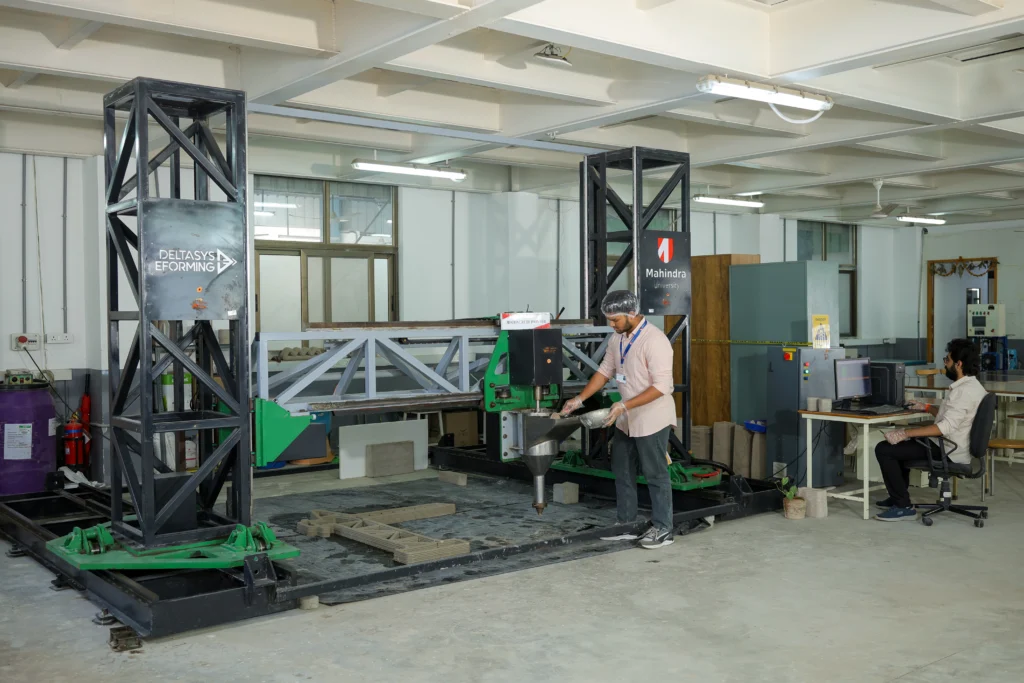
The labs of the civil engineering department play a pivotal role that provide hands-on learning in shaping future engineers. The state-of-the-art laboratories allow students to apply classroom knowledge to real-world challenges. Structural health monitoring lab, geotechnical engineering lab, concrete and advanced concrete lab, transportation engineering lab, and surveying lab are some of the labs set up at the University.

Core laboratoriesResearch laboratories/facilitiesResearch centresComputational facilities
Advanced concrete technology labAdvanced geotechnical labCentre for sustainable infrastructure and systemsHigh-performance computational facilities
Building information modeling labSmart & sustainable materials laboratoryCentre of excellence in artificial intelligenceAUTOCAD & Revit architecture
Structural health monitoring lab3D concrete printerBENTLEY academic suite (open roads, STAAD PRO, RAM connections, foundation design)
Uniaxial shake tableETABS
Controls testing facility (Compression, flexure, fracture, load-CMOD)Seismostruct
XRD – X-Ray diffraction lab (central facility)MIDAS
ACCA tools (building information modeling)
VISSIM, VISUM, VISWALK, VISTRO
PLAXIS 2D
Diana
LS-DYNA
ArcGIS
MATLAB
Python

Eligibility

  • Applicants must be employed professionals holding B. Tech in Civil Engineering with at least 60% aggregate marks.
  • Applicants must have a minimum of one year of work experience after the completion of the degree.

Duration

  • Two Years

Schedule

Our programs are scheduled for weekends, allowing the working professionals to maintain their job while working towards a master’s degree.

Fee structure

The fee for Mahindra University’s Civil Engineering Weekend PG Programs for Working Professionals is Rs. 2,00,000 per annum.

* Option to pay fees using an easy EMI with 0% interest and 0 down payment

Admission process

Curriculum

Students need to take 16 courses towards coursework for a duration of 4 semesters and complete one project/dissertation. Semester wise list of courses.

Semester ISemester IISemesterSemester IV
Structural dynamicsFinite element methodAdvanced foundation engineeringBridge engineering
Analysis of framed structuresAdvanced steel designTall buildingsStructural health monitoring
Advanced reinforced concrete designAdvanced cementitious compositesRepair and rehabilitation of structuresPre-engineered buildings
Theory of elasticityBuilding information modelingPrestressed concretePrecast construction and design

Programme features & strengths

School Icon

Faculty with doctorates from premium institutions

The faculty with the doctorate from premier institutions in India and abroad brings in a lot of research experience along with the skill set ethos required to nurture and strengthen the program. Particularly, the strong theoretical and computational background of the faculty at MU would allow us to provide this academic program with a significant practical component. Faculty of the department are also working on public and private funded projects of worth more than 2 crores.

School Icon

Strong industry connect

Civil Engineering Department is associated with several industries like Ramboll, L&T, Tandon Consultants, STUP Consultants, Aarvee Associates, Thornton Tomasetti, Atkins, Arup, MIDAS, CSIESPL (ETABS), Design Werkz Eng Pvt Ltd., Nanospan, Murugappa Group, Smart Built Prefab Pvt. Ltd., Techfab India, Bentley, PSV Precast, METEY Engineering and Consultancy Pvt. Ltd, SatyaVani Projects And Consultants Pvt. Ltd., and other structural engineering firms in the country

School Icon

Strong connect with professional bodies

American Society of Civil Engineers, Indian Geotechnical Societym Indian Concrete Institute, Indian Institute of Bridge Engineers, Indian Association of Structural Engineers, Precast Society India, Association of Consulting Civil Engineers, and RILEM.

School Icon

Interactive learning

Our dynamic classrooms, equipped with world-class laboratories and cutting-edge technology, foster experiential learning through Outcome Based Education, encouraging students to engage in lively discussions, solve real-world problems via case studies, and directly apply their knowledge to their jobs.

School Icon

Networking opportunities

Expand your professional network by collaborating with peers from diverse industries and accessing our alumni network for long-term career support.

FAQs

Civil engineers and professionals working in structural design, construction, infrastructure or related sectors seeking advanced technical upskilling while maintaining employment. 

The programme spans two years, delivered over four semesters.

Yes. The weekend-based format is specifically structured to allow continuation of professional duties alongside study. 

Yes. Students complete a project/dissertation component that synthesises learning and technical insight.

The curriculum comprises core and elective courses that evolve with academic board approval.

Start your journey with us

Home / Ecole Centrale School of Engineering

M. Tech in highway engineering for working professionals

An advanced postgraduate programme designed to develop specialised expertise in highway engineering while enabling professionals to continue working.

Programme overview 

The M.Tech in highway engineering for working professionals equips practicing engineers with in-depth knowledge and practical skills in highway materials, traffic engineering, geometric design, pavement analysis and related domains. The weekend-based structure allows candidates to pursue higher education without pausing their careers, blending coursework with a dissertation project over four semesters.

Balanced specialist curriculum

Covering highway materials, traffic engineering, geometric design, ground improvement and advanced field testing.

Weekend-friendly schedule

tailored to professionals who wish to study alongside full-time employment.

Hands-on laboratory exposure

through material testing and software-based field testing labs that support applied learning.

Capstone-style research project

 enabling students to apply theory to real-world engineering challenges.

Programme details

Programme objectives

  • To impart comprehensive knowledge on the elements of transportation to meet current and future challenges.
  • To prepare for working in an interdisciplinary environment with advanced technologies to solve complex transportation problems
  • To inculcate social responsibility, reflective learning, and professional ethics throughout their careers.

Programme specific objectives

  • Apply fundamental knowledge of highway for planning, design, construction, operation, and maintenance of sustainable infrastructure
  • Utilize modern equipment and software to progress a career in academics, industry, and research in the field of highway
  • Exhibit leadership qualities with an ethical attitude and ability to engage in lifelong learning

Civil engineering laboratory

The labs of the civil engineering department play a pivotal role that provide hands-on learning in shaping future engineers. The state-of-the-art laboratories allow students to apply classroom knowledge to real-world challenges. The department boasts of various dedicated labs having up to date and top-notch laboratory infrastructure. Design studio lab with a facility of AR/VR integration, Highway materials lab, GeoPave research lab, transportation system engineering lab, structural health monitoring lab, geotechnical engineering lab, concrete and advanced concrete lab, surveying lab are some of the labs set up at the University.

Apart from conventional labs, it also features specialized facilities like the materials hub for sustainable alternatives, the iMaS lab for intelligent mobility and transportation systems, and the ecosphere lab, which focuses on developing nature-based solutions aligned with the UN Sustainable Development Goals (SDGs). Other key labs include InfraVision (for BIM and Digital Twin technologies), GEMS (for geospatial surveying), NDT Lab, and the crafting lab. Collectively, these laboratories equip students with physical and digital tools from field sensors and drone systems to advanced simulation software to confidently tackle real-world challenges in infrastructure development, sustainable resource management, and resilient urban planning.

Eligibility, schedule, & duration

Eligibility
  • Applicants must be employed professionals holding B. Tech in Civil Engineering with at least 60% aggregate marks.
  • Applicants must have a minimum of one year of work experience after the completion of the degree.
Duration
  • Two Years
Schedule:

Our programmes are scheduled for weekends, allowing the working professionals to maintain their job while working towards a master’s degree.

Fee structure

The fee for Mahindra University’s civil engineering weekend PG programmes for working professionals is Rs. 2,00,000 per annum.

Admission structure

Curriculum

Semester ISemester IISemester IIISemester IV
Highway Materials, Testing & CharacterizationPavement Analysis & DesignElective – IIIProject Phase – II
Traffic EngineeringUrban Transportation Planning / PMSElective – IV
Geometric DesignGround Improvement Techniques & GeosyntheticsProject Phase – I
Elective – IElective – II
Material Testing LabAdvanced Materials & Field Testing / Software Lab

FAQs

Engineers and professionals working in highway, transportation or infrastructure sectors who want specialised academic training without interrupting their careers.

Yes. The weekly schedule is structured to accommodate professionals with employers’ support.

Core laboratory sessions in material testing and advanced field testing support applied understanding.

Yes. A dissertation project spans two semesters and culminates in a documented research output.

Electives provide flexibility and are offered based on academic approval to complement core learning.

Start your journey with us

Home / Ecole Centrale School of Engineering

B.Tech-LL.B. (Honours)

An integrated dual-degree programme that equips students with interdisciplinary expertise in technology and law.

Programme overview 

The B.Tech-LL.B (Hons) at Mahindra University is a six-year industry-backed integrated dual-degree programme that uniquely combines engineering principles with legal studies. Students gain both technical acumen and legal insight, enabling them to pursue careers in corporate law, intellectual property, compliance, technology policy and related domains. 

Interdisciplinary depth in technology and law

Core engineering principles are blended with essential legal knowledge, including constitutional law, contract law and intellectual property. 

Real-world and industry relevance

Learning is enriched by case studies, projects, internships and interactions that reflect legal-tech challenges. 

Critical analytical capability

The curriculum emphasises logical thinking, problem-solving and decision-making in both technical and legal contexts. 

Career readiness across sectors

Graduates are prepared for roles in law firms, technology companies, regulatory bodies and policy-oriented organisations. 

Programme details

Eligibility and admission

CategoryDetails
Academic QualificationApplicants must meet one of the following criteria:
  • Qualify in JEE (Main) 2026 and be eligible to appear for JEE Advanced 2026Secure a top All India Rank in JEE (Main) 2026 (exact cut-off rank will be announced after declaration of results)Hold a valid SAT Subject Test score (Mathematics, Physics, and Chemistry) with a minimum score of 800
Entrance Test RequirementAll applicants must qualify in the Mahindra University Law Entrance Test 2026 (MULET 2026).
Important NoticeApplicants who have completed Class 12 under IB, Cambridge, or any other international curriculum must submit a UGC equivalence certificate by 30 August 2026. Failure to submit the certificate by the deadline will result in automatic cancellation of admission.
MULET 2026 – Exam Structure
  • Total questions: 90 multiple-choice questionsTotal marks: 90Marking scheme: 1 mark per questionNegative marking: 0.25 marks deducted for each incorrect answer
MULET 2026 – Section-wise Distribution
  • English Knowledge and Skills – 20 questionsLogical Reasoning – 25 questionsGeneral Knowledge and Current Affairs – 20 questionsMathematics – 15 questionsLegal Reasoning – 10 questions

Fee structure

The fee structure for the programme is as follows: 

CategoryAcademic fees (per annum)Hostel charges (all-inclusive)Caution deposit (refundable)
Indian students₹ 5,00,000₹ 1,70,000₹ 20,000

Note: Hostel residence is mandatory for students enrolled in the B.Tech. LL.B. (Hons.) programme. Hostel stay is not mandatory for students enrolled in the B.A. LL.B. (Hons.) and BBA LL.B. (Hons.) programmes. All fees are subject to revision each year.

Important dates

Dates and schedules are subject to change; please refer to official admissions notifications for updates.

  • Last date to apply for next round of admissions:  9th May 2026
  • Mahindra University Law Entrance Test (MULET 2026): 25 January 2026
  • Last date for receipt of applications for admission: 09th July 2026

FAQs

The B.Tech–LL.B. (Hons.) is a six-year integrated dual-degree programme that combines engineering education with legal studies. The curriculum integrates technology subjects with core law courses to prepare students for emerging legal-technology domains.

The programme blends engineering fundamentals with legal education, covering subjects related to computer science and engineering alongside legal disciplines such as constitutional law, contract law, intellectual property law, and dispute resolution. It also addresses emerging fields like AI regulation, data protection, blockchain, and cyber law.

Graduates can pursue careers in technology law, intellectual property rights (IPR), corporate legal advisory, cyber law, regulatory policy, compliance, and legal consulting. Opportunities exist across law firms, technology companies, government agencies, research organisations, and policy institutions.

Applicants must qualify through recognised entrance routes such as JEE (Main) or submit valid SAT or ACT scores, along with meeting the university’s academic eligibility requirements in Class 12. Final admission may also involve additional evaluation steps as specified by the university.

The programme is designed to address the growing intersection between technology and law, preparing professionals who understand both engineering systems and legal frameworks. This interdisciplinary approach equips graduates to tackle complex issues involving emerging technologies, regulation, and digital governance.

Start your journey with us

Home / Ecole Centrale School of Engineering

5 Year Integrated M.Tech in Computer Science Engineering

An integrated programme that develops deep technical expertise in computing, algorithms and advanced engineering systems for future technology careers.

Programme overview 

The five-year integrated B.Tech + M.Tech in computer science & engineering combines undergraduate and postgraduate study into a continuous academic pathway. It is designed to prepare students with both solid foundations in computing and advanced capabilities in specialised and research-oriented aspects of computer science. 

Fundamental computing and engineering

Strong grounding in computer science principles, mathematical reasoning and engineering fundamentals.

Advanced technology learning

Exposure to key areas such as algorithms, machine learning, systems and security as part of the integrated master’s component.

Research capability development

Opportunities to engage in project, laboratory and design work that build analytical depth and problem-solving skills.

Preparation for careers and higher study

Integrated depth that supports roles in the software industry, research labs or further academic study.

Programme details

Programme objective

  • Graduates will identify and address complex challenges of the future, contributing to the advancement of computer science.
  • Graduates will develop original ideas and build technology-driven solutions that simplify processes and improve quality of life.
  • Graduates will demonstrate entrepreneurial thinking and advance their careers through continuous development of professional, communication and analytical skills.

Programme structure

The integrated structure is organised progressively to build breadth and depth:

  • Years 1–2: foundational phase: core courses in mathematics, fundamentals of computing, engineering sciences and introductory computer science.
  • Years 3–4: professional phase: advanced computing topics, software and systems engineering, data and algorithm courses aligned with industry needs.
  • Year 5: master’s phase: specialised advanced coursework and an integrated research/design project under faculty supervision.

The design ensures continuity between undergraduate breadth and postgraduate depth in computing.

Sr. No.Course CodeCourse TitleLTPCredits
1MA 1101Mathematics-I (Calculus & ODE)4105
2CH 1101 / CH1103Chemistry I + Lab2124
3EE 1101Intro to Electrical Engineering2122
4EE 1105Electronics2122
5CS 1101Introduction to Computing2124
6HS 1102Media Project1021.5
7HS 1101English0303
8HS 1104Intro to Entrepreneurship0031
9HS 1103French – I0200.5
Sr. No.Course CodeCourse TitleLTPCredits
1MA 1202Mathematics-2 (Linear Algebra, Complex Analysis)3104
2PH 1202Physics-I2124
3BI 1201Biology3003
4CS 1201Data Structures3125
5CS 1202Discrete Mathematical Structures2002
6ME 1202Workshop Practice0021
7CE 1101Earth and Environmental Sciences2002
8HS 1201Entrepreneurship Practice0021
9HS 1202Professional Ethics0101
10HS 1203French-II0200.5
Sr. No.Course CodeCourse TitleLTPCredits
1MA 2103Mathematics-3 (Probability & Statistics)3104
2PH 2102Physics-II3125
3CS 2101Optimization Techniques for AI3003
4CS 2102Design and Analysis of Algorithms3024
5EE 2101Signals and Systems3104
6CS 2104Programming Workshop0020.5
7HS 2101Lean Start-up0031
8HS 2102Principle of Economics3001.5
9HS 2103French-III0200.5
Sr. No.Course CodeCourse TitleLTPCredits
1MA 2208Mathematics-4 (Numerical Methods)3024
2CS 2201Digital Logic Design & Computer Architecture3104
3CS 2202Machine Learning3003
4CS 2102Artificial Intelligence3003
5CS 2204Theory of Computation3003
6CS 2205Programming Workshop0020.5
7HS 2201Design Thinking1022
8HS 2202Financial Accounting3001.5
9HS 2203French-IV0200.5
Sr. No.Course CodeCourse TitleLTPCredits
1CS 3101Compiler Design3003
2CS 3102Operating Systems3024
3CS 3103Database Management Systems3024
4CS 3105Object-Oriented Programming2023
5CS 3106Microprocessors and Interfacing2023
6CS 3107Digital Image Processing3003
7Liberal Arts Elective I2002
8CS 3104Programming Workshop0021
9HS 3102French-V (Optional)0200.5
Sr. No.Course CodeCourse TitleLTPCredits
1CS 3205Computer Networks3024
2CS 3206Software Engineering2023
3CS 3223Neural Networks & Deep Learning3003
4Elective I3003
5Elective II3003
6HS 3201Introduction to Professional Development2002
7Liberal Arts Elective II2002
8HS 3202French (Optional)0200.5
Sr. No.Course CodeCourse TitleLTPCredits
1CS 4101Distributed Systems3024
2CS 4103Cryptography & Network Security3003
3CS 4104Computational Intelligence & Evolutionary Computing3003
4CS 5104Mathematics for AI & Data Science3003
5Elective III3003
6Elective IV3003
7Liberal Arts Elective III2002
8HS 4101French – VII (Optional)0200.5
Sr. No.Course CodeCourse TitleLTPCredits
1CS 5203Natural Language Processing3003
2CS 5202Computer Vision3003
3CS 5209Advanced Algorithms3003
4Elective V3003
5Elective VI3003
6Elective VII3003
Sr. No.Course CodeCourse TitleLTPCredits
1CS 4121Computational Sequence Modelling3003
2CS 4122Reinforcement Learning3003
3Elective VIII3003
4Elective IX3003
5CS 5208Dissertation0066
Sr. No.Course CodeCourse TitleLTPCredits
1CS 5301Dissertation001818
Total Credits18
Course CodeElective Title
CS3220GPU Programming
CS3227Introduction to Robotics
CS3225Computational Biology
CS3226Control Systems
CS3224Recommender Systems
CS4106Wireless Sensor Networks
CS4107Computability and Complexity Theory
CS4108Quantum Computing and Quantum Machine Learning
CS4157Deep Learning
CS4110High Performance Computing
CS3201Big Data Analytics
CS4222Social Computing
CS4221Internet and Society
CS4223Performance Models of Computing Related Systems
CS4224Advanced Computer Networks
CS4225Enterprise Software Architecture
CS4187Game Theory
CS4189Medical Image Analysis
CS4285Foundations of Immersive Technology
CS4286Foundations of Cybersecurity and Privacy
CS4122Reinforcement Learning
CS4123Computational Genomics
CS4104AI in Industry 4.0

FAQs

It is a five-year, full-time integrated degree that awards both a B.Tech and M.Tech in computer science & engineering upon completion. 

Yes. The master’s component includes advanced coursework and research or project work under supervision.

The integrated pathway offers a continuous and deeper academic experience, reducing overall duration while building both undergraduate fundamentals and postgraduate specialisation.

Yes. The integrated master’s component positions graduates well for doctoral study in computing and related fields.

Yes. Mahindra University’s engineering programmes, including the integrated degree, follow a fully residential model.

Start your journey with us

Home / Ecole Centrale School of Engineering

Ph.D in Engineering and Applied Sciences

A full time and part time doctoral programme that offers rigorous research training, close faculty mentoring and access to high quality, continually upgraded science and engineering laboratories.

Ph.D in engineering and applied sciences overview

This is a research intensive programme that enables scholars to work closely with faculty on interdisciplinary problems across core engineering and applied science domains. With high quality laboratories, strong research infrastructure and projects funded by leading Indian government agencies, scholars are encouraged to pursue original work that leads to publications in reputed international journals Students experience:

Work closely with leading faculty

on interdisciplinary engineering and applied sciences projects, with regular supervision, research group interaction and exposure to externally funded national collaborations.

Follow a structured doctoral journey

with prescribed coursework, research initiation and comprehensive examination, then intensive research, publications and thesis defence typically completed in four years.

Access high quality research infrastructure

in upgraded science and engineering laboratories, supported by sponsored projects and collaborations that expose scholars to experimental and computational tools.

Engage with global research themes

through the Mahindra University and Virginia Tech centre, in topics such as artificial intelligence, smart cities and sustainable energy systems.

Programme details

Academic structure

The Ph.D. is structured around independent research and mentorship with faculty supervisors. Coursework, where required, will support the development of research methods and theoretical foundations for inquiry. Candidates refine their scholarly expertise while contributing original work to the field. 

Discipline / AreaSpecialized Research Areas
English Literature & Cultural StudiesWomen’s Writing, Indian Writing in English, Cultural Studies, Urban Studies, Postcolonial Literature, Digital Humanities, Medical Humanities, Energy Humanities, Posthumanism, South Asian Fiction, Literatures from the Global South, Graphic Narratives, Feminist Literary Studies, Crime Fiction and Detective Narratives, Law and Literature, Affect Theory, Literature and Cognition, African Literatures, Literature and the Body, Literature and Technology
PhilosophyPhilosophy of Mind, Philosophical Logic, Consciousness, Ethics, Professional Ethics, Indian Philosophy, Analytical Philosophy
English Language Education (ELE)English as a Second Language (ESL), Teacher Training and Professional Development, Classroom-based Research
EconomicsAI in Economics, Randomized Control Trials, Natural Experiments, Law and Economics, Stochastic Production Frontier Analysis, Political Economy, Macroeconomics, Labour Economics, Development Economics, Economics of Climate Change, Agricultural Economics, Environmental Economics, Energy Economics, Sustainability, Behavioral Economics, Development Studies
History, Political Science & AnthropologyIndian Ocean History, Economic Anthropology, Sociology of Migration, Borders and Political Anthropology, History of Colonial India (1700–1947), Indian Knowledge Systems (Ancient India), Decolonization, Political Ecology and Climate Change
Linguistics & Cognitive SciencesCognitive Science, Cognitive Linguistics, Applied Linguistics, Speech Perception, Syntax, Semantics, Cultural Linguistics, Discourse Analysis, Sociolinguistics
Education StudiesSchool Education, Educational Leadership and Governance, Gender and Education Leadership
Management & Social TheoryRisk Management, Organizational Behaviour, Feminist History and Theory, Gender History of Islamic Societies in Early Modern India, Social, Cultural and Imperial History, Law and Colonialism
AreaSpecialized Research Areas
Pure & Applied MathematicsPartial Differential Equations, Nonlinear PDEs, Well-posedness Analysis, Functional Analysis, Finite Group Theory, Graph Theory, Graph Algorithms
Computational & Numerical MethodsNumerical Analysis, Scientific Computing (C / Fortran / Python / Julia), Computational Fluid Dynamics, Simulation of Astrophysical Flows, Operator Learning, Conservation Laws
Data, Statistics & MLApplied Statistics, Bayesian Reliability, Copula-based Data Modelling, Machine Learning, Mathematical Biology, Tumor Dynamics Modelling
Optimization & Operations ResearchOptimization, Scheduling and Timetabling in Industry and Education, Operations Research
Financial & Stochastic ModellingFinancial Mathematics, Stochastic Differential Equations, System Reliability
SpecializationResearch Areas
Structural EngineeringBamboo Structures, Structural Health Monitoring, Durability of Concrete and SCMs, Geopolymer Concrete, Heritage Structures, Advanced Cementitious Composites, Earthquake Engineering, Seismic Risk Assessment, Nano-cementitious Composites, Ultra-High Performance Concrete, Structural Strengthening Systems, 3D Concrete Printing, Blast, Impact and Fire Loading, Computational Mechanics, Structural Vulnerability Modelling
Transportation EngineeringTravel Behaviour Modelling, Mobility as a Service (MaaS), Shared Mobility, Sustainable Urban Transportation, Road Safety Audit, Intelligent Transportation Systems, Driver Behaviour, Transportation Noise, GIS Applications, High-Speed Rail Planning
Urban & Regional SystemsData-driven Transportation Planning, Urban Analytics, Smart Mobility Systems, Transportation Economics, Spatial Econometrics, MCDA, Urban and Regional Planning
Geotechnical EngineeringGeosynthetics, Sustainable and Recycled Pavement Materials, Material Stabilization, Pavement Geotechnics, NDT Testing
Construction ManagementProject Management, Stakeholder Management, Risk Management in Mega Projects, Sustainability, Lean Construction, Circular Economy
AreaResearch Areas
Photonics & MetamaterialsHollow-core Optical Fibers, Photonic Time Crystals, High Power Beam Delivery, TMDC-based Metamaterials, Quantum Metasurfaces, Inverse Design
Condensed Matter & MaterialsTopological Transport, Quantum Magnets, Spintronics, Chalcogenides, Phase Change Memory, Nanotechnology, Functional Energy Materials, Solar Cells, Magnetic Materials
High Energy & AstrophysicsNeutrino Physics, Supernova Neutrinos, Dark Matter Phenomenology, Physics Beyond the Standard Model
SpecializationResearch Areas
Fluid & Thermal EngineeringSolar Thermal Power, Refrigeration and Air-conditioning, Battery Thermal Management, Lithium-ion Cell Ageing, Heat Transfer, Microfluidics, Biofluid Dynamics
Solid MechanicsComputational Mechanics, Theoretical Solid Mechanics, Mechanics of 3D Printed Cellular Materials
Materials & ManufacturingAdvanced Manufacturing, Additive Manufacturing, Smart Manufacturing, Tribology, Polymer Nanocomposites, Aerospace Material Forming
RoboticsCable-driven Robots, Exoskeletons, UAVs, Legged Robots, Autonomous Navigation, AR/VR-assisted Surgical Robotics
Aerospace EngineeringGas Turbine Combustion, Scramjet Propulsion, Turbulence Modelling, CFD Code Development, Propellant Combustion, Lighter-than-Air Systems, Wind Turbine Design, Fluid–Structure Interaction
SpecializationResearch Areas
VLSI & Embedded SystemsEmbedded AI, Edge Computing, Beyond-CMOS VLSI, Hardware Security, Approximate Computing, Quantum-dot Cellular Automata, In-memory Computing, Biosensors
Power & Energy SystemsRenewable Energy Systems, Smart Grids, Hybrid Energy Storage, Electric Vehicles, EV Charging, Fuel Cells, Cyber Security in Power Electronics
Communications & Signal ProcessingWireless Communications, 5G/6G, Massive IoT, MIMO, RF Security, AI/ML for RF Signal Processing, Underwater Communications, Integrated Sensing and Communications
AreaResearch Areas
Chemical SciencesNanomaterials, Electrocatalysis, Photocatalysis, Hydrogen Generation, Water Remediation, Sensors, Organic Fluorophores, Photodynamic Therapy, Organocatalysis, Photo-redox Catalysis, Metal-organic Frameworks, Boron Materials
AreaResearch Areas
Life SciencesComputational Biology
  • A Master’s degree in Engineering, Technology, Science, Humanities or Social Sciences with a minimum CGPA of 6.00 on a 10-point scale (or 60% marks); OR
  • A B.Tech or equivalent with at least CGPA 7.00 on a 10-point scale (or 70% marks) with a valid GATE score or national fellowship such as UGC/CSIR/DBT/INSPIRE. 
  • The requirement for GATE/National examination may be waived for graduates from Centrally Funded Technical Institutes (with appropriate CGPA), as outlined in the official admission notification.
  • Note: Applicants to the Ph.D. programmes in Physics, Chemistry, and Mathematics are required to select “Ph.D. in Engineering” as their preferred course during the application process.
  • Submit the online application via the Mahindra University admissions portal
  • Academic record and research proposal review
  • Selection interview/assessment with faculty and research supervisors
  • Offers issued to successful candidates

Applications open: To be announced

Shortlisting for interview: To be announced

Entrance test / interview: To be announced

Results announcement: To be announced

Programme (Fall semester) start: To be announced 

Fee structure

CategoryAnnual feesNotes
Academic fees₹50,000Standard academic fee per year for Ph.D. students. 
Security deposit₹20,000One-time refundable security deposit. 
Ph.D. assistantship₹30,000 per month + boarding & lodgingFor full-time scholars; includes mandatory 8 hours/week TA duties. 

Fees are subject to revision by the University.

FAQs

Aspiring researchers who hold a relevant Master’s degree or an exceptional B.Tech degree and wish to pursue advanced research in engineering science and technology. 

A GATE score is required for applicants with only a B.Tech degree, unless exempted under specific institutional criteria; Master’s degree holders should follow the standard eligibility criteria. 

The standard Ph.D. pathway is full-time research; details on part-time options (if available) would be provided in the official admissions notice.

Full-time Ph.D. scholars are eligible for assistantships that include a stipend and boarding & lodging support, along with access to research labs and faculty mentorship.

Yes. The programme supports interdisciplinary work across engineering and related science domains.

Start your journey with us

Home / Ecole Centrale School of Engineering

B. Tech in Civil Engineering for Working Professionals

A three-year undergraduate programme designed for employed diploma holders to advance their engineering qualifications while balancing work commitments, through a flexible weekend-based curriculum.

Programme overview 

This programme enables practising civil engineers with a diploma and industry experience to earn a B.Tech degree in civil engineering through a schedule that accommodates professional responsibilities. You will deepen your technical expertise and expand your ability to plan, design, construct and manage infrastructure projects, while integrating academic learning with workplace practice. Students experience:

Weekend-friendly learning

Classes are scheduled on weekends and holidays so you can pursue academic progression without interrupting your current employment. 

Applied engineering curriculum

You build on your practical knowledge with structured coursework in core civil engineering domains including structural concepts, materials, construction methods and analysis, adapted for working professionals. 

Professional growth and application

Designed to encourage to directly apply skills and frameworks learnt in class to real-world challenges at work, sharpening both competence and problem-solving. 

Career continuation and advancement

Completing this degree boosts your formal credentials while you continue working, positioning you for roles with greater responsibility or leadership in infrastructure, construction and engineering consulting.

Programme details

Academic structure

The B.Tech for Working Professionals is structured to balance work and study over three years / six semesters. Classes are primarily conducted on weekends, allowing you to maintain employment while completing a recognised undergraduate degree. 

You will progress from foundational civil engineering concepts to more advanced topics, integrating theory, design principles and practical applications.

Course
Mechanical Properties of Materials
Modern Surveying and Digital Cartography
Concrete Technology
Fluid Mechanics and Hydraulic Machines
Course
Structural Modeling and Behavior
Water Resource and Hydrological Systems
Introduction to Transportation Engineering
Environmental Engineering
Course
Urban Transportation Systems and Planning
Geotechnical Engineering
Reinforced Cement Concrete
Green Buildings and Sustainable Materials
Course
Traffic Engineering and ITS
Geosynthetics and Reinforced Soil Structures
Steel Structures
Industrial Waste Management
Course
Construction Law and Policy
Prestressed Concrete
Construction Planning, Estimating, and Scheduling
PEB / Prefab
Course
Forensic Engineering
Construction Safety Engineering
Remote Sensing and GIS
Dissertation / Thesis

Eligibility:

To be eligible for this programme: 

  • You must hold a diploma in civil engineering with at least 60% aggregate marks.
  • You must have a minimum of two years’ work experience in civil engineering after completing your diploma.
  • Applicants should be employed during the programme to benefit from integrated workplace learning.

Admission process:

  1. Complete and submit the online application via the Mahindra University admissions portal.
  2. Upload academic transcripts, diploma certificate and proof of work experience.
  3. Attend any interview or interaction as requested by the admissions panel.
  4. Receive your offer upon successful review of eligibility criteria and documentation.

Fee structure (per annum):

Fees for this working-professionals programme will be published in the official admission materials for the relevant academic year. Prospective applicants can request a fee schedule from the admissions office or through the admissions portal.

Note: Flexible payment plans or EMI options may be offered at the university’s discretion.

Learning facilities and laboratories:

The Civil Engineering for Working Professionals programme is supported by dedicated civil engineering laboratories that reinforce classroom learning through hands-on application. These facilities are integrated into the weekend-based academic structure, allowing working professionals to gain practical exposure without disrupting their employment.

Students engage with laboratory sessions linked to core civil engineering subjects, enabling them to apply concepts related to materials, structures, surveying and construction practices. The emphasis remains on practical understanding and professional relevance, ensuring that learning connects directly to real-world engineering contexts encountered at work.

Laboratory access is structured to align with the programme’s delivery model, supporting applied coursework, problem-solving exercises and project work throughout the programme.

Where global education meets real-world outcomes

From AI and biotechnology to aerospace and consulting, our graduates are shaping industries worldwide; many joining leading firms, founding start-ups, or pursuing advanced study at top universities

250+

Graduate acceptances

for advanced studies at premium universities across the world

100+

Recruiters

offering career-defining opportunities across industries

20+

Global academic partners

collaborating on exchanges, dual degrees, and joint research initiatives

FAQs

Working professionals in construction and infrastructure roles seeking formal project management training.

Yes. Classes are conducted on weekends to support working professionals.

Graduates move into roles such as project manager, planning engineer, contracts manager and construction management lead.

Yes. Project and dissertation components are aligned with real construction challenges.

The curriculum includes BIM, project management software, analytics tools and digital construction methods.

Start your journey with us

Home / Ecole Centrale School of Engineering

M.Tech in VLSI Design & Embedded Systems

A two-year postgraduate programme focused on chip design, embedded systems and design automation for the semiconductor and electronics industry.

M.Tech in VLSI design & embedded systems overview 

The programme prepares engineers to design, verify and integrate digital and analogue systems using industry-standard design flows and tools. Students experience:

Complete VLSI design flow

Working across architecture, logic design, synthesis, physical design and verification using industry-grade EDA tools.

Analogue and digital circuit design

Hands-on design, simulation and layout using Cadence Virtuoso across multiple technology nodes.

Embedded systems foundations

Learning embedded architectures, device modelling, fabrication concepts and hardware–software integration.

Advanced electives and research

Exploring areas such as low-power design, hardware security, testing, FPGA systems and machine learning for VLSI.

Programme details

Overview

Mahindra University offers a two-year M.Tech programme in VLSI Design and Embedded Systems, designed to develop advanced expertise in semiconductor design and embedded technologies. The curriculum covers key areas such as VLSI design, advanced computer architecture, algorithms for design automation, machine learning for VLSI design, low-power VLSI design, logic synthesis, design for testability, physical verification flows, and device and process simulation of semiconductor devices.

Advanced laboratory facilities

  • Mahindra University has established a state-of-the-art laboratory that provides students with access to the latest design automation tools from leading Electronic Design Automation (EDA) companies.
  • Students gain hands-on experience using the Synopsys tool suite, covering the complete design flow—from architectural design to physical verification. Tools available include Design Compiler, ICC2, PrimeTime, StarRCXT and Sentaurus TCAD, enabling device and process simulation, interconnect modelling and extraction.
  • Students also learn analogue and digital full-custom circuit design using Cadence Virtuoso, with technologies such as UMC 65nm, GPDK 45nm, 90nm and 180nm. Additional Cadence tools—including Assura, Innovus, Incisive and Genus—support training in circuit-level physical design and verification, gate-level design and functional simulation, synthesis and pre-layout timing analysis.
  • These facilities enable students to explore innovative design ideas and gain practical experience with industry-standard semiconductor design tools.

Career opportunities

Graduates of the programme can pursue careers with leading semiconductor design and manufacturing companies such as Intel, Qualcomm, Synopsys, Broadcom, AMD, NVIDIA, Apple, TSMC, GlobalFoundries and Samsung, among others.

Link: MU Test Syllabus

CourseL-T-PCredits
VLSI Design3-0-03
Semiconductor Device Modelling and Fabrication3-0-03
Embedded Systems3-0-03
Logic Synthesis and Verification2-0-02
Computer Organization and Architecture3-0-03
Embedded Systems Lab0-0-21
VLSI Design Lab0-0-21
Logic Synthesis and Verification Lab0-0-21
Semiconductor Device Modelling Lab0-0-21
Communication Skills2-0-02
CourseL-T-PCredits
VLSI Digital Signal Processing3-0-03
Low Power VLSI Design3-0-03
Physical Design Automation3-0-03
Hardware/Software Codesign3-0-03
Analog CMOS IC Design3-0-03
Physical Design Automation Lab0-0-21
Embedded Programming Lab0-0-21
Analog CMOS IC Design Lab0-0-21
Scripting Languages for Electronic Design Automation (EDA)0-0-21
CourseL-T-PCredits
Elective I3-0-03
Research Project and Seminar0-2-44
Elective II3-0-03
Elective III3-0-03
CourseL-T-PCredits
Masters’ Thesis0-0-2412
CourseL-T-PCredits
FPGA Based System Design3-0-03
Memory Design & Testing3-0-03
Semiconductor Devices for High Speed Applications3-0-03
Flexible & Wearable Sensors3-0-03
Fault Tolerant Systems3-0-03
MEMS & NEMS3-0-03
Hardware Security3-0-03
Pattern Recognition and Applications3-0-03
Digital Image Processing and Computer Vision3-0-03
High Performance Computing3-0-03
Internet of Things System Architecture and Design3-0-03
Cyber-Physical Systems3-0-03
Testing and Design for Testability3-0-03
Testing and Verification for Embedded Systems3-0-03
Electronics Systems Packaging3-0-03
Analog and Mixed-Signal Integrated Circuit Design3-0-03
High-Level Synthesis3-0-03
Analog Power Integrated Circuit Design3-0-03
Machine Learning3-0-03
Hardware Acceleration for ML Applications3-0-03
Embedded AI Applications3-0-03
Optoelectronic Devices3-0-03
Modeling of Nanoscale Devices3-0-03

Eligibility

  • Candidates must have completed a full-time bachelor’s degree from a recognised university or institute with a minimum aggregate of 60% marks or equivalent grade.
  • Eligible degrees include B.E./B.Tech. in Electrical Engineering, Electrical and Electronics Engineering, Electronics and Communication Engineering, Telecommunication Engineering, Communication and Information Systems, Instrumentation Engineering, Automobile Engineering, Mechatronics Engineering, Electronics and Biomedical Engineering or Electronics and Computer Engineering.
  • A valid GATE score in Electrical Engineering, Electronics and Communication Engineering or Instrumentation Engineering is mandatory.
  • Candidates appearing for their final semester examination in the current year are also eligible to apply.

Admission process

  • GATE-qualified candidates: Applicants with a valid GATE score and a percentile of 80 or above will be shortlisted for an interview.
  • Non-GATE candidates: Applicants without a valid GATE score, or with a percentile below 80, must appear for a written test conducted by ECSE–Mahindra University, followed by an interview for shortlisted candidates.

Fee structure

  • Tuition fee: ₹1,00,000 per annum
  • Hostel fee: Additional (hostel stay is not mandatory)

FAQs

It focuses specifically on VLSI design and embedded systems, aligning coursework and labs with industry design and verification practices.

Students train on professional EDA tools from Synopsys and Cadence across digital and analogue design flows.

Each core course is paired with laboratory work and design projects using industry-style methodologies.

Yes. The advanced coursework and thesis component provide a strong foundation for doctoral study.

The curriculum is tightly focused on integrated circuit design, design automation and embedded systems rather than broad electronics topics.

Start your journey with us

Make an enquiry Chat with a student