












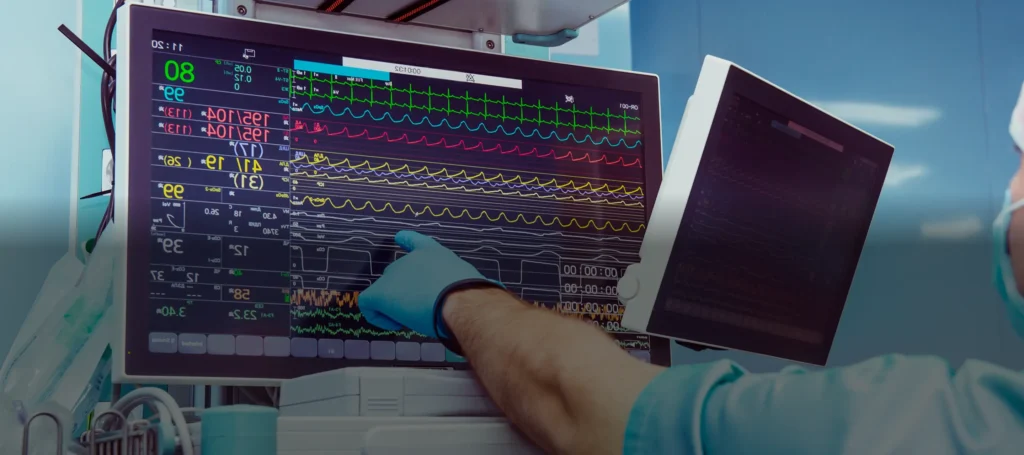
B.Sc. in Critical Care Technology
A four-year, industry-aligned programme that prepares students for high-intensity critical care environments through advanced clinical training and real-world exposure.
Programme overview
The B.Sc. in critical care technology at Mahindra University, offered in collaboration with Apollo Healthcare Academy, is a four-year programme designed to prepare students for modern intensive care environments. It combines academic rigour with hands-on clinical training to build competence in critical and emergency care settings.

Strong foundation in critical care sciences
The curriculum, aligned with NCAHP guidelines, builds a comprehensive understanding of critical care principles, integrating theory with structured clinical exposure.

Simulation-based training and lab experience
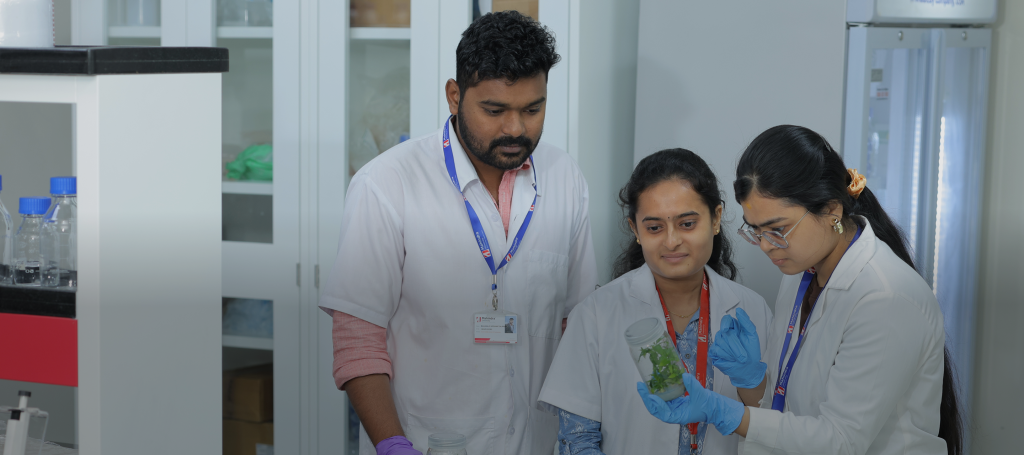
Students learn in advanced laboratories with access to simulation-based environments, enabling practical skill development for real-world critical care scenarios.

Clinical exposure through Apollo network
Learners undergo clinical rotations and internships across Apollo hospitals, gaining hands-on experience in ICUs, CCUs and emergency departments under expert supervision.

Career readiness in intensive care settings
Graduates are prepared for roles across critical care units, supported by placement assistance and access to Apollo’s extensive alumni network within the healthcare ecosystem.
Programme details
Course structure

Year 1 subjects
- Anatomy and physiology
- Basic biochemistry
- Hospital information systems
- Communication skills
- Fundamentals of nursing
- Microbiology and pathology
- Introduction to critical care
- Basic medical procedures
- Medical ethics
- Basic life support
- Clinical psychology
Year 2 subjects
- Advanced cardio-respiratory care
- Ventilator management and technology
- Clinical assessment in critical care
- Trauma management
- Intensive care equipment and technology
- Emergency medicine
- Critical care pharmacology
- Patient monitoring systems
- Infection control and prevention
- Clinical practicum I
Year 3 subjects
- Specialised critical care (cardiac, neurological, paediatric, burn)
- Renal replacement therapy
- Advanced ventilation techniques
- Critical care documentation
- Biomedical waste management
- Advanced life support systems
- Critical care research methodology
- ICU management and quality improvement
- Nutritional support in critical care
- Clinical practicum II
- Internship and project work
Year 4 subjects
- Job training
Career prospect
| Key sectors | Roles | Avg. starting salary (LPA) |
|---|---|---|
| Hospitals | Critical care technologist, ICU technician, ventilator specialist | ₹3.5–5.2 |
| Emergency services | Emergency care technician, trauma care specialist | ₹3.2–4.8 |
| Medical equipment companies | Application specialist, clinical support specialist, product trainer | ₹4–6 |
| Ambulance services | Critical care transport technician, mobile ICU specialist | ₹2.8–4.5 |
Curriculum
| S. no. | Course code | Course title | Credits |
|---|---|---|---|
| 1 | CCT1A | Anatomy for health sciences | 4 |
| 2 | CCT1C | Physiology for health sciences | 4 |
| 3 | CCT1G | Psychology for health sciences | 3 |
| 4 | CCT1E | Biochemistry for health sciences | 4 |
| 5 | CCT1H | Medical terminologies | 2 |
| 6 | CCT1J | English | 2 |
| 7 | CCT1B | Anatomy for health sciences (practical) | 1 |
| 8 | CCT1D | Physiology for health sciences (practical) | 1 |
| Total credits | 21 | ||
| S. no. | Course code | Course title | Credits |
|---|---|---|---|
| 1 | CCT2A | Microbiology for health sciences | 4 |
| 2 | CCT2C | Pathology for health sciences | 4 |
| 3 | CCT2D | Pharmacology for health sciences | 4 |
| 4 | CCT2H | Environmental sciences | 2 |
| 5 | CCT2E | Sociology for health sciences | 3 |
| 6 | CCTE | General elective | 3 |
| 7 | CCT2B | Microbiology (practical) | 1 |
| 8 | CCT2J | Observational posting | 2 |
| 9 | CCT2G | Computer science | 2 |
| Total credits | 25 | ||
| S. no. | Course code | Course title | Credits |
|---|---|---|---|
| 1 | CCT3A | Applied anatomy and physiology related to critical care technology | 4 |
| 2 | CCT3L | Pharmacology related to critical care technology | 4 |
| 3 | CCT3N | Fundamentals of ICU monitoring | 4 |
| 4 | CCT3G | Research methodology and biostatistics for health sciences | 3 |
| 5 | CCTE | General elective | 3 |
| 6 | CCT3B | Pharmacology (practical) | 1 |
| 7 | CCT3M | ICU monitoring (practical) | 1 |
| 8 | CCT3H | Clinical training 1 | 5 |
| Total credits | 25 | ||
| S. no. | Course code | Course title | Credits |
|---|---|---|---|
| 1 | CCT4J | Pathophysiology and management of critical condition | 4 |
| 2 | CCT4L | Advanced ICU monitoring | 4 |
| 3 | CCT4E | Medical electronics for health sciences | 3 |
| 4 | CCTE | General elective | 3 |
| 5 | CCT4M | Pathophysiology (practical) | 1 |
| 6 | CCT4K | Advanced ICU monitoring (practical) | 1 |
| 7 | CCT4H | Clinical training 2 | 5 |
| Total credits | 21 | ||
| S. no. | Course code | Course title | Credits |
|---|---|---|---|
| 1 | CCT5J | Instrumentation and troubleshooting in critical care technology | 4 |
| 2 | CCT5L | Procedure related to critical care technology I | 4 |
| 3 | CCT5N | Quality assurance in respective technology | 3 |
| 4 | CCTE | Generic elective | 3 |
| 5 | CCT5K | Instrumentation (practical) | 1 |
| 6 | CCT5M | Procedure I (practical) | 1 |
| 7 | CCT5H | Clinical training 3 | 5 |
| Total credits | 21 | ||
| S. no. | Course code | Course title | Credits |
|---|---|---|---|
| 1 | CCT6J | Procedure related to critical care technology II | 4 |
| 2 | CCT6L | Procedure related to critical care technology III | 4 |
| 3 | CCT6E | Basic life support and emergency care | 2 |
| 4 | CCT6K | Procedure II (practical) | 1 |
| 5 | CCT6M | Procedure III (practical) | 1 |
| 6 | CCT6G | Advanced cardiac life support | 2 |
| 7 | CCT6H | Clinical training 4 | 7 |
| Total credits | 21 | ||
| S. no. | Course code | Course title | Credits |
|---|---|---|---|
| 1 | CCT7A | Internship | 15 |
| Total credits | 15 | ||
| S. no. | Course code | Course title | Credits |
|---|---|---|---|
| 1 | CCT8A | Internship | 15 |
| 2 | CCT8B | Project | 6 |
| Total credits | 21 | ||
Total Credits: 21+25+25+21+21+21+15+21 = 170
Note: “This is as per current NCAHP guidelines and is under discussion and may be subject to change.”
FAQs
The B.Sc. in Critical Care Technology is a 4-year programme designed to equip students with essential clinical skills for critical care settings.
Yes, eligible students get merit-based scholarships of up to 25% of tuition fees. Students can access partner-bank education loans as well as need-based financial assistance. Special scholarships are also available to students from underrepresented backgrounds and areas.
Students who have completed their 10+2 with Physics, Chemistry and Biology as main subjects and a minimum of 50% marks are eligible. The selection process is based on an entrance test and a personal interview.