










M.Tech in Artificial Intelligence & Data Science

A two-year postgraduate programme focused on AI and data science, enabling graduates to design intelligent systems and extract insight from complex, large-scale data.

M.Tech in artificial intelligence & data science overview 

The programme develops strong foundations in artificial intelligence, data science and high-performance computing, progressing towards advanced techniques used in real-world AI systems. Students experience:

Strong AI and data foundations

Advanced learning in databases, machine learning, mathematics for AI and core artificial intelligence concepts.

Hands-on work with real data

Practical coursework in big data analytics, computer vision, natural language processing and deep learning.

Domain-focused specialisation

Electives that connect AI with application areas such as bioinformatics, communications and smart industry.

Research and industry exposure

An industry internship, project-based learning and a two-stage dissertation on real-world AI problems.

Programme details

Objective

The M.Tech in Data Science and Artificial Intelligence programme is designed to train graduates from computer science and engineering, electronics and communication engineering, electrical and electronics engineering, or Artificial Intelligence backgrounds to develop advanced expertise in artificial intelligence and data science.

The programme combines theoretical foundations with practical applications to help students build strong capabilities in emerging technologies and analytical methods.

During the first two semesters, students study core subjects such as databases, big data analytics and high-performance computing (HPC). The curriculum also introduces key areas including natural language processing (NLP) and digital image processing, followed by advanced topics such as computational sequence modelling and deep learning. These areas form the foundation for developing professional competence in artificial intelligence.

Students are also introduced to reinforcement learning, with applications in autonomous systems, as well as financial risk management, where data analytics plays an increasingly significant role.

The programme offers the option to specialise in one of the following streams:

  • Bioinformatics
  • Communications
  • Smart industry

Each stream includes a foundational course followed by an advanced course.

Graduates of the programme are expected to develop both the motivation and expertise to pursue careers in the rapidly evolving fields of artificial intelligence and data science, or continue into doctoral research programmes in related areas.

  • Total credits: 63
  • Prior degree required: B.Tech in CSE, AI, ECE or EEE

Note: The extension of the work visa period for students pursuing a master’s degree in France has been increased from 2 years to 5 years.

Academic structure

Our academic structure is designed to establish robust foundations, followed by increasing specialization in later years.

  • Credit structure: Total of 62 credits
  • Duration: 2 years / 4 semesters
  • Coursework is covered in Semesters 1 and 2, with project, seminars, internship and thesis across Semesters 3 and 4.
CourseL-T-PCredits
Advanced Engineering Mathematics3-1-04
Foundations of Artificial Intelligence3-0-24
Probability & Random Processes3-1-04
Advanced Data Structures & Algorithms3-0-24
AI & Data Science Lab0-0-42
Research Methodology2-0-02
CourseL-T-PCredits
Machine Learning3-1-04
Deep Learning3-0-24
Big Data Analytics3-0-24
Statistical Learning & Data Mining3-0-03
Advanced AI Lab0-0-42
Program Elective I3-0-03
CourseL-T-PCredits
Program Elective II3-0-03
Program Elective III3-0-03
Seminar0-0-21
Dissertation – Phase I0-0-126
CourseL-T-PCredits
Dissertation – Phase II0-0-2412

FAQs

This programme focuses specifically on AI and Data Science, with all core courses aligned to machine learning, data systems and intelligent applications.

Through applied coursework, modern tools, an industry internship and a final-year dissertation.

Yes. The curriculum begins with foundational courses before progressing to advanced topics and specialisations.

Yes. Advanced electives and a substantial dissertation prepare students for doctoral study and research roles.

Graduates pursue roles such as data scientist, machine learning engineer, AI researcher and related positions across technology and research organisations.

Start your journey with us

M.Tech in Advanced Wireless Communication

A two-year postgraduate programme focused on advanced wireless systems, enabling engineers to design, simulate and optimise 4G, 5G and emerging 6G communication technologies.

M.Tech in advanced wireless communication overview 

The programme prepares students to work across modern and next-generation wireless communication systems, covering physical and MAC layers, networks and optimisation. It combines strong theoretical foundations with hands-on system design, simulation and experimentation aligned with international wireless standards. Students experience:

Foundation in next-generation wireless

4G, 5G and emerging 6G concepts through digital and wireless communication, RF and microwave engineering.

Hands-on communication labs

Industry-relevant labs using USRPs, MATLAB simulators, and AI/ML platforms for link- and system-level implementation.

AI-driven and secure networks

Courses in AI/ML for communications and wireless security focused on intelligent, resilient network design.

Advanced specialisation and research

Electives in MIMO, ISAC, vehicular networks, IoT, antennas and coding, culminating in a research-led thesis.

Programme details

Academic structure

Our academic structure is designed to establish robust foundations, followed by increasing specialization in later years.

  • Credit structure: Total of 62 credits
  • Duration: 2 years / 4 semesters
  • Coursework is covered in semesters 1 and 2, with project, seminars, internship and thesis across Semesters 3 and 4.
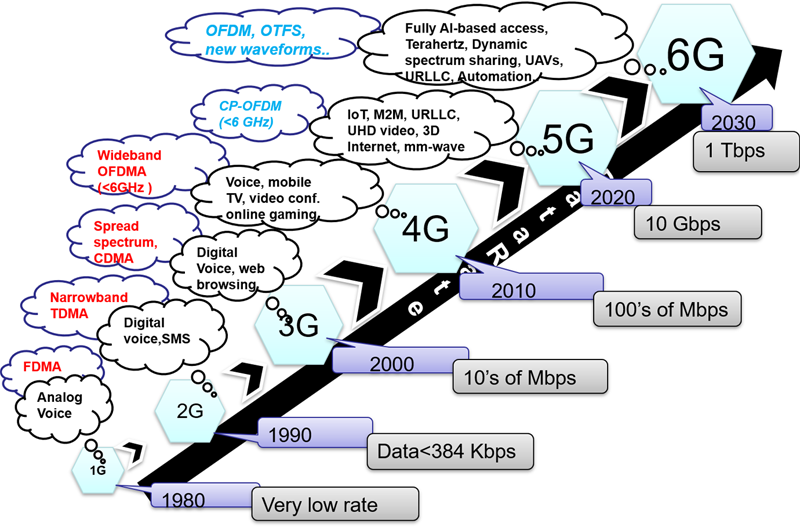
Figure 1. Evolution of wireless communication technologies
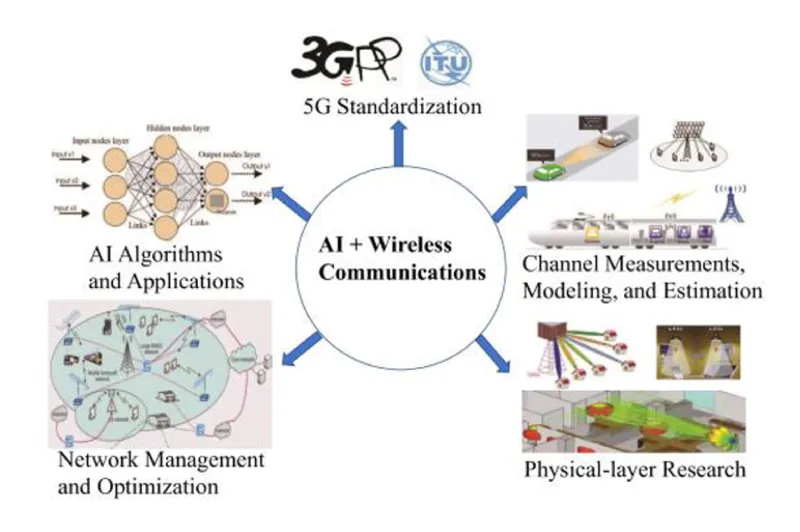
Figure 2. Research aspects that bring AI technologies into beyond 5G wireless networks

Programme outcomes

Graduates of the programme will be able to:

  • Understand the principles of next-generation telecommunications systems based on evolving user requirements.
  • Design, model and implement energy-efficient wireless communication systems and modern telecommunication standards.
  • Integrate artificial intelligence and machine learning techniques with wireless communication systems.
  • Apply advanced communication technologies to develop multi-protocol network architectures.
  • Design and analyse communication links and systems for next-generation networks.
CourseL-T-PCredits
Advanced Engineering Mathematics3-1-04
Advanced Digital Communication3-1-04
Probability & Random Processes3-1-04
RF & Microwave Engineering3-0-24
Wireless Communication Lab0-0-42
Research Methodology2-0-02
CourseL-T-PCredits
MIMO & Massive MIMO Systems3-1-04
5G & Beyond Wireless Systems3-1-04
Machine Learning for Wireless Communication3-0-24
Advanced Antennas & Propagation3-0-03
Advanced Wireless Lab0-0-42
Program Elective I3-0-03
CourseL-T-PCredits
Program Elective II3-0-03
Program Elective III3-0-03
Seminar0-0-21
Dissertation – Phase I0-0-126
CourseL-T-PCredits
Dissertation – Phase II0-0-2412

Eligibility

  • B.E./B.Tech. in Electrical Engineering, Electrical and Electronics Engineering, Electronics and Communication Engineering, Telecommunication Engineering, Communication and Information Systems, Computer Science and Engineering, Instrumentation Engineering, Electronics and Biomedical Engineering, or Electronics and Computer Engineering.
  • A valid GATE score in Electrical Engineering, Electronics and Communication Engineering or Instrumentation Engineering is mandatory.
  • Candidates appearing for their final semester examination in the current year are also eligible to apply, provided they submit a valid GATE score.

Admission process

  • GATE-qualified candidates: Applicants with a valid GATE score and a percentile of 70 or above will be invited for an interview as part of the admission process.
  • Non-GATE candidates: Applicants without a valid GATE score, or with a percentile below 70, must appear for a written test conducted by the École Centrale School of Engineering, Mahindra University, followed by an interview for shortlisted candidates.

FAQs

This programme focuses specifically on advanced wireless systems aligned with 4G, 5G and emerging 6G standards, rather than broad analogue or mixed communication themes.

Students work with USRPs, MATLAB wireless toolchains and AI-based communication labs to design, simulate and validate link-level and system-level models.

It is suited for graduates in Electrical, Electronics, Communication, Telecommunication, Computer Science, Instrumentation or related disciplines with an interest in wireless systems and networks.

Yes. The curriculum and tools are aligned with industry expectations of major telecom vendors, chipset companies and network operators.

Yes. The strong theoretical foundation, advanced electives and substantial thesis prepare students well for doctoral research and advanced research roles.

Start your journey with us

Masters of Technology (M.Tech)

Mahindra University offers two-year M.Tech programmes offered in collaboration with École Centrale, bringing global academic perspectives into the curriculum.

M.Tech at Mahindra University overview 

Our M.Tech programmes build advanced capability through rigorous coursework, research-oriented learning and applied projects within an interdisciplinary academic environment. Students experience:

Real-world approach

Postgraduate learning focuses on integrating theory with research and real-world application.

Research-led learning

Students engage with advanced concepts through faculty-guided research and projects.

Interdisciplinary exposure

Programmes encourage learning across engineering, science and data-driven domains.

Application focus

Projects and laboratory work translate theory into practice.

Specialisations

Programmes include areas such as biomedical data science, biotechnology, computational technologies and allied engineering disciplines.

M.Tech in VLSI Design & Embedded Systems

M.Tech in Transportation Engineering

M.Tech in Systems Engineering

M.Tech in Smart Grid & Energy Storage Technologies

M.Tech in Robotics

M.Tech in Computer Science and Engineering

M.Tech in Computer Aided Structural Engineering

M.Tech in Computational Mechanics

M.Tech in Biomedical Data Sciences

M.Tech in Autonomous Electric Vehicles

M.Tech in Artificial Intelligence & Data Science

M.Tech in Advanced Wireless Communication

International programme highlights

  • A truly international programme with a strong focus on natural, creative and engineering sciences.
  • A culturally diverse learning environment for students, faculty and staff.
  • International exchange opportunities with mandatory internships.
  • A research-driven academic experience with strong industry linkages.
  • An interdisciplinary engineering education that integrates humanities, social sciences, management and philosophy.

Vision

  • Mahindra University’s vision is to develop multi-skilled students equipped to address complex global challenges.
  • The University brings together an internationally trained faculty with strong academic and industry backgrounds, global exposure and a research-driven approach. The curriculum is regularly reviewed and updated to align with evolving global business and industry requirements.
  • Mahindra University aims to:
  • Train multi-skilled leaders capable of reflection, innovation and responsible decision-making.
  • Promote interdisciplinary academic excellence by integrating science and technology with the liberal arts, including humanities, ethics, philosophy and design thinking.
  • Balance academic learning with practical experience through entrepreneurial and problem-solving projects that address societal challenges.

FAQs

All M.Tech programmes are offered over two academic years (four semesters).

Yes. Select programmes are delivered in collaboration with international partner institutions, including École Centrale.

The programme includes advanced coursework, laboratories, electives and a final-year project or dissertation.

Eligibility criteria and admission details are available on individual M.Tech programme pages.

Yes. Scholarships and financial aid options are available for eligible students.

Start your journey with us

M.Tech in Smart Grid & Energy Storage Technologies

A two-year postgraduate programme focused on smart grids, renewable integration and advanced energy storage for modern power systems.

Programme overview 

The programme prepares engineers to work with intelligent power networks that integrate renewables, storage and digital control for reliable and sustainable energy delivery. Students experience:

Smart grid fundamentals

Learning modern grid architectures, monitoring, control and communication for intelligent power systems.

Renewable integration and storage

Understanding how solar, wind and distributed generation are integrated, and how energy storage improves reliability and flexibility.

Power system analysis and resilience

Working with realistic grid data and tools to study power flow, stability, protection and network performance.

Research and industry exposure

Project-based learning, internships and interdisciplinary work linked to evolving energy and utility practices.

Programme details

About the programme

The M.Tech in Power Electronics and Renewable Energy Systems is designed for students who wish to build careers in the broad domain of power electronics, electric drives and renewable energy technologies. These technologies are widely used across industrial, commercial and automotive sectors. The programme also emphasises developments in the renewable energy sector, particularly in the context of future smart grids and sustainable energy systems.

The programme offers flexibility for students to specialise in specific areas through elective courses and research projects. A design project is incorporated in the first two semesters to strengthen practical and analytical skills.

The programme spans four semesters and requires more than 60 credits for completion. Approximately two-thirds of the credits are devoted to coursework, while the remaining credits are allocated to research and project work. Students undertake original research and submit a master’s thesis based on their findings.

Courses

The curriculum covers three major domains:

Power electronics

Courses focus on the design, implementation and control of power converters, including emerging technologies based on wide-bandgap semiconductor devices.

Electric drives

Courses examine electric drive systems, including their working principles, modelling, design and high-performance control. Topics include developments such as sensorless speed and position control, AI-assisted drive systems and advanced motor-drive topologies.

Renewable energy systems

Courses explore renewable energy resources, power conversion and grid integration. Students study microgrids in both standalone and grid-connected modes, including their design and control strategies.

Elective courses enable students to explore emerging areas such as the application of artificial intelligence and machine learning in power and energy systems.

Industry collaboration

Curriculum development

The programme curriculum is developed in consultation with industry partners to ensure alignment with evolving industry needs. Industry professionals may contribute to the delivery of selected core and elective courses.

Live projects and internships

Students may work on live industry projects during coursework and thesis work, strengthening real-world problem-solving skills. The final year may also include internships with companies in power electronics, electric vehicles, automation and renewable energy sectors.

Eligibility

  • Candidates must hold a full-time bachelor’s degree from a recognised university or institute with a minimum aggregate of 60% marks or equivalent grade.
  • Candidates appearing for their final semester examination in the current year are also eligible to apply.

Admission process

Route 1 – GATE-qualified candidates
Applicants with a valid GATE score and a percentile above 90% will be invited for an interview.

Route 2 – Non-GATE candidates
Applicants without a valid GATE score, or with a percentile below 90%, must appear for a written examination, followed by an interview for shortlisted candidates.

FAQs

It focuses on smart grids and energy storage, which are central to renewable integration and modern power systems.

Students work on issues such as renewable variability, storage placement, grid stability and system resilience.

Together they enable cleaner, more flexible and reliable electricity networks.

A fully residential, research-oriented setting with strong interdisciplinary and industry engagement.

Yes. The thesis and advanced coursework provide a strong foundation for doctoral study.

Start your journey with us

M.Tech in Robotics

A two-year interdisciplinary postgraduate programme focused on the design, control and integration of intelligent robotic systems.

M.Tech in robotics overview 

The programme integrates mechanical design, electronics, control and computer science to prepare graduates for advanced roles in robotics and automation. Students experience:

Core robotics foundations

Learning dynamics, embedded systems, mathematics for robotics and robot control theory from a multidisciplinary perspective.

Hands-on robotics laboratories

Practical work with robotic hardware, embedded systems and automation through lab-intensive courses.

Robotic intelligence and autonomy

Exposure to robot modelling, AI for robotics and Robot Operating System, linking perception, planning and control.

Research and industry readiness

Advanced electives and a two-phase master’s thesis addressing real-world robotics challenges.

Programme details

Objective

This interdisciplinary programme is offered by the Department of Mechanical and Aerospace Engineering at the École Centrale School of Engineering, Mahindra University, in collaboration with the Departments of Electronics and Computer Science.

The two-year programme provides advanced engineering knowledge through courses in kinematics, dynamics, electronics, computer programming, mathematics and specialised electives. Students also gain exposure to emerging areas such as intelligent machines, healthcare technologies and automation systems.

The programme requires a minimum of 60 credits across four semesters. Approximately two-thirds of the credits are devoted to coursework, while the remaining credits are allocated to a master’s thesis based on original research. Most courses include practical components to ensure hands-on learning and application.

Expected programme outcomes

Graduates of the programme are expected to:

  • Design and implement analogue and digital electronic circuits within robotics and automation systems.
  • Understand fundamental and advanced engineering concepts with a strong theoretical foundation in robotics.
  • Apply principles of mechanical design, electronics design and control systems.
  • Use engineering tools and methodologies to design and develop mechanical components and robotic systems.
  • Develop robotic products and automation systems using integrated hardware and software approaches.

The curriculum includes courses across major areas such as:

  • Robotics and automation
  • Electronics and embedded systems
  • Programming and software–hardware interfaces
  • ROS (Robot Operating System)
  • Advanced robotics and automation technologies

In addition, students may choose specialised elective courses covering emerging topics in robotics and intelligent systems.

CourseL-T-PCredits
Multi‐body Dynamics2-0-24
Embedded Systems3-0-24
Plant Automation and Cyber-Physical Systems3-0-03
Mathematics for Robotics3-0-03
Robot Control Theory3-0-03
Robotics Lab-10-0-21
Robotics and Hardware Interfacing3-0-21
CourseL-T-PCredits
Advanced Robot Modelling and Analysis3-0-24
AI for Robotics3-0-03
Elective I3-0-03
Elective II3-0-03
Elective III3-0-03
Introduction to Robot Operating System (ROS)1-0-22
Robotics Lab-20-0-21
CourseL-T-PCredits
Master Thesis Phase-I0-0-2412
CourseL-T-PCredits
Master Thesis Phase-II0-0-2412

Mobile robots

  • Introduction to mobile robots (MAE)
  • Aerial robotics / UAVs (MAE)
  • Bio-inspired robots (MAE)

Medical robots

  • Medical robots (MAE)
  • Soft robotics (MAE)
  • Human–computer interaction (MAE)

Industrial robots

  • AI in industrial IoT (CSE)
  • Advanced grasping and actuation (MAE)
  • Machine vision and image processing (CSE)

Autonomous systems

  • Machine learning for automobiles (ECE)
  • Digital image processing and computer vision for self-driving cars (ECE)
  • State estimation and localisation of self-driving cars (ECE)
  • Motion planning for self-driving cars (ECE)
  • Safety and standards in autonomous electric vehicles (ECE)

Career roles

Graduates of the programme can pursue roles such as:

  • Project manager
  • Robotics engineer
  • Automation engineer
  • Industrial robotics manager
  • Automation and logistics manager

Robotics and hardware systems

  • Industrial robots, mobile robots, legged robots and drones
  • Haptics and exoskeleton (exo-suit) systems
  • Embedded systems and PLC platforms
  • Pneumatic and electro-pneumatic control systems
  • Measurement and instrumentation laboratory
  • Robotics and hardware interface laboratory

Software tools

  • ABB RobotStudio
  • ROS (Robot Operating System)
  • OpenCV
  • MATLAB
  • Simulink

Admission process

Route 1 – GATE-qualified candidates
Applicants with a valid GATE score and a percentile above 90% will be shortlisted for an interview.

Route 2 – Non-GATE candidates
Applicants without a valid GATE score, or with a percentile below 90%, must appear for a written examination, followed by an interview for shortlisted candidates.

FAQs

It integrates mechanical design, electronics, control and software within a single robotics-focused curriculum.

Students work with robotic hardware, embedded systems, automation tools and robotics software platforms.

Mechanical, mechatronics and electronics engineering graduates are eligible to apply.

The first year focuses on core robotics coursework, while the second year is dedicated to thesis and project work.

Yes. The strong thesis component and advanced coursework provide a solid foundation for doctoral study.

Start your journey with us

M.Tech in Computer Science and Engineering

A two-year postgraduate programme focused on advanced computing, algorithms and system design.

M.Tech in computer science and engineering overview 

The programme prepares engineers to design, analyse and build advanced computing systems through strong foundations in computer science and applied problem solving. Students experience:

Core computer science foundations

Learning in algorithms, data structures, operating systems and computer networks.

Advanced computing domains

Exposure to areas such as machine learning, data systems, information security and distributed computing.

Hands-on systems and programming

Practical coursework and projects focused on building and evaluating real software and system-level solutions.

Research and industry exposure

Project-based learning, internships and thesis work aligned with contemporary computing challenges.

Programme details

Method of intake

  • Applicants must first qualify through GATE. Candidates are then shortlisted for an interview-based selection process. Applicants from non-CSE backgrounds may be assessed on core computer science subjects such as computer architecture, data structures and operating systems.
  • The first semester focuses on strengthening the foundational pillars of hardware and software systems, including computer architecture, high-performance computing (HPC), algorithms and data structures.
  • Students in the M.Tech programme may choose to specialise in one of four streams. The curriculum enables engineering graduates to build expertise in emerging areas such as machine learning, data science and related applications.
  • In Semester 2, students gain both theoretical and practical understanding of areas such as network softwarisation, advanced databases and modern operating systems. Each stream builds on foundational courses and progresses to specialised electives.
  • Students are required to undertake a two-month industry internship or contribute to an industry-sponsored project under faculty supervision.
  • In Semester 3, students identify a research problem and begin work on their research project and dissertation, alongside elective coursework.
  • The final semester is dedicated entirely to the research project and dissertation, which may lead to research publications.

Programme objectives

  • Enable B.Tech graduates from non-CSE branches to acquire essential computer science knowledge and develop deeper theoretical and practical expertise in specialised areas.
  • Provide B.Tech CSE and AI graduates an opportunity to pursue advanced study and gain greater depth in emerging computer science domains.
  • Develop technology specialists capable of adapting quickly to advances in computer science and contributing to technological innovation.
  • Strengthen collaboration between the university and industry experts engaged in advanced computer science research and development.

Programme outcomes

  • Graduates will develop the motivation and capability to apply their knowledge and skills to real-world technological challenges and contribute to innovation.
  • Some graduates may pursue research careers by advancing their expertise through doctoral studies in computer science or related fields.
  • During the programme, students are expected to make intellectual contributions through research publications, patents, or the development of software, hardware or theoretical tools.
S. No.Course nameCreditsRemarks
1Mathematics for computer science3Foundational mathematics for CS
2High-performance computing (HPC)3Current approaches to HPC
3Machine learning3Concepts in AI and deep learning
4Algorithm design techniques3Algorithmic approaches and data structures
5Advanced databases3Advances in DBMS and novel database systems
S. No.Course nameCreditsRemarks
1Network softwarisation: principles and foundations3Concepts such as software-defined networking (SDN)
2Big data analytics3Analytical challenges with large-scale data
3Modern operating systems3Concepts including embedded and real-time OS
4Elective 13
5Elective 23
S. No.Course nameCreditsRemarks
1Industry internship4Industry exposure and practical training
S. No.Course nameCreditsRemarks
1Elective 33
2Elective 43
3Dissertation project6Problem identification and initial research
S. No.Course nameCreditsRemarks
1Dissertation project16Final project and demonstration, with potential publication

Abbreviations:
HPC – High-performance computing
SDN – Software-defined networking
DBMS – Database management systems

Computer vision
Electives: 1, 2, 15

Networking and cyber security
Electives: 8, 16, 18

Data science
Electives: 3, 4, 6, 12

Advances in computing
Electives: 11, 14, 17

  • Digital image processing and analysis
  • Computer vision
  • Data mining and data warehousing
  • Bioinformatics
  • Natural language processing
  • Data analytics and visualisation
  • Classical and evolutionary optimisation: applications
  • Cyber-physical systems
  • Performance evaluation of computing-related systems
  • Robotics and autonomous systems
  • Quantum computing
  • Information retrieval and search engines
  • Software engineering
  • Human–computer interaction
  • Virtual and augmented reality
  • Internet of Things
  • Cloud and edge computing
  • Network and cyber security

FAQs

It combines core computer science theory with advanced systems and applied computing rather than focusing only on application development.

Students work on programming-intensive coursework, system-level projects and applied research problems.

Yes. The curriculum begins with core foundations before moving into advanced domains.

Graduates move into roles such as software engineer, systems engineer, data engineer, security specialist and research engineer.

Yes. The final-year thesis and research focus provide a strong base for doctoral study.

Start your journey with us

M.Tech in Computer Aided Structural Engineering

A two-year postgraduate programme focused on advanced modelling, simulation and analysis of complex civil structures.

M.Tech in computer aided structural engineering overview 

To integrate the strengths of computer science with structural engineering to deliver robust, accurate, efficient and sustainable solutions for current and future infrastructure challenges.

Advanced structural modelling

Learning non-linear, static and dynamic analysis through computational and numerical methods.

Hands-on laboratory exposure

Practical work in structural engineering, structural dynamics and SHM laboratories to study real structural behaviour.

Large-scale simulation and computing

Exposure to high-performance computing for finite element simulations and advanced structural analysis.

Industry and research immersion

Capstone projects and internships addressing real structural engineering and infrastructure challenges.

Programme details

Why choose the Computer-Aided Structural Engineering programme at Mahindra University

The M.Tech in Computer-Aided Structural Engineering (CASE) programme provides in-depth training in mathematical modelling and computational methods for analysing complex structural systems. The curriculum covers areas such as non-linear analysis, static and dynamic structural analysis, and integrates analytical thinking with programming skills.

This interdisciplinary approach enables students to solve complex design and analysis problems involving various materials and structural systems.

Link : MU Test Syllabus

Convergence of AI and structural engineering

Emerging technologies are transforming the construction and infrastructure sectors. The programme introduces students to advanced applications such as:

  • AI-assisted construction, 3D-printed housing and prefabricated concrete structures.
  • Monitoring structural issues including moisture intrusion, corrosion, settlement and structural deficiencies.
  • Structural health monitoring (SHM) using image analysis to detect cracks and structural damage.
  • Building Information Modelling (BIM) for integrating data across the lifecycle of infrastructure—from design and construction to maintenance and demolition.
  • Use of AI, IoT and data analytics to optimise construction processes, reduce delays and improve infrastructure performance.

Core strengths

  • Faculty: Doctoral faculty trained at leading institutions across the world.
  • Research ecosystem: Research centres such as the Centre for Sustainable Infrastructure and Systems (CSIS) and the Centre for Artificial Intelligence.
  • Experimental facilities
    • Structural engineering laboratory
    • Structural health assessment and monitoring laboratory
    • Structural dynamics laboratory
  • Computing infrastructure: High-performance computing facilities, wireless innovations laboratories and a 5G design studio.
  • Collaborations: Active collaborations with industry partners and national and international universities.

Programme-specific outcomes

  • Develop analytical, computational and programming skills required to analyse and design sustainable solutions for infrastructure challenges in both new and ageing civil structures.
  • Equip students with the expertise needed to pursue careers as design consultants, entrepreneurs or researchers in structural engineering and related fields.
  • Provide exposure to advanced technologies such as AI, BIM, IoT and 3D printing for monitoring, repair, retrofitting and sustainable infrastructure development.
  • Develop analytical, computational and programming skills required to analyse and design sustainable solutions for infrastructure challenges in both new and ageing civil structures.
  • Equip students with the expertise needed to pursue careers as design consultants, entrepreneurs or researchers in structural engineering and related fields.
  • Provide exposure to advanced technologies such as AI, BIM, IoT and 3D printing for monitoring, repair, retrofitting and sustainable infrastructure development.

Programme educational objectives (PEOs)

  • Develop proficiency in fundamental and advanced principles of structural engineering to analyse and solve civil infrastructure problems for sustainable environments.
  • Expose students to emerging technologies and innovations that support research-driven applications in structural engineering.
  • Prepare graduates for professional leadership, teamwork, lifelong learning and successful careers in the structural engineering domain.

Eligibility

  1. Candidates must have completed a full-time bachelor’s degree from a recognised university or institute with a minimum aggregate of 60% marks or equivalent grade.
  2. B.E./B.Tech. in Civil Engineering is mandatory, along with a valid GATE score in Civil Engineering.
  3. Candidates appearing for their final semester examination are also eligible to apply.

Admission process

  • GATE-qualified candidates: Applicants with a valid GATE score and a percentile of 80 or above will be invited for an interview as part of the admission process.
  • Non-GATE candidates: Applicants without a valid GATE score, or with a percentile below 80, must appear for a written test conducted by ECSE–Mahindra University, followed by an interview for shortlisted candidates.

FAQs

It focuses on simulation-based analysis and design methods used in consulting, infrastructure and research roles.

Students work extensively in structural, dynamics and monitoring laboratories alongside computational simulation tools.

Yes. Programming is integrated into coursework, with structured support to build confidence alongside analysis skills.

Civil engineering graduates with a minimum of 60% aggregate and a valid GATE score.

Yes. The final year emphasises thesis and project work, providing a strong base for doctoral studies.

Start your journey with us

M.Tech in Computational Mechanics

A two-year postgraduate programme focused on numerical methods, simulation and programming for advanced engineering analysis.

M.Tech in computational mechanics overview 

The programme prepares engineers to model and solve complex solid, fluid and dynamic problems using modern computational techniques. Students experience:

Core computational methods

Learning numerical methods, Python programming, finite element methods and computational fluid dynamics.

Solids, fluids and dynamics

Courses covering applied solid mechanics, fluid mechanics, vibrations and computational dynamics.

Multiphysics and advanced simulation

Exposure to coupled problems, data analysis and advanced applications such as non-linear FEM and turbulent flows.

Industry and research immersion

Extended project, internship or thesis work focused on real computational mechanics problems.

Programme details

About the programme

The two-year M.Tech in Computational Mechanics is offered by the Department of Mechanical and Aerospace Engineering, École Centrale School of Engineering, Mahindra University.

The programme focuses on three key areas:

  • Programming and computational modelling
  • Widely used computational methods such as FEM and CFD
  • Coupled problems and multiphysics analysis

A distinctive feature of the programme is the strong emphasis on practical training, with extended laboratory and project work designed to address real-world industry problems. The curriculum has been developed with input from industry experts across multiple sectors.

Students also gain exposure to advanced topics through core and open electives, including:

  • Turbulent flows
  • Non-linear finite element methods
  • Engineering optimisation

Approximately one-third of the total 62 programme credits are dedicated to extended industry internships or original research projects under faculty supervision. The second year provides an opportunity for a full-time industry internship, enabling students to gain hands-on experience and understand professional expectations in solving industry-relevant challenges.

Programme outcomes

Graduates of the programme will be able to:

  • Understand the product development lifecycle and adapt to modern engineering development processes.
  • Develop computational models by capturing the relevant physical phenomena of engineering problems.
  • Validate designs using appropriate experimental methods and data analysis techniques.
  • Develop additional computational models or programming frameworks for specialised engineering applications.

The curriculum balances coursework across solid mechanics, fluid mechanics, dynamics, programming and data analysis.

Students complete mandatory core courses in:

  • Programming fundamentals
  • Computational methods for solids, fluids and dynamics

Elective courses allow students to deepen expertise in selected areas, while emerging topics such as multiphysics modelling and data-driven analysis are integrated into the curriculum.

The programme structure enables students to undertake an extended internship or research project during the second year, strengthening both academic and industry exposure.

CourseL-T-PCredits
Numerical Methods3-0-03
Programming with Python0-0-31.5
Finite Element Methods and Lab3-0-24
Computational Fluid Dynamics and Programming3-0-24
Applied Solid Mechanics*3-0-01.5
Applied Fluid Mechanics*3-0-01.5
Introduction to Systems Engineering*3-0-01.5
CourseL-T-PCredits
Multiphysics2-0-12.5
Computational Dynamics and Vibrations3-0-24
Programming FEM0-0-21
CFD Lab0-0-21
Communication Skills and Technical Writing2-0-02
Experimental Methods and Statistics*3-0-01.5
Elective I3-0-03
CourseL-T-PCredits
Elective II*6-0-03
Elective III*6-0-03
Thesis / Internship / Project0-0-287
CourseL-T-PCredits
Thesis / Internship0-0-3015
CourseL-T-PCredits
Turbulent Flows3-0-03
Compressible Flows3-0-03
Reacting Flows3-0-03
Turbo Machinery3-0-03
Special Topics in Fluid Mechanics I3-0-03
Special Topics in Fluid Mechanics II3-0-03
Nonlinear FEM3-0-03
Materials Modelling3-0-03
Fracture and Fatigue3-0-03
Composite Materials3-0-03
Design Optimization3-0-03
Machine Learning3-0-03

Eligibility

  • Candidates must hold a full-time bachelor’s degree from a recognised university or institute with a minimum aggregate of 60% marks or equivalent grade.
  • B.E./B.Tech. in Mechanical, Aerospace, Civil or Chemical Engineering** with a valid GATE score is required.
  • Candidates appearing for their final semester examination are also eligible to apply.

Note: Candidates from Civil or Chemical Engineering backgrounds may be required to complete a bridge course before the start of the M.Tech programme.

Admission process

  • GATE-qualified candidates: Applicants with a valid GATE score and a percentile of 80 or above will be invited for an interview as part of the admission process.
  • Non-GATE candidates: Applicants without a valid GATE score, or with a percentile below 80, must appear for a written test conducted by ECSE–Mahindra University, followed by an interview for shortlisted candidates.

Note: Deserving candidates may receive a stipend in accordance with university policy.

Career opportunities

Graduates of the programme can pursue roles such as design engineer, mechanical engineer, analysis lead or research engineer across industries including:

  • Defence and aerospace
  • Automotive and electric vehicles
  • Materials processing and manufacturing
  • Energy and renewable technologies
  • Engineering services and consulting.

FAQs

It focuses on FEM, CFD and multi-physics methods used in design and analysis roles across industries.

Students work extensively with simulation tools through lab-linked courses and applied projects.

Yes. The curriculum begins with numerical methods and python programming before advancing to complex simulations.

Mechanical, aerospace, civil and chemical engineering graduates are eligible.

Graduates move into design, analysis and research roles in aerospace, automotive, energy, manufacturing and consulting.

Start your journey with us

M.Tech in Biomedical Data Sciences

A two-year postgraduate programme at the intersection of life sciences and data science.

M.Tech in biomedical data sciences overview 

The programme integrates biological sciences with data science to prepare graduates to analyse complex biomedical data for research and healthcare applications. Students experience:

Biomedical data foundations

Learning in statistics, computational biology, programming and data management for biomedical datasets.

Machine learning in healthcare

Application of machine learning to clinical trials, biomedical imaging and healthcare decision-making.

Hands-on work with real data

Workshops using genomics, imaging and digital health data, from cleaning to interpretation.

Interdisciplinary research exposure

Systems biology, network modelling and research projects focused on real biomedical problems.

Programme details

About

The M.Tech in Biomedical Data Science provides an interdisciplinary curriculum designed to train students to analyse and interpret large, complex biomedical datasets from multiple sources. The programme equips students with the skills required to solve challenging problems in healthcare and life sciences through advanced data analysis and computational approaches.

The Centre for Life Sciences at Mahindra University is developing a collaborative research and teaching environment where students and faculty work together to create innovative technologies and analytical methods. These efforts aim to improve disease diagnosis and treatment while reducing healthcare costs through data-driven insights.

Why M.Tech in Biomedical Data Science?

The rapid growth of biomedical data has created a strong demand for professionals capable of analysing and interpreting this information. As noted by experts in the field, the increasing availability of biomedical datasets requires highly skilled data scientists who can translate data into meaningful improvements in healthcare.

Over the past decade, biomedical data has expanded significantly due to advancements in:

  • Large-scale genomic sequencing
  • Medical imaging technologies
  • Mobile health (mHealth) data
  • Clinical and electronic health records

Simultaneously, advances in computing power and storage have made it possible to analyse this data using advanced statistical techniques, machine learning models and biological simulations. These developments have led to the emergence of biomedical data science as a critical field that integrates biology, medicine, statistics and computing.

While leading universities globally already offer specialised programmes in biomedical data science, such programmes are still rare in India. This programme aims to address that gap by training the next generation of professionals capable of advancing biomedical research and healthcare innovation.

Through this programme, the Centre for Life Sciences seeks to develop expertise in biomedical data science and support research across areas ranging from basic biological research to clinical investigation.

CourseL-T-PCredits
Computational Biology3-0-03
Statistics for Biomedical Data Science3-0-24
Python Programming2-0-23
Linux Workshop0-0-21
Data Management and Engineering3-0-03
Workshop in Data Visualization0-0-21
CourseL-T-PCredits
Machine Learning for Biomedical Data Science3-0-03
Clinical Trials: Design & Analysis3-0-03
Algorithms in Biomedical Data Science3-0-03
Biomedical Imaging3-0-03
Workshop in Genomics Data Analysis0-0-21
Elective I3-0-03
CourseL-T-PCredits
Digital Health Informatics3-0-03
Systems Biology & Network Modeling2-0-23
Research Project – I0-0-126
Elective II3-0-03
CourseL-T-PCredits
Research Project – II0-0-3216

Eligibility

Applicants may hold any of the following degrees:

  • B.E. / B.Tech, B.Sc. (Engineering), B.Sc. (four-year programme), M.Sc., M.C.A., MBBS, BDS, B.Pharm., B.V.Sc.

Minimum academic requirement

Applicants must have:

  • Minimum 60% aggregate marks, or
  • First-class qualification as defined by the awarding university, or
  • CGPA / CPI of at least 6.0 on a 10-point scale, or an equivalent grade under other grading systems.

MU test syllabus

Potential employers

Graduates of the programme may find opportunities across research organisations, healthcare companies, pharmaceutical firms, consulting companies and technology service providers.

Core research and pharmaceutical companies

  • Eli Lilly
  • AstraZeneca
  • Takeda
  • Pfizer
  • Merck
  • Johnson & Johnson
  • Novartis
  • Corteva Agrisciences
  • Sanofi
  • Bristol Myers Squibb
  • GSK
  • Novo Nordisk
  • Abbott
  • Siemens Healthineers
  • Boehringer Ingelheim

Research services and analytics companies

  • Clarivate
  • Elucidata
  • Nimble Clinical Research
  • IQVIA
  • Evalueserve
  • LabCorp
  • Quantium
  • WNS
  • Cardinal Health
  • Syneos Health
  • US Pharmacopeia
  • Axtria
  • Ingenious Insights
  • Caidya

IT and technology services companies

  • Tech Mahindra
  • Wipro
  • TCS
  • Infosys
  • Cognizant
  • Persistent
  • Accenture
  • HCLTech

Note: The list is indicative and not exhaustive.

FAQs

All core courses and projects are anchored in biomedical and healthcare data rather than generic applications.

Yes. The curriculum is designed to support both biology-focused and engineering-focused learners.

Students work with genomics, imaging, clinical trial and digital health datasets.

Graduates pursue roles in biomedical data science, bioinformatics, health analytics and research.

Yes. The final year focuses on research projects and thesis work, supporting doctoral pathways.
Start your journey with us

M.Tech in Autonomous Electric Vehicles

A two-year postgraduate programme focused on electric vehicles and intelligent mobility systems.

M.Tech in autonomous electric vehicles overview 

The programme prepares engineers to work across electric vehicles and intelligent mobility by integrating powertrain systems with embedded intelligence, connectivity and autonomous technologies. Students experience:

EV powertrain fundamentals

Core learning in power electronics, electric drives, batteries and powertrain systems.

Embedded and vehicular systems

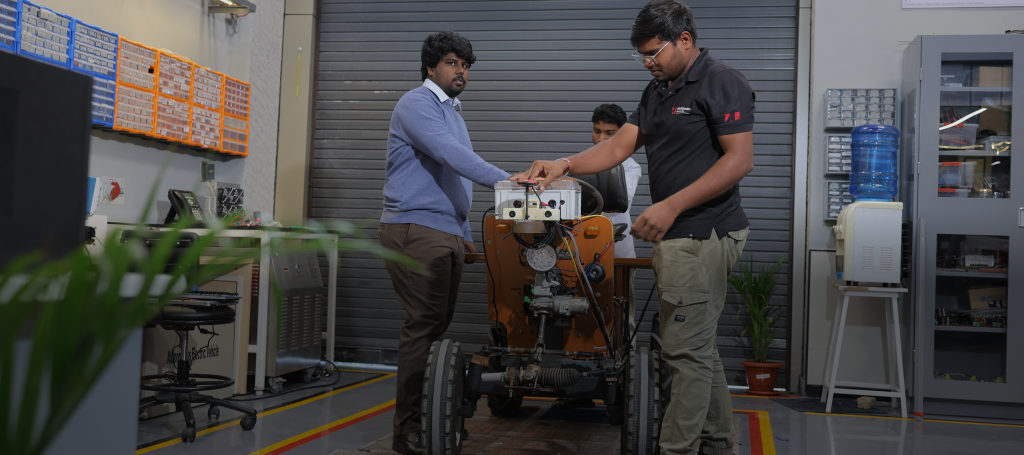
Hands-on work with embedded automotive platforms and vehicular communication technologies.

Vehicle intelligence and autonomy

Application of sensors, connectivity and AI algorithms to autonomous driving problems.

Industry exposure

Internships and industry interaction embedded into the programme structure.

Programme details

Expected programme outcomes

Graduates of this programme will be able to:

  • Understand the various components of an electric vehicle and their integrated functioning.
  • Conceptualise, design and implement electric drive systems for automobiles along with the associated electronic circuitry.
  • Analyse and design battery management systems (BMS) for electric vehicles.
  • Understand the role of intelligent systems in modern automobiles.
  • Develop intelligent mechanisms to improve vehicle performance and operation.
  • Design and implement intelligent transport systems (ITS) with vehicular and infrastructure-based communication.
  • Conceptualise and analyse autonomous vehicle systems.

Programme highlights

100% internship opportunities for admitted students

Highest stipend offered: ₹60,000 per month

Eligibility

  • A full-time bachelor’s degree from a recognised university or institute with a minimum aggregate of 60% marks or equivalent grade.
  • Candidates appearing for their final semester examination are also eligible to apply.
  • B.E./B.Tech. in Electrical Engineering, Electrical and Electronics Engineering, Electronics and Communication Engineering, Instrumentation Engineering, Mechanical Engineering, Automobile Engineering or Mechatronics***

And

  • A valid GATE score in Electrical Engineering, Electronics and Communication Engineering, Instrumentation Engineering or Mechanical Engineering is mandatory.

*Applicants with degrees in Mechanical Engineering, Automobile Engineering or Mechatronics may be required to complete a bridge course before the start of the programme.

Admission process

  • GATE-qualified candidates: Applicants with a valid GATE score and a percentile of 80 or above will be shortlisted for an interview.
  • Non-GATE candidates: Applicants without a valid GATE score, or with a percentile below 80, must appear for a written test conducted by ECSE–MU, followed by an interview for shortlisted candidates.

Fee structure

Tuition fee: ₹1,00,000 per annum

Hostel stay: Not mandatory

Laboratory facilities

  • Power electronics and machines laboratory
  • Embedded systems for automobiles laboratory
  • Vehicular communication networks laboratory
  • Battery management systems and controls laboratory

FAQs

It integrates electric powertrains, embedded systems, connectivity and autonomy within a single curriculum.

Students work with EV power electronics, embedded automotive systems and vehicular communication platforms.

Yes. Bridge support is provided to strengthen electrical and electronics fundamentals where required.

Through internships, industry interaction and applied project work aligned to current mobility technologies.

Yes. Advanced coursework and a strong thesis component prepare students for doctoral study and R&D roles.

Start your journey with us

Make an enquiry Chat with a student