














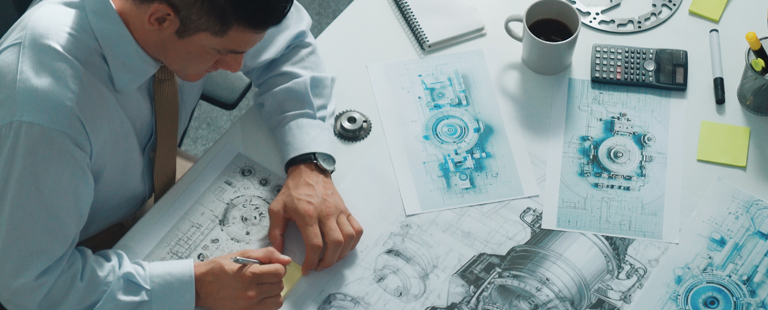
Mechanical Engineering is rightly recognised as the “mother of all engineering branches”. It is an extremely diverse and versatile field that applies scientific principles to construct real-world functioning mechanical systems. Mechanical engineers build, design and manufacture everything, from small nano sensors inside smartphones to large propulsion systems in aerospace vehicles.
Recent market trends also highlight the rise in this field and indicate that the mechanical engineering services market size will increase at a rapid pace in the future, owing to the influence of automation, EVs and smart manufacturing. Consequently, the demand for these engineers will rise substantially.
Students looking to get a foothold in this field must be familiar with the various branches of mechanical engineering and have a clear understanding of the various subjects involved. Below is a comprehensive breakdown of mechanical engineering subjects and the flow they follow.
The Structural Breakdown of Mechanical Engineering Subjects
The undergraduate programme in Mechanical Engineering typically spans over a period of four years, in the form of a Bachelor of Technology (B.Tech.) or a Bachelor of Engineering (B.E.) and it is split into 8 semesters. The subjects are arranged in such a way that students are taken through all the fundamental sciences right up to highly specialised mechanical engineering design aspects.
1. Foundation Coursework (Semesters 1 & 2)
The first year courses focus strongly on providing a rock solid foundation in basic science subjects and introductory engineering tool subjects. According to statistics, nearly 80% of first year engineering subjects are interdisciplinary among all global universities to ensure a strong technical base.
- Engineering Mathematics (Calculus, ODEs and Linear Algebra)– provides tools of mathematical modelling so that equations of complex engineering problems can be solved.
- Engineering Physics and Chemistry- deals with Mechanics, wave optics, Material Properties and Chemical Thermodynamics.
- Engineering Drawing and CAD– it is the basic language of engineers to model, visualise and represent the 3-dimensional designs onto a 2-dimensional surface and use of drawing and CAD tools.
- Basic Workshop Practice– learning practical engineering operations using tools in a carpentry, fitting, smithy and welding shop.
2. Core Mechanical Engineering Subjects (Semesters 3 to 6)
During the sophomore and junior years, students delve into departmental courses. These programmes are responsible for building the basic technical fluency of mechanical engineers.
A. Thermal and Fluid Sciences
This subject cluster provides an insight into the conversion of energy, the movement of heat through surfaces and the characteristics of fluid flows.
- Thermodynamics– this science deals with the heat, work and the transformations of energy. It dictates the designs of I.C engines, steam power plants and refrigerators.
- Fluid Mechanics and Applied Fluid Dynamics- covers the study of the behaviour of fluids, in rest or in motion. It helps design aerodynamic shapes of car bodies, aeroplanes and pipelines, etc.
- Heat and Mass Transfer- this science teaches how fast the energy is transferred by convection, radiation and conduction.
B. Machine Design and Mechanics
This part teaches students to study the forces acting upon them and how to ensure the structure of the machinery stays sound.
- Mechanics of Solids / Strength of Materials– studies how various solids respond to their environment internally, when being deformed and subject to some load.
- Theory of Mechanisms and Machines– covers the relative motion, kinematics and dynamics aspects of different linkage mechanisms and machines.
- Design of Machine Elements– covers topics from mathematics, mechanics and material science which are required for designing specific parts of the machinery, such as nuts, bolts, bearings and springs.
C. Manufacturing and Materials Science
This involves getting the product to be constructed from its design by using specialised knowledge of the materials’ response and methods of production.
- Introduction to Material Science– studies the atomic structures, mechanical behaviour of materials and their crystal structures, metals, ceramics and polymers.
- Manufacturing Processes (I and II)– discusses the fundamentals behind different traditional manufacturing techniques like casting, forging, machining and welding, as well as non-traditional manufacturing techniques.
- Metrology and Computer-Aided Manufacturing (CAM)– covers precision measurements in manufacturing, quality controls and use of CAM for automated machine control using CNC.
3. Advanced and Elective Streams (Semesters 7 & 8)
Students often choose their electives based on their desired career paths, for example:
- Industrial Engineering and Operations Research– deals with operations research, optimisation, resource management and logistics.
- Control Theory and Automation– applying control theory to develop automated mechanical systems using various feedback loops and mathematical concepts.
- Finite Element Methods (FEM)– The finite element method uses numerical models to study the mechanical behaviour of materials under various load conditions, which are typically used to study performance of different aircraft, car and engine parts.
The Intersection of Mechanical Engineering and Industry 4.0
The modern industrial landscape is changing rapidly. The integration of digital technologies into manufacturing, often referred to as Industry 4.0, requires mechanical engineers to be proficient in modern, data-driven disciplines.
As a result, contemporary university curricula are aggressively introducing interdisciplinary mechanical engineering subjects. Core programmes now frequently incorporate Introduction to Robotics, Machine Learning (ML), Data Structures & Algorithms and Mechatronics. This ensures graduates can confidently design smart, autonomous systems like self-driving cars, automated robotic assembly lines and internet-connected industrial hardware.
Shaping Tomorrow’s Innovators: B.Tech. Mechanical Engineering at Mahindra University
Students seeking a holistic, future-ready education can consider the B.Tech. Mechanical Engineering programme at the École Centrale School of Engineering, Mahindra University. The course aims to impart the traditional skills of mechanical engineering along with a vision for advanced systems engineering.
A Blended, Global Curriculum
The Mechanical Engineering curriculum at Mahindra University is aligned with global standards and is structured to foster strong technical acumen, coupled with an entrepreneurial approach. The modular curriculum spans different academic and research areas:
- Basic Sciences and Engineering Foundations for strong analytical depth.
- Core Mechanical Engineering Courses such as Transport phenomena, Strength of Materials, Machine Design, etc.
- Modern Technology Integration featuring dedicated coursework in Machine Learning, Control Theory, FinTech and Design Thinking.
- Humanities, Entrepreneurship and Creative Sciences to equip students with a broad perspective and strong social quotient.
Advanced Mechanical Engineering Labs & Green-Tech Spaces
At Mahindra University, mechanical engineering concepts move rapidly from theory to execution. Learning happens in green-tech, smart classrooms built for collaborative, multimedia-driven design thinking.
The university’s newly upgraded engineering infrastructure includes world-class facilities specifically designed for mechanical engineering students:
- The Fluidics and Heat Transfer Laboratory- Where students analyse aerodynamic and thermal behaviours.
- The Materials Testing Laboratory- Equipped to test structural integrity and advanced composites.
- The Centre for Robotics & Automation- A modern sandbox where mechanical students collaborate with electronics and AI systems.
Supporting this intensive research is an RFID-enabled digital library (operating via the KOHA system), providing 24/7 access to international engineering journals, CAD design databases and over 13,000 reference volumes.
Extracurricular Brilliance: Engineering Clubs, Fests and Sports
Mechanical engineering students at Mahindra University lead an active, well-rounded campus life. Students regularly dominate tech and cultural clubs like Roboverse and the Automotive Club, applying classroom knowledge to build functional prototypes.
The campus peaks in energy during national-level flagship fests like Aether (Tech Fest) and AIRO (Sports Fest), giving students a platform to manage massive operations and showcase technical innovations. For physical fitness, the state-of-the-art Palaestro Fitness Club, an on-campus swimming pool and pristine outdoor courts for cricket, football and basketball keep students active and sharp.
Conclusion
The comprehensive range of mechanical engineering subjects offers students a foundation to innovate and work across a wide spectrum of important fields. A thorough understanding of thermal sciences, solid mechanics and manufacturing practices while staying open to fields such as computing, robotics and ML, is crucial for Mechanical engineers to play a significant role in the future. Universities that have bridged this gap, such as Mahindra University, provide an undeniable edge to students aiming for a career in the dynamic, ever-evolving world of Mechanical Engineering.
FAQs
- What are the core subjects in mechanical engineering?
The core subjects span thermodynamics, fluid mechanics, strength of materials, machine design and manufacturing processes.
- Which mechanical engineering subjects are considered the most difficult?
Fluid mechanics, heat and mass transfer and the mechanics of solids are typically considered the most difficult due to their complex mathematical modelling and abstract concepts.
- Are coding and computer science subjects included in modern mechanical engineering?
Yes, modern curricula integrate programming, computer-aided design (CAD) and machine learning to prepare students for automation and Industry 4.0.
- Which mechanical engineering subjects carry the highest weightage in competitive exams?
Production engineering, thermodynamics and the strength of materials consistently carry the highest weightage in technical competitive exams.