











Home / PhD

Ph.D. in Computational Biology

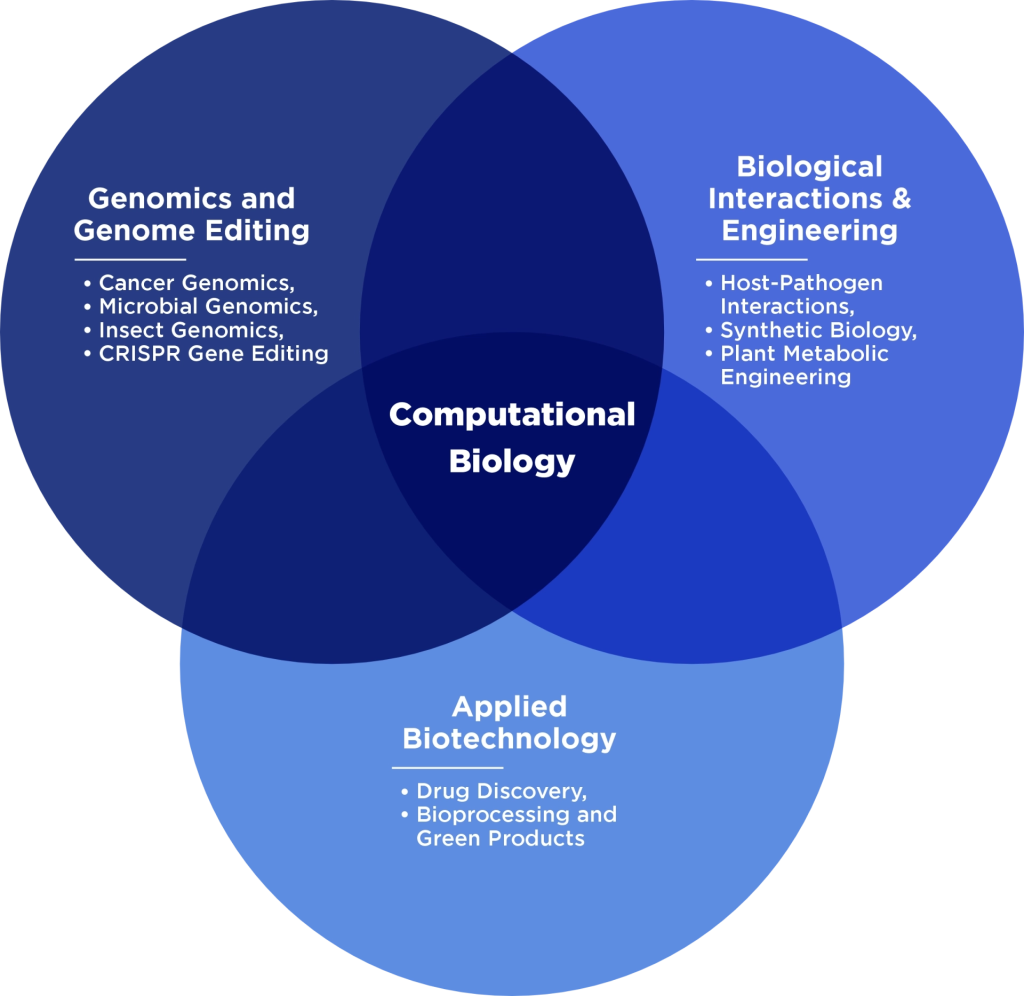
An interdisciplinary doctoral research programme that blends biological inquiry with computational and data-driven approaches to address complex scientific challenges. 

Programme overview

The Ph.D. in Computational Biology at Mahindra University is offered through the Centre for Life Sciences and was launched in Fall 2023 as a research-driven programme integrating biology with computational technologies. The specialisation prepares candidates to design and conduct independent research that applies quantitative, algorithmic and analytical methods to biological problems and datasets.

Interdisciplinary research training

that melds life science foundations with computational modelling and analysis.

Rigorous coursework and research methodology

preparing candidates for advanced data-oriented investigation. 

Original thesis work

that contributes new insights or tools at the intersection of biology, computation and data science. 

Exposure to real-world scientific problems

in domains such as genomics, systems biology and biomedical data analysis.

Programme details

Expected outcomes

Graduates of the program will:

  • Advanced knowledge: Develop deep expertise in areas such as artificial intelligence, machine learning, and their applications in biology and healthcare.
  • Research methods: Gain hands-on training in advanced computational tools and data analysis techniques, including high-performance computing, computational modelling and analytical pipelines.
  • Original research: Conduct independent and collaborative research projects that contribute new knowledge and may lead to the development of software tools, R packages, Python libraries or innovative technology solutions.
  • Pedagogy: Gain teaching experience and mentorship skills through teaching assistantships in relevant courses and academic activities.
  • Communication: Develop the ability to effectively communicate research outcomes through journal publications, conference presentations and academic seminars.
  • Professionalism: Understand and apply scientific, professional and ethical standards essential for successful careers in academia, research and industry.

Key differentiators

  • World-class research infrastructure – Access to over 11,000 sq. ft. of dedicated research laboratory space, NVIDIA supercomputing clusters (20 CPUs and 40,960 CUDA cores, with planned expansion), along with facilities for biosensors, 3D printing and robotics research.
  • Strong industry connections – Collaborations with Hyderabad’s leading biotech and MedTech ecosystem, comprising 800+ companies and 20+ incubators.
  • Globally trained faculty – Faculty members trained at leading international institutions provide opportunities for joint supervision, collaborative research and academic exchange.
  • Interdisciplinary research focus – Emphasis on translational research at the intersection of artificial intelligence, healthcare technologies, clinical decision systems and bio-inspired innovation.
  • Entrepreneurship support – Scholars with commercially viable research ideas receive guidance through the Centre for Innovation and Entrepreneurship.
  • Competitive fellowship – A fellowship of ₹30,000 per month, along with campus accommodation and meals provided at no cost.

Specialisations

Core themes

  • AI in healthcare
  • Computational drug discovery
  • Biomedical image analytics
  • Disease modelling
  • Computational genomics
  • Computational biosciences
  • Clinical informatics

FAQs

It is a research degree that prepares scholars to conduct independent original research in life science disciplines, culminating in a doctoral thesis. 

Duration varies but is typically structured to be completed within six years, depending on research progress and requirements.

Yes. The programme includes a set of prescribed coursework to build research foundations before dissertation work. 
The programme includes areas such as biotechnology, computational biology and other life science subfields as defined by faculty expertise and research priorities at the Centre for Life Sciences.

Doctoral research is expected to lead to publication in peer-reviewed journals or equivalent scholarly venues. 

Start your journey with us

Home / PhD

Ph.D. in Biotechnology

A doctoral research programme focused on advancing life science innovation through interdisciplinary biotechnological inquiry.

Ph.D in biotechnology overview

The Ph.D. in Biotechnology at Mahindra University, offered through the Centre for Life Sciences, is designed to nurture independent researchers capable of addressing global challenges in health, agriculture, environment and industry through cutting-edge biotechnological solutions. The programme combines structured coursework, comprehensive assessment and original research culminating in an independent doctoral dissertation.

Research-centred training

that blends laboratory work with conceptual and analytical depth to tackle complex biological questions.

Advanced methods in biotechnology

including molecular biology, bioinformatics, synthetic biology and bioprocess technologies. 

Scholarly competence in data analysis

including high-throughput and statistical approaches relevant to life science research. 

Original contribution to knowledge

through dissertation work that meets the highest standards of scientific inquiry and impact.

Programme details

Learning outcomes

Ph.D. graduates are expected to achieve the following outcomes upon completion of the programme:

  • Scientific and technical proficiency: Demonstrate expertise in advanced biotechnological tools and techniques, and the ability to design and execute rigorous, reproducible research projects.
  • Data analysis and bioinformatics: Develop strong competence in computational biology, statistical analysis and the interpretation of high-throughput biological data.
  • Critical thinking and problem-solving: Critically evaluate scientific literature, formulate innovative research questions and develop solutions to complex challenges in health, agriculture and environmental sustainability.
  • Scholarly communication: Communicate research effectively through peer-reviewed publications, patents and grant proposals, along with clear oral presentations for academic, industry and public audiences.
  • Collaboration and interdisciplinary integration: Work effectively in interdisciplinary teams, integrating knowledge from biology, chemistry, engineering and data science, and collaborate across academia, industry and policy environments.
  • Ethical and responsible research conduct: Apply principles of research ethics, biosafety, intellectual property and responsible data management, with a commitment to transparency and societal impact.
  • Academic and teaching preparedness: Gain exposure to pedagogy and mentorship through teaching assistantships and academic engagement, enabling effective supervision of undergraduate and postgraduate students.

Key differentiators

Interdisciplinary focus
Integrates biotechnology with computational biology, systems biology and data science to address complex biological challenges.

Research-driven with translational impact
Emphasises research that leads to impactful outcomes, including publications, patents and technology development with societal relevance.

State-of-the-art research facilities
Access to advanced laboratories equipped for genomics, proteomics, imaging, cell culture and high-end scientific instrumentation.

Industry and international collaborations
Opportunities to collaborate with leading biotechnology companies and global academic partners for joint research and internships.

Entrepreneurship and innovation support
Access to the university’s innovation ecosystem, incubation support and mentorship for biotechnology start-up initiatives.

Faculty mentorship
Guidance from experienced faculty with diverse research expertise and international academic training.

Alignment with national research priorities
Research themes aligned with initiatives of organisations such as DBT, DST and ICMR, as well as India’s National Biotechnology Development Strategy.

Holistic research training
Training includes grant writing, research ethics, science communication and teaching assistantships for comprehensive professional development.

Sustainability and SDG alignment
Focus on biotechnology solutions addressing healthcare, food security and environmental sustainability challenges.

Specialisations

  • Genomics
  • Immunotechnology
  • mRNA therapeutics
  • Host–pathogen interactions
  • Plant metabolic engineering
  • Genetic disorders
  • Cancer biomarkers
  • Gene therapy
  • Bioprocess technology
  • Food processing and nutrition
  • Agricultural biotechnology
  • Precision therapeutics
  • Nanobiotherapeutics
  • Biomedical devices

FAQs

Duration varies but is typically structured to be completed within six years, depending on research progress and requirements.

Yes. The programme includes a set of prescribed coursework to build research foundations before dissertation work. 

The programme includes areas such as biotechnology, computational biology and other life science subfields as defined by faculty expertise and research priorities at the Centre for Life Sciences.

Doctoral research is expected to lead to publication in peer-reviewed journals or equivalent scholarly venues. 

Start your journey with us

Home / PhD

Ph.D in Life Sciences

A doctoral research programme that prepares scholars to make original contributions to life science knowledge and innovation. 

Ph.D in life sciences overview

The Ph.D. in life sciences at Mahindra University is offered through the Centre for Life Sciences and focuses on interdisciplinary, research-driven inquiry in core areas such as biotechnology and computational biology. The programme integrates coursework, research methods training and dissertation work, leading to new scientific insights, innovative methodologies or original technological developments. Doctoral candidates work closely with faculty mentors to design, execute and present research that meets high standards of academic and scientific contribution. 

Advanced scientific training

In-depth engagement with specialised life science topics such as biological systems, molecular processes and computational methods. 

Research method proficiency

Rigorous training in quantitative and qualitative methods used to collect, analyse and interpret scientific data. 

Original research creation

Completion of a thesis involving either discovery of new facts, innovative interpretation of known phenomena, or development of new technologies. 

Scholarly communication and pedagogy

Opportunities to present findings in academic venues and contribute to research dissemination.

Programme details

Eligibility

Master (or four-year bachelor’s degree) in any field of Life Sciences/ Biology/ Biotechnology/ ​Nanobiotechnology/​ Chemistry/ ​Bioinformatics, etc.

University fellowship

University will provide a fellowship of Rs. 30,000 per month plus free lodging and boarding on the campus.

Important dates

Last Date for submission of applicationsTo be announced
Shortlisting of candidates for interviewTo be announced
Ph.D. Entrance Test / InterviewTo be announced
Announcement of ResultsTo be announced
Commencement of the Fall 2025 Semester TeachingTo be announced

Specialisations

Biotechnology

Focuses on advancing biological innovation through experimental research and translational science.

Computational Biology

Integrates computation and life sciences to analyse complex biological systems and data-driven patterns.

FAQs

It is a research degree that prepares scholars to conduct independent original research in life science disciplines, culminating in a doctoral thesis. 

Duration varies but is typically structured to be completed within six years, depending on research progress and requirements.

Yes. The programme includes a set of prescribed coursework to build research foundations before dissertation work. 

The programme includes areas such as biotechnology, computational biology and other life science subfields as defined by faculty expertise and research priorities at the Centre for Life Sciences.

Doctoral research is expected to lead to publication in peer-reviewed journals or equivalent scholarly venues. 

Start your journey with us

Home / PhD

Ph.D. Programmes – School of Management

A doctoral programme that develops researchers and educators in management.

Programme overview

The Ph.D. in Management at Mahindra University, offered by the School of Management (SOM), prepares scholars for careers in research, teaching and advanced professional practice. The programme combines rigorous coursework, interdisciplinary engagement and original research under the guidance of experienced faculty from Mahindra University and other reputed institutions.

Research-centred doctoral training

that develops scholars capable of conducting rigorous research and contributing to the advancement of management knowledge.

Specialised research areas

including economics, finance, decision sciences, marketing, information science and technology, and management disciplines such as strategy, entrepreneurship, organisational behaviour and human resource management.

Interdisciplinary academic mentorship

guided by experienced faculty from diverse disciplines and leading institutions.

Structured doctoral programme

a four-year programme with residential requirements; full-time scholars reside on campus, while part-time scholars follow full or partial residential arrangements.

Specialisations

Ph.D in Economics

Ph.D in Decision Sciences

Ph.D in Finance

Ph.D. in Business Administration: Marketing

Ph.D in Management

Ph.D in Information Science & Technology

Programme details

Eligibility criteria

The eligibility criteria ensure that applicants possess the required academic background and research aptitude to pursue doctoral studies. Candidates are advised to review the guidelines carefully before submitting their applications.

Educational qualifications

Applicants must have:

  • An MBA, master’s degree, or postgraduate diploma in a business-related discipline with a minimum of 60% marks.
  • A minimum of 60% marks in Class 10, Class 12, undergraduate and postgraduate studies.
  • Applicants who are completing their postgraduate programme may apply; however, they must submit the final transcript and degree certificate before the commencement of classes.

Standardised test scores

Applicants must submit one of the following:

  • GMAT – Official scores must be sent directly by GMAC. The GMAT programme code is JXX-TZ-44.
  • CAT – Valid CAT scores must be submitted.
  • GRE – Official GRE scores must be submitted.
  • MUMET (Mahindra University MBA Entrance Test) – Applicants may apply through the MUMET pathway.

Curriculum

The Ph.D. programme typically spans four years, with classes commencing in August or September each academic year.

The curriculum is designed to develop strong research and professional capabilities, including:

  • Business knowledge
  • Analytical and critical thinking skills
  • Communication skills
  • Proficiency in business and information technology tools

In the first year, students complete a set of common core courses, which include foundational business subjects as well as life-skills and research-oriented modules.

In the second year, students begin taking elective courses and may choose to specialise in one of the following areas:

  • Economics
  • Decision Sciences
  • Finance
  • Marketing
  • Information Science and Technology
  • Entrepreneurship
  • Organisational Behaviour / Human Resource Management (OB/HR)

Fee structure

The Ph.D. fee structure provides a clear overview of tuition and research-related expenses to help applicants plan their doctoral studies.

Full-time Ph.D. students
Full-time scholars will pay INR 50,000 per year, with a tuition waiver of INR 150,000, along with a one-time security deposit of INR 20,000. Students will receive a monthly stipend of INR 30,000, along with free accommodation and meals. Full-time scholars are also required to undertake 8 hours of teaching assistantship duties per week.

Part-time Ph.D. students
Part-time scholars will pay the full tuition fee of INR 200,000 per year, along with a one-time security deposit of INR 20,000.

Important dates

Aspiring researchers are invited to apply for Ph.D. admission to advance their expertise and contribute to research and knowledge creation in their chosen field.

Admission milestoneDate
Last date for submission of applications4 June 2025
Shortlisting of candidates for interview9 June 2025
Ph.D. entrance test / interview14 June 2025
Announcement of results30 June 2025
Commencement of Fall 2025 semester4 August 2025

FAQs

The programme offers specialisations in Economics, Finance, Decision Sciences, Marketing, Information Science and Technology, and Management (with areas such as Strategy, Entrepreneurship, Organisational Behaviour and Human Resource Management).

The Ph.D. in Management is typically a four-year programme that includes coursework, comprehensive assessment and independent research leading to a doctoral dissertation.

Yes. Full-time Ph.D. scholars are required to reside on campus for the duration of the programme. Part-time scholars may follow full or partial residential requirements as specified by the University.

The programme is guided by experienced faculty from the School of Management and other disciplines at Mahindra University, along with visiting scholars from reputed institutions.

Graduates typically pursue careers in academia, research institutions, consulting organisations, and leadership roles in industry where advanced research and analytical expertise are valued.

Start your journey with us

Home / PhD

Ph.D in Management

A doctoral programme that prepares researchers for careers in academic research, teaching and thought leadership in management, with a focus on strategy, entrepreneurship, organisational behaviour and human resource management.

Ph.D in management overview 

The M.A. in Education is designed for graduates who want to think deeply about education and its role in society. Students develop strong analytical, reflective and practical capabilities that support careers across education, research, policy and allied fields. Students experience:

Theory-centric research culture

Engage with foundational management theories and contemporary scholarly debates that support high-quality doctoral research.

Methodological depth

Develop rigorous research methods skills, both qualitative and quantitative, to design, execute and analyse original research.

Scholarly engagement

Participate in research seminars, colloquia and discussions that foster critical thinking and peer learning.

Faculty mentorship

Receive structured supervision and guidance from experienced faculty members throughout the research journey.

FAQs

Candidates with a master’s degree and strong research interest in management domains such as strategy, entrepreneurship, organisational behaviour or HRM.

Research broadly spans Management specialisations including strategy, organisational behaviour, corporate entrepreneurship, engagement at work and related contemporary questions. 

Full-time Ph.D. scholars receive a fee waiver, a monthly stipend, free boarding and lodging, and undertake teaching assistant duties as part of the support package. 

Yes. Part-time Ph.D. enrolment is available with a different fee structure, and without teaching assistant duties.

Graduates typically pursue academic and research-focused careers, contributing to knowledge creation and dissemination in business and management. 

Start your journey with us

Home / PhD

Ph.D in Information Science & Technology

A full-time or part-time doctoral programme that prepares scholars to lead research and teaching in information systems, digital transformation and technology-driven organisational change.

Ph.D in information science & technology overview

This programme focuses on human–centred digital innovation and the design and management of information systems. Scholars work closely with faculty on research in human–computer interaction, management information systems and technology–enabled organisational change, building expertise that is equally valued in academia and data–driven industries.  Students experience:

Human-centred digital research

gives scholars strong grounding in human–computer interaction, mobile learning, e-health and technology-mediated collaboration, strengthening their ability to design impactful digital solutions.

Focus on information systems

exposes students to theories and cases on enterprise platforms, hospital information systems and decision support systems, aligning their research with real organisational transformation.

Interdisciplinary research

mentoring from faculty experienced in experimental, qualitative and ethnographic methods helps scholars build a strong publication pipeline in high-quality international journals.

Preparation for academic and industry careers

trains scholars for tenure-track positions worldwide as well as leadership roles guiding IT and analytics strategy in multinational organisations.

Core areas

Human-centred digital transformations

Explores how digital technologies support and transform human activities. Students engage with theories and case studies in computer-supported collaborative work and learning, human–computer interaction, and science and technology studies. Faculty research areas include mobile learning platforms, remote healthcare systems, and critical studies of machine learning and artificial intelligence.

Management information systems and organisational change

Examines how organisations adopt and manage information systems such as enterprise resource planning (ERP), hospital management information systems and decision support systems. Students study the economics of information systems, organisational and behavioural change related to technology adoption, and strategic management of digital technologies. Faculty research focuses on areas such as health information systems, education technology and e-governance.

FAQs

The programme is designed to train tenure-track faculty by combining rigorous coursework, strong research mentoring and opportunities to publish in reputed peer-reviewed journals in information systems and digital transformation.

Scholars can specialise in human-centred digital transformations or management information systems and organisational change, working on topics such as mobile learning, e-health platforms, e-government and critical studies of artificial intelligence systems.

By engaging with real-world contexts like enterprise systems, hospital information systems and digital platforms, scholars gain insights that are directly relevant to organisations undergoing technology-enabled change, making them valuable in consulting and leadership roles.

Each scholar works closely with experienced faculty supervisors and a research committee that monitors progress, provides feedback on research design and publications, and supports preparation for comprehensive examinations and thesis defence.

Ph.D regulations and the university’s research ecosystem encourage interdisciplinary work, allowing Information Science & Technology scholars to collaborate with engineering, law, media and design faculties on projects at the intersection of technology, organisations and society.

Start your journey with us

Make an enquiry Chat with a student