












B.Tech in VLSI Design & Technology
A 4-year undergraduate programme specialising in VLSI design, semiconductor technology and chip-design tools, preparing engineers for the global semiconductor ecosystem.
B.Tech in VLSI design and technology overview
This programme is crafted in response to India’s semiconductor mission, and trains students in VLSI design, analog/digital circuits, logic synthesis, device simulation and physical verification flows, using industry-standard tools from EDA companies. Students experience:

Solid foundational understanding
in computing, electrical and mathematical modules in early semesters.

Hands-on experience
in advanced VLSI design, memory design & testing, analog/digital full-custom circuit design using simulation tools.

Project-driven learning
culminating in embedded hardware projects and research project phases, enabling students to own complex design tasks.

Industry orientation
with exposure to major semiconductor firms such as Intel, Qualcomm, Broadcom, AMD, TSMC, preparing graduates to join the semiconductor value-chain.
Programme details
Scope of employment
Students in the B.Tech programme may pursue career opportunities with leading semiconductor design and manufacturing companies such as Intel, Qualcomm, Synopsys, Cadence, Siemens, Dell, Broadcom, AMD, NVIDIA, Apple, TSMC, GlobalFoundries, Samsung, Apex Semiconductors, NXP Semiconductors and STMicroelectronics.
These organisations represent a broad spectrum of the semiconductor ecosystem, where demand for skilled talent in design, manufacturing and technology development continues to grow.
Programme specific outcomes
PSO1: IC Design, HDL-Based Development & Verification
Graduates will be able to design and simulate digital and analog integrated circuits using CMOS technology; describe and validate hardware systems at the RTL level using hardware description languages, apply verification methodologies to ensure functional correctness, and realize designs through the complete physical design flow — from synthesis and floorplanning to placement, routing, and sign-off. They will be able to implement using FPGA prototyping.
PSO2: Semiconductor Devices and Fabrication Technology
Graduates will be able to relate semiconductor device physics to process-level phenomena, interpret fabrication sequences for sub-micron and nanoscale CMOS process technologies, and apply characterization techniques to evaluate device and process parameters in a laboratory setting.
PSO3: Embedded Hardware Implementation and Industry Readiness
Graduates will be able to architect and integrate embedded systems using hardware-software codesign and execute end-to-end VLSI design flows using industry-standard EDA tools, and demonstrate professional competencies — including teamwork, ethical practice, and adaptability.
Academic structure
Our academic structure is designed to establish robust foundations, followed by increasing specialization in later years.
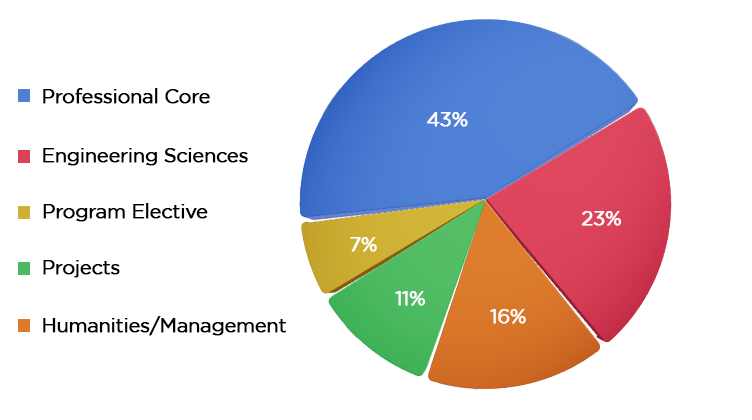
- Total credits & degree requirement: The programme requires not less than 165 credits to be awarded a B.Tech degree.
- Duration: 4 years / 8 semesters
Laboratories
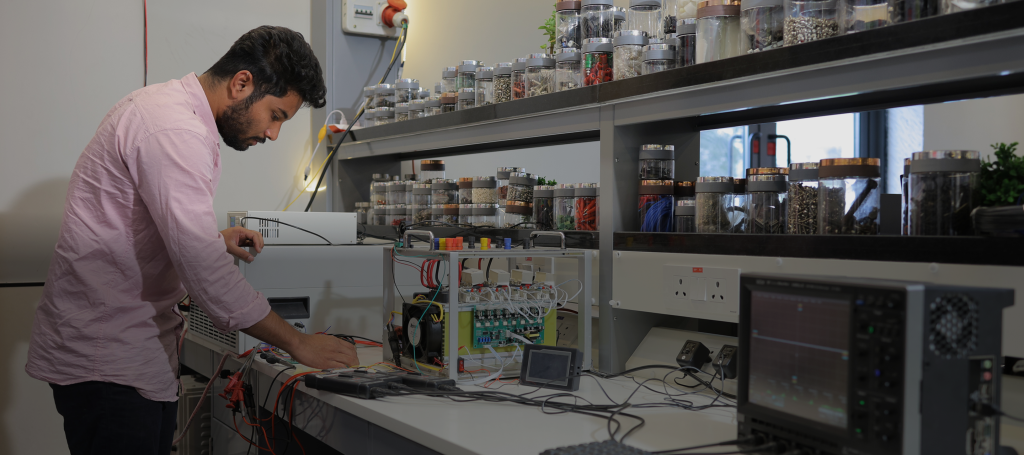
Students have access to advanced design automation software from leading Electronic Design Automation (EDA) companies such as Synopsys and Cadence. The laboratory enables B.Tech students to learn the complete VLSI design flow, from architecture and circuit design to physical verification, using tools such as Design Compiler, ICC2, PrimeTime, StarRCXT and Sentaurus TCAD.
Students also gain experience in analogue and digital full-custom circuit design using Cadence Virtuoso with sub-micron technologies. Additional Cadence tools, including Assura, Innovus, Incisive and Genus, are available for circuit-level physical design and verification, gate-level physical design, functional simulation, synthesis and pre-layout timing analysis.
These resources provide students with the flexibility to explore and develop innovative designs while gaining hands-on experience with industry-standard tools.
| Course | L-T-P | Credits |
|---|---|---|
| MA 1101 – Calculus and ODE | 4-1-0 | 5 |
| CH 1101 – Quantum Chemistry & Spectroscopy | 2-1-2 | 4 |
| EC 1102 – Introduction to Electrical Engineering | 2-1-2 | 4 |
| CS 1001 – Introduction to Computing | 3-0-2 | 4 |
| CE 1101 – Earth and Environmental Sciences | 2-0-0 | 2 |
| HS 1101 – English | 3-0-0 | 3 |
| HS 1102 – Media Project | 1-0-2 |
| Course | L-T-P | Credits |
|---|---|---|
| MA 1202 – Linear Algebra & Complex Analysis | 3-1-0 | 4 |
| PH 1201 – Classical & Quantum Mechanics | 2-1-2 | 4 |
| BI 1201 – Introduction to Biology | 3-0-0 | 3 |
| EC 1202 – Introduction to Electronics | 2-1-2 | 4 |
| CS 1202 – Discrete Mathematical Structures | 3-0-0 | 3 |
| CS 1002 – Data Structures | 3-0-2 | 4 |
| ET 1201F – Entrepreneurship Practice | 0-0-2 | 1 |
| HS 1202 – Professional Ethics | 0-1-0 | 1 |
| HS 1203 – French – II | 0-2-0 | 0.5 |
| Total Credits | 24.5 |
| Course | L-T-P | Credits |
|---|---|---|
| MA 2103 – Probability & Statistics | 3-1-0 | 4 |
| PH 2102 – Electromagnetics & Optics | 3-1-2 | 5 |
| EC 2102 – Signals and Systems | 3-1-0 | 4 |
| EC 2103 – Digital System Design | 3-0-2 | 4 |
| CS 2102 – Design and Analysis of Algorithms | 3-0-2 | 4 |
| ET 2101F – Lean Startup | 0-0-3 | 1 |
| HS 2102 – Principles of Economics | 1-1-0 | 1.5 |
| HS 2103 – French – III | 0-2-0 | 0.5 |
| Total Credits | 24 |
| Course | L-T-P | Credits |
|---|---|---|
| EC 2207 – Analog Circuits | 3-1-2 | 5 |
| EC 2208 – Semiconductor Devices | 3-1-2 | 5 |
| EC 2209 – Semiconductor Materials and Characterization | 3-0-0 | 3 |
| CS 2203 – Optimization Techniques for AI | 3-0-0 | 3 |
| CS 2204 – Theory of Computation | 3-0-0 | 3 |
| HS 2201 – Design Thinking | 1-0-2 | 2 |
| HS 2202 – Financial Accounting | 1-1-0 | 1.5 |
| HS 2203 – French – IV | 0-2-0 | 0.5 |
| Total Credits | 23 |
| Course | L-T-P | Credits |
|---|---|---|
| EC 3101 – Introduction to VLSI Design | 3-0-3 | 4.5 |
| EC 3103 – Programmable Devices | 3-0-2 | 4 |
| EC 3106 – VLSI Fabrication Technology | 3-0-2 | 4 |
| EC 3109 – Digital Signal Processing | 2-1-2 | 4 |
| CS 3101 – Object Oriented Programming | 2-0-2 | 3 |
| CS 3102 – Machine Learning | 3-0-0 | 3 |
| ZZ XXXX – Liberal Arts Elective – I | 2-0-0 | 2 |
| HS 3111 – French – V (opt) | 0-2-0 | 0.5 |
| Total Credits | 24.5 |
| Course | L-T-P | Credits |
|---|---|---|
| EC 3202 – Computing Systems Architecture | 3-0-0 | 3 |
| EC 3204 – Advanced VLSI Design | 3-0-0 | 3 |
| EC 3205 – Memory Design & Testing | 3-0-0 | 3 |
| EC 32XX – Program Elective – I | 3-0-0 | 3 |
| EC 32XX – Program Elective – II | 3-0-0 | 3 |
| HS 3201 – Introduction to professional development | 2-0-0 | 2 |
| ZZ 32XX – Liberal Arts Elective – II | 2-0-0 | 2 |
| HS 3222 – French -VI (opt) | 0-2-0 | 0.5 |
| Total Credits | 19 |
| Course | L-T-P | Credits |
|---|---|---|
| EC 4100 – Embedded Hardware Project | 0-0-6 | 3 |
| EC 4103 – Verilog for Synthesis | 2-0-2 | 3 |
| PR 4000 – Research Project Phase I | 0-0-6 | 3 |
| EC 41XX – Program Elective – III | 3-0-0 | 3 |
| EC 41XX – Program Elective-IV | 3-0-0 | 3 |
| ZZ 41XX – Liberal Arts Elective – III | 2-0-0 | 2 |
| HS 4111 – French – VII (opt) | 0-2-0 | 0.5 |
| Total Credits | 17 |
| Course | L-T-P | Credits |
|---|---|---|
| PR 4000 – Final Year Project Phase II | 0-0-24 | 12 |
| HS 4222 – French – VIII (opt) | 0-2-0 | 0.5 |
| Total Credits | 12 |
FAQs
The course structure addresses the full chip-design process, from circuit theory and logic design to simulation and verification using professional-grade EDA tools.
Students are trained using Cadence and Synopsys platforms for analog/digital circuit design, layout and testing, ensuring industry relevance.
Project modules in embedded hardware, design verification and fabrication processes translate core principles into hands-on expertise.
Graduates are suited for semiconductor firms, chip-design consultancies and R&D labs worldwide, addressing the growing demand for VLSI engineers.
Through national semiconductor initiatives, specialised laboratories and research collaborations, students gain an understanding of how VLSI innovation powers future technologies.
